☕️ Morning Call en📞 Podcast vrijdag 5 november - Signalen aandelen na uitverkoop tech

■ Europa en futures: Europa gaat een zwakkere opening tegemoet na de zware liquidatie op Wall Street. DAX-futures staan circa 0,7% lager en EURO STOXX 50-futures ongeveer 0,9% in de min, terwijl S&P 500-futures vrijwel vlak liggen en Nasdaq 100-futures circa 0,8% herstellen. De AEX blijft extra kwetsbaar door de grote chipweging, maar het herstel van Amerikaanse technologie futures maakt een tweede capitulatiesessie niet automatisch het basisscenario.
 Hoofdredactie

■ ING $INGA – AI-krediet: ING zou ongeveer $500 miljoen aan twaalf Amerikaanse datacenterleningen te koop zetten, waaronder krediet gekoppeld aan een Stargate-project en leningen aan grote datacenterbedrijven. Op zichzelf is dat een slecht signaal, omdat een bank juist nu blootstelling aan AI- en datacenterkrediet wil afbouwen.
🚨 $ING wil voor 500 miljoen dollar aan leningen AI- en datacenters van de hand doen - Reutershttps://t.co/pTyhjjGq5X
— scetrader (@scetrader) November 6, 2026
Toch moeten we eerst de details zien, vooral tegen welke prijs de leningen worden verkocht en of ING simpelweg balansruimte en risico wil vrijmaken of daadwerkelijk verslechterende kredietkwaliteit ziet. Voorlopig is dit daarom een duidelijke waarschuwing voor de AI-kredietmarkt, maar nog geen bewijs van een bredere kredietcrisis.
■ Wall Street-capitulatie: De S&P 500 verloor donderdag 4,36%, de Nasdaq 5,52%, de Dow 3,44% en de SOX zelfs 12,25%. QQQ daalde 6,49%, SMH 11,21% en de VIX schoot naar 28,17. De omvang van de beweging wijst niet alleen op lagere winstverwachtingen, maar ook op gedwongen verkoop en een abrupte reductie van risico.
■ Gedwongen deleveraging: Hedgefondsen bouwden risico agressief af en leveraged ETF’s moesten naar schatting ongeveer $47 miljard aan aandelen verkopen om hun leverage opnieuw in balans te brengen. Ook particuliere beleggers verkochten opvallend hard en de gebruikelijke kooplust op dips verdween grotendeels. Er is geen bevestigd bewijs dat een systeemrelevant hedgefonds is omgevallen, maar het blijft onzeker hoeveel margin calls en interne risicolimieten nog moeten worden verwerkt.
■ BTIG – marktrotatie: BTIG waarschuwt dat de voortdurende sectorrotatie de kwetsbaarheid van Wall Street al langer maskeert. Ongeveer 22% van de S&P 500-aandelen is technisch overbought, terwijl de RSI van de index zelf slechts rond 50,4 ligt, een divergentie die volgens BTIG slechts één keer extremer was sinds 1999. Halfgeleiders zijn inmiddels oversold, terwijl defensieve sectoren juist steeds verder zijn opgerekt, waardoor zowel een chiprebound als een bredere correctie mogelijk blijft.
■ Halfgeleiders en AI: Chips zijn in enkele sessies van euforie naar capitulatie gegaan. De SOX verloor 12,25%, SMH 11,21%, terwijl Zuid-Korea en Taiwan opnieuw zwaar onder druk kwamen en de Kospi eerder zelfs meer dan 8% verloor voordat kopers terugkeerden. De fundamentele zorgen zijn reëel, maar de koersdaling is inmiddels veel groter dan de verandering in korte termijn winstverwachtingen alleen kan verklaren.
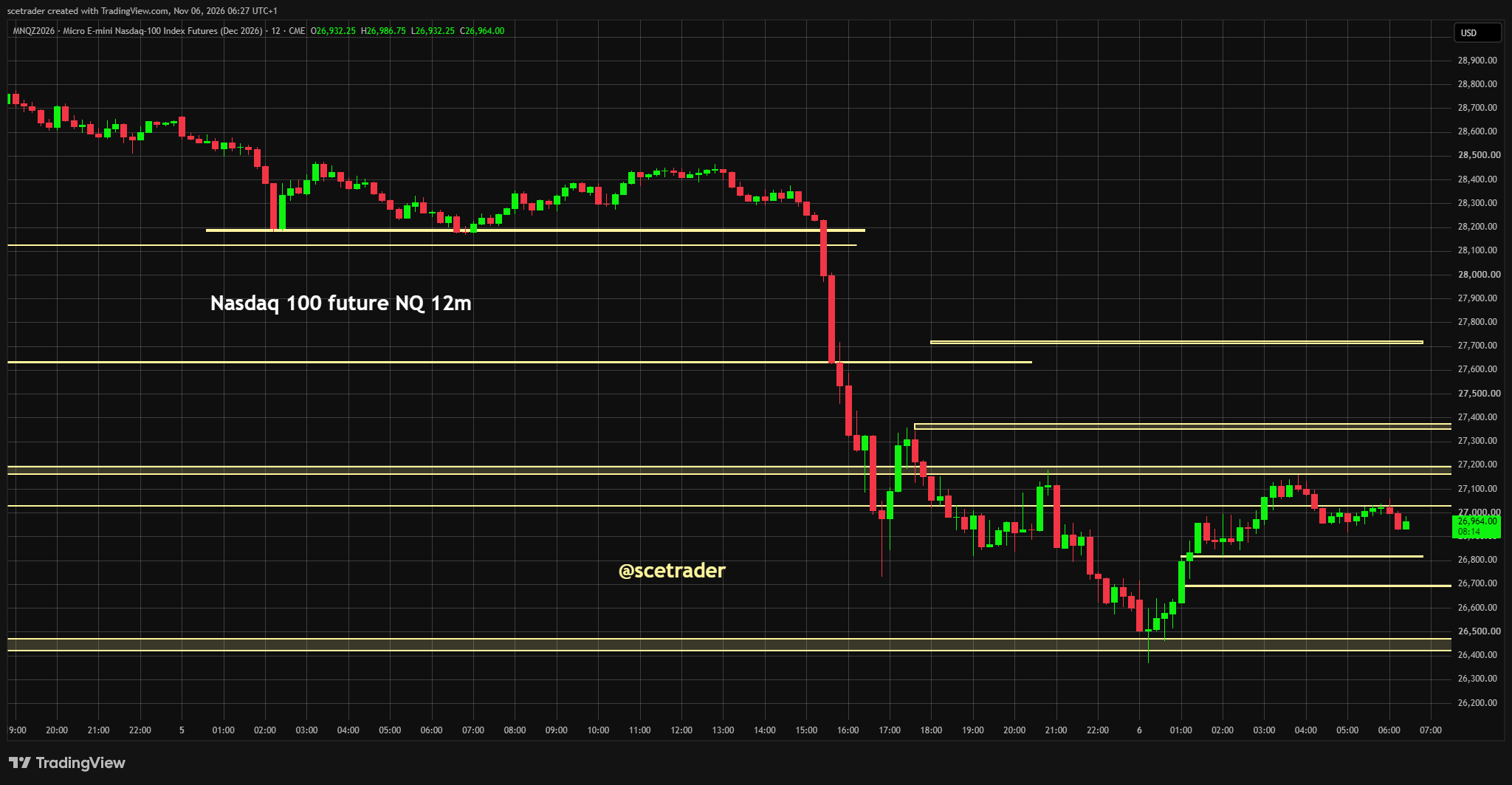
■ Technisch herstel: Nasdaq 100-futures herstellen ongeveer 0,8% en dat is het eerste duidelijke teken dat kopers na de capitulatie terugkeren. Zulke extreme bewegingen verhogen de kans op short covering en kooporders rond technische steun. Een krachtige rebound is mogelijk, maar dat is nadrukkelijk niet hetzelfde als zeggen dat de bodem al staat.
■ AI-vraag: De structurele vraag naar rekenkracht is niet verdwenen. AMD rapporteerde eerder deze week 97% groei bij Data Center en Arm blijft zijn positie in servers uitbreiden. De discussie verschuift daarom van de vraag óf AI groeit naar de vraag hoe snel capaciteit moet worden gebouwd en welke bedrijven die uitbreiding financieel kunnen dragen.
■ Anthropic – IPO en waardering: De kans dat Anthropic in 2026 naar de beurs gaat is op Kalshi teruggevallen tot onder 60%, tegenover bijna 90% vóór de midterms. Tegelijk zouden investeerders mikken op een waardering van ongeveer $1,5–$1,6 biljoen in plaats van eerder genoemde niveaus rond $2 biljoen. Dat laat zien dat ook private AI-waarderingen niet immuun zijn voor de huidige herwaardering, terwijl een prediction market uiteraard geen garantie biedt voor de daadwerkelijke timing.
■ Anthropic – infrastructuur: Anthropic heeft ongeveer $895 miljard aan toekomstige verplichtingen voor AI-infrastructuur opgebouwd, inclusief aankopen en leases voor rekenkracht en gerelateerde infrastructuur. Circa $448 miljard daarvan moet voor eind 2030 worden uitgegeven en ongeveer $70 miljard al in de komende twaalf maanden. De schaal is uitzonderlijk en maakt vrije kasstroom, financiering en rendement op kapitaal uiteindelijk net zo belangrijk als omzetgroei.
■ Broadcom $AVGO: Anthropic heeft ongeveer $161 miljard aan toekomstige verplichtingen richting Broadcom. Dat bevestigt de enorme structurele vraag naar custom AI-silicium en netwerkoplossingen. Tegelijk wordt Broadcom hierdoor gevoeliger voor het daadwerkelijke tempo waarin zeer grote klanten hun investeringsplannen uitvoeren.
■ Alphabet $GOOGL: Anthropic heeft circa $121 miljard aan bestaande verplichtingen richting Google, met mogelijk nog ongeveer $150 miljard extra uitgaven aan Google AI-chips. Dat bevestigt de strategische waarde van Google’s eigen infrastructuur en accelerators. De kanttekening is dat de onderlinge financiële afhankelijkheid binnen de AI-keten steeds groter wordt.
■ Amazon $AMZN: Anthropic heeft minimaal $110 miljard aan verplichtingen richting Amazon. Dat onderstreept de structurele vraag naar AWS-capaciteit en de sterke positie van Amazon binnen AI-infrastructuur. Wij blijven lange termijn positief, maar de markt gaat terecht kritischer kijken naar hoeveel van die enorme investeringen uiteindelijk in vrije kasstroom worden omgezet.
■ OpenAI – data centers: OpenAI bespreekt inmiddels of de verwachtingen voor beschikbare data-center capaciteit volgend jaar omlaag moeten worden bijgesteld. Kiezers in minstens 29 Amerikaanse plaatsen hebben beperkingen of verboden rond nieuwe data centers gesteund en Goldman Sachs waarschuwt dat lokale en regionale politieke verschuivingen een groot gedeelte van geplande Amerikaanse capaciteit kunnen vertragen. Minder Amerikaanse bouw betekent echter niet automatisch minder AI-vraag, maar kan investeringen juist naar andere regio’s verschuiven.
■ AI-kredietstress: De combinatie van enorme verplichtingen, lagere technologie-waarderingen en hogere eisen aan rendement maakt financiering een steeds belangrijker onderdeel van de AI-case. Cashrijke hyperscalers kunnen veel zelf financieren, terwijl ondernemingen die voortdurend nieuw schuld- of aandelenkapitaal nodig hebben veel kwetsbaarder worden. Lagere staatsrentes lossen dat probleem niet automatisch op wanneer kredietspreads tegelijkertijd oplopen.
■ Applied Optoelectronics $AAOI: AAOI liet opnieuw zien hoe sterk de vraag naar AI-optica blijft. Q3-omzet steeg naar $269,9 miljoen, waarvan $155,6 miljoen uit Data Center kwam, terwijl de vraag naar 800G en 1.6T verder versnelt. De Q4-guidance bleef wel onder de marktverwachting en Amerikaanse capaciteitsuitbreiding richting 2027 loopt vertraging op door beperkte elektriciteitsbeschikbaarheid en componentknelpunten. Wij hebben bewust slechts een zeer kleine positie, maar willen uiteindelijk groter worden wanneer marktsentiment en technische structuur verbeteren.
■ Cloudflare $NET: Cloudflare rapporteerde 39% omzetgroei naar $782,5 miljoen en een aangepaste winst per aandeel van $0,38. Voor Q4 rekent het bedrijf op $845–846 miljoen omzet en de jaarverwachting werd verhoogd naar ongeveer $2,96 miljard. Dat laat zien dat bedrijven met sterke omzetgroei én verbeterende winstgevendheid zich zelfs tijdens een bredere technologiecorrectie kunnen onderscheiden.
■ Airbnb $ABNB: Airbnb rapporteerde 19% omzetgroei naar $4,87 miljard en een winst per aandeel van $3,16. Het bedrijf verhoogde zijn jaarverwachting naar hoge dubbelcijferige groei en kondigde een nieuw aandeleninkoopprogramma van maximaal $12 miljard aan. De combinatie van groei en kapitaalteruggave is sterk, al blijft de waardering gevoelig voor een verdere brede risk-offbeweging.
■ IREN $IREN: IREN boekte $228 miljoen omzet, waarvan ongeveer $200 miljoen uit AI cloud kwam. Een deel van het Microsoft-programma is vertraagd door wijzigingen in netwerkontwerp en timing bij leveranciers, terwijl naar verwachting nog ongeveer $15 miljard extra investeringen nodig zijn. Daarmee is IREN bijna een schoolvoorbeeld van de huidige marktvragen rond groei, uitvoering en financierbaarheid.
■ Microsoft $MSFT: Vertragingen bij externe data-centerpartners leggen meer nadruk op execution risk. De vraag naar capaciteit blijft sterk, maar niet iedere geplande megawatt kan op tijd worden geleverd. De eerdere beslissing om een grote Nscale-deal niet door te zetten past in hetzelfde beeld van strengere selectie en hogere eisen aan rendement.
■ SoftBank: Ook de kredietmarkt wordt duidelijk voorzichtiger rond grote AI-verplichtingen. Dat betekent dat de herwaardering inmiddels verder gaat dan alleen aandelenkoersen. Voor ondernemingen die veel extern kapitaal nodig hebben kan dat uiteindelijk belangrijker worden dan de daling van de brede markt zelf.
■ Europese sectoren: Halfgeleiders blijven waarschijnlijk de zwakste sector bij de opening, maar bieden tegelijkertijd het grootste technische herstelpotentieel. Software en cloud kunnen zich relatief beter houden wanneer winstgevendheid sterk blijft, terwijl banken en gezondheidszorg kunnen profiteren van de vlucht naar voorspelbaardere kasstromen. Industrie, chemie, luchtvaart en transport krijgen steun van energieprijzen die ondanks het herstel nog duidelijk lager liggen dan eerder deze week.
■ Rente en obligaties: De Amerikaanse tienjaarsrente staat rond 4,84% en de tweejaarsrente rond 4,47%, waardoor de curve duidelijk positief blijft. De kans op een renteverhoging door de Fed in december is teruggevallen richting ongeveer 70%, tegenover meer dan 80% eerder deze week. Lagere rentes helpen groeiaandelen, maar kunnen gedwongen deleveraging of oplopende kredietspreads niet volledig compenseren.
■ Amerikaanse arbeidsmarkt: De cijfers van donderdag waren sterk zonder direct extra inflatiedruk te veroorzaken. Eerste werkloosheidsaanvragen kwamen uit op 189.000 tegenover 196.000 verwacht, terwijl de productiviteit met 3,6% groeide en de arbeidskosten per eenheid product juist 0,7% daalden. Dat is een gunstige combinatie van een veerkrachtige arbeidsmarkt en een betere productiviteitsontwikkeling.
■ Amerikaans banenrapport: Vanmiddag om 14.30 uur volgt het banenrapport over oktober. De markt rekent op ongeveer 65.000 nieuwe banen, 4,2% werkloosheid en circa 0,3% maandelijkse loongroei. Een cijfer rond verwachting met gematigde lonen zou waarschijnlijk het beste scenario zijn, terwijl een veel sterker rapport de rente opnieuw omhoog kan duwen en technologie kan raken.
■ Valuta: De dollarindex noteert rond 101,7, EUR/USD rond 1,122 en USD/JPY rond 157–158. Risicoaversie ondersteunt de dollar, terwijl lagere Amerikaanse rentes juist de opwaartse ruimte beperken. De yen en Zwitserse frank profiteren relatief van defensieve kapitaalstromen.
■ Olie, Iran en Hormuz: Brent noteert rond $100 en WTI rond $92 en herstellen na de forse daling eerder deze week. De markt heeft een gedeelte van de geopolitieke premie verwijderd door verwachtingen van meer diplomatie rond Iran, maar nieuwe tankerincidenten rond Hormuz tonen aan dat fysieke risico’s niet verdwenen zijn. Voor Europa blijft de weekdaling in energie duidelijk gunstig voor inflatie, industrie, consument, chemie en transport.
■ Europees gas: De gasprijs ligt duidelijk onder de pieken van eind oktober en dat geeft enige verlichting aan de Europese industrie. Opslagniveaus blijven echter relatief laag en Europa blijft sterk afhankelijk van LNG. Nieuwe verstoringen in het Midden-Oosten kunnen de markt daardoor snel opnieuw verkrappen.
■ Goud en zilver: Goud noteert rond $4.052 en zilver rond $51,49, beide lager na de sterke rally eerder deze week. De richting van de Amerikaanse rente na het banenrapport wordt vandaag waarschijnlijk de belangrijkste katalysator. Wij willen technische bevestiging zien voordat wij opnieuw agressiever op edelmetalen inzetten.
■ Koper: Koper noteert rond $6,22 per pond en houdt relatief goed stand. Structurele vraag vanuit stroomnetwerken, elektrificatie en data centers blijft positief. De onzekerheid rond het tempo van nieuwe AI-investeringen kan op korte termijn echter voor grote koersbewegingen blijven zorgen.
■ Crypto: Bitcoin staat rond $76.200 na de zware verkoop van donderdag en de zone rond $75.000 wordt technisch belangrijk. Ether blijft eveneens onder druk en crypto blijft sterk gekoppeld aan het risicosentiment rond technologie. Lagere rentes geven enige steun, maar stabilisatie boven de recente dieptepunten is noodzakelijk voordat we van een overtuigender herstel kunnen spreken.
■ Aperam $APAM: Aperam rapporteert vanochtend. Wij letten vooral op marges, volumes, vrije kasstroom en leverage. Zonder de daadwerkelijke cijfers trekken wij nog geen nieuwe conclusie.
■ Sif $SIFG: Sif komt met een kwartaalupdate. Productie, uitvoering van het orderboek, liquiditeit en offshore-windprojecten zijn de belangrijkste punten. Ook hier wachten wij op de daadwerkelijke cijfers voordat we onze visie aanpassen.
■ Brunel $BRNL: Brunel rapporteert vanochtend met omzet, marges en activiteit binnen energie en engineering als belangrijkste meetpunten. De cyclische blootstelling maakt vooral de ontwikkeling van marges belangrijk.
■ Agenda: Naast de Europese bedrijfscijfers volgen Duitse industriële productie, de Franse handelsbalans en Europese detailhandelsverkopen. Om 14.30 uur staat het Amerikaanse banenrapport centraal, gevolgd door Michigan consumentenvertrouwen en inflatieverwachtingen en meerdere Fed-sprekers. Voor Wall Street rapporteren onder meer Moderna, Humana, Enbridge, Brookfield Asset Management, Charter Communications, Oklo en TeraWulf.
■ Politiek en data centers: De Democratische winst bij de midterms heeft het politieke evenwicht in Washington veranderd en lokale weerstand tegen data centers neemt toe. Elektriciteit, water, netcapaciteit en vergunningen worden daardoor steeds grotere beperkingen voor nieuwe projecten. President Trump behoudt tegelijk veto- en uitvoerende macht, waardoor een volledige beleidsomslag niet vanzelfsprekend is.
■ Richting: Europa opent waarschijnlijk duidelijk lager, waarbij de AEX extra kwetsbaar blijft door zijn chipweging. Wij verwachten echter niet automatisch opnieuw een capitulatiesessie. Wanneer Amerikaanse futures hun herstel vasthouden en de VIX stabiliseert, kan gedurende de dag een stevige technische herstelbeweging ontstaan.
■ Positief: Nasdaq 100-futures herstellen ongeveer 0,8%, S&P 500-futures liggen vrijwel vlak en de Amerikaanse tienjaarsrente staat rond 4,84%. Tegelijk blijven de structurele AI-vraag en sterke operationele cijfers bij bedrijven als Cloudflare zichtbaar.
■ Negatief: De SOX verloor 12,25%, de VIX staat boven 28 en het is nog onduidelijk hoeveel gedwongen deleveraging resteert. Daar komen de mogelijke verkoop van AI- en datacenterleningen door ING, politieke weerstand tegen nieuwe capaciteit en de enorme financieringsverplichtingen binnen AI bovenop.
■ Belangrijkste signaal: Kunnen halfgeleiders en de VIX tegelijk stabiliseren terwijl Nasdaq-futures hun herstel vasthouden? Daarnaast wordt belangrijk of kredietsignalen zoals de mogelijke ING-verkoop geïsoleerde balansoptimalisatie blijken of de voorbode zijn van bredere verkoopdruk in AI-krediet.
■ Positieve surprise: Het grootste gedeelte van de gedwongen verkoop blijkt donderdag al te zijn verwerkt en een gematigd banenrapport houdt de rente laag. Wanneer bovendien blijkt dat banken zoals ING vooral actief risico herverdelen zonder grote verliezen te nemen, kan extreme oversold-positionering bij chips een krachtige short-covering rally veroorzaken.
■ Negatieve surprise: Nieuwe margin calls of interne risicolimieten zorgen voor een tweede liquidatiegolf, terwijl banken AI- en datacenterleningen alleen tegen duidelijke discounts van hun balans kunnen krijgen. In combinatie met hogere Amerikaanse rentes zou dat de huidige correctie snel kunnen verbreden.
■ Positionering: Wij gaan capitulatie niet blind verder omlaag verkopen, maar kopen ook niet automatisch de eerste groene candle. Eerst willen wij stabilisatie zien bij Nasdaq, SOX, VIX, obligaties én de kredietmarkt. Bij hoogwaardige groeibedrijven wordt de verhouding tussen risico en potentieel rendement wel duidelijk interessanter.
■ Houding: Voor de korte termijn blijven wij voorzichtig, maar het technische herstelpotentieel is na donderdag uitzonderlijk groot. Chips zijn oversold, waarderingen zijn sterk gedaald en de rente helpt. Daar staat tegenover dat financiering, data-centerbouw en rendement op AI-investeringen veel belangrijkere risico’s zijn geworden.
■ Desk-view: Donderdag was geen normale correctie maar een capitulatiesessie waarin fundamentele herwaardering en gedwongen deleveraging elkaar versterkten. De markt heeft AI niet afgeschreven, maar accepteert niet langer automatisch dat iedere nieuwe data-center investering economisch aantrekkelijk is. Anthropic laat die spanning extreem goed zien met bijna $900 miljard aan toekomstige infrastructuurverplichtingen terwijl private waarderingsverwachtingen dalen, en OpenAI kijkt tegelijk naar mogelijke capaciteitsbeperkingen in de Verenigde Staten. De mogelijke verkoop door ING van circa $500 miljoen aan AI- en datacenterleningen past in dat veranderende klimaat en is op het eerste gezicht een slecht signaal. De cruciale vraag is echter of ING tegen normale prijzen simpelweg balansrisico herverdeelt of dat kopers alleen met aanzienlijke discounts bereid zijn het krediet over te nemen. BTIG waarschuwt bovendien dat de enorme sectorrotatie de markt al langer kwetsbaarder maakte dan de brede index liet zien. Tegelijk zijn chips technisch oversold en zijn koersen veel sneller gedaald dan de feitelijke vraag naar AI-rekenkracht. Als het grootste gedeelte van de gedwongen verkoop achter ons ligt en de kredietmarkt ordelijk blijft functioneren, kan juist die combinatie een zeer krachtige rebound veroorzaken. Wij willen daarom niet achter de capitulatie aan verkopen, maar ook niet blind de eerste opleving kopen. Het banenrapport, de Amerikaanse rente, de VIX, de kredietmarkt en vooral de eerste echte stabilisatie bij halfgeleiders bepalen of vrijdag het begin wordt van herstel of slechts een pauze binnen een bredere correctie.
🔵 English version
Morning Call: semiconductor capitulation raises the risks, but also the rebound potential
■ Europe and futures: Europe is heading for a weaker open after the heavy liquidation on Wall Street. DAX futures are down around 0.7% and EURO STOXX 50 futures approximately 0.9%, while S&P 500 futures are broadly flat and Nasdaq 100 futures recover around 0.8%. The AEX remains particularly vulnerable because of its large semiconductor weighting, but the recovery in US technology futures means a second capitulation session is not automatically our base case.
■ ING $INGA – AI credit: ING is reportedly putting around $500 million of twelve US data-centre loans up for sale, including credit linked to a Stargate project and loans to major data-centre companies. On the surface this is a negative signal because a bank is seeking to reduce AI and data-centre credit exposure precisely while the sector is under pressure. We still need the details, particularly the price at which the loans are sold and whether ING is simply freeing up balance-sheet capacity or is seeing deterioration in underlying credit quality. For now, we view this as a clear warning for the AI credit market, but not yet evidence of a broader credit crisis.
■ Wall Street capitulation: The S&P 500 fell 4.36% Thursday, Nasdaq 5.52%, the Dow 3.44% and the SOX as much as 12.25%. QQQ lost 6.49%, SMH 11.21% and the VIX surged to 28.17. The scale of the move points not only to lower earnings expectations, but also to forced selling and an abrupt reduction in risk.
■ Forced deleveraging: Hedge funds aggressively cut exposure and leveraged ETFs were estimated to have needed to sell roughly $47 billion of equities to rebalance leverage. Retail investors also sold unusually aggressively and the normal appetite to buy dips largely disappeared. There is no confirmed evidence that a systemically important hedge fund has failed, but it remains uncertain how many margin calls and internal risk limits still need to be processed.
■ BTIG – market rotation: BTIG warns that relentless sector rotation has been masking Wall Street's underlying fragility. Around 22% of S&P 500 stocks are technically overbought while the index itself has an RSI of only around 50.4, a divergence BTIG says has been more extreme only once since 1999. Semiconductors are now oversold while defensive sectors are increasingly stretched, leaving room for both a semiconductor rebound and a broader market correction.
■ Semiconductors and AI: Semiconductors have moved from euphoria to capitulation within only a few sessions. The SOX lost 12.25%, SMH 11.21%, while South Korea and Taiwan came under renewed pressure and the Kospi at one point fell more than 8% before buyers returned. The fundamental concerns are real, but the price decline has become much larger than the change in near-term earnings expectations alone can explain.
■ Technical rebound: Nasdaq 100 futures are recovering around 0.8%, the first meaningful sign that buyers are returning after capitulation. Moves of this magnitude increase the probability of short covering and buying around technical support. A powerful rebound is possible, but that is explicitly not the same as saying the final bottom is already in.
■ AI demand: Structural demand for compute has not disappeared. AMD reported 97% Data Center growth earlier this week and Arm continues to expand its server presence. The debate is therefore shifting from whether AI grows to how quickly capacity should be built and which companies can financially support that expansion.
■ Anthropic – IPO and valuation: The probability of an Anthropic IPO in 2026 has fallen below 60% on Kalshi, versus almost 90% before the midterms. At the same time, investors are reportedly targeting a valuation of around $1.5–$1.6 trillion rather than earlier estimates near $2 trillion. This shows that private AI valuations are not immune to the current repricing, while prediction-market probabilities are of course no guarantee of actual timing.
■ Anthropic – infrastructure: Anthropic has accumulated around $895 billion of future AI infrastructure commitments, including purchases and leases for compute and related infrastructure. Roughly $448 billion is expected to be incurred by the end of 2030 and about $70 billion over the next twelve months. The scale is exceptional and makes free cash flow, financing and returns on capital ultimately just as important as revenue growth.
■ Broadcom $AVGO: Anthropic has approximately $161 billion of future commitments to Broadcom. This confirms the enormous structural demand for custom AI silicon and networking solutions. At the same time, Broadcom becomes more sensitive to the actual pace at which very large customers execute their investment plans.
■ Alphabet $GOOGL: Anthropic has around $121 billion of existing commitments to Google, with potentially another approximately $150 billion of spending on Google AI chips. This confirms the strategic value of Google's proprietary infrastructure and accelerators. The key caveat is that financial interdependence across the AI ecosystem is becoming increasingly large.
■ Amazon $AMZN: Anthropic has at least $110 billion of commitments to Amazon. This underlines the structural demand for AWS capacity and Amazon's strong position within AI infrastructure. We remain positive over the long term, but the market is rightly becoming more critical about how much of the enormous investment ultimately converts into free cash flow.
■ OpenAI – data centres: OpenAI is already discussing whether expectations for available data-centre capacity next year need to be revised lower. Voters in at least 29 US locations have supported restrictions or bans on new data centres, while Goldman Sachs warns that local and regional political changes could delay a significant portion of planned US capacity. Less US construction does not automatically mean less AI demand and can instead push investment toward other regions.
■ AI credit stress: The combination of enormous commitments, lower technology valuations and higher return requirements makes financing an increasingly important part of the AI case. Cash-rich hyperscalers can self-fund a large portion of their investments, while companies that continually need new debt or equity capital become much more vulnerable. Lower government yields do not automatically solve that problem when credit spreads are widening at the same time.
■ Applied Optoelectronics $AAOI: AAOI again demonstrated how strong demand for AI optics remains. Q3 revenue increased to $269.9 million, including $155.6 million from Data Center, while demand for 800G and 1.6T continues to accelerate. Q4 guidance remained below market expectations and US capacity expansion toward 2027 is being delayed by limited electricity availability and component constraints. We deliberately hold only a very small position, but ultimately want to become larger when market sentiment and the technical structure improve.
■ Cloudflare $NET: Cloudflare reported 39% revenue growth to $782.5 million and adjusted EPS of $0.38. The company expects Q4 revenue of $845–846 million and raised full-year guidance to around $2.96 billion. This shows that companies combining strong revenue growth with improving profitability can still differentiate themselves during a broader technology correction.
■ Airbnb $ABNB: Airbnb reported 19% revenue growth to $4.87 billion and EPS of $3.16. The company raised its full-year outlook to high-teens growth and authorised a new share-repurchase programme of up to $12 billion. The combination of growth and capital returns is strong, although valuation remains vulnerable to a further broad risk-off move.
■ IREN $IREN: IREN generated $228 million of revenue, including approximately $200 million from AI cloud. Part of the Microsoft programme has been delayed because of networking-design changes and supplier timing, while around $15 billion of additional investment is expected to be required. IREN therefore represents almost a textbook example of today's market questions around growth, execution and financing.
■ Microsoft $MSFT: Delays at external data-centre partners put greater emphasis on execution risk. Demand for capacity remains strong, but not every planned megawatt can be delivered on time. The earlier decision not to proceed with a major Nscale agreement fits the same picture of stricter project selection and higher return requirements.
■ SoftBank: Credit markets are also becoming materially more cautious around large AI commitments. That means the repricing has moved beyond equity prices alone. For companies that rely heavily on external capital, this can ultimately matter more than the decline in the broad equity market itself.
■ European sectors: Semiconductors are likely to remain the weakest sector at the open while simultaneously offering the greatest technical rebound potential. Software and cloud can hold up relatively better when profitability remains strong, while banks and healthcare can benefit from rotation toward more predictable cash flows. Industrials, chemicals, aviation and transportation are supported by energy prices that remain materially lower than earlier this week despite the rebound.
■ Rates and bonds: The US ten-year yield is around 4.84% and the two-year around 4.47%, leaving the curve clearly positive. The probability of a December Fed rate increase has fallen toward roughly 70%, from above 80% earlier this week. Lower yields help growth equities, but cannot fully offset forced deleveraging or widening credit spreads.
■ US labour market: Thursday's data were strong without immediately adding inflation pressure. Initial jobless claims came in at 189,000 versus 196,000 expected, while productivity increased 3.6% and unit labour costs actually declined 0.7%. This is a favourable combination of a resilient labour market and better productivity.
■ US employment report: The October employment report arrives at 14:30 CET. Markets expect roughly 65,000 new jobs, unemployment of 4.2% and around 0.3% monthly wage growth. A result close to expectations with contained wages would probably be the best outcome, while a materially stronger report could push yields higher again and pressure technology.
■ Currencies: The Dollar Index trades around 101.7, EUR/USD around 1.122 and USD/JPY around 157–158. Risk aversion supports the dollar while lower US yields limit further upside. The yen and Swiss franc benefit relatively from defensive capital flows.
■ Oil, Iran and Hormuz: Brent trades around $100 and WTI around $92, recovering after the sharp decline earlier this week. Markets have removed part of the geopolitical premium on expectations of more diplomacy around Iran, but fresh tanker incidents around Hormuz show that physical risks have not disappeared. For Europe, the weekly decline in energy remains clearly constructive for inflation, industry, consumers, chemicals and transportation.
■ European gas: Gas prices are materially below the late-October peaks, providing some relief for European industry. Storage levels remain relatively low and Europe remains heavily dependent on LNG. Renewed Middle East disruptions could therefore tighten the market quickly.
■ Gold and silver: Gold trades around $4,052 and silver around $51.49, both lower after the strong rally earlier this week. The direction of US yields following the employment report is likely to be the main catalyst today. We want technical confirmation before becoming more aggressive again in precious metals.
■ Copper: Copper trades around $6.22 per pound and remains relatively resilient. Structural demand from power grids, electrification and data centres remains constructive. Uncertainty around the pace of new AI investment can nevertheless continue to create large short-term swings.
■ Crypto: Bitcoin trades around $76,200 following Thursday's heavy selling and the $75,000 area becomes technically important. Ether also remains under pressure and crypto continues to be closely linked to technology risk appetite. Lower yields provide some support, but stabilisation above recent lows is necessary before we can speak of a more convincing recovery.
■ Aperam $APAM: Aperam reports this morning. We are mainly watching margins, volumes, free cash flow and leverage. Without the actual results, we are not drawing a new conclusion yet.
■ Sif $SIFG: Sif provides a quarterly update. Production, order-book execution, liquidity and offshore-wind projects are the key areas to watch. Here too, we wait for the actual numbers before changing our view.
■ Brunel $BRNL: Brunel reports this morning, with revenue, margins and activity across energy and engineering as the main indicators. Its cyclical exposure makes margin development particularly important.
■ Agenda: In addition to European corporate results, German industrial production, the French trade balance and euro-area retail sales are due. The US employment report is the main event at 14:30 CET, followed by Michigan consumer sentiment and inflation expectations as well as several Fed speakers. Before Wall Street, companies including Moderna, Humana, Enbridge, Brookfield Asset Management, Charter Communications, Oklo and TeraWulf report.
■ Politics and data centres: Democratic gains in the midterms have changed the political balance in Washington and local resistance to data centres is increasing. Electricity, water, grid capacity and permitting are therefore becoming larger constraints on new projects. President Trump still retains veto power and substantial executive authority, meaning a complete policy reversal is far from automatic.
■ Direction: Europe is likely to open clearly lower, with the AEX particularly vulnerable because of its semiconductor weighting. We do not automatically expect another capitulation session. If US futures hold their rebound and the VIX stabilises, a strong technical recovery can develop during the session.
■ Positive: Nasdaq 100 futures are recovering around 0.8%, S&P 500 futures are broadly flat and the US ten-year yield is around 4.84%. At the same time, structural AI demand and strong operating results from companies such as Cloudflare remain visible.
■ Negative: The SOX fell 12.25%, the VIX is above 28 and it remains unclear how much forced deleveraging is still outstanding. The possible sale of AI and data-centre loans by ING, political resistance to new capacity and enormous financing commitments across AI add further uncertainty.
■ Key signal: Can semiconductors and the VIX stabilise at the same time while Nasdaq futures hold their rebound? In addition, it will be important to determine whether credit signals such as the potential ING loan sale are simply isolated balance-sheet optimisation or an early indication of broader selling pressure in AI credit.
■ Positive surprise: Most forced selling proves to have been processed on Thursday and a moderate employment report keeps yields contained. If it also becomes clear that banks such as ING are mainly reallocating risk without taking large losses, extreme oversold positioning in semiconductors could trigger a powerful short-covering rally.
■ Negative surprise: New margin calls or internal risk limits cause a second liquidation wave while banks can only move AI and data-centre loans off balance sheets at substantial discounts. Combined with higher US yields, that could quickly broaden the current correction.
■ Positioning: We are not blindly selling capitulation lower, but we are also not automatically buying the first green candle. We first want stabilisation across Nasdaq, SOX, VIX, bonds and the credit market. The risk-reward in high-quality growth companies is nevertheless becoming clearly more interesting.
■ Stance: We remain cautious in the short term, but technical rebound potential after Thursday is exceptionally large. Semiconductors are oversold, valuations have fallen sharply and lower yields help. Against that, financing, data-centre construction and returns on AI investment have become materially more important risks.
■ Desk view: Thursday was not a normal correction but a capitulation session in which fundamental repricing and forced deleveraging reinforced each other. Markets have not abandoned AI, but they no longer automatically accept that every new data-centre investment will generate attractive economics. Anthropic illustrates that tension extremely well with almost $900 billion of future infrastructure commitments while private valuation expectations are declining, while OpenAI is simultaneously confronting potential capacity constraints in the United States. ING's potential sale of roughly $500 million in AI and data-centre loans fits this changing environment and is negative at first glance. The crucial question is whether ING can sell the loans near normal prices as part of routine balance-sheet risk management or whether buyers only step in at substantial discounts. BTIG also warns that extreme sector rotation had already made the market more fragile than the headline index suggested. At the same time, semiconductors are technically oversold and share prices have fallen much faster than actual demand for AI compute. If most forced selling is behind us and credit markets continue functioning in an orderly way, that combination can produce a very powerful rebound. We therefore do not want to sell after capitulation, but neither do we want to blindly buy the first bounce. The employment report, US yields, the VIX, credit markets and especially genuine stabilisation in semiconductors will determine whether Friday marks the beginning of a recovery or merely a pause within a broader correction.
Disclaimer Aan de door ons opgestelde informatie kan op geen enkele wijze rechten worden ontleend. Alle door ons verstrekte informatie en analyses zijn geheel vrijblijvend. Alle consequenties van het op welke wijze dan ook toepassen van de informatie blijven volledig voor uw eigen rekening.
Wij aanvaarden geen aansprakelijkheid voor de mogelijke gevolgen of schade die zouden kunnen voortvloeien uit het gebruik van de door ons gepubliceerde informatie. U bent zelf eindverantwoordelijk voor de beslissingen die u neemt met betrekking tot uw beleggingen.

