🏭 Stille renaissance oude chip: Waarom mature en specialty nodes AI-trade worden
Geen tijd om het volledige artikel te lezen? Gebruik dan de onderstaande bullets voor de belangrijkste punten en de aandelen die binnen dit thema een rol spelen.
■ Onze Investment view op mature-node en specialty semiconductors wordt duidelijk positiever. AI stimuleert niet alleen de vraag naar de nieuwste accelerators, maar creëert ook extra vraag naar power management, analog, mixed-signal, RF, controllers, silicon photonics en andere ondersteunende chips die vaak juist op mature en specialty processen worden geproduceerd.
■ De belangrijkste verandering is dat de bottlenecks binnen AI zich verbreden. Naast pure compute worden stroomvoorziening, memory, networking, optical connectivity en thermal management steeds belangrijker, waardoor productieprocessen die jarenlang als minder spannend of zelfs legacy werden gezien opnieuw strategische betekenis krijgen.
■ De economics van deze fabrieken kunnen sterk verbeteren wanneer utilization, pricing en productmix tegelijkertijd aantrekken. Semiconductor fabs hebben hoge vaste kosten, waardoor een hogere bezettingsgraad een disproportioneel effect op winst en vrije kasstroom kan hebben, vooral wanneer relatief eenvoudige commodityproducten plaatsmaken voor hoogwaardige power-, analog- en photonicsproducten.
■ Een belangrijk gedeelte van het betere vooruitzicht is inmiddels wel door beleggers ontdekt. Bij verschillende aandelen loopt de koers al vooruit op hogere AI-vraag en betere utilization, waardoor wij niet achter iedere stijging willen aanlopen; stevige correcties kunnen juist nieuwe kansen geven wanneer de operationele ontwikkeling intact blijft.
■ Het cruciale onderscheid loopt tussen commodity mature en specialty mature. Chinese capaciteitsuitbreiding kan bij generieke producten druk op de prijzen veroorzaken, terwijl gespecialiseerde processen voor power, automotive, RF, SiGe en silicon photonics veel moeilijker te vervangen zijn en daardoor structureel aantrekkelijkere economics kunnen hebben.
■ GlobalFoundries (GFS), Tower Semiconductor (TSEM), United Microelectronics (UMC), Powerchip Semiconductor Manufacturing (PSMC) en X-FAB Silicon Foundries (XFAB) vormen de foundrygroep. Zij laten ieder op een andere manier zien hoe mature en specialty productie kan profiteren van AI, photonics, power, edge computing en hogere bezettingsgraden.
■ Texas Instruments (TXN), Analog Devices (ADI), NXP Semiconductors (NXPI), Infineon Technologies (IFX), STMicroelectronics (STMPA) en onsemi (ON) vormen de belangrijkste analog-, embedded-, automotive- en powergroep. AI raakt deze bedrijven via datacenter-power, edge intelligence, robots, auto's en industriële automatisering.
■ Coherent (COHR), Lumentum (LITE) en Marvell Technology (MRVL) vertegenwoordigen de optical- en connectivitylaag. Zij zijn geen pure mature-node beleggingen, maar horen bij dezelfde structurele ontwikkeling omdat steeds grotere AI-clusters een verschuiving van elektrische naar optische dataverbindingen afdwingen.
■ Wolfspeed (WOLF) vormt de uitgesproken SiC-case. De onderneming speelt rechtstreeks in op de behoefte aan efficiëntere high-voltage power conversion en richt zich inmiddels nadrukkelijker op AI-datacenters, maar het aandeel kent aanzienlijk meer bedrijfsspecifiek risico dan de technologie alleen doet vermoeden.
De AI-race wordt meestal beschreven aan de hand van de meest geavanceerde semiconductorprocessen ter wereld. De aandacht gaat naar 3 nanometer, 2 nanometer en uiteindelijk 1,4 nanometer, naar steeds krachtigere accelerators en naar de enorme fabinvesteringen die noodzakelijk zijn om deze chips te produceren. Dat is terecht, maar het vertelt slechts een gedeelte van het verhaal, want achter iedere extreem krachtige AI-chip bevindt zich een complete elektronische infrastructuur die ervoor moet zorgen dat de processor voldoende stroom krijgt, continu data kan ontvangen en versturen en betrouwbaar binnen zijn thermische grenzen blijft functioneren.
Juist daar ontstaat een veel minder zichtbare tweede AI-trade. Een groot gedeelte van de chips die stroom omzetten, spanningen regelen, signalen verwerken, motoren aansturen, licht moduleren of fysieke sensoren uitlezen, hoeft helemaal niet op 2 nanometer te worden geproduceerd. Voor veel van deze functies zijn oudere of gespecialiseerde productieprocessen technisch geschikter, goedkoper en betrouwbaarder. Wat jarenlang werd afgedaan als mature of legacy semiconductorcapaciteit krijgt daardoor opnieuw een strategische functie in een van de modernste investeringscycli ter wereld.
Wil je alle artikelen kunnen lezen en elke podcast beluisteren? Neem dan een abonnement en krijg toegang tot alle artikelen en de database met duizenden berichten.
Investment view
Onze Investment view op mature-node en specialty semiconductors wordt structureel positiever. De belangrijkste verandering is dat de hoeveelheid economische waarde rond de processor steeds groter wordt. Naarmate AI-accelerators krachtiger worden, nemen de eisen aan power delivery, networking, analog control en optical connectivity toe, waardoor een steeds groter gedeelte van de totale semiconductorcontent buiten de leading-edge processor zelf terechtkomt.
Daarbij moeten we wel onderscheid maken tussen een aantrekkelijke structurele ontwikkeling en een aandeel dat tegen iedere prijs aantrekkelijk is. In augustus 2026 heeft de markt een groot gedeelte van de AI-keten inmiddels ontdekt en verschillende aandelen in power, foundry en optical connectivity hebben al stevige bewegingen laten zien. Bij sommige bedrijven wordt dus niet alleen het huidige herstel ingeprijsd, maar ook een gedeelte van de winstverbetering die in 2027 of daarna nog moet worden gerealiseerd.
Wij zouden daarom niet achter iedere stijging aanlopen. Semiconductor-aandelen kunnen zelfs binnen een structurele bullmarkt gemakkelijk 20% tot 30% corrigeren wanneer automotive tijdelijk tegenvalt, klanten voorraden afbouwen, hyperscalers hun investeringsritme aanpassen of de algemene risicobereidheid afneemt. Wanneer zo'n correctie plaatsvindt terwijl utilization blijft verbeteren, prijzen redelijk standhouden en de productmix verder richting AI-gerelateerde specialtyproducten verschuift, kan juist een veel interessanter instapmoment ontstaan.
Mature betekent niet achterhaald
Bij digitale logic geldt in algemene zin dat kleinere transistors meer rekenkracht op dezelfde oppervlakte mogelijk maken. Dat verklaart waarom de meest geavanceerde CPUs, GPUs en AI-accelerators voortdurend richting kleinere nodes bewegen. Een processor waarop tientallen miljarden transistors moeten worden geïntegreerd heeft daadwerkelijk voordeel van 3 of 2 nanometer.
Voor een groot gedeelte van de semiconductorwereld gelden echter andere natuurkundige en economische optimalisaties. Een voltage regulator moet stroom uiterst nauwkeurig regelen, een automotive microcontroller moet jarenlang betrouwbaar blijven werken en een RF-component moet signalen bij zeer hoge frequenties verwerken. Een analog chip heeft nauwelijks voordeel van een extreem dure leading-edge node wanneer nauwkeurigheid, spanningstolerantie of betrouwbaarheid veel belangrijker is dan maximale transistor density.
Mature nodes zoals 28, 40, 55, 65, 90, 130 en 180 nanometer kunnen daarom nog tientallen jaren economisch relevant blijven. Hun processen zijn stabiel, de yields zijn doorgaans hoog en klanten hebben producten soms jarenlang voor een specifieke fabriek gekwalificeerd. De waarde zit niet in het feit dat deze technologie oud is, maar in het feit dat zij precies doet wat voor een bepaalde toepassing nodig is.
De verborgen chiplaag achter iedere AI-server
Een moderne AI-server bestaat uit veel meer dan accelerators en HBM. Stroom moet verschillende keren worden geconverteerd voordat de processor precies de spanning krijgt die hij nodig heeft, terwijl controllers voortdurend veranderingen in belasting moeten opvangen. Daarnaast moeten temperaturen, voltages en stromen worden gemeten, pumps en ventilatoren worden aangestuurd en enorme hoeveelheden data door het systeem worden verplaatst.
Veel van die functies worden uitgevoerd door analog-, mixed-signal-, power- en controlchips die op volwassen productieprocessen worden gemaakt. Daardoor kan een toenemende hoeveelheid high-end compute indirect meer vraag naar mature-node chips creëren. De spectaculaire processor aan de bovenkant van het systeem maakt de minder spectaculaire chips eromheen niet overbodig; hij maakt juist steeds hogere eisen aan die componenten noodzakelijk.
De consequentie is belangrijk voor beleggers. De economische AI-exposure van een semiconductorbedrijf kan veel groter zijn dan het woord AI in de productbeschrijving doet vermoeden. Een fabrikant hoeft geen accelerator te ontwerpen om structureel van AI te profiteren wanneer zijn chips essentieel zijn voor iedere accelerator die in een datacenter wordt geïnstalleerd.
Power delivery verandert de waardeketen
Power delivery wordt daarbij een van de duidelijkste bottlenecks. De vermogensdichtheid van AI-racks loopt zo sterk op dat de traditionele manier waarop elektriciteit door een datacenter wordt gedistribueerd steeds moeilijker schaalbaar wordt. Dat vraagt om nieuwe power architectures, betere voltage conversion en componenten die hogere spanningen met minder energieverlies kunnen verwerken.
Hier komen mature BCD-processen, gespecialiseerde power semiconductors en nieuwe materialen zoals GaN en SiC samen. BCD combineert verschillende transistorstructuren zodat digitale control, analog precision en high-voltage functionaliteit binnen één semiconductorproces kunnen worden geïntegreerd. Voor power management is dat veel belangrijker dan het gebruik van de allerkleinste transistor.
De ironie van de huidige AI-cyclus wordt daarmee zichtbaar. Een extreem geavanceerde accelerator kan afhankelijk zijn van powerchips die op een veel oudere node worden geproduceerd. Naarmate de accelerator meer stroom gebruikt, kan de economische waarde van die relatief eenvoudige ondersteunende componenten juist toenemen.
8-inch capaciteit kan opnieuw schaars worden
Veel power-, analog- en mixed-signalchips worden nog altijd geproduceerd op 200-millimeter, oftewel 8-inch wafers. Deze productielijnen hebben jarenlang minder investeringsaandacht gekregen dan grote 300-millimeterfabs, maar kunnen juist daardoor interessant worden wanneer de vraag aantrekt. Capaciteit die jarenlang voldoende leek, kan snel krap worden wanneer meerdere eindmarkten tegelijkertijd herstellen.
Het belangrijkste economische mechanisme is utilization. Een fab heeft hoge vaste kosten voor machines, cleanrooms, personeel, gebouwen en onderhoud, ongeacht hoeveel wafers daadwerkelijk worden geproduceerd. Wanneer dezelfde fabriek van bijvoorbeeld 70% naar 85% of 90% bezetting beweegt, stijgt de omzet terwijl een groot gedeelte van de kostenbasis nauwelijks verandert. Daardoor kan de operationele winst aanzienlijk sneller oplopen dan de omzet.
Dat werkt uiteraard ook omgekeerd en verklaart waarom deze aandelen cyclisch blijven. De aantrekkelijke situatie ontstaat wanneer utilization stijgt terwijl pricing niet wegzakt en de productmix tegelijkertijd verbetert. Dan kunnen drie winsthefboomeffecten tegelijk gaan werken.
Productmix is misschien belangrijker dan volume
Niet iedere wafer vertegenwoordigt dezelfde economische waarde. Een standaard display-driver of generieke microcontroller waarvoor tientallen alternatieve aanbieders bestaan, heeft een totaal ander margeprofiel dan een gespecialiseerde photonics-, RF-, automotive- of high-voltagecomponent die jarenlang voor een bepaald proces is gekwalificeerd.
AI kan deze mix verbeteren. Datacenters vragen meer power management, high-speed analog, silicon photonics en andere gespecialiseerde componenten. Foundries die capaciteit naar deze toepassingen kunnen verschuiven, hoeven daardoor niet noodzakelijk veel meer wafers te produceren om aanzienlijk meer winst te verdienen.
Voor beleggers is dit een cruciaal onderscheid. De thesis is niet simpelweg dat oude fabs opnieuw vol raken, maar dat dezelfde fabcapaciteit economisch waardevoller kan worden doordat zij technologisch belangrijkere producten produceert. Juist dat kan een structurele verbetering veroorzaken die langer duurt dan een normale voorraadcyclus.
GlobalFoundries (GFS): van mature foundry naar essentiële AI-infrastructuur
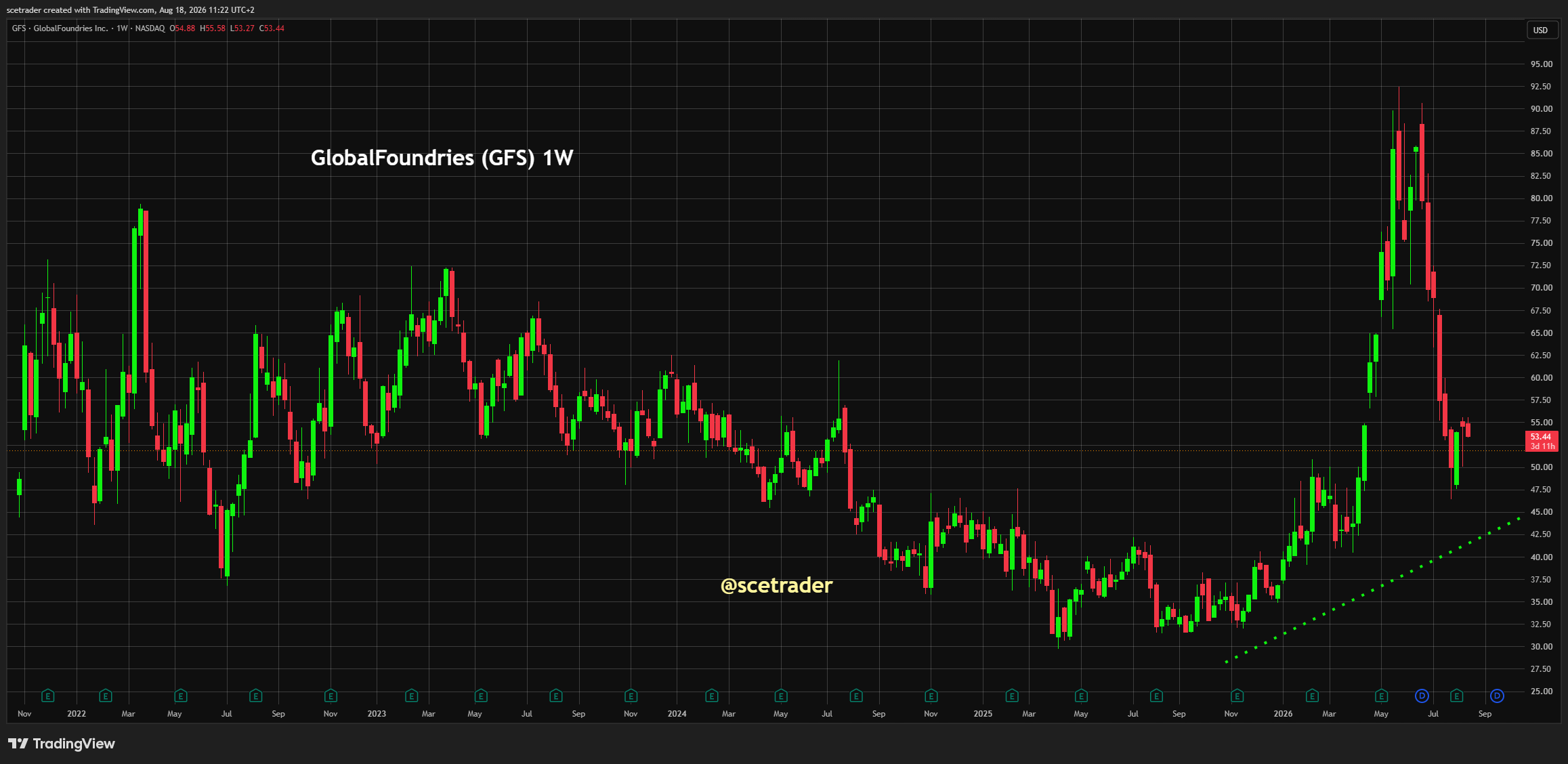
GlobalFoundries (GFS) is misschien het duidelijkste voorbeeld van hoe het begrip mature foundry verandert. Het bedrijf concurreert niet met de allerduurste leading-edge logicfabrieken, maar richt zich op gespecialiseerde technologieën voor RF, power-efficient compute, automotive, embedded toepassingen en vooral silicon photonics en SiGe. Daarmee probeert GlobalFoundries bewust economische waarde te creëren buiten de klassieke race naar de kleinste transistor.
De ontwikkelingen van juni en juli 2026 versterken dat verhaal. In juni rondde GlobalFoundries de overname van de processor-IP-activiteiten van Synopsys af, waarmee het bedrijf zijn aanbod voor physical AI en embedded intelligente systemen verbreedt. Eind juli volgde bovendien een intentieverklaring voor $300 miljoen Amerikaanse steun om de Amerikaanse positie in next-generation silicon photonics verder uit te bouwen.
Voor AI is vooral die photonicspositie interessant. Naarmate copper interconnect tegen fysieke beperkingen aanloopt, moet steeds meer dataverkeer binnen en tussen datacenters optisch worden afgehandeld. GlobalFoundries beschikt over gespecialiseerde silicon-photonics- en SiGe-platforms die juist voor deze verbindingen zijn ontworpen, waardoor het bedrijf kan profiteren zonder zelf een AI-accelerator te hoeven produceren.
Onze Investment view op GlobalFoundries wordt hierdoor positiever, maar de interessante ontwikkeling moet wel in hogere volumes en betere fab-economics worden vertaald. Na sterke koersbewegingen zouden wij liever gebruikmaken van correcties dan het aandeel uitsluitend op het photonicsverhaal achterna te lopen. Het aantrekkelijke aan GFS is juist de combinatie van verschillende specialtyplatforms, waardoor AI één extra groeimotor wordt boven op automotive, communications en industrial.
Tower Semiconductor (TSEM): een van de zuiverste specialty AI-foundry cases
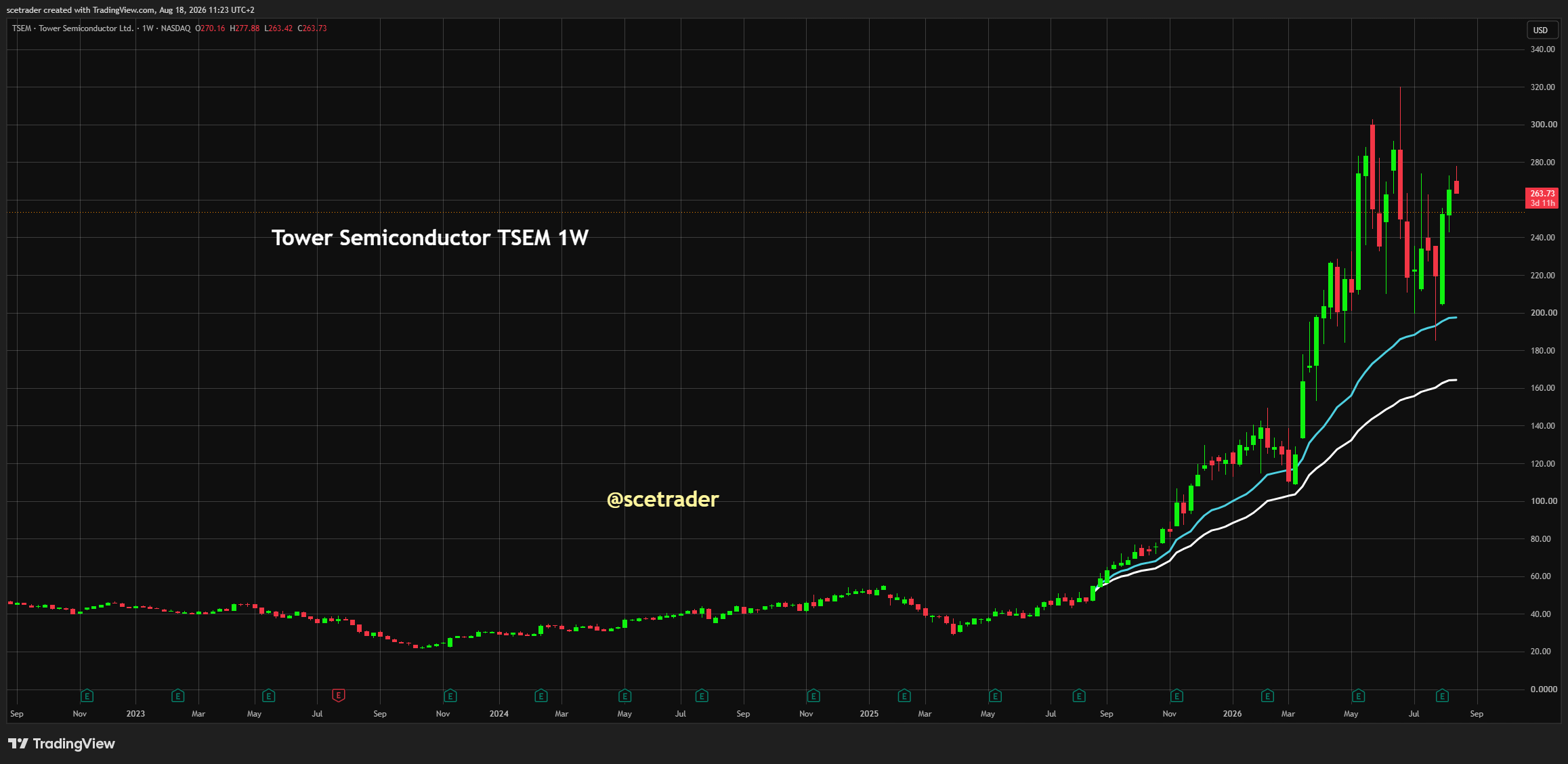
Tower Semiconductor (TSEM) is nog scherper gepositioneerd op high-value specialty manufacturing. Het bedrijf produceert onder meer analog, RF, power-management, image-sensor, SiGe- en silicon-photonicsproducten en is daardoor veel minder afhankelijk van de klassieke leading-edge roadmap. Voor beleggers die precies willen begrijpen hoe een oudere foundrystructuur door AI opnieuw relevant kan worden, is Tower een bijzonder interessante case.
De recente ontwikkelingen zijn opvallend. In juni meldde Tower samen met Marvell dat meer dan vijf miljoen coherent photonic ICs waren verscheept, waarmee duidelijk wordt dat silicon photonics geen laboratoriumverhaal meer is maar al in echte datacenterinfrastructuur terechtkomt. In juli kondigde Tower vervolgens een omvangrijke uitbreiding van zijn 300-millimeter silicon-photonics-, SiGe- en advanced-packagingcapaciteit in Japan aan, waarbij de eerste extra capaciteit tegen het vierde kwartaal van 2027 productieklaar moet zijn.
Tower verhoogde daarbij zijn financiële ambitie voor 2028 naar $3,6 miljard omzet en $1,2 miljard nettowinst. Dat laat zien hoe belangrijk het bedrijf verwacht dat photonics en andere specialty technologieën voor de toekomstige winst worden. In augustus werd het photonicsplatform bovendien verder uitgebreid met een InP-on-silicon benadering waarmee onder meer lasers, modulators en amplifiers sterker geïntegreerd kunnen worden voor AI-infrastructuur.
Bij Tower zit daarmee tegelijkertijd de kracht en het risico. De AI-koppeling is inmiddels zo duidelijk dat beleggers niet langer voor een onontdekte niche betalen. Wij vinden het bedrijf fundamenteel aantrekkelijk, maar zouden juist na stevige correcties opnieuw geïnteresseerd raken wanneer de uitbouw richting 2027 intact blijft. De komende kwartalen moeten vooral bewijzen dat het orderboek zich daadwerkelijk omzet in snel stijgende omzet en winst.
United Microelectronics (UMC): mature foundry schuift richting AI en photonics
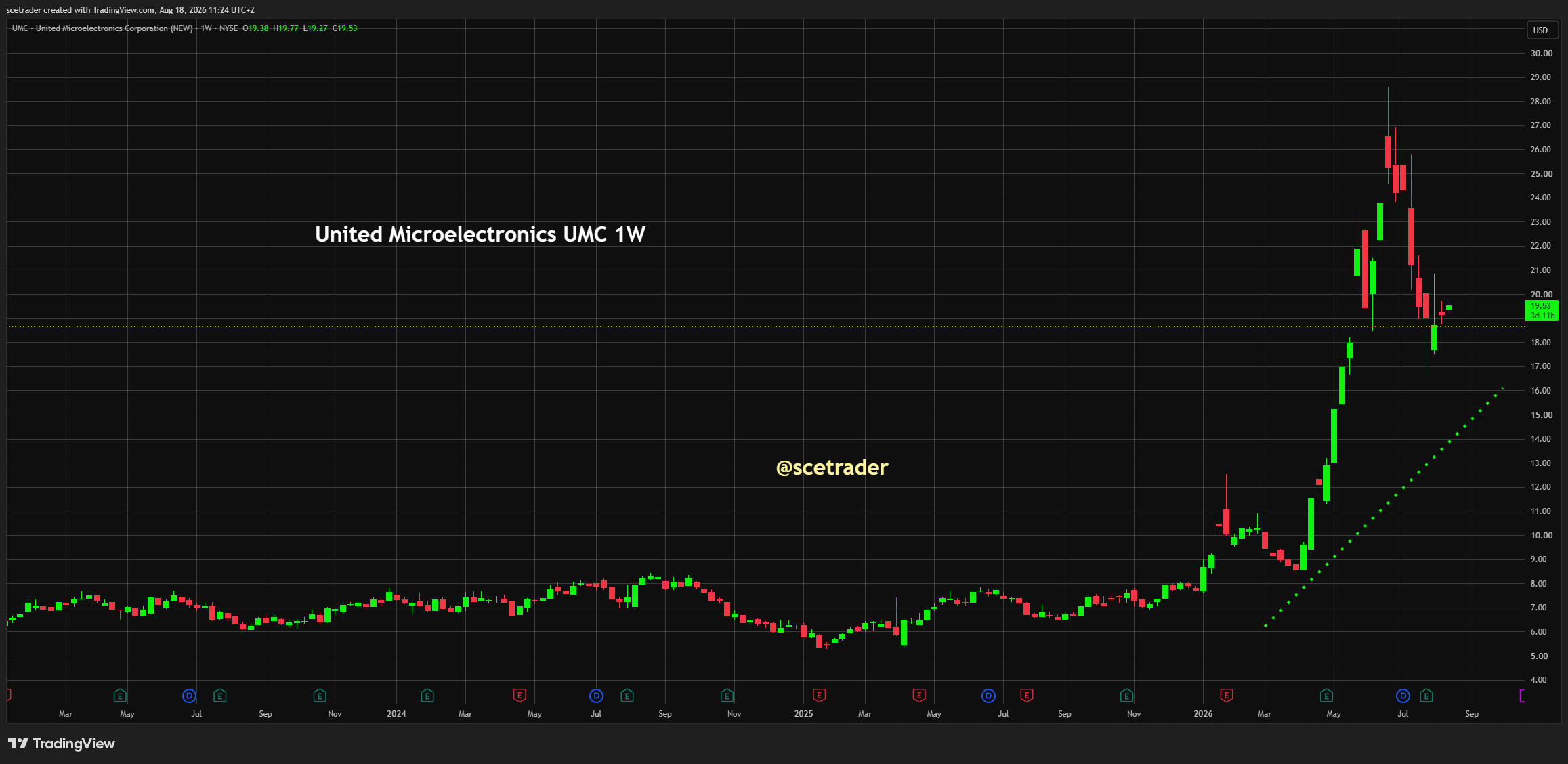
United Microelectronics (UMC) behoort tot de grootste pure-play foundries ter wereld, maar concentreert zich vooral op nodes buiten de absolute leading edge. Het bedrijf produceert onder meer chips voor communications, consumer, automotive en industrial en beschikt daardoor over een brede mature- en specialtybasis.
Juli 2026 bracht twee belangrijke signalen voor de AI-these. UMC meldde de eerste massaproductie van silicon-photonicswafers vanuit zijn 12-inch fabriek in Singapore, waarmee de technologie de stap van ontwikkeling naar volumeproductie zette. Later die maand kondigde het bedrijf uitbreiding van cleanroomcapaciteit in Singapore en de bouw van een nieuwe fabstructuur in Tainan aan om sneller te kunnen inspelen op groeiende AI- en edge-computingvraag.
Ook de utilizationontwikkeling is relevant. UMC verwachtte voor het derde kwartaal een bezettingsgraad boven 90%, precies het gebied waarin de operationele leverage van een foundry veel interessanter wordt. Wanneer een mature foundry tegelijkertijd hoge bezetting, betere pricing en meer specialtyproducten realiseert, kunnen de marges veel sneller verbeteren dan tijdens een traditionele commoditycyclus.
UMC blijft echter gevoeliger voor Chinese concurrentie dan bijvoorbeeld Tower, omdat een groter gedeelte van het portfolio makkelijker vergelijkbaar is met andere mature-node capaciteit. De investment case wordt daarom aantrekkelijker wanneer silicon photonics en andere differentiated technologies een groter gedeelte van de mix gaan vormen. Ook hier zouden wij na sterke rallies eerder op correcties wachten dan uitsluitend op basis van hoge utilization achter de koers aanlopen.
Powerchip Semiconductor Manufacturing (PSMC): pricing, memory en een nieuwe AI-foundrystrategie
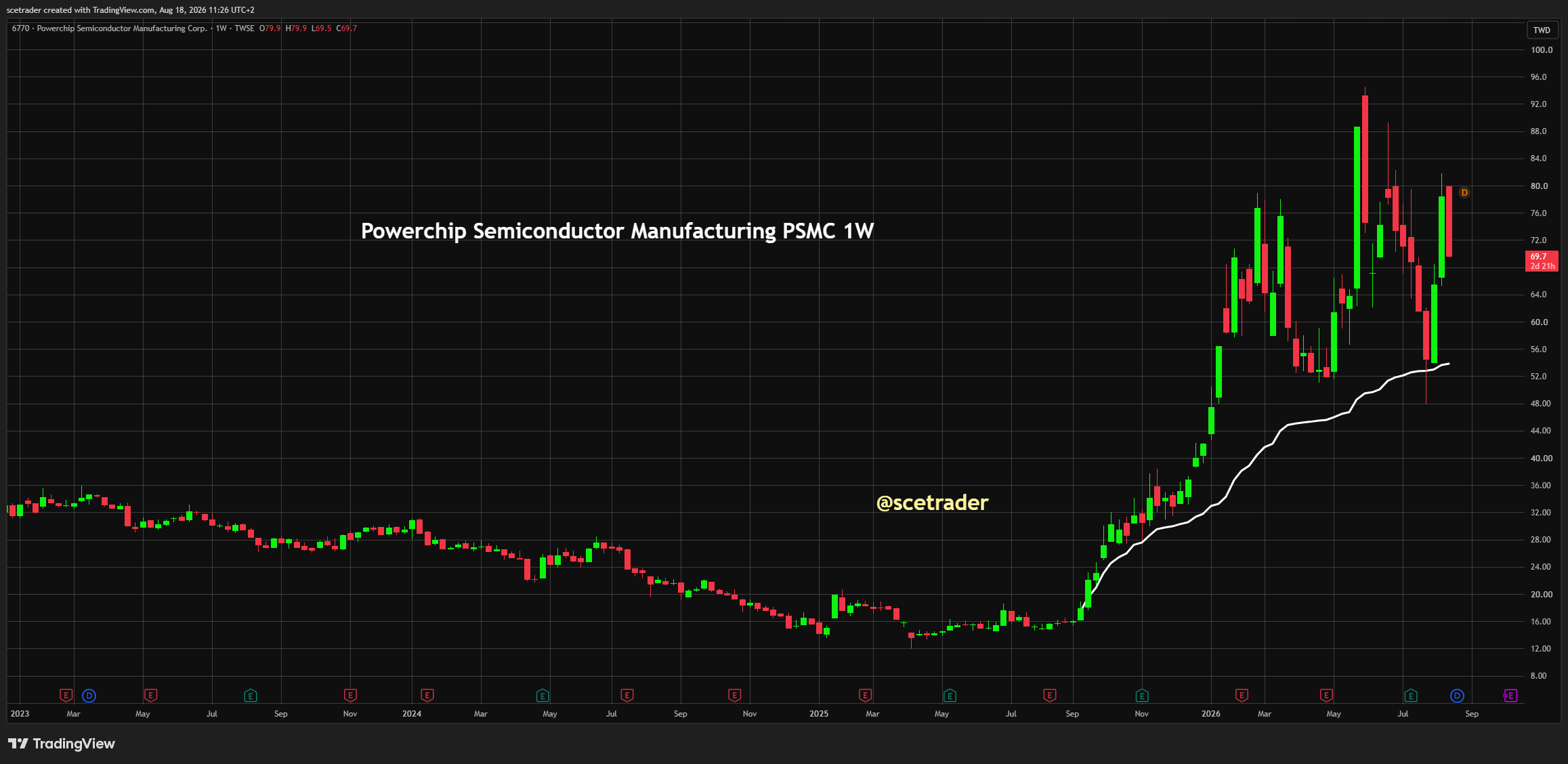
Powerchip Semiconductor Manufacturing (PSMC) is een Taiwanese foundry met activiteiten in DRAM en mature-node logic, waaronder power-management- en display-driverchips. Daarmee bevindt het bedrijf zich precies op het kruispunt van twee markten die in 2026 opnieuw krapper zijn geworden: memory en mature foundrycapaciteit.
In juni haalde PSMC ongeveer $886 miljoen op via een internationale aandelenuitgifte, waarmee het financiële ruimte creëerde voor verdere investeringen en balansversterking. In juli werd vervolgens duidelijk hoe sterk de marktdynamiek was veranderd. Het bedrijf verhoogde volgens zijn operationele update niet alleen de prijzen voor DRAM-waferproductie fors, maar ook de prijzen voor 8- en 12-inch foundrydiensten, terwijl de orderinstroom de beschikbare capaciteit overtrof.
Strategisch probeert PSMC daarnaast verder te bewegen dan klassieke mature foundry. De onderneming bouwt een zogenoemde 3D AI Foundry-activiteit rond onder meer silicon capacitors, interposers en HBM-gerelateerde back-end waferdiensten. De samenwerking met Micron rond HBM blijft daarbij belangrijk; begin augustus bevestigde het bedrijf dat de strategie na het overlijden van oprichter en voorzitter Frank Huang ongewijzigd doorgaat, met een pilotlijn voor de Micron-samenwerking tegen eind 2026 en beoogde massaproductie later in 2027.
Dit is duidelijk een hoger-risicoprofiel dan bij de grotere mature foundries. De pricingverbetering is aantrekkelijk, maar juist sterke prijsstijgingen kunnen nieuwe capaciteit aantrekken en uiteindelijk een volgende cyclus veroorzaken. PSMC vinden wij daarom vooral interessant wanneer de onderneming kan aantonen dat het aandeel van high-value 3D AI Foundry daadwerkelijk groeit en zij minder afhankelijk wordt van zuivere commoditypricing.
X-FAB Silicon Foundries (XFAB): Europa's uitgesproken specialty foundry
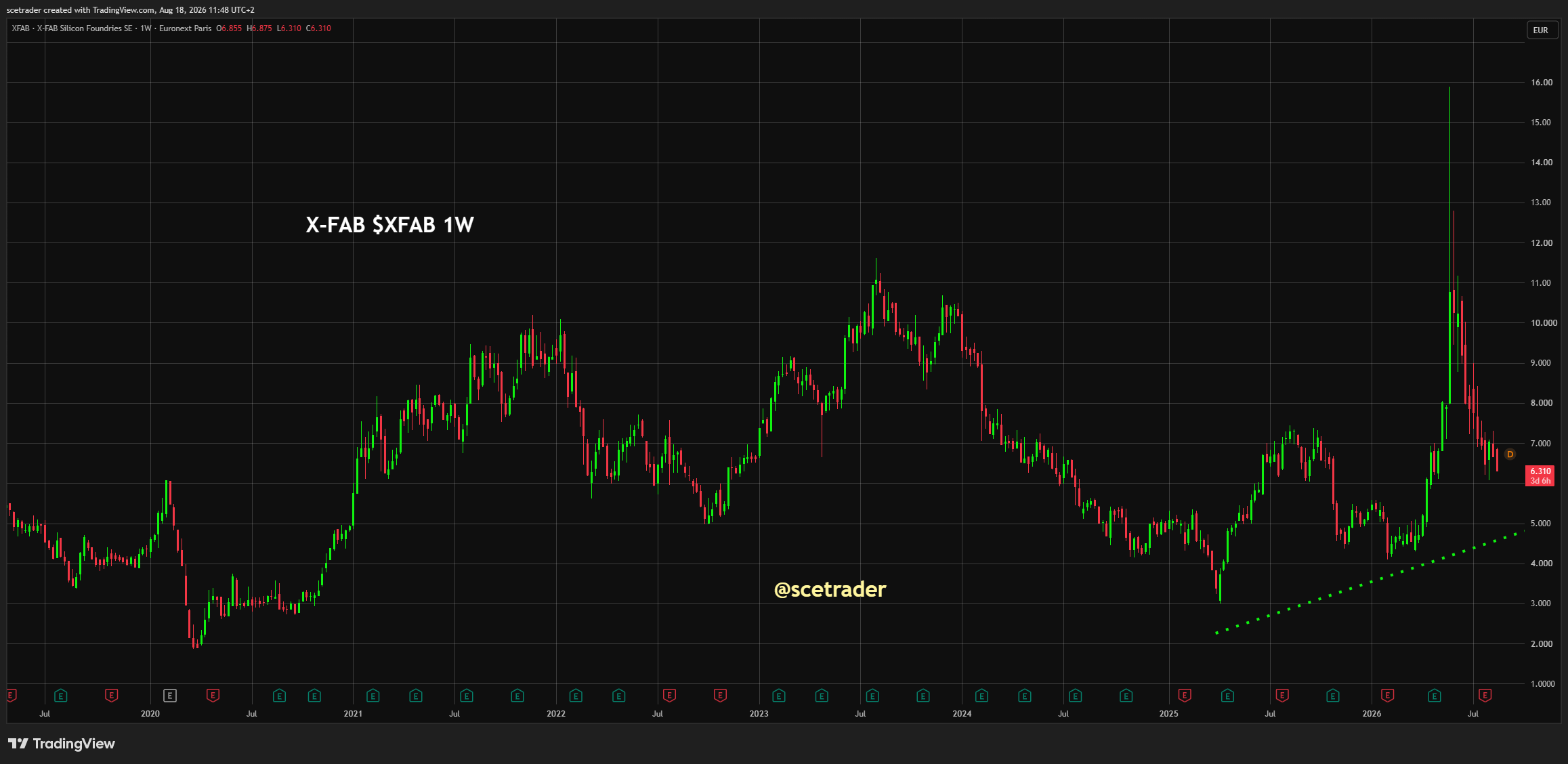
X-FAB Silicon Foundries (XFAB) is een van de interessantste Europese namen binnen dit thema omdat het bedrijf bewust niet probeert mee te doen aan de leading-edge logicrace. X-FAB richt zich op analog/mixed-signal, high-voltage, sensors, MEMS, SiC en andere specialtyprocessen voor automotive, industrial en medische toepassingen.
De cijfers over het tweede kwartaal van 2026 laten tegelijkertijd zien waarom dit geen simpele rechte AI-trade is. Microsystems & Photonics realiseerde $28,7 miljoen omzet, 14% meer dan een jaar eerder maar 15% minder dan in het eerste kwartaal. Dat onderstreept dat structurele groeimarkten en kwartaalvolatiliteit prima naast elkaar kunnen bestaan.
Strategisch is het beeld aantrekkelijker. In juni kreeg X-FAB €127,4 miljoen publieke financiering binnen het kader van de Europese chipstrategie, terwijl het bedrijf verder investeert in photonicscapaciteit waarvan volumeproductie vanaf 2028 wordt voorzien. X-FAB positioneert zichzelf nadrukkelijk voor de combinatie van power en photonics die door datacenterontwikkeling belangrijker wordt.
Voor beleggers maakt dat X-FAB interessant als Europese pure specialty case, maar de timing blijft belangrijk. Het bedrijf moet eerst bewijzen dat de huidige investeringsfase daadwerkelijk leidt tot hogere fabbezetting en structureel betere marges. Een sterke correctie waarbij de photonics- en powerroadmap intact blijft, zou voor ons interessanter zijn dan het vooruitbetalen voor resultaten die pas vanaf 2027 en 2028 volledig zichtbaar kunnen worden.
Texas Instruments (TXN): analog wordt ineens een AI-datacenterverhaal
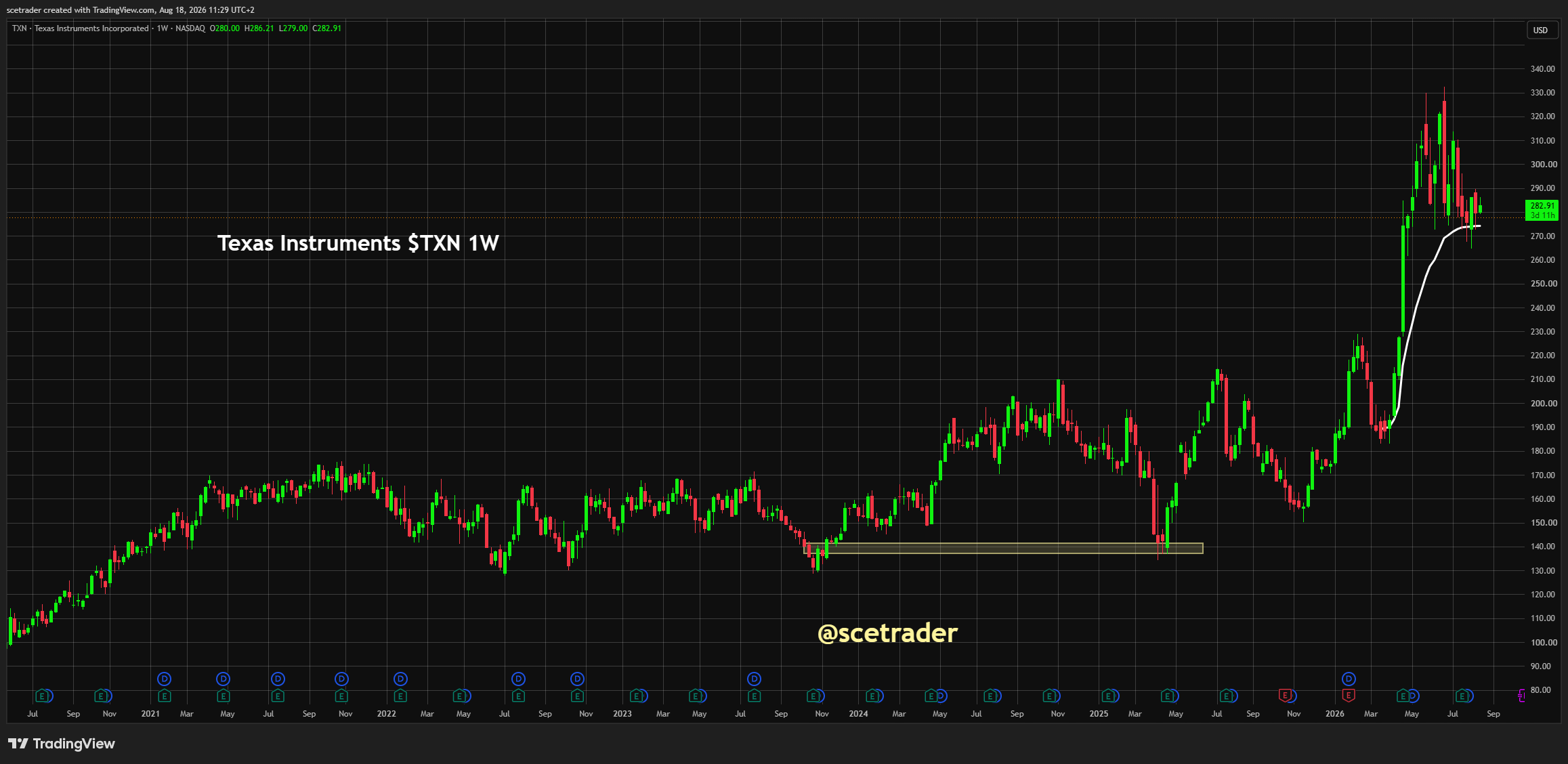
Texas Instruments (TXN) wordt vaak gezien als een klassieke analogonderneming met sterke posities in industrial en automotive. Die beschrijving is nog steeds correct, maar mist inmiddels een steeds belangrijker derde onderdeel: datacenters.
In het tweede kwartaal van 2026 rapporteerde Texas Instruments $5,5 miljard omzet, 23% meer dan een jaar eerder. De analogdivisie groeide daarbij 26% en Embedded Processing 16%. Belangrijker voor deze thesis is dat datacenteractiviteiten veel sneller groeien dan de historische kernmarkten, waarbij de onderneming profiteert van de enorme hoeveelheid power-management- en signal-chaincontent die rond iedere nieuwe generatie compute wordt geplaatst.
TI beschikt bovendien over eigen productiecapaciteit en heeft jarenlang zwaar geïnvesteerd in 300-millimeter analog manufacturing. Dat kan een belangrijk kostvoordeel geven wanneer de volumes verder stijgen. De onderneming hoeft de GPU niet te ontwerpen om te profiteren van de stijgende power density; zij levert juist de chips die stroom converteren, meten en regelen rond de processor.
Veel van deze aantrekkelijkheid is inmiddels echter bekend. Texas Instruments is geen verborgen AI-aandeel meer en een sterk herstel van industrial en automotive wordt eveneens steeds meer ingeprijsd. Wij zouden daarom vooral geïnteresseerd zijn tijdens correcties waarbij de structurele datacentergroei intact blijft en de fabutilization verder verbetert.
Analog Devices (ADI): power delivery wordt rechtstreeks onderdeel van de AI-strategie
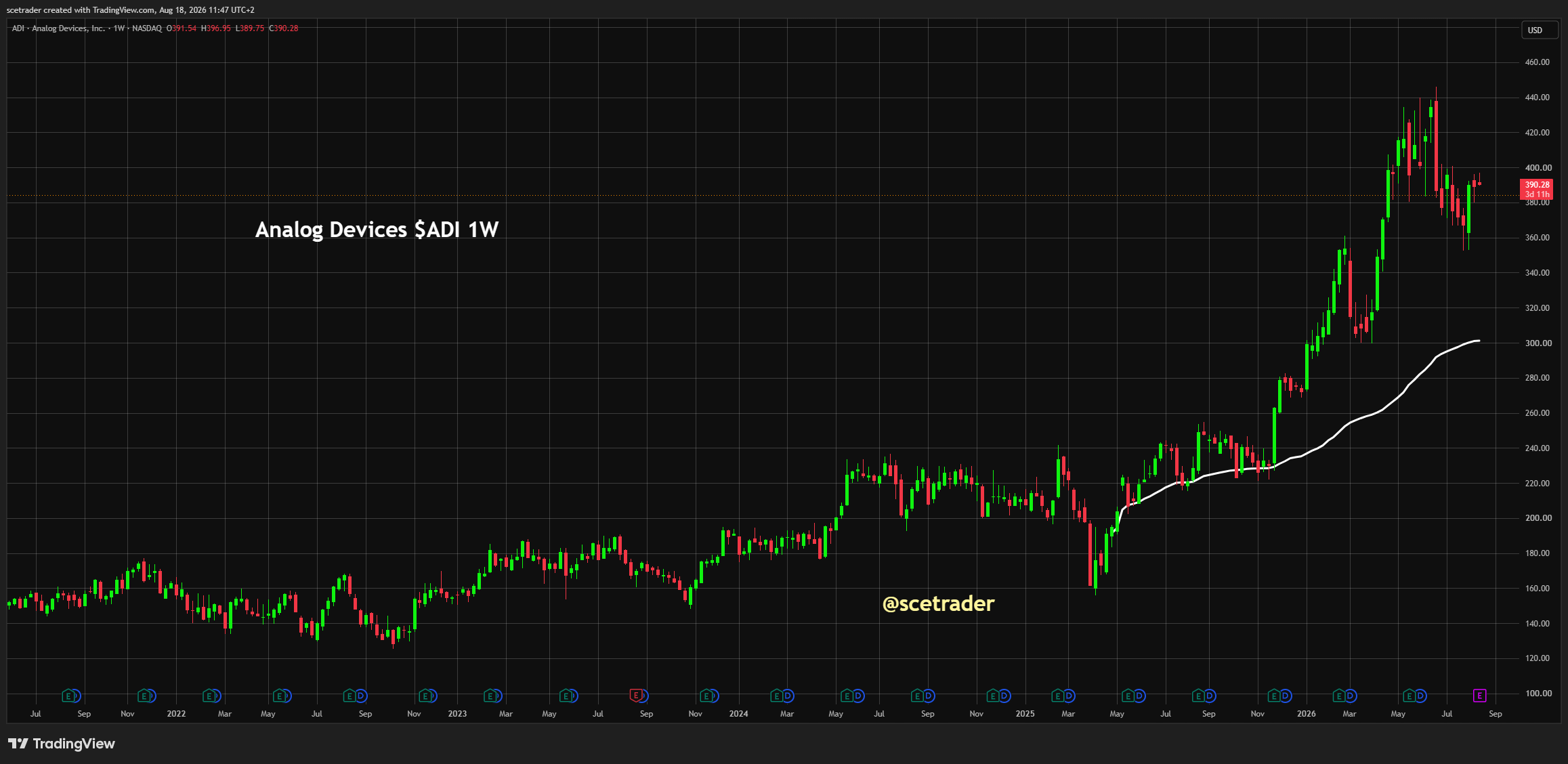
Analog Devices (ADI) heeft een breed portfolio in high-performance analog, mixed-signal en power-managementtechnologie en is sterk aanwezig in industrial, automotive en communications. AI-data-infrastructuur wordt echter steeds belangrijker omdat juist de extreme vermogensdichtheid van nieuwe accelerators veel nauwkeurigere power delivery vereist.
In juli 2026 rondde Analog Devices de overname van Empower Semiconductor af. Daarmee kreeg ADI toegang tot integrated voltage regulator-technologie en silicon capacitors voor verticale power delivery dicht bij de computechip. De strategische logica is sterk: wanneer stroom steeds dichter bij de accelerator moet worden geconverteerd om verliezen en ruimtegebruik te beperken, wordt power delivery steeds meer onderdeel van de compute-architectuur zelf.
Empower stelde bij de aankondiging dat deze technologie de power footprint sterk kan verkleinen en het energiegebruik van datacentercompute met ongeveer 10% tot 15% kan terugbrengen. Zelfs wanneer de uiteindelijke besparing per ontwerp verschilt, laat dit zien hoeveel economische waarde rondom stroomvoorziening ontstaat wanneer datacenters tegen fysieke energielimieten aanlopen.
Voor ADI vergroot dit de directe AI-exposure boven op de bestaande communications- en industrialactiviteiten. Wij vinden dat aantrekkelijk, maar ook hier is de markt zich steeds bewuster van het thema. Een correctie waarbij de integratie van Empower en de datacentergroei intact blijven, zou daarom aantrekkelijker zijn dan simpelweg achter een rerating van AI-power aan te lopen.
NXP Semiconductors (NXPI): physical AI brengt intelligentie naar auto's, fabrieken en robots
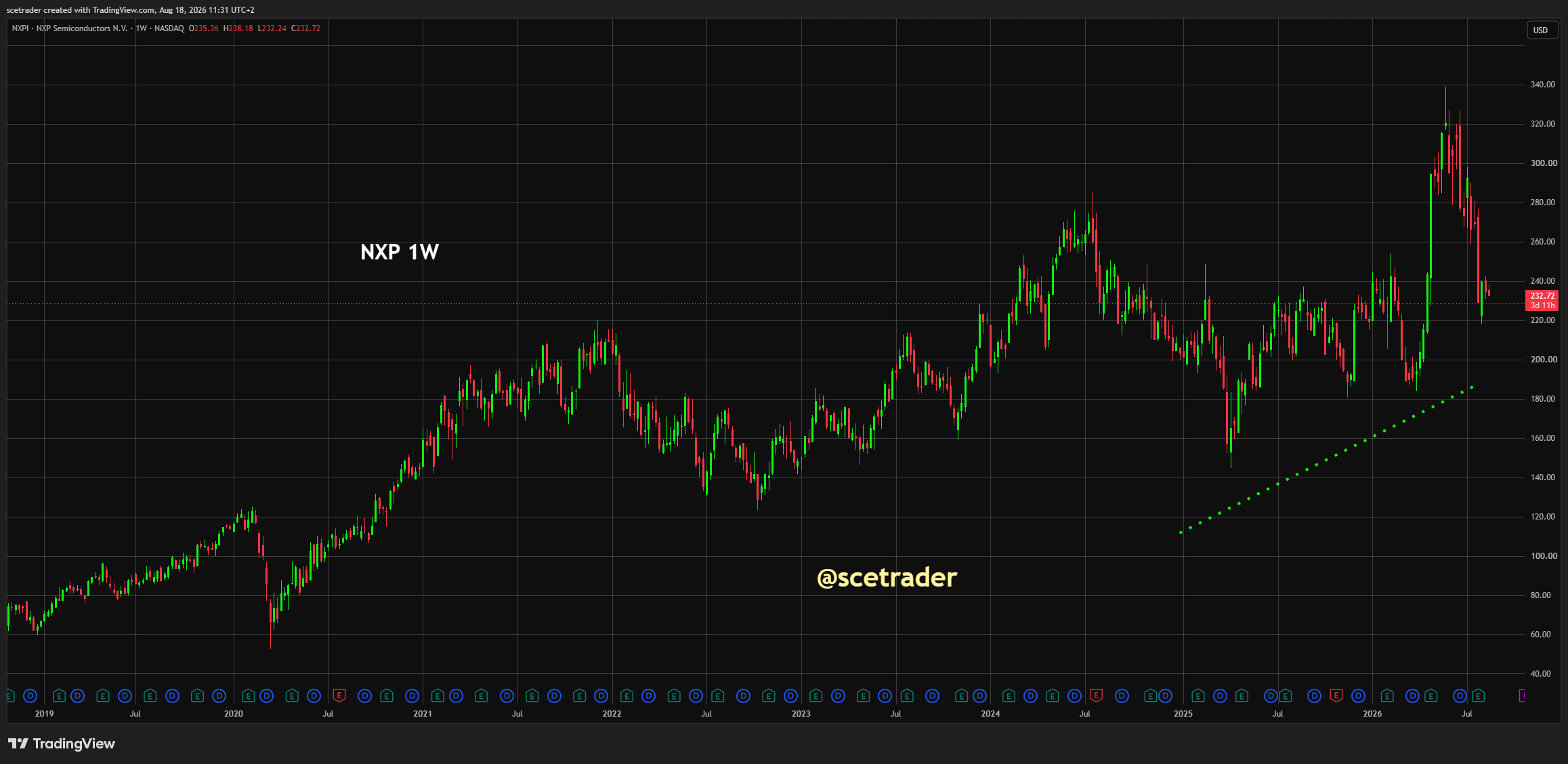
NXP Semiconductors (NXPI) verschilt duidelijk van de datacenter-powernamen. De onderneming is sterk in automotive processing, connectivity, security, microcontrollers en industrial edge computing en profiteert daarom vooral wanneer AI het datacenter verlaat en de fysieke wereld binnengaat.
Die strategie werd in juli 2026 opvallend expliciet. NXP rapporteerde in het tweede kwartaal $3,5 miljard omzet, 19% meer dan een jaar eerder en 10% meer dan in het voorgaande kwartaal. Het management koppelde de toekomstige groei nadrukkelijk aan software-defined vehicles en physical AI in voertuigen, fabrieken en robots.
Voor mature en specialty nodes is dat relevant omdat dergelijke systemen nooit alleen uit één geavanceerde AI-processor bestaan. Een robot of auto bevat talloze microcontrollers, connectivitychips, securityelementen, motorcontrol en sensors die juist op langer bestaande processen worden geproduceerd. NXP kan daardoor profiteren van zowel intelligence aan de edge als van de stijgende semiconductorcontent rond ieder intelligent fysiek systeem.
Wij vinden NXP structureel aantrekkelijk binnen physical AI, maar het aandeel blijft gevoelig voor automotivecycli. Dat maakt correcties juist interessant wanneer de markt tijdelijk alleen naar zwakkere autoproductie kijkt terwijl de strategische verschuiving richting edge intelligence doorloopt.
Infineon Technologies (IFX): AI-power is inmiddels zichtbaar in de cijfers
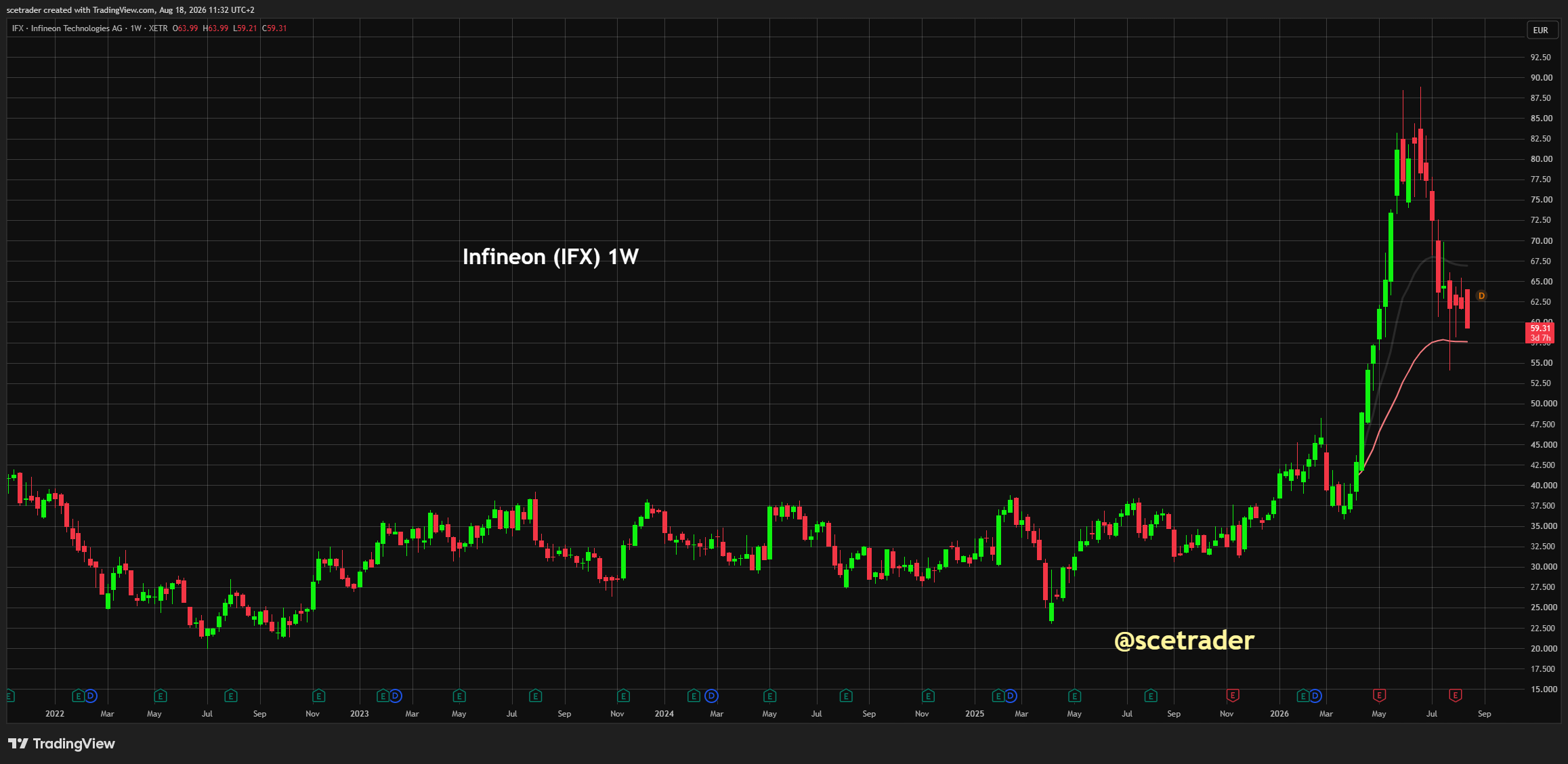
Infineon Technologies (IFX) is een van de duidelijkste Europese winnaars van de verschuiving naar power-intensive AI-infrastructuur. De onderneming behoort wereldwijd tot de belangrijkste producenten van power semiconductors en combineert traditionele siliconproducten met GaN- en SiC-technologie.
De resultaten van augustus 2026 bevestigen dat AI niet langer slechts een toekomstverhaal is. Infineon realiseerde in het derde fiscale kwartaal €4,172 miljard omzet en een segmentresultaat van €797 miljoen, goed voor een marge van 19,1%. Voor het vierde kwartaal verwacht het bedrijf ongeveer €4,7 miljard omzet en een verdere stijging van de marge richting circa 23%, waarbij sterke AI-activiteiten expliciet als groeifactor worden genoemd.
Ook technologisch beweegt Infineon verder richting de nieuwe datacenter-powerarchitectuur. In augustus kondigde het bedrijf samenwerking aan rond efficiënte direct-current poweroplossingen voor AI-datacenters. Dat past precies bij de overgang naar hogere voltages en minder conversiestappen die nodig is om de steeds hogere rackvermogens economisch beheersbaar te houden.
Infineon behoort daarmee tot onze duidelijkste fundamentele winnaars binnen deze tweede AI-trade. Tegelijkertijd betekent de sterke erkenning van het AI-powerverhaal dat wij na grote koerssprongen eerder op een correctie zouden wachten. De structurele case blijft aantrekkelijk zolang AI-omzet, marge en powerdesign-wins blijven stijgen.
STMicroelectronics (STMPA): herstel plus een nieuwe datacenterpoot
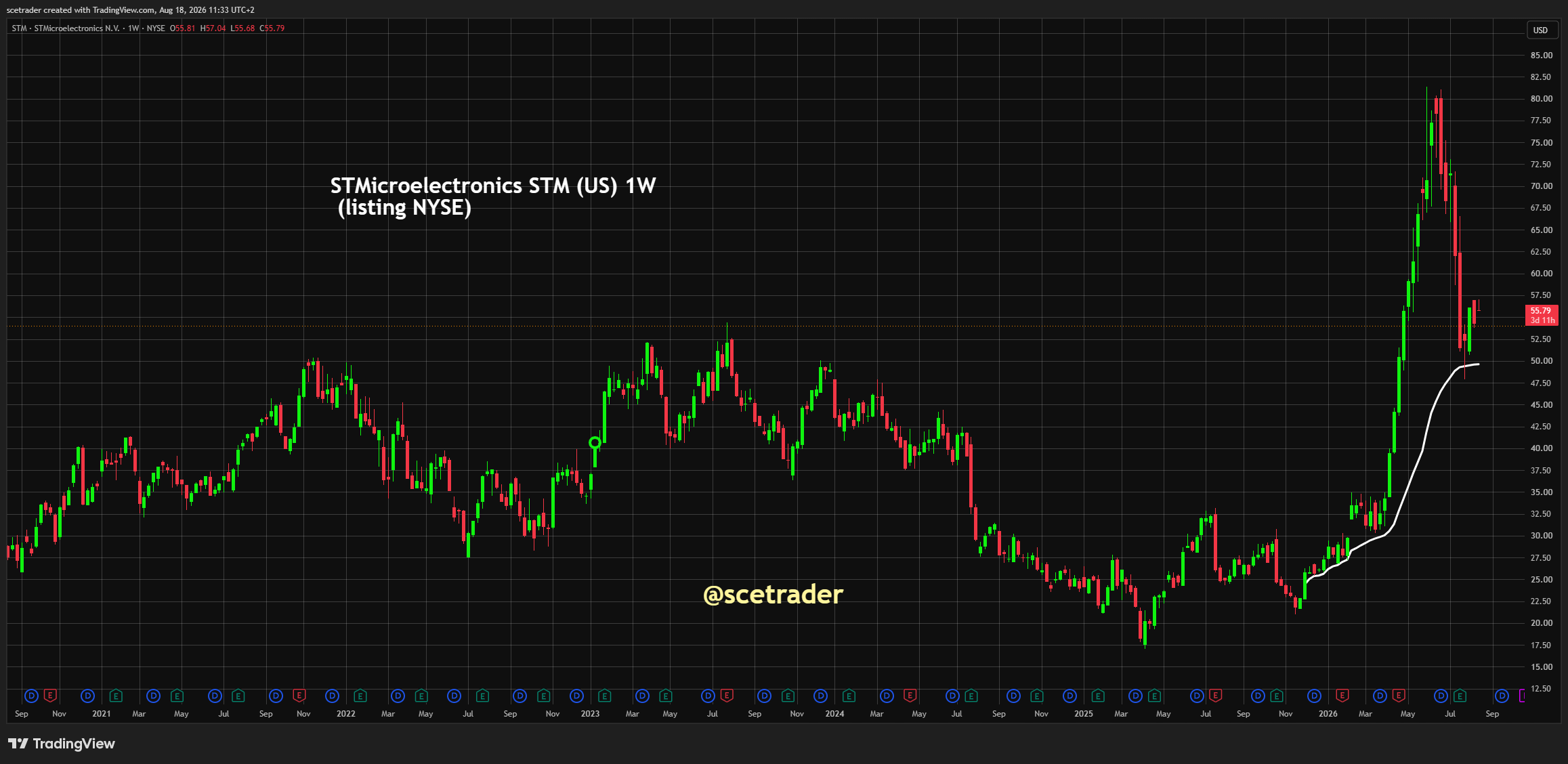
STMicroelectronics (STMPA) is een brede Europese semiconductorproducent met sterke posities in microcontrollers, automotive, analog, sensors en power. Daardoor was de onderneming historisch sterk afhankelijk van automotive en industrial, maar in 2026 wordt AI-datacenterinfrastructuur steeds meer een afzonderlijke groeimotor.
In het tweede kwartaal rapporteerde ST $3,49 miljard omzet, 26% meer dan een jaar eerder, met een brutomarge van 34,8%. Voor het derde kwartaal rekende het bedrijf op ongeveer $3,7 miljard omzet, terwijl het richting het vierde kwartaal verdere groei verwacht uit programma's voor AI-datacenters en LEO-infrastructuur.
Dat is belangrijk omdat ST beschikt over uiteenlopende technologies die rondom de accelerator kunnen worden gebruikt, waaronder power management en andere specialtyproducten. Het bedrijf hoeft daardoor niet de leading-edge computechip te leveren om van de datacenterinvesteringen te profiteren.
ST blijft voor ons wel een herstelcase naast een AI-case. De marges moeten verder verbeteren en automotive en industrial blijven belangrijk. Juist daarom kan een correctie aantrekkelijk worden wanneer de markt opnieuw pessimistisch wordt over de traditionele eindmarkten terwijl de nieuwe datacenterprogramma's blijven opschalen.
onsemi (ON): van power semiconductor naar physical-AI-platform
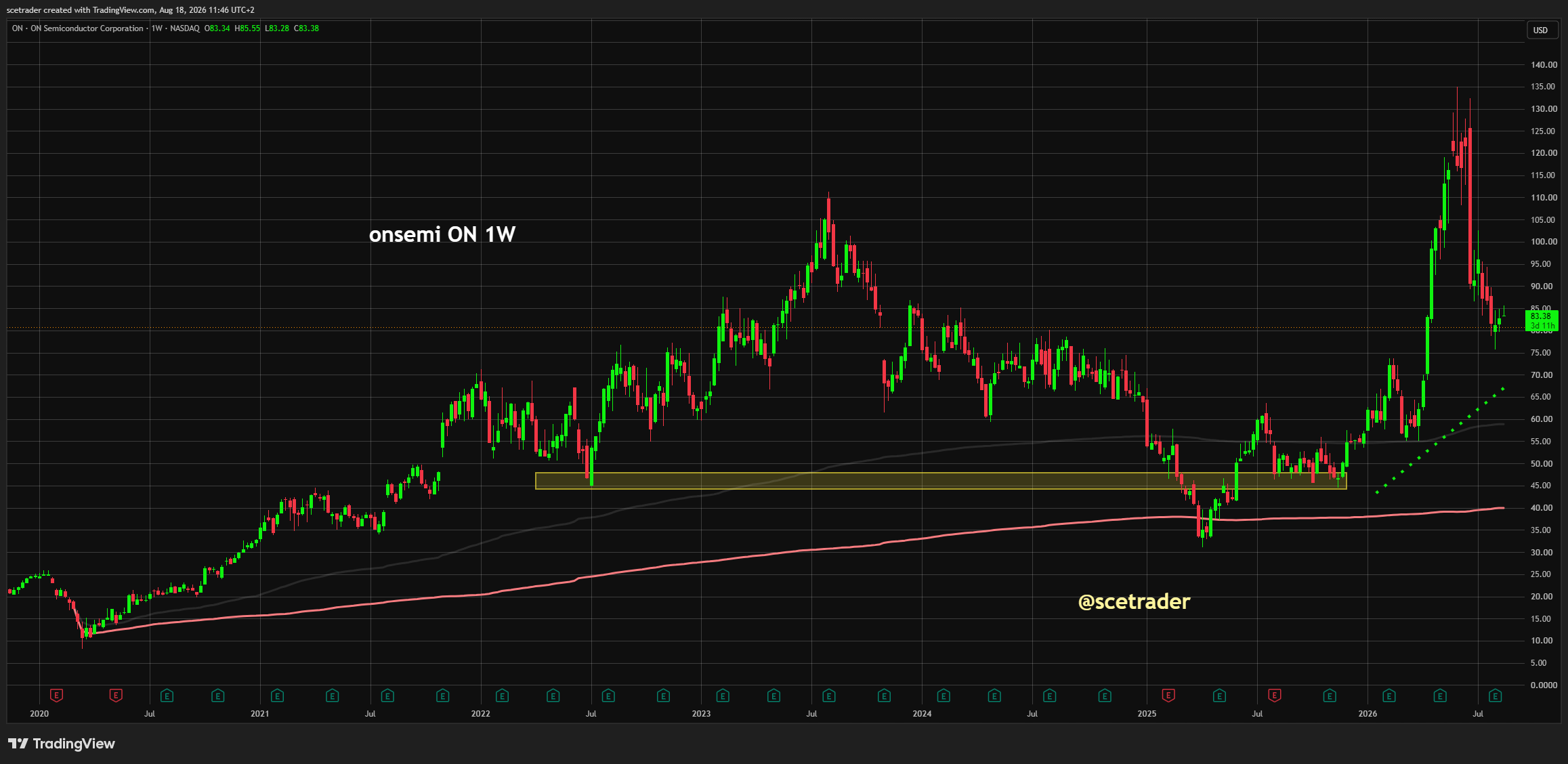
onsemi (ON) is traditioneel sterk in power semiconductors, sensors, automotive en industrial. Daarmee heeft de onderneming al een natuurlijke positie in electrification en machine control, maar in 2026 probeert het bedrijf nadrukkelijk een bredere rol binnen physical AI te creëren.
De grote strategische stap kwam in juni met de voorgenomen overname van Synaptics in een aandelenovereenkomst van ongeveer $7 miljard. De combinatie moet onsemi's power- en sensingexpertise samenbrengen met connected-compute- en edge-technologie, waardoor het bedrijf meer van het volledige intelligente systeem kan leveren in auto's, robots en industriële machines.
De logica sluit direct aan bij deze long read. Physical AI vraagt niet alleen om compute, maar ook om sensing, connectivity, power management en actuation. Door deze functies dichter bij elkaar te brengen kan onsemi zich ontwikkelen van componentleverancier naar een bredere platformspeler rond intelligente fysieke systemen.
De uitvoering wordt echter cruciaal. Een grote acquisitie introduceert integratierisico en de onderneming blijft blootgesteld aan automotive en industrial. Wij zien daarom potentieel, maar vinden dit bij sterke koersstijgingen geen aandeel om blind achteraan te lopen; correcties waarbij de strategische physical-AI-case intact blijft zijn interessanter.
Coherent (COHR): materialen en optics voor de AI-bandbreedte-explosie
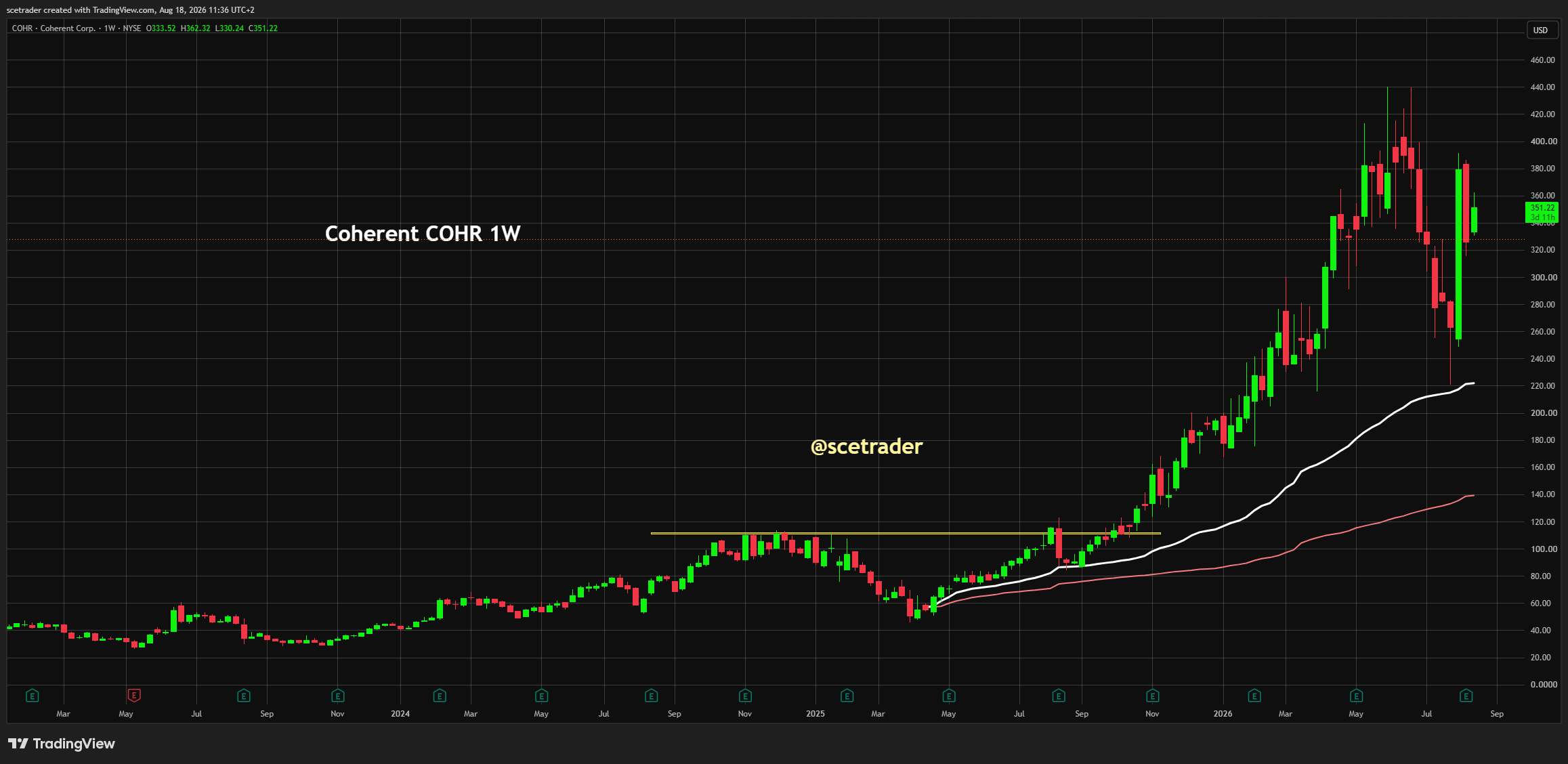
Coherent (COHR) bevindt zich aan een andere kant van de keten. Het bedrijf levert optical components, lasers, transceivers en gespecialiseerde materialen die noodzakelijk zijn om enorme hoeveelheden data door moderne communications- en datacenterinfrastructuur te verplaatsen.
De investment case wordt direct gevoed door het feit dat AI-clusters steeds hogere bandbreedte nodig hebben. Naarmate honderden duizenden accelerators als één systeem moeten functioneren, wordt de interconnect een even belangrijke bottleneck als compute. Daardoor stijgt de vraag naar snellere optical links en componenten die 800G, 1.6T en uiteindelijk nog hogere snelheden mogelijk maken.
Coherent is daarmee geen mature-node foundry en hoort technisch niet in dezelfde categorie als UMC of X-FAB. De reden dat het bedrijf wel in deze long read thuishoort, is dat het precies laat zien hoe de economische waarde zich van pure compute naar de ondersteunende infrastructuur verspreidt.
Bij optical aandelen is in 2026 al veel optimisme ingeprijsd. Wij zouden daarom extra prijsdiscipline hanteren. De structurele vraag kan jarenlang sterk blijven, maar juist aandelen met hoge AI-verwachtingen kunnen bij een kwartaal dat slechts 'goed' in plaats van uitzonderlijk is fors corrigeren.
Lumentum (LITE): optical connectivity wordt een primaire AI-infrastructuurlaag
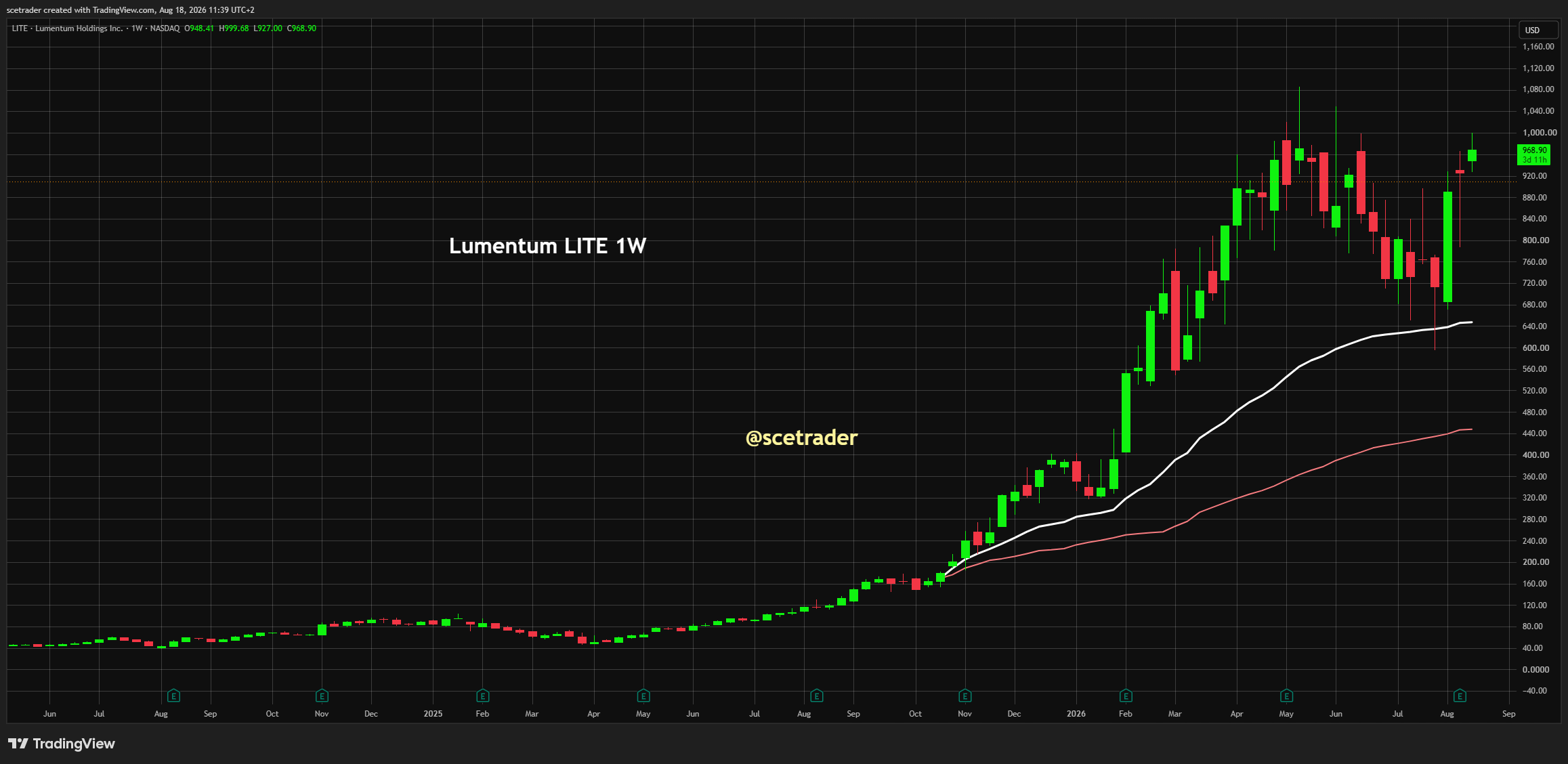
Lumentum (LITE) is nog directer gekoppeld aan optical communications en levert onder meer lasers en optical components voor datacenter- en telecomverbindingen. De ontwikkeling van augustus 2026 bevestigt hoe snel AI deze markt verandert.
Over het vierde fiscale kwartaal rapporteerde Lumentum $1,01 miljard omzet. Het management beschreef de verschuiving naar optical connectivity als structureel en wees erop dat 1.6T cloudmodules en optical-circuit-switchingoplossingen nog maar aan het begin van hun bijdrage staan.
Dat is fundamenteel belangrijk. AI-clusters kunnen niet onbeperkt groter worden wanneer data tussen accelerators met onvoldoende snelheid of te veel energieverlies wordt verplaatst. Optical connectivity wordt daardoor geen luxe toevoeging, maar steeds meer een basisvoorwaarde voor schaalbare AI.
Het risico bij Lumentum is vooral de waardering na sterke AI-gerelateerde koersbewegingen. Wij geloven in de structurele markt, maar juist dit soort momentum-aandelen kunnen tijdens een algemene semiconductorcorrectie hard terugvallen. Wanneer orders en 1.6T-adoptie intact blijven, kunnen zulke correcties interessante nieuwe instapmomenten creëren.
Marvell Technology (MRVL): de brug tussen custom compute, memory en optical networking
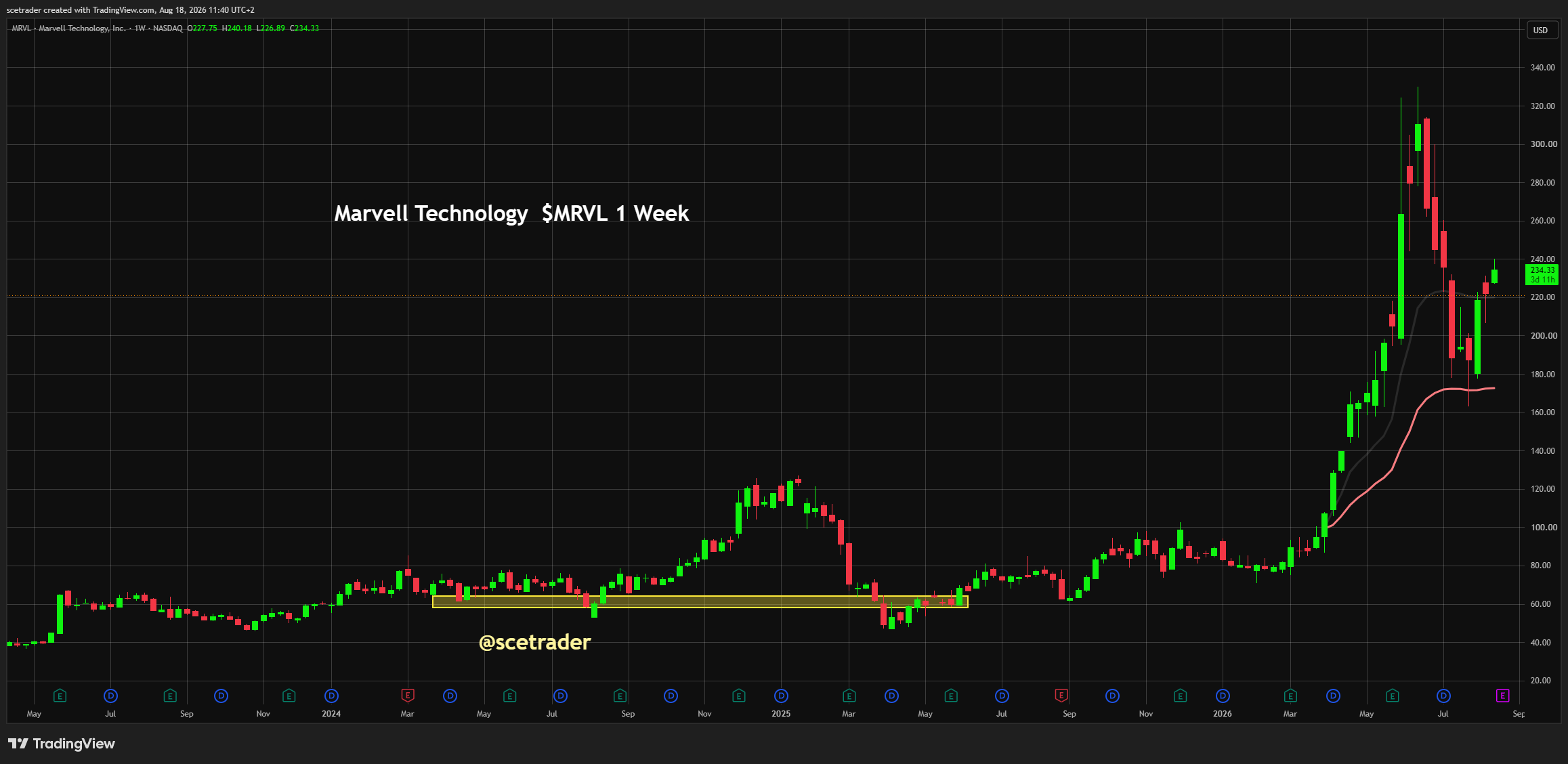
Marvell Technology (MRVL) is geen mature-node pure play, maar wel essentieel om het volledige AI-systeem te begrijpen. Het bedrijf ontwerpt data-infrastructuurchips voor networking, custom compute, electro-optics, storage en steeds meer gespecialiseerde AI-infrastructuur.
In augustus 2026 presenteerde Marvell nieuwe memory- en storageoplossingen voor agentic-AI-inference. Het centrale probleem daarbij is dat processors steeds vaker niet door pure compute worden begrensd, maar doordat data en memory niet snel genoeg beschikbaar zijn. Marvell probeert die bottleneck te verminderen met architecturen waarbij memory flexibeler kan worden uitgebreid, gedeeld en dichter bij de workload beschikbaar gemaakt.
Daarnaast blijft optical connectivity belangrijk. De samenwerking met Tower Semiconductor, waarbij inmiddels miljoenen coherent photonic ICs zijn verscheept, toont dat Marvell niet alleen een theoretisch optical-verhaal heeft maar daadwerkelijk volume door de keten beweegt.
Marvell is daarmee een hoger-beta manier om op dezelfde structurele verschuiving te spelen. De potentiële groei is groot, maar een aanzienlijk gedeelte van het AI-optimisme is al bekend. Wij zouden daarom juist bij scherpe correcties kijken of de custom-silicon-, networking- en opticalroadmap intact blijft.
Wolfspeed (WOLF): SiC krijgt een nieuwe kans in AI-datacenters
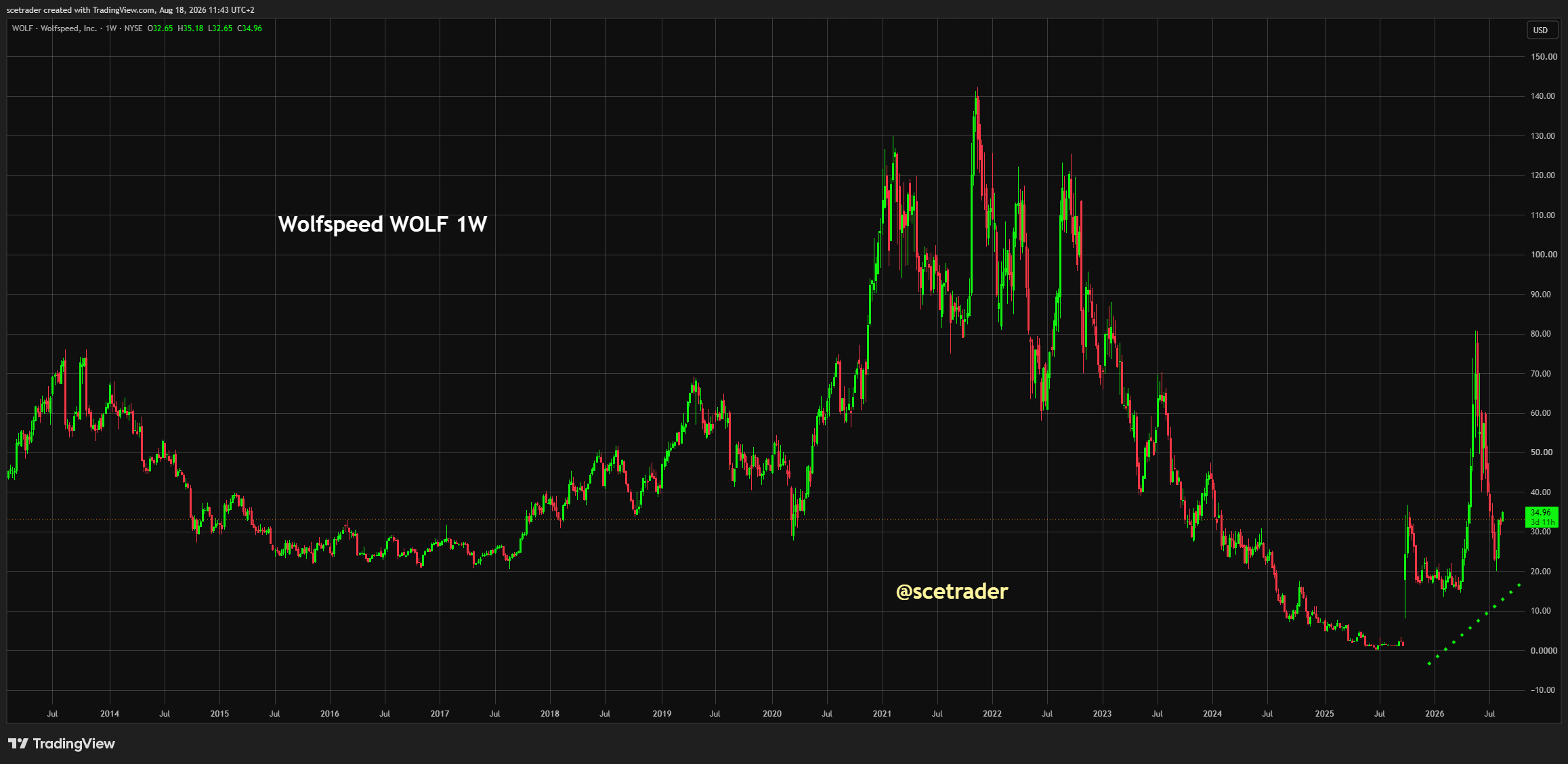
Wolfspeed (WOLF) is de meest uitgesproken high-risk case binnen deze groep. Het bedrijf ontwikkelt en produceert silicon-carbidematerialen en power devices, een technologie die vooral aantrekkelijk is wanneer hoge voltages en lage energieverliezen belangrijk zijn.
In juni 2026 richtte Wolfspeed een speciaal datacenterteam op om zijn SiC-technologie sterker richting AI-infrastructuur te brengen. In augustus volgde een samenwerking met LITEON rond 800-volt gelijkstroomoplossingen voor hyperscale AI-datacenters. Dat sluit direct aan bij de verwachting dat de stroomarchitectuur van toekomstige AI-faciliteiten naar hogere voltages moet verschuiven om verliezen, kopergebruik en warmte te beperken.
Technologisch is dat interessant. Bedrijfsspecifiek blijft Wolfspeed echter veel riskanter dan bijvoorbeeld Texas Instruments of Infineon. De onderneming heeft een turbulente financiële geschiedenis achter zich en moet bewijzen dat technologische kwaliteit ook daadwerkelijk kan worden vertaald in consistente winst en vrije kasstroom.
Wij zouden Wolfspeed daarom niet behandelen als een normale mature-node investering. Het is eerder een asymmetrische SiC- en AI-powercase waarbij de potentiële upside groot kan zijn, maar de foutmarge eveneens. Een koerscorrectie maakt het aandeel dus niet automatisch aantrekkelijk; verbetering van de operationele uitvoering blijft noodzakelijk.
Waarom Chinese capaciteit het verhaal niet vernietigt, maar wel verdeelt
China blijft de grootste tegenkracht voor de mature-node bullcase. Het land heeft jarenlang grote bedragen geïnvesteerd in capaciteit op oudere nodes en kan daarmee bij standaardproducten aanzienlijke prijsdruk creëren. Het zou daarom een fout zijn om te concluderen dat iedere 28-, 55- of 90-nanometerfabriek automatisch meer waard wordt door AI.
Juist hier wordt het verschil tussen commodity en specialty essentieel. Wanneer dezelfde chip relatief eenvoudig bij vijf verschillende foundries kan worden geproduceerd, blijft de prijs de belangrijkste concurrentiefactor. Wanneer een proces specifieke materialen, photonics, high-voltagefunctionaliteit of jarenlang gekwalificeerde automotiveproductie vereist, wordt overstappen veel moeilijker.
De recente cijfers uit Azië laten bovendien zien dat mature-node capaciteit ondanks die Chinese expansie opnieuw zeer hoog kan worden benut. Dat suggereert dat AI niet alleen direct nieuwe vraag creëert, maar ook capaciteit uit andere segmenten wegtrekt en daarmee het aanbod voor traditionele toepassingen krapper kan maken.
Waarom pricing power terug kan komen
Bij lage fabbezetting ligt de macht vooral bij de klant. Foundries accepteren lagere prijzen om hun machines gevuld te houden en concurreren vooral op kosten. Zodra utilization richting 90% beweegt, verandert dat spel omdat de klant minder alternatieve capaciteit beschikbaar heeft.
Bij specialty processen wordt dat effect versterkt door switching costs. Een automobielbedrijf of industriële klant kan een gekwalificeerd ontwerp niet zomaar in enkele weken naar een andere fabriek verplaatsen. Er zijn nieuwe maskers, tests, procesvalidatie en soms uitgebreide reliabilityprocedures nodig.
Wanneer de chip bovendien maar een klein gedeelte vormt van de totale kostprijs van een AI-server, auto of industriële machine, wordt leveringszekerheid belangrijker dan een prijsverschil van enkele procenten. Dat is de omgeving waarin specialty foundries weer pricing power kunnen opbouwen.
More-than-Moore wordt belangrijker naast Moore's Law
De semiconductorindustrie is decennialang beoordeeld via één dominante maatstaf: hoeveel kleiner kunnen transistors worden? Moore's Law blijft cruciaal voor high-performance compute, maar AI maakt steeds duidelijker dat de prestaties van een volledig systeem niet alleen door transistor density worden bepaald.
Meer compute heeft sneller memory nodig, sneller memory heeft betere interconnect nodig en meer vermogen vraagt betere power conversion en cooling. Nieuwe materialen, chiplets, silicon photonics, advanced packaging, GaN, SiC en analog integration worden daardoor net zo relevant voor de prestaties van het volledige systeem.
Dat is de essentie van More-than-Moore. Verschillende functies worden geproduceerd op de technologie die daarvoor optimaal is en daarna steeds dichter in één systeem geïntegreerd. Een 2-nanometerprocessor kan daardoor zij aan zij functioneren met componenten op 65 of 130 nanometer zonder dat die oudere technologie ook maar enigszins overbodig is.
Edge AI en physical AI kunnen de volgende vraaggolf worden
De datacenterboom is waarschijnlijk slechts de eerste fase. Wanneer AI zich steeds verder verspreidt naar auto's, robots, fabrieken, medische apparatuur en andere fysieke systemen, verandert de semiconductor bill of materials opnieuw.
Een robot heeft misschien één krachtige processor voor reasoning en perception, maar daarnaast zijn motorcontrollers, power semiconductors, sensors, connectivity, veiligheidssystemen en microcontrollers nodig. Veel van die chips worden geproduceerd op mature en specialty nodes.
Daarmee kan physical AI voor bedrijven zoals NXP, onsemi, STMicroelectronics, Infineon en GlobalFoundries uiteindelijk minstens zo belangrijk worden als de huidige datacenterboom voor andere delen van de sector. Het volume kan enorm worden wanneer intelligente machines op grote schaal worden geproduceerd, terwijl iedere machine tientallen of honderden ondersteunende semiconductors bevat.
Een groot deel van het goede nieuws zit inmiddels al in de koersen
Dit is tegelijkertijd het punt waarop wij voorzichtig worden met de aandelenmarkt. De tweede AI-trade is niet meer volledig onontdekt. Power, optical connectivity en specialty foundries krijgen inmiddels veel meer aandacht en verschillende aandelen hebben verwachtingen ingeprijsd die pas in 2027 of 2028 volledig moeten worden waargemaakt.
Dat hoeft niet te betekenen dat de aandelen geen verdere upside hebben. Het betekent wel dat het verwachte rendement steeds afhankelijker wordt van de prijs waarop wordt ingestapt. Een fantastisch bedrijf kan immers een slechte investering zijn wanneer de belegger al betaalt voor een vrijwel perfect toekomstscenario.
Wij verwachten daarom dat correcties binnen deze groep steeds opnieuw kansen kunnen creëren. Semiconductor-aandelen blijven volatiel en wanneer zorgen over rente, China, automotive of tijdelijke AI-capexvertraging tot stevige koersdalingen leiden, willen wij vooral beoordelen of de langetermijnfundamentals daadwerkelijk zijn veranderd.
Niet iedere correctie moet worden gekocht
Daarbij is discipline noodzakelijk. Een aandeel dat 25% daalt omdat een fab structureel opnieuw leegloopt, prijzen instorten en Chinese concurrenten marktaandeel overnemen, is niet automatisch goedkoop. Een lagere koers wordt pas interessant wanneer de markt sneller verslechtert dan de operationele realiteit.
Onze belangrijkste indicatoren zijn daarom utilization, pricing, mix en AI-gerelateerde ordergroei. Wanneer deze vier overeind blijven terwijl een aandeel hard corrigeert, kan een aantrekkelijk risk/reward ontstaan. Wanneer verschillende indicatoren tegelijkertijd verslechteren, kan de koersdaling juist het begin van een nieuwe neerwaartse cyclus zijn.
Dat onderscheid is vooral belangrijk bij semiconductors omdat positieve en negatieve operationele leverage allebei krachtig zijn. Dezelfde vaste kosten die de winst spectaculair laten stijgen wanneer fabs vollopen, kunnen de winst snel laten verdwijnen wanneer utilization terugvalt.
Wat willen wij richting 2027 zien?
De eerste bevestiging moet komen uit de fabbezetting. UMC beweegt al richting zeer hoge utilization en bij andere specialtyfoundries willen wij eveneens zien dat de bezettingsgraad structureel verbetert. Eén sterk kwartaal is onvoldoende; de vraag moet ook na voorraadnormalisatie standhouden.
Daarnaast moet de productmix blijven veranderen. Meer omzet uit silicon photonics, power, high-voltage, SiGe en physical-AI-gerelateerde chips zou veel waardevoller zijn dan uitsluitend meer commodityvolume. Juist Tower, GlobalFoundries, X-FAB en PSMC moeten bewijzen dat hun nieuwe specialty-activiteiten een groter gedeelte van omzet en winst gaan vertegenwoordigen.
Bij de IDMs willen wij vooral kijken naar de bijdrage van AI buiten traditionele automotive en industrial. Texas Instruments, Analog Devices, Infineon en STMicroelectronics moeten aantonen dat datacenter-power daadwerkelijk een betekenisvolle meerjarige groeimotor wordt. NXP en onsemi moeten op hun beurt bewijzen dat physical AI en intelligent edge uiteindelijk commerciële schaal bereiken.
Bull case
In de bullcase blijft AI-capex tot minstens 2027 krachtig doorgroeien terwijl de bottlenecks verder verschuiven van alleen compute naar power, networking en optical connectivity. Tegelijkertijd herstelt automotive, blijft industrial redelijk stabiel en begint physical AI een aanvullende vraaglaag te creëren. Hierdoor kunnen verschillende mature en specialty fabs vanuit meerdere eindmarkten tegelijk naar hoge utilization bewegen.
Wanneer daar pricing power en een betere productmix bovenop komen, kan de winst dankzij operationele leverage veel sneller groeien dan de omzet. In dat scenario worden bedrijven zoals GlobalFoundries, Tower, UMC en X-FAB niet langer hoofdzakelijk gewaardeerd als cyclische mature foundries, maar steeds meer als leveranciers van essentiële AI-infrastructuur.
De grootste upside kan dan ontstaan bij bedrijven waar de markt de snelheid van deze verandering nog onderschat. Correcties kunnen in deze bullcase relatief snel worden opgevangen zolang nieuwe orders bevestigen dat de structurele vraag intact blijft.
Base case
Onze base case is gematigder en waarschijnlijker. AI blijft veel extra vraag creëren naar power, analog, photonics en connectivity, maar niet iedere markt blijft permanent extreem krap. Automotive en industrial herstellen geleidelijk, terwijl utilization bij specialty fabs hoger blijft dan tijdens de zwakke fase van de vorige cyclus.
Pricing verbetert selectief in plaats van overal en de grootste winst komt uit de verschuiving naar producten met meer toegevoegde waarde. Daardoor ontstaat geen permanente semiconductor-supercycle, maar wel een duidelijk sterkere earningsbasis voor delen van de mature- en specialtysector.
In dit scenario verwachten wij ook regelmatig forse beurscorrecties. Juist dat kan aantrekkelijk zijn, omdat fundamenteel sterkere bedrijven opnieuw goedkoper kunnen worden zonder dat de structurele thesis breekt.
Bear case
In de bearcase groeit de capaciteit sneller dan de vraag. Chinese mature fabs blijven agressief uitbreiden, AI-capex vertraagt en automotive en industrial herstellen minder sterk dan verwacht. Utilization valt terug, prijsverhogingen worden teruggedraaid en commodityproducten komen opnieuw in een scherpe prijsstrijd terecht.
De hoge vaste kosten van fabs zorgen dan voor negatieve operationele leverage. Een beperkte omzetdaling kan een veel grotere winstdaling veroorzaken, waardoor aandelen ondanks een forse correctie nog steeds niet goedkoop hoeven te zijn.
Specialtyproducenten zouden in dat scenario waarschijnlijk beter standhouden dan pure commodityfoundries, maar ook zij zijn niet immuun. Daarom blijft differentiatie de kern van de investment case: hoe moeilijker het proces te vervangen is, hoe groter de kans dat marges en utilization een zwakkere cyclus kunnen doorstaan.
Wat betekent dit voor beleggers?
Wij denken dat naast de eerste AI-trade rond accelerators, HBM en advanced packaging een tweede trade duidelijker zichtbaar wordt. Deze draait om de enorme hoeveelheid infrastructuur die nodig is om AI-compute daadwerkelijk economisch bruikbaar te maken: power management, analog, silicon photonics, SiGe, optical networking, controllers en uiteindelijk de semiconductorcontent in fysieke AI-systemen.
De aandelen verschillen daarbij sterk. GlobalFoundries, Tower, UMC, Powerchip en X-FAB geven foundry-exposure; Texas Instruments, Analog Devices, Infineon, STMicroelectronics, NXP en onsemi bieden verschillende combinaties van power, analog, automotive en physical AI; Coherent, Lumentum en Marvell spelen de bandbreedtebottleneck; Wolfspeed vormt een veel speculatievere manier om op high-voltage SiC voor AI-infrastructuur in te zetten.
Wij willen deze groep daarom niet als één mandje behandelen. Bij sommige aandelen is de investment case al verder gevorderd en zit veel van het goede nieuws in de koers, terwijl andere bedrijven nog moeten bewijzen dat hun nieuwe AI-activiteiten werkelijk materieel worden. Dat verschil bepaalt uiteindelijk waar een correctie een kans is en waar een lagere koers slechts een weerspiegeling is van zwakkere fundamentals.
Conclusie
AI veroorzaakt een opmerkelijke renaissance in een gedeelte van de semiconductorindustrie dat jarenlang als weinig spannend werd beschouwd. Terwijl tientallen miljarden worden geïnvesteerd om transistors steeds kleiner te maken, stijgt tegelijkertijd de waarde van fabrieken die chips produceren op technologieën die soms tientallen jaren ouder zijn.
Dat is geen tegenstelling. Hoe krachtiger de accelerator wordt, hoe meer stroom moet worden geconverteerd, hoe meer data moet worden verplaatst en hoe ingewikkelder het volledige systeem eromheen wordt. AI maakt daardoor niet alleen leading-edge logic belangrijker, maar verhoogt ook de economische waarde van power, analog, RF, photonics en controllers.
De recente ontwikkelingen van juni, juli en augustus 2026 laten zien dat deze verschuiving inmiddels praktisch zichtbaar wordt. Tower breidt silicon-photonics- en SiGe-capaciteit uit, UMC heeft silicon photonics naar volumeproductie gebracht, GlobalFoundries investeert verder in photonics en physical AI, Texas Instruments ziet snelle datacentergroei, Analog Devices versterkt zijn powerportfolio, Infineon rapporteert inmiddels duidelijk AI-gedreven groei en STMicroelectronics bouwt nieuwe datacenterprogramma's op. Tegelijkertijd bewegen NXP en onsemi verder richting physical AI, terwijl Lumentum, Coherent en Marvell profiteren van de steeds grotere behoefte aan optical connectivity.
Dat betekent echter niet dat beleggers nu tegen iedere prijs moeten kopen. Een deel van het betere nieuws zit al in de koersen en juist binnen semiconductors kunnen sentiment en waarderingen veel sneller bewegen dan de onderliggende vraag. Wij verwachten daarom dat correcties van tijd tot tijd opnieuw aantrekkelijke kansen creëren, maar alleen wanneer utilization, pricing, productmix en structurele AI-vraag overeind blijven.
De echte opportunity zit uiteindelijk niet in het kopen van iedere onderneming met een oude fabriek. Zij zit bij bedrijven waarvan oudere of gespecialiseerde productietechnologie ineens een steeds belangrijkere bottleneck oplost binnen de AI-economie. De meest geavanceerde processor ter wereld kan alleen functioneren wanneer tientallen minder spectaculaire chips hem van stroom voorzien, verbinden, meten en besturen. Precies daardoor kan de stille renaissance van de oude chipfabriek uitgroeien tot een van de interessantste tweede-orde-effecten van de AI-boom.
Dit is geen beleggingsadvies. Rendementen uit het verleden bieden geen garantie voor de toekomst.
English version
AI and the silent renaissance of old chip fabs: why mature and specialty nodes could become the second AI trade
No time to read the full article? Use the bullets below for the key points and the stocks involved in this theme.
■ Our Investment view on mature-node and specialty semiconductors is becoming clearly more positive. AI is not only driving demand for the newest accelerators, but is also creating additional demand for power management, analog, mixed-signal, RF, controllers, silicon photonics and other supporting chips that are often manufactured on mature and specialty processes.
■ The key change is that AI bottlenecks are broadening. Alongside pure compute, power delivery, memory, networking, optical connectivity and thermal management are becoming increasingly important, giving renewed strategic relevance to manufacturing processes that were long regarded as less exciting or even legacy.
■ The economics of these fabs can improve materially when utilisation, pricing and product mix strengthen simultaneously. Semiconductor fabs have high fixed costs, meaning higher utilisation can have a disproportionate impact on earnings and free cash flow, particularly when relatively simple commodity products are replaced by high-value power, analog and photonics products.
■ An important part of this improved outlook has already been recognised by investors. Several power, foundry and optical stocks already discount higher AI demand and better utilisation, so we would not chase every rally; corrections can create new opportunities when the operating trajectory remains intact.
■ The crucial distinction is between commodity mature and specialty mature. Chinese capacity expansion can pressure pricing for generic products, while specialised processes for power, automotive, RF, SiGe and silicon photonics can be much more difficult to replace and therefore enjoy structurally better economics.
■ GlobalFoundries (GFS), Tower Semiconductor (TSEM), United Microelectronics (UMC), Powerchip Semiconductor Manufacturing (PSMC) and X-FAB Silicon Foundries (XFAB) make up the foundry group. Each demonstrates in a different way how mature and specialty manufacturing can benefit from AI, photonics, power, edge computing and higher fab utilisation.
■ Texas Instruments (TXN), Analog Devices (ADI), NXP Semiconductors (NXPI), Infineon Technologies (IFX), STMicroelectronics (STMPA) and onsemi (ON) form the key analog, embedded, automotive and power group. AI reaches these companies through data-centre power, edge intelligence, robots, vehicles and industrial automation.
■ Coherent (COHR), Lumentum (LITE) and Marvell Technology (MRVL) represent the optical and connectivity layer. They are not pure mature-node investments, but belong to the same structural development because ever-larger AI clusters are forcing a transition from electrical towards optical data connections.
■ Wolfspeed (WOLF) represents the higher-risk SiC case. The company is directly exposed to the need for more efficient high-voltage power conversion and is now targeting AI data centres more explicitly, but the stock carries substantially more company-specific risk than the technology itself might suggest.
The AI race is usually described through the most advanced semiconductor manufacturing technologies in the world. Attention is focused on 3nm, 2nm and eventually 1.4nm, on increasingly powerful accelerators and on the enormous fab investments required to manufacture these chips. That focus is justified, but it describes only one part of the cycle because behind every extremely powerful AI chip sits a complete electronic infrastructure required to deliver power, move data and keep the entire system operating reliably within its thermal limits.
This is where a far less visible second AI trade begins to emerge. A large proportion of the semiconductors converting electricity, regulating voltage, processing signals, controlling motors, modulating light or reading physical sensors do not need to be manufactured on 2nm. For many of these functions, older or specialised processes are technically superior, cheaper and more reliable. Semiconductor capacity that was dismissed for years as mature or legacy can therefore regain strategic relevance inside one of the most advanced technology investment cycles in history.
Investment view
Our Investment view on mature-node and specialty semiconductors is becoming structurally more positive. The most important change is that increasing amounts of economic value are appearing around the processor itself. As AI accelerators become more powerful, requirements for power delivery, networking, analog control and optical connectivity also rise, causing a larger share of total semiconductor content to sit outside the leading-edge processor.
We do, however, need to distinguish between an attractive structural development and a stock that is attractive at any price. By August 2026, investors have already discovered a substantial part of the AI supply chain and several power, foundry and optical-connectivity stocks have made strong moves. Some share prices therefore discount not only the current recovery but also part of the earnings improvement that still needs to materialise in 2027 and beyond.
We would therefore not chase every rally. Semiconductor stocks can easily correct by 20% to 30% even within a structural bull market when automotive temporarily weakens, customers reduce inventories, hyperscalers alter the pace of investment or broader risk appetite falls. If such a correction occurs while utilisation continues to improve, pricing remains resilient and product mix keeps moving towards AI-related specialty products, the risk-reward can become much more attractive again.
Mature does not mean obsolete
In digital logic, smaller transistors generally allow greater compute density. This explains why the most advanced CPUs, GPUs and AI accelerators continuously migrate towards smaller nodes. A processor integrating tens of billions of transistors genuinely benefits from 3nm or 2nm manufacturing.
For a large part of the semiconductor industry, however, the optimisation problem is completely different. A voltage regulator needs to control electricity accurately, an automotive microcontroller needs to operate reliably for years and an RF component needs to process signals at very high frequencies. An analog semiconductor gains little from an extremely expensive leading-edge process when precision, voltage tolerance or reliability matters more than maximum transistor density.
Mature nodes such as 28nm, 40nm, 55nm, 65nm, 90nm, 130nm and 180nm can therefore remain economically relevant for decades. Their processes are stable, yields are typically high and customers may have spent years qualifying products for a particular fab. Their value lies not in being old, but in performing precisely the function required.
The hidden semiconductor layer behind every AI server
A modern AI server consists of far more than accelerators and HBM. Electricity must be converted several times before the processor receives exactly the voltage it requires, while controllers need to absorb rapid changes in load. Temperatures, voltages and currents must be monitored, pumps and fans controlled and enormous quantities of data moved throughout the system.
Many of these tasks are performed by analog, mixed-signal, power and control semiconductors manufactured using mature processes. Increasing investment in high-end compute can therefore indirectly generate additional demand for mature-node semiconductor content. The spectacular processor at the top of the system does not eliminate the less glamorous chips around it; it demands increasingly sophisticated versions of them.
The implication for investors is important. A semiconductor company's economic AI exposure can be much larger than the word AI in its product portfolio suggests. A manufacturer does not need to design an accelerator to benefit structurally from AI when its products are essential to every accelerator installed.
Power delivery changes the value chain
Power delivery is becoming one of the clearest bottlenecks. The power density of AI racks is rising so rapidly that traditional approaches to distributing electricity through data centres become increasingly difficult to scale. This requires new power architectures, better voltage conversion and components capable of handling higher voltages with lower losses.
This brings mature BCD processes, specialised power semiconductors and newer materials such as GaN and SiC into the same story. BCD combines different transistor structures so digital control, analog precision and high-voltage functionality can be integrated within a single semiconductor process. For power management, that capability matters far more than using the smallest possible transistor.
The irony of the current AI cycle becomes obvious. An extremely advanced accelerator can depend on power semiconductors manufactured on processes that are many generations older. As accelerator power consumption rises, the economic value of these comparatively simple supporting devices can increase rather than decline.
8-inch capacity can become scarce again
A substantial portion of power, analog and mixed-signal semiconductors continues to be manufactured on 200mm, or 8-inch, wafers. These production lines attracted less investment attention than large 300mm fabs for years, but that can make them particularly interesting when demand recovers. Capacity that appeared sufficient for years can tighten rapidly when several end markets recover simultaneously.
The key economic mechanism is utilisation. A fab has high fixed costs for equipment, cleanrooms, employees, buildings and maintenance regardless of actual production levels. If the same facility moves from around 70% utilisation towards 85% or 90%, revenue rises while much of the fixed-cost base changes relatively little. Operating earnings can therefore grow significantly faster than revenue.
The same mechanism also works in reverse, which explains why these stocks remain cyclical. The particularly attractive environment is one in which utilisation rises, pricing remains firm and product mix improves simultaneously. Three separate earnings levers can then work in the same direction.
Product mix may matter more than volume
Not every wafer carries the same economic value. A standard display driver or generic microcontroller with numerous alternative suppliers has a very different margin profile from a specialised photonics, RF, automotive or high-voltage component that has been qualified for years.
AI can improve this mix. Data centres require more power management, high-speed analog, silicon photonics and other specialised components. Foundries capable of shifting capacity towards these applications may therefore generate materially higher earnings without needing dramatic wafer-volume growth.
For investors, this distinction is crucial. The thesis is not simply that old fabs fill up again, but that the same capacity can become economically more valuable because it manufactures strategically more important products. That can support a structural improvement lasting far longer than a normal inventory cycle.
GlobalFoundries (GFS): from mature foundry to essential AI infrastructure
GlobalFoundries (GFS) may be the clearest example of how the mature-foundry concept is changing. Rather than competing in the most expensive leading-edge logic race, the company focuses on specialised technologies for RF, power-efficient compute, automotive, embedded applications and particularly silicon photonics and SiGe. This gives GlobalFoundries a route to creating economic value outside the conventional transistor-scaling race.
Developments during June and July 2026 strengthened that strategy. In June, GlobalFoundries completed its acquisition of Synopsys' processor-IP activities, expanding its capabilities around physical AI and embedded intelligent systems. At the end of July, it also signed a letter of intent covering $300 million of U.S. support aimed at strengthening domestic next-generation silicon-photonics capabilities.
Photonics is particularly important for the AI thesis. As copper interconnect approaches physical limitations, increasing volumes of data inside and between data centres need to move optically. GlobalFoundries' specialised silicon-photonics and SiGe platforms allow the company to participate in this transition without manufacturing the accelerator itself.
Our Investment view on GlobalFoundries is becoming more constructive, although this strategic progress still needs to translate into stronger volumes and fab economics. After large share-price moves, we would rather use corrections than chase the stock solely on the photonics narrative. The attraction of GFS lies in its diversified specialty platforms, where AI can become an additional growth engine alongside automotive, communications and industrial.
Tower Semiconductor (TSEM): one of the purest specialty AI-foundry cases
Tower Semiconductor (TSEM) is even more directly positioned towards high-value specialty manufacturing. The company produces analog, RF, power-management, image-sensor, SiGe and silicon-photonics products, making it much less dependent on the conventional leading-edge roadmap. For investors trying to understand how mature manufacturing can become increasingly relevant through AI, Tower is a particularly interesting example.
Recent developments have been significant. In June, Tower and Marvell disclosed that more than five million coherent photonic ICs had been shipped, demonstrating that silicon photonics has already moved beyond the laboratory into real data-centre infrastructure. In July, Tower announced a substantial expansion of its 300mm silicon-photonics, SiGe and advanced-packaging capacity in Japan, with the first additional capacity expected to be production-ready during the fourth quarter of 2027.
Tower also lifted its 2028 business ambition towards $3.6 billion in revenue and $1.2 billion in net income, demonstrating how important photonics and related specialty technologies could become to its earnings structure. In August, its photonics platform was expanded further through an InP-on-silicon approach designed to integrate lasers, modulators and amplifiers more closely for advanced optical systems.
The strength and risk are therefore closely connected. Tower's AI exposure is now visible enough that investors are no longer paying for a completely undiscovered niche. We view the company positively on fundamentals, but would become particularly interested after substantial corrections if the capacity and customer roadmap towards 2027 remains intact.
United Microelectronics (UMC): mature foundry moves towards AI and photonics
United Microelectronics (UMC) is one of the world's largest pure-play foundries, but focuses primarily on processes outside the absolute leading edge. Its broad mature and specialty manufacturing base serves communications, consumer, automotive and industrial applications.
July 2026 produced two important signals for the AI thesis. UMC announced its first volume-produced silicon-photonics wafers from its 12-inch Singapore facility, representing a transition from development towards actual high-volume manufacturing. Later that month, the company approved additional cleanroom capacity in Singapore and a new fab shell in Tainan to respond more rapidly to future AI and edge-computing demand.
Utilisation is equally important. UMC expected third-quarter fab utilisation above 90%, precisely the territory where foundry operating leverage becomes much more powerful. If a mature foundry simultaneously achieves high utilisation, better pricing and greater specialty content, margins can improve much more quickly than during a conventional commodity cycle.
UMC nevertheless remains more exposed to Chinese mature-node competition than a highly specialised company such as Tower. The investment case therefore becomes more attractive as silicon photonics and other differentiated processes grow as a share of the business. Following strong rallies, we would prefer to wait for corrections rather than chase utilisation alone.
Powerchip Semiconductor Manufacturing (PSMC): pricing, memory and an emerging AI-foundry strategy
Powerchip Semiconductor Manufacturing (PSMC) is a Taiwanese foundry active in DRAM and mature-node logic, including power-management and display-driver ICs. This places the company at the intersection of two markets that have tightened again in 2026: memory and mature foundry capacity.
In June, PSMC raised approximately $886 million through an international equity offering, creating additional financial flexibility. During July, the market environment became even more interesting as the company raised prices for both DRAM wafer production and 8-inch and 12-inch foundry services while customer demand exceeded available capacity.
PSMC is also attempting to move beyond conventional mature foundry through a 3D AI Foundry strategy spanning silicon capacitors, interposers and HBM-related back-end wafer services. Its cooperation with Micron remains important; in early August the company confirmed that the strategy would continue following the death of founder and chairman Frank Huang, with a pilot line expected by year-end 2026 and larger-scale production targeted later in 2027.
This is clearly a higher-risk case than the larger mature foundries. Improved pricing is attractive, but strong price increases can themselves attract additional supply and eventually create another cycle. PSMC becomes more interesting to us if it can demonstrate that high-value 3D AI Foundry activities become a materially larger part of the business.
X-FAB Silicon Foundries (XFAB): Europe's focused specialty foundry
X-FAB Silicon Foundries (XFAB) is one of the most interesting European names in this theme because it deliberately does not compete in leading-edge logic. Instead, X-FAB focuses on analog/mixed-signal, high-voltage, sensors, MEMS, SiC and other specialty processes serving automotive, industrial and medical applications.
Second-quarter 2026 results also demonstrate why this is not a simple straight-line AI trade. Microsystems & Photonics generated $28.7 million in revenue, up 14% year-on-year but down 15% sequentially. Structural growth markets and short-term volatility can therefore exist at the same time.
Strategically, the story is more attractive. In June, X-FAB secured €127.4 million in public funding under the European chip framework while continuing investments in photonics capacity, where volume production is expected to begin in 2028. The company is explicitly positioning itself for data-centre growth through power and photonics.
For investors, this makes X-FAB an interesting European specialty pure play, but timing remains relevant. The company first needs to demonstrate that its current investment phase results in higher utilisation and structurally better margins. A strong correction while the photonics and power roadmap remains intact would be more attractive than paying in advance for results that may not be fully visible until 2027 and 2028.
Texas Instruments (TXN): analog becomes an AI data-centre story
Texas Instruments (TXN) is usually viewed as a classic analog company with strong positions in industrial and automotive. That remains true, but it increasingly misses a third leg: data centres.
Texas Instruments reported second-quarter 2026 revenue of $5.5 billion, up 23% year-on-year. Analog grew 26% and Embedded Processing 16%. More important to this thesis is that data-centre activity has been expanding much faster than TI's traditional core markets as increasingly power-dense systems require additional power-management and signal-chain content.
TI also owns substantial internal manufacturing and has invested heavily in 300mm analog production. This can produce an important structural cost advantage as volumes increase. The company does not need to design the GPU to benefit from rising power density because it supplies many of the semiconductors converting, measuring and controlling power around it.
A substantial part of this attractiveness is already understood. Texas Instruments is no longer a hidden AI beneficiary and an industrial and automotive recovery is also increasingly reflected in expectations. We would therefore be most interested during corrections where structural data-centre growth remains intact and fab utilisation continues to improve.
Analog Devices (ADI): power delivery moves directly into the AI strategy
Analog Devices (ADI) has a broad high-performance analog, mixed-signal and power-management portfolio with major positions across industrial, automotive and communications. AI infrastructure is becoming increasingly important because the extreme power density of new accelerators requires much more sophisticated power delivery.
In July 2026, Analog Devices completed its acquisition of Empower Semiconductor. This gave ADI integrated voltage-regulator technology and silicon capacitors designed for vertical power delivery close to the compute device. The strategic logic is compelling: as power conversion moves increasingly close to the accelerator to reduce losses and save space, power delivery itself becomes part of the compute architecture.
Empower's technology was positioned as being capable of materially reducing the power footprint and lowering compute energy consumption in data centres. Even if realised savings vary by design, the broader point is clear: enormous economic value can emerge around power as data centres approach physical energy constraints.
For ADI, this increases direct AI exposure alongside existing communications and industrial businesses. We view that positively, but the market is increasingly aware of the opportunity. A correction while Empower integration and data-centre growth remain on track would therefore be more attractive than simply chasing the AI-power rerating.
NXP Semiconductors (NXPI): physical AI brings intelligence into vehicles, factories and robots
NXP Semiconductors (NXPI) differs materially from the data-centre power names. The company has strong positions in automotive processing, connectivity, security, microcontrollers and industrial edge computing and therefore benefits primarily as intelligence moves outside the data centre and into the physical world.
That strategy became especially explicit in July 2026. NXP reported second-quarter revenue of $3.5 billion, up 19% year-on-year and 10% sequentially. Management directly linked future growth to software-defined vehicles and physical AI across vehicles, factories and robots.
This matters for mature and specialty nodes because intelligent physical systems never consist of one advanced processor alone. A robot or vehicle contains numerous microcontrollers, connectivity devices, security elements, motor-control functions and sensors manufactured using longer-established processes. NXP can therefore benefit both from intelligence at the edge and from rising semiconductor content around each intelligent physical system.
We view NXP as structurally attractive within physical AI, although the stock remains exposed to automotive cycles. This makes corrections particularly interesting when the market focuses on temporary weakness in vehicle production while the strategic shift towards edge intelligence continues.
Infineon Technologies (IFX): AI power is already visible in the numbers
Infineon Technologies (IFX) is one of the clearest European beneficiaries of the transition towards power-intensive AI infrastructure. The company is one of the world's leading power-semiconductor manufacturers and combines traditional silicon technologies with GaN and SiC.
August 2026 results demonstrate that AI is no longer merely a future narrative. Infineon generated €4.172 billion of third-quarter revenue and €797 million of segment result, representing a 19.1% margin. For the fourth quarter, it expects revenue of approximately €4.7 billion and a further margin improvement towards roughly 23%, with strong AI activity explicitly identified as a growth driver.
Technologically, Infineon is also moving further towards new data-centre power architectures. The company is working on high-efficiency direct-current power solutions for AI data centres, fitting directly into the transition towards higher-voltage architectures and fewer conversion stages required to manage increasingly extreme rack power.
Infineon therefore ranks among the clearest fundamental beneficiaries within this second AI trade. Strong market recognition of the AI-power story also means that after major rallies we would prefer to wait for corrections. The structural thesis remains attractive as long as AI-related revenue, margins and power design wins continue to expand.
STMicroelectronics (STMPA): recovery plus a new data-centre growth engine
STMicroelectronics (STMPA) is a broad European semiconductor producer with strong positions in microcontrollers, automotive, analog, sensors and power. It has historically been heavily exposed to automotive and industrial, but AI data-centre infrastructure is becoming an additional growth engine in 2026.
ST reported second-quarter revenue of $3.49 billion, up 26% year-on-year, with a gross margin of 34.8%. For the third quarter, the company expected approximately $3.7 billion in revenue, while further acceleration later in the year is expected to be supported in part by AI data-centre and low-Earth-orbit infrastructure programmes.
This matters because ST offers numerous technologies that can be used around the accelerator, including power-management and other specialty products. The company can therefore benefit from the data-centre buildout without manufacturing the leading-edge compute device itself.
For us, ST remains a recovery case as well as an AI case. Margins need to improve further and automotive and industrial remain important. That can make corrections especially interesting when the market becomes pessimistic about traditional end markets while newer data-centre programmes continue scaling.
onsemi (ON): from power semiconductor to physical-AI platform
onsemi (ON) is traditionally strong in power semiconductors, sensors, automotive and industrial. This already gives the company natural exposure to electrification and machine control, but in 2026 it is attempting to build a much broader role around physical AI.
The major strategic development came in June through the proposed acquisition of Synaptics in an all-stock transaction valued at approximately $7 billion. The combination is intended to bring onsemi's power and sensing strengths together with connected-compute and edge technologies, allowing the company to address a larger portion of intelligent vehicles, robots and industrial machines.
The logic fits this long read directly. Physical AI requires not only compute, but sensing, connectivity, power management and actuation. Combining these capabilities can move onsemi from being primarily a component supplier towards a broader platform role around intelligent physical systems.
Execution will be critical. A large acquisition creates integration risk and the company remains exposed to automotive and industrial. We therefore see potential, but after strong share-price moves this is not a stock we would chase blindly; corrections where the physical-AI strategy remains intact can be much more interesting.
Coherent (COHR): materials and optics for the AI bandwidth explosion
Coherent (COHR) sits on a different part of the semiconductor and optical supply chain. The company supplies optical components, lasers, transceivers and specialised materials required to move enormous quantities of data through modern communications and data-centre infrastructure.
The investment case is directly driven by growing AI-cluster bandwidth requirements. As hundreds of thousands of accelerators increasingly need to operate as one system, interconnect becomes almost as important as compute itself. Demand therefore rises for faster optical links capable of supporting 800G, 1.6T and eventually even higher data rates.
Coherent is not a mature-node foundry and technically does not belong in the same category as UMC or X-FAB. It belongs in this long read because it demonstrates how economic value is spreading from pure compute towards supporting infrastructure.
A significant amount of optimism is already reflected in optical stocks during 2026. We would therefore apply especially strict valuation discipline. Structural demand can remain strong for years, but stocks carrying very high AI expectations can correct sharply if quarterly results are merely good rather than exceptional.
Lumentum (LITE): optical connectivity becomes a primary AI infrastructure layer
Lumentum (LITE) is even more directly exposed to optical communications and supplies lasers and optical components for data-centre and telecom networks. Its August 2026 results confirm how rapidly AI is reshaping the market.
Lumentum reported fourth-quarter fiscal 2026 revenue of $1.01 billion. Management described the migration towards optical links as a secular industry shift and highlighted emerging contributions from 1.6T cloud modules and optical-circuit-switching solutions.
This is fundamentally important because AI clusters cannot scale indefinitely if information between accelerators moves too slowly or consumes excessive amounts of energy. Optical connectivity therefore moves from being an incremental feature towards a basic requirement for scalable AI infrastructure.
The key risk for Lumentum is valuation after strong AI-related share-price performance. We believe in the structural market, but momentum names can fall sharply during broader semiconductor corrections. If orders and 1.6T adoption remain intact, those corrections could create much better entry opportunities.
Marvell Technology (MRVL): the bridge between custom compute, memory and optical networking
Marvell Technology (MRVL) is not a mature-node pure play, but is essential to understanding the complete AI system. The company designs data-infrastructure semiconductors for networking, custom compute, electro-optics, storage and increasingly specialised AI infrastructure.
In August 2026, Marvell introduced additional memory and storage solutions for agentic-AI inference. The underlying problem is increasingly that processors are constrained not purely by compute, but by the ability to make data and memory available quickly enough. Marvell is addressing this through architectures that enable memory to be expanded, pooled and shared more flexibly.
Optical connectivity also remains important. Its cooperation with Tower Semiconductor, where millions of coherent photonic ICs have now been shipped, demonstrates that Marvell's optical exposure is already translating into meaningful volume across the supply chain.
Marvell consequently offers a higher-beta way to participate in the same structural shift. Potential growth remains substantial, but much of the AI optimism is already well known. We would therefore use sharp corrections to reassess whether the custom-silicon, networking and optical roadmaps remain intact rather than chase the stock after strong momentum.
Wolfspeed (WOLF): SiC receives a new opportunity in AI data centres
Wolfspeed (WOLF) is the most pronounced high-risk case in this group. The company develops and manufactures silicon-carbide materials and power devices, a technology that becomes particularly attractive where high voltage and low energy losses matter.
In June 2026, Wolfspeed established a dedicated data-centre team to target AI infrastructure more directly. In August, it announced a partnership with LITEON around 800V direct-current power solutions for hyperscale AI data centres. This aligns directly with the expectation that future AI facilities will need higher-voltage power architectures to reduce losses, copper requirements and heat.
Technologically, the opportunity is interesting. Company-specific risk remains much higher than at Texas Instruments or Infineon, however. Wolfspeed has gone through major financial disruption and still needs to demonstrate that technology leadership can translate into consistent profitability and free cash flow.
We would therefore not treat Wolfspeed as a conventional mature-node investment. It is better viewed as an asymmetric SiC and AI-power case with meaningful upside but also substantial execution risk. A lower share price alone does not make the investment attractive; operational improvement remains essential.
Why Chinese capacity does not destroy the thesis, but divides the market
China remains the largest counterforce to the mature-node bull case. The country has invested heavily in older-node manufacturing and can create meaningful pricing pressure in standardised product categories. It would therefore be incorrect to conclude that every 28nm, 55nm or 90nm fab automatically becomes more valuable because of AI.
This is precisely where the distinction between commodity and specialty becomes essential. If a semiconductor can be moved relatively easily between five different foundries, price remains the dominant competitive factor. If the process requires specific materials, photonics, high-voltage capabilities or years of automotive qualification, changing suppliers becomes much more difficult.
Recent Asian industry developments also demonstrate that mature-node capacity can nevertheless return to very high utilisation despite Chinese expansion. This suggests that AI not only creates direct incremental demand but can also pull capacity away from other end markets, making supply for traditional applications tighter.
Why pricing power can return
When fab utilisation is low, customers hold most of the negotiating leverage. Foundries reduce pricing to keep equipment running and compete primarily on cost. Once utilisation moves towards 90%, the balance shifts because customers have fewer alternative slots available.
Specialty processes amplify this effect through switching costs. An automotive or industrial customer cannot transfer a qualified design to another fab in a matter of weeks. New masks, testing, process validation and often extensive reliability procedures are required.
When the semiconductor itself represents only a small percentage of the total cost of an AI server, vehicle or industrial machine, supply security can matter more than a few percentage points of pricing. This is the environment in which specialty foundries can rebuild genuine pricing power.
More-than-Moore becomes increasingly important alongside Moore's Law
The semiconductor industry spent decades being judged primarily by one metric: how much smaller can transistors become? Moore's Law remains essential for high-performance compute, but AI increasingly demonstrates that complete-system performance depends on far more than transistor density.
More compute requires faster memory, faster memory requires better interconnect and more power requires more efficient conversion and cooling. New materials, chiplets, silicon photonics, advanced packaging, GaN, SiC and analog integration therefore become increasingly important to overall performance.
This is the essence of More-than-Moore. Different functions are manufactured using the technologies best suited to them and then integrated increasingly closely inside one system. A 2nm processor can therefore operate alongside components built on 65nm or 130nm without making the older technologies obsolete in any meaningful sense.
Edge AI and physical AI could create the next demand wave
The data-centre boom is probably only the first phase. As AI moves increasingly into vehicles, robots, factories, medical devices and other physical systems, the semiconductor bill of materials changes again.
A robot may contain one powerful processor for reasoning and perception, but it also needs motor controllers, power semiconductors, sensors, connectivity, safety functions and microcontrollers. Many of these devices are manufactured using mature and specialty processes.
Physical AI could therefore eventually become as important to companies such as NXP, onsemi, STMicroelectronics, Infineon and GlobalFoundries as the current data-centre boom is to other parts of the sector. The potential volumes become substantial if intelligent machines are produced at scale, while each machine contains dozens or hundreds of supporting semiconductors.
Much of the good news is already reflected in prices
This is also where we become more cautious about the stocks themselves. The second AI trade is no longer entirely undiscovered. Power, optical connectivity and specialty foundries receive much more investor attention today, and several stocks already discount expectations that will only be fully tested during 2027 or 2028.
This does not imply that further upside has disappeared. It means expected returns become increasingly dependent on entry price. Even an exceptional business can become a poor investment if investors already pay for an almost perfect future.
We therefore expect corrections across this group to create recurring opportunities. Semiconductor stocks remain volatile and if concerns about rates, China, automotive or temporary AI-capex weakness produce large declines, the key question for us is whether long-term fundamentals have genuinely changed.
Not every correction should be bought
Discipline remains essential. A stock falling 25% because fab utilisation is structurally declining, pricing is collapsing and Chinese competitors are taking market share is not automatically cheap. A lower price becomes interesting only when market expectations deteriorate more rapidly than operating reality.
Our main indicators are therefore utilisation, pricing, product mix and AI-related order growth. If these four remain intact while a share price corrects sharply, risk-reward can become attractive. If several deteriorate at the same time, the decline may instead mark the start of a new downcycle.
This distinction is particularly important in semiconductors because both positive and negative operating leverage are powerful. The same fixed costs that cause earnings to surge when fabs fill can rapidly destroy profitability when utilisation falls.
What do we want to see through 2027?
The first confirmation needs to come from fab utilisation. UMC is already moving towards very high levels and we want other specialty foundries to demonstrate a similarly durable improvement. One strong quarter is insufficient; demand needs to remain healthy after inventory normalisation.
Product mix also needs to continue improving. Greater revenue exposure to silicon photonics, power, high-voltage, SiGe and physical-AI-related products would be far more valuable than merely producing more commodity wafers. Tower, GlobalFoundries, X-FAB and PSMC in particular need to demonstrate that newer specialty activities become a larger contributor to earnings.
Among the IDMs, we want to see AI become increasingly meaningful beyond traditional automotive and industrial demand. Texas Instruments, Analog Devices, Infineon and STMicroelectronics need to demonstrate that data-centre power is becoming a genuine multiyear growth engine, while NXP and onsemi need to prove that physical AI and intelligent-edge applications eventually achieve meaningful commercial scale.
Bull case
In the bull case, AI capex remains powerful through at least 2027 while bottlenecks continue broadening from compute towards power, networking and optical connectivity. Automotive recovers at the same time, industrial remains relatively stable and physical AI creates an incremental source of demand. Several mature and specialty fabs can therefore move towards high utilisation from multiple end markets simultaneously.
If pricing power and better product mix are added to this, operating leverage can drive earnings significantly faster than revenue. Companies such as GlobalFoundries, Tower, UMC and X-FAB could then increasingly be valued not simply as cyclical mature foundries but as suppliers of essential AI infrastructure.
The greatest upside can emerge where the market still underestimates the speed of the transformation. Corrections may be absorbed relatively quickly in this environment as long as new orders continue to demonstrate structural demand.
Base case
Our base case is more moderate and, in our view, more probable. AI continues creating substantial incremental demand for power, analog, photonics and connectivity, but not every market remains permanently supply-constrained. Automotive and industrial gradually recover while utilisation at specialty fabs remains structurally above the weakest points of the previous cycle.
Pricing improves selectively rather than universally and much of the earnings growth comes from higher-value product mix. This does not create a permanent semiconductor supercycle, but it does establish a stronger earnings base for several parts of the mature and specialty industry.
We also expect regular market corrections in this scenario. That can actually be attractive because fundamentally stronger companies can become cheaper again without the structural thesis being broken.
Bear case
In the bear case, capacity expands faster than demand. Chinese mature fabs continue aggressive expansion, AI capex slows and automotive and industrial recover less than expected. Utilisation falls, price increases are reversed and commodity markets return to intense competition.
The high fixed-cost structure of fabs then creates negative operating leverage. A relatively modest revenue decline can produce a much larger earnings decline, meaning stocks can remain expensive even after substantial corrections.
Specialty manufacturers would probably perform better than pure commodity foundries in this environment, but they would not be immune. Differentiation therefore remains the core of the investment case: the harder a process is to replace, the greater the probability that margins and utilisation can survive a weaker cycle.
What does this mean for investors?
We believe that alongside the first AI trade around accelerators, HBM and advanced packaging, a second trade is becoming increasingly visible. It revolves around the enormous infrastructure required to make AI compute economically useful: power management, analog, silicon photonics, SiGe, optical networking, controllers and ultimately the semiconductor content inside physical-AI systems.
The individual stocks offer very different exposure. GlobalFoundries, Tower, UMC, Powerchip and X-FAB provide foundry exposure; Texas Instruments, Analog Devices, Infineon, STMicroelectronics, NXP and onsemi offer various combinations of power, analog, automotive and physical AI; Coherent, Lumentum and Marvell address the bandwidth bottleneck; Wolfspeed represents a much more speculative way to gain exposure to high-voltage SiC for AI infrastructure.
We therefore would not treat this group as one homogeneous basket. At some companies the investment case is already much more mature and significant good news is reflected in the share price, while others still need to prove that their new AI businesses can become material. That difference ultimately determines whether a correction represents an opportunity or simply a reflection of weakening fundamentals.
Conclusion
AI is creating a remarkable renaissance in a part of the semiconductor industry that investors considered relatively unexciting for years. While tens of billions are being invested to make transistors increasingly small, the economic value of fabs using technologies that can be decades older is rising at the same time.
This is not a contradiction. The more powerful the accelerator becomes, the more electricity needs to be converted, the more data needs to be moved and the more complex the surrounding system becomes. AI therefore makes not only leading-edge logic more valuable, but also increases the economic importance of power, analog, RF, photonics and control semiconductors.
Developments during June, July and August 2026 demonstrate that this shift is already becoming visible. Tower is expanding silicon-photonics and SiGe capacity, UMC has moved silicon photonics into volume manufacturing, GlobalFoundries is investing further in photonics and physical AI, Texas Instruments is benefiting from rapidly growing data-centre demand, Analog Devices is strengthening its AI-power portfolio, Infineon is already reporting clearly AI-driven growth and STMicroelectronics is building new data-centre programmes. At the same time, NXP and onsemi are moving further into physical AI, while Lumentum, Coherent and Marvell benefit from the increasing need for optical connectivity.
This does not mean investors should buy at any price. Part of the improved future is already reflected in share prices and semiconductor sentiment can move far more rapidly than underlying demand. We therefore expect corrections to create renewed opportunities from time to time, but only when utilisation, pricing, product mix and structural AI demand remain intact.
The real opportunity ultimately does not lie in owning every company with an old fab. It lies in identifying companies whose mature or specialised technology suddenly solves an increasingly important bottleneck within the AI economy. The world's most advanced processor can function only because dozens of far less spectacular semiconductors power, connect, measure and control it. That is precisely why the silent renaissance of the old chip fab may become one of the most interesting second-order effects of the AI boom.
This is not investment advice. Past performance is no guarantee of future results.
Disclaimer Aan de door ons opgestelde informatie kan op geen enkele wijze rechten worden ontleend. Alle door ons verstrekte informatie en analyses zijn geheel vrijblijvend. Alle consequenties van het op welke wijze dan ook toepassen van de informatie blijven volledig voor uw eigen rekening.
Wij aanvaarden geen aansprakelijkheid voor de mogelijke gevolgen of schade die zouden kunnen voortvloeien uit het gebruik van de door ons gepubliceerde informatie. U bent zelf eindverantwoordelijk voor de beslissingen die u neemt met betrekking tot uw beleggingen.


