Circle: Stablecoin-markt boven $300 miljard, maar de groei zit bijna volledig bij Tether
Wil je alle artikelen kunnen lezen en elke podcast beluisteren? Neem dan een abonnement en krijg toegang tot alle artikelen en de database met duizenden berichten.
The Block schrijft dat de totale stablecoin supply inmiddels boven de grens van $300 miljard is uitgekomen. Dat klinkt sterk, maar onder de oppervlakte is het beeld minder breed dan de headline suggereert. De markt groeit nauwelijks, terwijl Tether’s USDT juist verder marktaandeel naar zich toe trekt.
Investment view
Wij zien dit niet als een zwak signaal voor digitale activa, maar vooral als een aanwijzing dat de stablecoin-markt in een nieuwe fase terechtkomt. De totale supply ligt nu boven $300 miljard, maar de groei is smal en wordt vrijwel volledig gedragen door Tether. Dat maakt de markt kwetsbaarder, maar opent ook ruimte voor een latere verschuiving richting stablecoins die sterker aansluiten op wetgeving, transparantie en institutionele adoptie.
■ Circle kan profiteren als gereguleerde stablecoins belangrijker worden.
■ De koers kan tussendoor stevig corrigeren, maar het lange termijn verhaal blijft interessant.
■ Als USDC marktaandeel wint, kan Circle de komende jaren veel hoger worden gewaardeerd.
Juist daarom blijft Circle voor beleggers interessant. USDC voldoet veel beter aan de eisen die grote financiële partijen, gereguleerde platforms en toezichthouders stellen aan stablecoins. Op korte termijn blijft USDT dominant door liquiditeit, handelsvolume en wereldwijde acceptatie, maar de volgende fase van de markt kan anders worden bepaald. Naarmate stablecoins dieper worden geïntegreerd in gereguleerde financiële infrastructuur, kan compliance veranderen van een rem naar een concurrentievoordeel.
Dat betekent niet dat de koers van Circle recht omhoog hoeft te gaan. Na een sterke beweging kan een stevige correctie altijd komen, zeker als de bredere cryptomarkt of fintechsector onder druk komt. Voor lange termijn beleggers hoeft dat echter niet het einde van het verhaal te zijn. Als de markt in de komende jaren verschuift naar gereguleerde stablecoins, kan Circle juist één van de partijen zijn die structureel meer waard wordt.
Wat valt op?
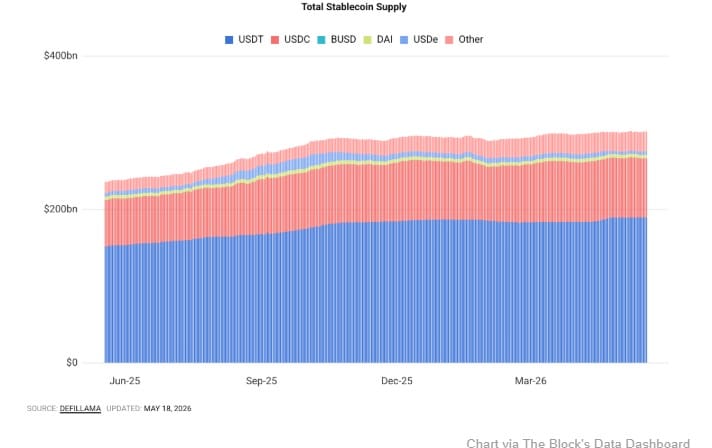
Volgens The Block voegde Tether’s USDT in de afgelopen maand meer dan $5 miljard aan supply toe. Dat is op zichzelf sterk, maar de rest van de markt liet juist krimp zien. USDC, USDe en PYUSD verloren samen ongeveer $4,2 miljard aan supply.
Daardoor kwam de netto groei van de totale stablecoin-markt uit op slechts $0,89 miljard. Dat is ongeveer 0,3% groei in één maand. Voor een markt die boven $300 miljard is uitgekomen, is dat eerder stagnatie dan echte expansie.
De kern is dus niet dat stablecoins massaal nieuw kapitaal aantrekken. De kern is dat kapitaal binnen de sector verschuift. Iedere extra dollar in USDT lijkt voor een belangrijk deel een dollar te vervangen die uit andere stablecoins verdwijnt.
USDe verliest zijn momentum
Vooral USDe van Ethena staat onder druk. De supply daalde met 28% in de afgelopen maand en staat sinds het begin van het jaar bijna 34% lager. Dat raakt niet alleen aan sentiment, maar ook aan de structuur van het product.
USDe is afhankelijk van een rendement dat sterk samenhangt met positieve funding in perpetual futures. Na de deleveraging van 10 oktober 2025 is die funding samengedrukt. Daardoor is het rendement minder aantrekkelijk geworden ten opzichte van alternatieven die anders zijn opgebouwd.
Daar profiteren andere modellen van. Sky’s USDS steeg met 48,9% sinds het begin van het jaar en World Liberty Financial’s USD1 groeide met 33,7%. Dat laat zien dat kapitaal niet volledig uit stablecoins verdwijnt, maar wel kritischer kiest tussen verschillende structuren.
PYUSD blijft achter
Ook PYUSD laat zwakte zien. De supply daalde in de afgelopen maand met 13%. Dat is relevant, omdat PYUSD juist werd neergezet als een stablecoin met sterke institutionele distributie via PayPal.
Tot nu toe levert dat verhaal nog geen duidelijke supply-groei op. Dat maakt duidelijk hoe moeilijk het is om USDT direct aan te vallen. Een sterke merknaam of gereguleerde positionering is niet genoeg als handelsdiepte, rendement en marktgebruik achterblijven.
Wat betekent dit voor de stablecoin-markt?
De markt is boven $300 miljard gekomen, maar de onderliggende groei is beperkt. Dat maakt de huidige mijlpaal minder krachtig dan hij op het eerste gezicht lijkt. Voor crypto als geheel betekent dit dat er nog geen brede liquiditeitsgolf zichtbaar is.
Tether blijft voorlopig de duidelijke winnaar. USDT heeft de distributie, handelsparen en liquiditeit die andere stablecoins nog niet kunnen evenaren. Daardoor blijft USDT de dominante munt voor handel, vooral buiten de meest gereguleerde markten.
Toch ligt daar ook precies de kans voor Circle. Als wetgeving, institutionele adoptie en transparantie zwaarder gaan wegen, kan USDC opnieuw terrein winnen. De stablecoin-markt hoeft daarvoor niet alleen groter te worden. De samenstelling van de markt moet veranderen.
Conclusie
De stablecoin-markt staat op een recordniveau boven $300 miljard, maar de groei is smal. Tether blijft kapitaal aantrekken, terwijl USDC, USDe en PYUSD druk ervaren. Dat wijst niet op een brede liquiditeitsexplosie, maar op een markt die selectiever wordt.
Voor Circle is dat beeld juist interessant. De huidige markt beloont vooral schaal en liquiditeit, maar de volgende fase kan meer draaien om regelgeving, vertrouwen en institutionele bruikbaarheid. Daardoor kan USDC op termijn weer sterker worden, vooral als banken, brokers en gereguleerde platforms meer stablecoin-infrastructuur gaan gebruiken.
Onze visie blijft dat Circle tussendoor fors kan corrigeren, zeker na sterke koersbewegingen en bij druk op crypto of fintech. Toch kan het aandeel in de komende jaren veel hoger staan als de verschuiving richting gereguleerde stablecoins echt doorzet. Dat maakt Circle geen risicoloze positie, maar wel een naam met een groot structureel hefboomeffect op de verdere professionalisering van digitale activa.
🔵 English
Stablecoin market moves above $300 billion, but growth is almost entirely driven by Tether
The Block writes that total stablecoin supply has now moved above the $300 billion mark. On the surface, that looks like a strong milestone, but the underlying picture is much less broad. The market is barely expanding, while Tether’s USDT continues to capture more share.
Investment view
We do not see this as a weak signal for digital assets, but rather as evidence that the stablecoin market is entering a new phase. Total supply is now above $300 billion, yet growth is narrow and almost entirely carried by Tether. That makes the market more concentrated, but also creates room for a future shift toward stablecoins that are better aligned with regulation, transparency and institutional adoption.
■ Circle can benefit if regulated stablecoins become more important.
■ The stock can still correct sharply along the way, but the long-term story remains attractive.
■ If USDC gains market share, Circle could command a much higher valuation in the coming years.
That is why Circle remains interesting for investors. USDC is better aligned with the standards that large financial institutions, regulated platforms and supervisors are likely to demand from stablecoins. In the short term, USDT remains dominant because of liquidity, trading volume and global acceptance, but the next phase of the market may be shaped by different forces. As stablecoins become more deeply integrated into regulated financial infrastructure, compliance can shift from a constraint into a competitive advantage.
This does not mean Circle’s share price has to move higher in a straight line. After a strong rally, a sharp correction is always possible, especially if the broader crypto market or fintech sector comes under pressure. For long-term investors, that does not necessarily weaken the case. If the market shifts toward regulated stablecoins in the coming years, Circle could become one of the structural winners.
What stands out?
According to The Block, Tether’s USDT added more than $5 billion in supply over the past month. That is strong in isolation, but the rest of the market moved in the opposite direction. USDC, USDe and PYUSD together lost roughly $4.2 billion in supply.
As a result, net growth in the total stablecoin market was only $0.89 billion. That equals roughly 0.3% growth in one month. For a market that has moved above $300 billion, this looks more like stagnation than real expansion.
The key point is not that stablecoins are attracting a large wave of fresh capital. The key point is that capital is rotating inside the sector. Every additional dollar in USDT appears to be replacing, at least partly, a dollar leaving other stablecoins.
USDe loses momentum
Ethena’s USDe is under particular pressure. Supply fell 28% over the past month and is down almost 34% year to date. That is not only a sentiment issue, but also a structural issue tied to the product.
USDe depends on yield that is closely linked to positive funding in perpetual futures. After the October 10, 2025 deleveraging event, that funding compressed. As a result, the yield became less competitive versus alternatives built on different structures.
Other models are benefiting from that rotation. Sky’s USDS is up 48.9% year to date, while World Liberty Financial’s USD1 has grown by 33.7%. This shows that capital is not fully leaving stablecoins, but it is becoming more selective.
PYUSD remains weak
PYUSD is also under pressure. Supply declined by 13% over the past month. That matters because PYUSD was positioned as a stablecoin with strong institutional distribution through PayPal.
So far, that thesis has not translated into clear supply growth. It shows how difficult it is to attack USDT directly. A strong brand or regulated positioning is not enough if trading depth, yield and actual market usage lag behind.
What does this mean for the stablecoin market?
The market has crossed $300 billion, but the underlying growth remains limited. That makes the milestone less powerful than it first appears. For crypto overall, it means there is no broad liquidity wave visible yet.
Tether remains the clear winner for now. USDT has the distribution, trading pairs and liquidity that other stablecoins have not yet matched. That keeps USDT dominant in trading, especially outside the most regulated markets.
This is also where the opportunity for Circle sits. If regulation, institutional adoption and transparency become more important, USDC can regain ground. The stablecoin market does not only need to become larger. Its composition needs to change.
Conclusion
The stablecoin market is at a record level above $300 billion, but growth is narrow. Tether continues to attract capital, while USDC, USDe and PYUSD face pressure. This points less to a broad liquidity explosion and more to a market that is becoming increasingly selective.
For Circle, that picture is interesting. Today’s market rewards scale and liquidity, but the next phase may be driven more by regulation, trust and institutional utility. That could allow USDC to regain strength over time, especially if banks, brokers and regulated platforms make greater use of stablecoin infrastructure.
Our view remains that Circle can still correct sharply along the way, especially after strong price moves and during periods of pressure in crypto or fintech. Still, the stock can trade much higher in the coming years if the shift toward regulated stablecoins truly develops. That makes Circle a risky position, but also one with major structural leverage to the continued professionalization of digital assets.
Disclaimer Aan de door ons opgestelde informatie kan op geen enkele wijze rechten worden ontleend. Alle door ons verstrekte informatie en analyses zijn geheel vrijblijvend. Alle consequenties van het op welke wijze dan ook toepassen van de informatie blijven volledig voor uw eigen rekening.
Wij aanvaarden geen aansprakelijkheid voor de mogelijke gevolgen of schade die zouden kunnen voortvloeien uit het gebruik van de door ons gepubliceerde informatie. U bent zelf eindverantwoordelijk voor de beslissingen die u neemt met betrekking tot uw beleggingen.


