🧠 Chips: Koper is bijna voorbij en licht regeert - Van POET tot AAOI tot LWLG
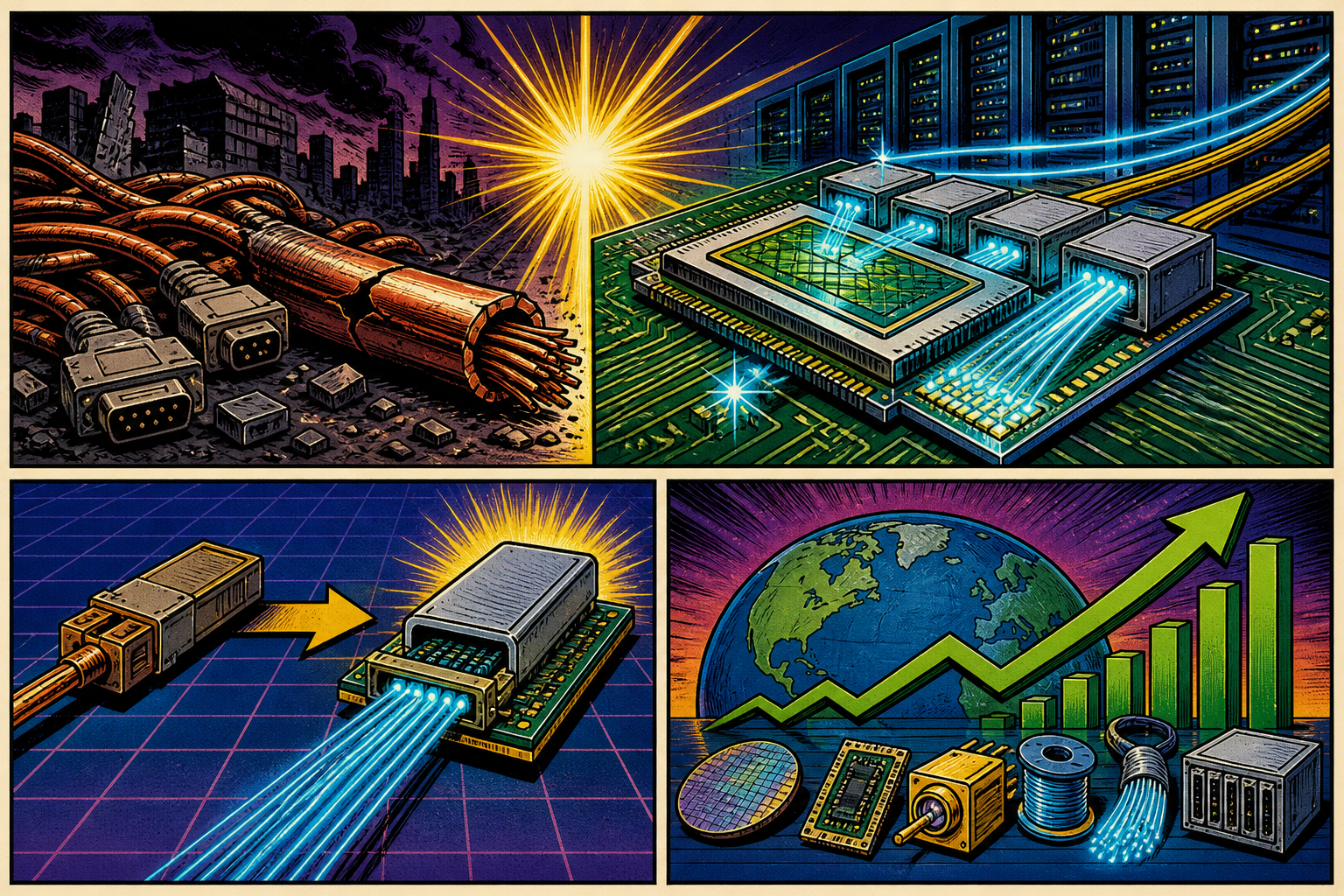
Er is een moment in de geschiedenis van iedere grote technologiecyclus waarop de bestaande infrastructuur simpelweg niet meer meekan. Voor de ene generatie was dat het moment waarop seriële verbindingen het niet meer trokken tegen parallelcommunicatie.
Wil je alle artikelen kunnen lezen en elke podcast beluisteren? Neem dan een abonnement en krijg toegang tot alle artikelen en de database met duizenden berichten.
Voor een andere was het de dag dat draad het verloor van draadloos. We leven nu in zo'n moment. En dit keer gaat het om de kabel die al vijftig jaar het ruggenmerg van de digitale wereld vormt: de koperen verbinding.
🟩 Co-packaged optics is geen hypeverhaal meer, maar een structurele infrastructuurverschuiving binnen AI-datacenters. De schaal waarop hyperscalers GPU-clusters bouwen, maakt koper steeds minder geschikt door energieverbruik, latency en fysieke bandbreedtebeperkingen.
🟩 De kern van CPO is dat optische componenten veel dichter bij de chip komen te liggen. Daardoor wordt data niet langer over grotere afstanden elektrisch verplaatst, maar veel sneller en energiezuiniger via licht verwerkt.
🟩 Voor AI-infrastructuur is dit belangrijk omdat de volgende generatie GPU-clusters veel meer interne verbindingen nodig heeft. Naarmate snelheden richting 800 gigabit, 1,6 terabit en uiteindelijk 3,2 terabit gaan, wordt de waarde van optische verbindingen steeds groter.
🟩 Het veelbesproken Goldman Sachs-getal van 91 miljard dollar moet goed worden begrepen. Het gaat niet om een smalle markt voor losse CPO-componenten, maar om de bredere economische waarde binnen optische interconnects voor AI-datacenters.
🟩 NVIDIA’s NVL576-roadmap is het belangrijkste kantelpunt voor beleggers. Dit platform moet vanaf 2027 de interne GPU-naar-GPU-verbindingen optisch maken, waardoor CPO verschuift van interessant thema naar noodzakelijke infrastructuur.
🟩 De toeleveringsketen wordt nu al gebouwd, terwijl de echte volumefase pas later komt. Dat betekent dat de markt vooruitloopt op orders, design wins, capaciteit en strategische positionering.
🟩 De grote winnaars zitten waarschijnlijk niet alleen bij namen als Broadcom, Marvell, TSMC, Coherent en Lumentum. Juist kleinere spelers met specifieke technologie, materialen, lasers, assemblage of substraten kunnen relatief sterker bewegen door hun lagere marktkapitalisatie.
🟩 POET Technologies is een pure-play naam met veel aandacht, een grote kaspositie en relevante partnerschappen. Toch blijft het risico hoog, omdat de omzet nog zeer beperkt is en commerciële tractie uiteindelijk moet blijken uit echte orders en volumeproductie.
🟩 Lightwave Logic heeft interessante materiaaltechnologie met elektro-optische polymeren, maar blijft voorlopig een pre-revenue verhaal. De aanwezigheid van grote bedrijven in de prototypefase is positief, alleen wordt materiële omzet pas later verwacht.
🟩 Voor beleggers ligt de kans in het herkennen van de infrastructuurverschuiving vóórdat deze volledig in de cijfers zichtbaar wordt. De grootste fout is om alleen de hype te kopen, terwijl de beste kansen waarschijnlijk liggen bij bedrijven die aantoonbaar een knelpunt oplossen in energieverbruik, bandbreedte, lasers, assemblage of optische integratie.
Wil je alle artikelen kunnen lezen en elke podcast beluisteren? Neem dan een abonnement en krijg toegang tot alle artikelen en de database met duizenden berichten.
AI heeft een datacenterhonger die geen enkel materiaal aankan dat elektronen als transportmiddel gebruikt. Niet bij de schalen waarop de grote hyperscalers nu bouwen. Niet bij de energiebudgetten die overheden en investeerders nog acceptabel vinden. En zeker niet bij de bandbreedtes die de volgende generatie GPU-clusters eisen. De oplossing is zo oud als de telecom en toch zo nieuw als de halfgeleiderindustrie hem maar kan maken: licht.
Co-packaged optics — CPO in het vakjargon — is de technologie waarbij optische componenten die data omzetten van elektrisch naar optisch niet meer meters verderop zitten in een losstaande module, maar letterlijk naast of op hetzelfde substraat als de chip worden geplaatst. Millimeters in plaats van centimeters.
De gevolgen zijn niet triviaal: tot 73 procent minder energieverbruik per 800 gigabit bandbreedte, een fractie van de latency, en een bandbreedtedichtheid die met conventionele elektrische verbindingen fysiek onmogelijk is.
Dit is geen toekomstverhaal. CPO is al in productie.
Het Goldman-getal dat niemand goed begrijpt
De claim
Wie de afgelopen maanden ook maar zijdelings in beleggingskringen actief was, heeft het getal voorbij zien komen: Goldman Sachs ziet een CPO-markt van 91 miljard dollar. Het klinkt enorm. Het klinkt ook verdacht, want andere marktonderzoekers schatten de CPO-markt op 1 à 2 miljard dollar in 2035. Hoe rijmen die getallen?
Ze rijmen omdat ze niet over hetzelfde gaan.
Wat Goldman echt zegt
Goldman Sachs-analist Allen Chang publiceerde eerder dit jaar een rapport dat de hele optische interconnect-markt voor AI-datacenters herdefinieerde als een zelfstandige beleggingsthese.
Zijn conclusie: die markt groeit van de huidige circa 15 miljard dollar naar 154 miljard dollar — een vernegendubbeling. Van dat bedrag valt 69 procent, grofweg 106 miljard dollar, in de categorie "scale-up": de hoge-snelheidsverbindingen binnen racks en ultra-nodes, tussen GPU's onderling, niet de verbindingen ertussen.
De 91 miljard dollar voor CPO is Goldmans schatting van wat CPO aan die scale-up markt bijdraagt bij een penetratiegraad van 29 procent. Het is geen losstaande marktschatting voor CPO-componenten.
Het is een deelbedrag binnen een veel breder optisch ecosysteem dat transceivers, CPO-engines, externe laserbronnen, siliciumfotonische chips, optische schakelaars, vezels, connectoren en assemblage omvat.
Waarom zo groot versus andere schattingen?
Omdat firms als IDTechEx de puur fysieke CPO-componentmarkt meten. Goldman meet de economische waarde die optische verbindingstechnologie creëert in de totale AI-datacenterinfrastructuur.
Wil je alle artikelen kunnen lezen en elke podcast beluisteren? Neem dan een abonnement en krijg toegang tot alle artikelen en de database met duizenden berichten.
Dat zijn fundamenteel verschillende vragen. Ter illustratie: één toekomstige NVIDIA-computecluster op NVL576-schaal vereist 324 optische engines, 162 externe laserbronnen en meer dan vijfduizend optische vezels — de materiaalkosten voor scale-up alleen al bedragen per eenheid naar schatting 800 miljoen dollar.
De penetratiegraad van 29 procent is een aanname, geen garantie. Maar de richting van het verhaal wordt door vrijwel alle serieuze analisten gedeeld. Het getal verdient context. De these verdient aandacht.
Wat de NVL576 werkelijk is — en wanneer het er komt
De roadmap in volgorde
Wat nu in productie is bij de grote cloudproviders is de Blackwell Ultra-architectuur in NVL72-configuratie: 72 GPU-dies per rack, tot 120 kilowatt verbruik. Op CES 2026 bevestigde Jensen Huang dat de opvolger — Rubin in NVL144-configuratie — in productie is en in de tweede helft van dit jaar bij de eerste klanten land, waaronder Microsoft, Amazon, Google en Oracle.
De NVL576 is iets anders. Dat is Rubin Ultra, de tweede generatie Rubin, gepland voor de tweede helft van 2027 in wat NVIDIA de "Kyber Rack" noemt. Dit is het platform waarom de CPO-wereld zo opgewonden is.
Waarom de NVL576 alles verandert
Niet alleen de schaal is indrukwekkend — 576 GPU-dies per rack, 15 exaFLOPS aan FP4-inferentievermogen, 600 kilowatt verbruik — maar de architecturale beslissing die daarvoor nodig is.
De GPU-naar-GPU-verbindingen binnen het rack gaan bij Rubin Ultra voor het eerst optisch. Tot nu toe bleef dat domein koper. Met NVL576 verschuift NVIDIA ook de interne verbindingsarchitectuur naar licht.
Dit is precies het inflectiepunt dat Goldman Sachs bedoelt. Van NVL72 naar NVL576 stijgt de optische waarde per rekeneenheid met een factor 29. Niet omdat CPO duurder is per link, maar omdat er exponentieel meer verbindingen nodig zijn en de waarde per link dramatisch hoger is naarmate snelheden van 800 gigabit naar 1,6 en 3,2 terabit gaan.
De eerlijke tijdlijn
De NVL576 bestaat vandaag als aangekondigde roadmap — niet als leverbaar product. Maar de toeleveringsketen voor iets dat in 2027 in productie moet, wordt nú gebouwd. Dat is precies het window waar slimme kapitaal nu naartoe stroomt.
De toeleveringsketen: wie er écht van profiteert
De grote namen — Coherent, Lumentum, Broadcom, Marvell, TSMC — domineren de headlines terecht. Maar de meest interessante beleggingsvraag gaat over de laag eronder: de smallcaps die specifieke onderdelen van de CPO-keten beheersen en buitensporig kunnen profiteren ten opzichte van hun huidige marktkapitalisatie.
POET Technologies: nauwelijks omzet
De meest besproken pure-play CPO-smallcap. POET's Optical Interposer-platform integreert lasers, modulatoren en elektronica op één chipniveau — een andere benadering dan de discretere assemblage die concurrenten hanteren.
De CFO wacht begin mei 2026 nog steeds op nieuwe inkooporders van Foxconn en Luxshare. Kas is de brandstof voor de reis. Het garandeert niet de bestemming.
Lightwave Logic: volumecontracten pas in 2027
LWLG ontwikkelt geen chips — het ontwikkelt materialen. Specifiek elektro-optische polymeren, gebrandmerkt als Perkinamine, die op bestaande siliciumfotonische chips worden aangebracht om modulatoren te maken met een fractie van het energieverbruik van standaardoplossingen.
De commerciële pipeline vult zich snel. Vier Fortune Global 500-bedrijven bevinden zich inmiddels in Stage 3 van de Design Win Cycle — van productontwerp naar een formeel engineeringprogramma, gericht op eindproducten voor hyperscale-datacenters.
De volledige omzet over 2025 bedroeg 237.000 dollar, een stijging van 147 procent ten opzichte van 2024 — maar gemeten van een uiterst lage basis. Volumeproductie en licentie-inkomsten verwacht het management pas in 2027. Vier Fortune Global 500-klanten in de late prototypefase is geen triviale prestatie. Maar pre-revenue blijft pre-revenue.
Applied Optoelectronics: de brug die men vergeet
Beleggers denken dat CPO AAOI overbodig maakt. Dat klopt voor de lange termijn, maar mist de nuance van de overgangsperiode. AAOI produceert zijn lasers volledig in eigen huis, wat een structureel voordeel is nu indiumfosfide laserproductie het bewezen knelpunt is in de keten.
In maart 2026 ontving AAOI zijn eerste volumeorder voor 1,6 terabit transceivers van een grote hyperscaler. De CFO schetste een revenue run-rate van bijna 380 miljoen dollar per maand richting mid-2027. Pluggables leven tot minstens 2028 — en AAOI staat goed gepositioneerd voor die hele tussenperiode.
AXT: het knelpunt dat niemand noemt
AXT produceert compound semiconductor substraten — indiumfosfide, galliumarsenide, germanium — het uitgangsmateriaal voor de lasers in iedere CPO-architectuur. Op 9 maart 2026 steeg AXTI bijna 20 procent mee met de bredere CPO-sectorrally. Niet toevallig: het is de markt die begint te begrijpen waar het echte bottleneck zit.
De rest van de keten
Fabrinet voor precision optical assembly, MACOM voor high-speed analoge halfgeleiders, Credo Technology als brug tussen de pluggable wereld van nu en de CPO-architecturen van straks. Minder speculatief, solider in revenue — maar met bescheidener opwaarts potentieel.
En nLIGHT: de aandelen bewogen mee op CPO-nieuws in maart 2026, maar de fundamentele verbinding met de CPO-supply chain is indirect en onbewezen. Een speculatie op mogelijke heroriëntatie, niet op bestaande positie.
Vier dingen die beleggers fout begrijpen
1. CPO maakt pluggables onmiddellijk overbodig
Onjuist. Pluggables domineren tot minstens 2027-2028 omdat nieuwe switcharchitecturen, cabling en standaarden tijd vergen om zich te verspreiden. De overgang is gradueel, niet abrupt.
2. Een grote kaspositie betekent een sterk bedrijf
POET heeft 430 miljoen dollar cash — en een jaaromzet van minder dan anderhalf miljoen dollar over heel 2025. Kas is de brandstof voor de reis. Het garandeert niet de bestemming.
3. Fortune 500-partnership betekent omzet
LWLG heeft vier Fortune Global 500-bedrijven in de prototypefase. Dat is indrukwekkend. Het levert in 2026 nog geen materiele revenue op. Volumeproductie en licenties verwacht het management zelf pas in 2027.
4. De timing staat vast
CPO-fabricage op TSMC's COUPE-platform is technisch complex. Yields bij volumeproductie zijn nog onzeker. En Broadcom, NVIDIA en TSMC integreren agressief verticaal — ze laten minder ruimte voor smallcaps dan optimisten verwachten. Het verhaal is reëel. De tijdlijn is langer dan de meeste social-mediathreads suggereren.
Slot: het licht staat aan
De overgang van koper naar licht in AI-datacenters is geen beleggingshypothese meer. Het is een engineeringnoodzaak die de grootste chipmaker ter wereld, de dominante netwerkchipmaker en de leidende foundry allemaal tegelijkertijd uitvoeren. Het is een markt die Goldman Sachs kwantificeert op een vernegendubbeling. En het is een toeleveringsketen die op dit moment wordt gebouwd door een handvol bedrijven waarvan de meeste nog niet door de brede markt zijn ontdekt.
De kans is reëel. De risico's zijn reëel. En de beleggers die beide serieus nemen — in plaats van de hype te volgen — staan het beste gepositioneerd voor wat er de komende drie jaar gaat gebeuren.
Wil je alle artikelen kunnen lezen en elke podcast beluisteren? Neem dan een abonnement en krijg toegang tot alle artikelen en de database met duizenden berichten.
English
Copper is hone and light wins
There is a moment in the lifecycle of every great technology cycle when the existing infrastructure simply cannot keep up. For one generation, it was the point at which serial connections could no longer compete with parallel communication.
For another, it was the day wire lost to wireless. We are living inside one of those moments right now. And this time, it is the cable that has formed the backbone of the digital world for fifty years that is losing: the copper interconnect.
🟩 Co-packaged optics is no longer a hype story, but a structural infrastructure shift inside AI datacenters. The scale at which hyperscalers are building GPU clusters makes copper increasingly unsuitable because of energy consumption, latency and physical bandwidth limits.
🟩 CPO moves optical components directly next to the chip, which is the real breakthrough. Data no longer has to travel through longer electrical paths, but can move through light with lower power usage, lower latency and far greater bandwidth density.
🟩 For AI infrastructure, this matters because the next generation of GPU clusters requires far more internal connections. As speeds move from 800 gigabit toward 1.6 terabit and 3.2 terabit, optical connectivity becomes less of an upgrade and more of a necessity.
🟩 The Goldman Sachs figure of 91 billion dollars should be read in the right context. It is not a narrow estimate for standalone CPO parts, but a broader value estimate inside the optical interconnect ecosystem for AI datacenters.
🟩 NVIDIA’s NVL576 roadmap is the key inflection point for investors. If internal GPU-to-GPU connections shift to optics from 2027, CPO moves from an emerging theme to core AI infrastructure.
🟩 The supply chain is being built before the real volume phase starts. That is why investors are already watching design wins, capacity expansion, laser supply, substrate availability and strategic partnerships.
🟩 The biggest winners may not only be the obvious large-cap names such as Broadcom, Marvell, TSMC, Coherent and Lumentum. Smaller companies with a defensible position in optical engines, photonic materials, lasers, assembly or substrates can potentially deliver stronger upside because their current revenue bases and market values are still much smaller.
🟩 POET Technologies is one of the clearest pure-play CPO names, but also one of the more speculative ones. The company has cash, partnerships and technology credibility, yet the investment case still depends on real purchase orders, volume shipments and proof that revenue can scale.
🟩 Lightwave Logic offers a different angle through electro-optic polymer materials, which could become valuable if hyperscale customers adopt lower-power modulation technology. The opportunity is meaningful, but investors must respect that material revenue is still expected later and that prototype progress is not the same as commercial scale.
🟩 The best way to play this theme is to focus on bottlenecks rather than hype. The companies that can solve energy consumption, bandwidth density, laser supply, optical assembly or chip-level integration are the ones most likely to matter when AI infrastructure shifts from copper to light.
AI has a datacenter appetite that no material carrying electrons as its transport medium can satisfy. Not at the scales hyperscalers are now building toward. Not at the energy budgets that governments and investors still consider acceptable. And certainly not at the bandwidths that the next generation of GPU clusters demand. The solution is as old as telecommunications and as new as the semiconductor industry can make it: light.
Co-packaged optics — CPO in industry shorthand — is the technology by which the optical components that convert data from electrical to optical signals are no longer housed in a separate module meters away, but placed literally adjacent to or on the same substrate as the compute chip. Millimeters instead of centimeters. The consequences are not trivial: up to 73 percent lower energy consumption per 800-gigabit bandwidth, a fraction of the latency, and a bandwidth density that is physically impossible to achieve with conventional electrical connections.
This is not a future story. CPO is already in production.
The Goldman number nobody understands correctly
The claim
If you have spent any time in investment circles over the past few months, you have seen the figure: Goldman Sachs sees a CPO market of $91 billion. It sounds enormous. It also sounds suspicious, because other market research firms peg the CPO market at $1 to $2 billion by 2035. How do those numbers square?
They square because they are measuring different things.
What Goldman actually says
Goldman Sachs analyst Allen Chang published a report earlier this year that redefined the entire optical interconnect market for AI datacenters as a standalone investment thesis. His conclusion: that market grows from the current roughly $15 billion to $154 billion — a ninefold expansion. Of that figure, 69 percent, or approximately $106 billion, falls into what analysts call "scale-up": the high-speed optical connections within racks and ultra-nodes, between GPUs, not the connections between racks.
The $91 billion attributed to CPO is Goldman's estimate of what CPO contributes to that scale-up market at a penetration rate assumption of 29 percent. It is not a standalone market estimate for CPO components. It is a sub-figure within a far broader optical ecosystem that encompasses transceivers, CPO engines, external laser sources, silicon photonics chips, optical circuit switches, fibers, connectors, and assembly.
Why the gap with other estimates?
Because firms like IDTechEx measure the pure physical CPO component market. Goldman measures the economic value that optical interconnect technology creates across the total AI datacenter infrastructure. Those are fundamentally different questions.
To make it concrete: one future NVIDIA compute cluster at NVL576 scale requires 324 optical engines, 162 external laser sources, and more than five thousand optical fibers. The material cost for scale-up interconnects alone is estimated at roughly $800 million per unit. The 29 percent penetration assumption is exactly that — an assumption. But the direction of the argument is shared by virtually every serious analyst covering the space. The number deserves context. The thesis deserves attention.
What the NVL576 actually is — and when it arrives
The roadmap in order
What is in production and being deployed at large cloud providers today is the Blackwell Ultra architecture in the NVL72 configuration: 72 GPU dies per rack, up to 120 kilowatts of power consumption. At CES 2026, Jensen Huang confirmed that the successor — Rubin in NVL144 configuration — is in full production and will begin arriving at initial customers in the second half of this year, including Microsoft, Amazon, Google, and Oracle.
The NVL576 is something different. That is Rubin Ultra, the second Rubin generation, planned for the second half of 2027 in what NVIDIA calls the "Kyber Rack." And this is the platform that has the CPO world excited.
Why the NVL576 changes everything
The scale alone is staggering — 576 GPU dies per rack instead of 72, delivering 15 exaFLOPS of FP4 inference performance at a power draw of 600 kilowatts per rack, equivalent to four hundred average homes. But the architectural decision that makes it possible is what matters most for optics investors. The GPU-to-GPU connections within the rack, via NVSwitch, go optical for the first time with Rubin Ultra. Until now, that domain remained copper. With NVL576, NVIDIA moves the internal interconnect architecture to light as well.
This is precisely the inflection point Goldman Sachs is modeling. From NVL72 to NVL576, the optical value per compute unit increases by a factor of 29. Not because CPO is more expensive per link — it is not — but because exponentially more optical connections are required per cluster, and the value per link rises dramatically as speeds move from 800 gigabit to 1.6 and 3.2 terabit.
The honest timeline
The NVL576 exists today as an announced roadmap — not a shipping product. Anyone claiming otherwise is wrong. But the supply chain for something that must enter production in 2027 is being built right now. That is precisely the window smart capital is moving into.
The supply chain: who actually benefits
The large names — Coherent, Lumentum, Broadcom, Marvell, TSMC — dominate the headlines and are rightly the solid core of any serious optical portfolio. But the most interesting investment question concerns the layer beneath: the smallcaps that control specific segments of the CPO chain and that could benefit disproportionately relative to their current market capitalization if the ramp succeeds.
POET Technologies — $430 million in cash, barely any revenue
The most discussed pure-play CPO smallcap. POET's Optical Interposer platform integrates lasers, modulators, and electronics at chip level — a different architectural approach than the more discrete assembly that most competitors pursue. After multiple capital raises, POET now holds a cash position of $430 million.
As of early May 2026, the CFO is still waiting on fresh purchase orders from Foxconn and Luxshare — discussions the company describes as active. Cash is the fuel for the journey. It does not guarantee the destination.
Lightwave Logic — revenue up 147%, but volume contracts not until 2027
LWLG does not make chips. It makes materials. Specifically, electro-optic polymers branded as Perkinamine that are applied to existing silicon photonic chips to create modulators operating at a fraction of the energy consumption of standard solutions.
The commercial pipeline has filled rapidly. Four Fortune Global 500 companies have now entered Stage 3 of the Design Win Cycle, moving from product design into formal engineering programs targeting final products for hyperscale datacenters or AI factories. Full-year 2025 revenue came in at $237,000 — up 147 percent from $96,000 in 2024, but measured from an extremely low base. Management itself has guided that volume production and licensing revenues are not expected until 2027. Four Fortune Global 500 customers in late-stage prototyping is a real achievement. Pre-revenue is still pre-revenue.
Applied Optoelectronics — the bridge everyone forgets
Investors assume CPO will make AAOI obsolete. That is true in the long run, but it misses the nuance of the transition period. AAOI manufactures its lasers entirely in-house — a rarity in the industry — which is a structural advantage now that indium phosphide laser production is the proven bottleneck in the optical supply chain. In March 2026, AAOI received its first volume order for 1.6-terabit transceivers from a major hyperscaler. The CFO has outlined a revenue run-rate approaching $378 million per month from transceivers by mid-2027. Pluggables are not dead — they dominate through at least 2028, and AAOI is well positioned for that entire bridge period.
AXT Inc. — the bottleneck nobody mentions
AXT produces compound semiconductor substrates — indium phosphide, gallium arsenide, germanium — the raw material for the lasers required by every CPO architecture. When the broader CPO sector rallied on March 9, 2026 following NVIDIA's announcement, AXTI rose nearly 20 percent. That is not coincidence. It is the market beginning to understand where the actual chokepoint sits.
The rest of the chain
Fabrinet for precision optical assembly, MACOM for high-speed analog semiconductors, Credo Technology as the bridge between today's pluggable world and tomorrow's CPO architectures. Less speculative, more solid on revenue — but with correspondingly more modest upside. And nLIGHT: shares moved with the CPO news cycle in March 2026, but the fundamental connection to the CPO supply chain remains indirect and unproven. It is a bet on possible reorientation, not on existing position.
Four things investors get wrong
1. CPO immediately obsoletes pluggable transceivers
It does not. Pluggables dominate through at least 2027 to 2028 because new switch architectures, cabling infrastructure, and industry standards require time to propagate. The transition is gradual, not a cliff edge.
2. A large cash position means a strong business
POET holds $430 million in cash against full-year 2025 revenue of less than $1.5 million across all quarters combined. Cash is the fuel for the journey. It does not guarantee the destination.
3. Fortune 500 partnership means revenue
LWLG has four Fortune Global 500 companies in the prototype phase. That is genuinely impressive. It generates no material revenue in 2026. Management's own guidance puts volume production and licensing income in 2027 at the earliest. There is a world of difference between an engineering collaboration and a volume contract.
4. The timeline is settled
CPO fabrication on TSMC's COUPE platform is technically complex. Yields at volume remain uncertain. And Broadcom, NVIDIA, and TSMC are integrating aggressively and vertically — they will leave less room for smallcaps than the optimists expect. The story is real. The timeline is longer than most social media threads suggest.
Conclusion: the light is on
The transition from copper to light in AI datacenters is no longer an investment hypothesis. It is an engineering necessity being executed simultaneously by the world's largest chipmaker, the dominant networking chip company, and the leading foundry. It is a market that Goldman Sachs quantifies as a ninefold expansion. And it is a supply chain being built right now by a handful of companies that the broader market has not yet fully discovered.
The opportunity is real. The risks are real. And the investors who take both seriously — rather than chasing the hype cycle — are best positioned for what the next three years will bring.
Disclaimer Aan de door ons opgestelde informatie kan op geen enkele wijze rechten worden ontleend. Alle door ons verstrekte informatie en analyses zijn geheel vrijblijvend. Alle consequenties van het op welke wijze dan ook toepassen van de informatie blijven volledig voor uw eigen rekening.
Wij aanvaarden geen aansprakelijkheid voor de mogelijke gevolgen of schade die zouden kunnen voortvloeien uit het gebruik van de door ons gepubliceerde informatie. U bent zelf eindverantwoordelijk voor de beslissingen die u neemt met betrekking tot uw beleggingen.


