Besi krijgt opnieuw tik rond HBM, maar structurele hybrid-bondingcase blijft intact

Geen tijd om het volledige artikel te lezen? Gebruik dan de vijf onderstaande bullets voor de belangrijkste punten.
■ TSMC wil voor de HBM-koppeling in CoWoS voorlopig blijven werken met steeds fijnere microbumps in plaats van direct over te stappen op hybrid bonding. Dat is op korte termijn negatief voor de timing van een belangrijke volumemarkt voor Besi.
■ Ook SK hynix lijkt microbump-technologie langer door te trekken, tot HBM4 en HBM4E, terwijl hybrid bonding pas bij HBM5 en stacks boven 20 lagen nadrukkelijker in beeld komt. Daarmee schuift een deel van de verwachte HBM-volumes voor hybrid bonding verder naar achteren.
■ Dit betekent niet dat de hybrid-bondingcase van Besi stuk is. De technologie blijft belangrijk voor logic stacking, photonics en andere advanced-packaging toepassingen, terwijl de fysieke voordelen van hybrid bonding bij steeds hogere dichtheid en meer lagen overeind blijven.
■ Fijnere microbumps zijn bovendien niet uitsluitend negatief voor Besi. De stap richting ongeveer 5 micrometer vraagt om extreem nauwkeurige thermo-compression equipment, een markt waarin Besi met TC Next eveneens actief is.
■ Onze Investment view blijft genuanceerd. Bij een negatieve technische lezing kan het aandeel terug richting ongeveer €165, gemeten aan de relevante VWAP-lijnen. Toch verwachten wij nog steeds een nieuwe rally wanneer het sentiment rond chips verbetert.
Het nieuwste nieuws rond HBM en advanced packaging is op het eerste gezicht negatief voor Besi. TSMC lijkt voorlopig niet van plan om bij de koppeling van HBM aan de interposer in CoWoS versneld over te stappen op hybrid bonding. In plaats daarvan vraagt het zijn leveranciers om microbumps verder te verkleinen richting ongeveer 5 micrometer. Tegelijkertijd heeft SK hynix aangegeven dat het microbump-gebaseerde oplossingen langer wil blijven gebruiken en hybrid bonding pas nadrukkelijker richting HBM5 en hogere stacks ziet verschuiven.
Voor beleggers is vooral de timing belangrijk. De markt heeft de afgelopen jaren steeds meer waarde toegekend aan de verwachting dat hybrid bonding een grote volgende groeimarkt wordt binnen HBM en AI-infrastructuur. Dat scenario verdwijnt niet, maar het lijkt wel verder naar achteren te schuiven. Juist dat verschil tussen uitstel en afstel is essentieel voor de manier waarop wij Besi nu beoordelen.
Wil je alle artikelen kunnen lezen en elke podcast beluisteren? Neem dan een abonnement en krijg toegang tot alle artikelen en de database met duizenden berichten.
Investment view
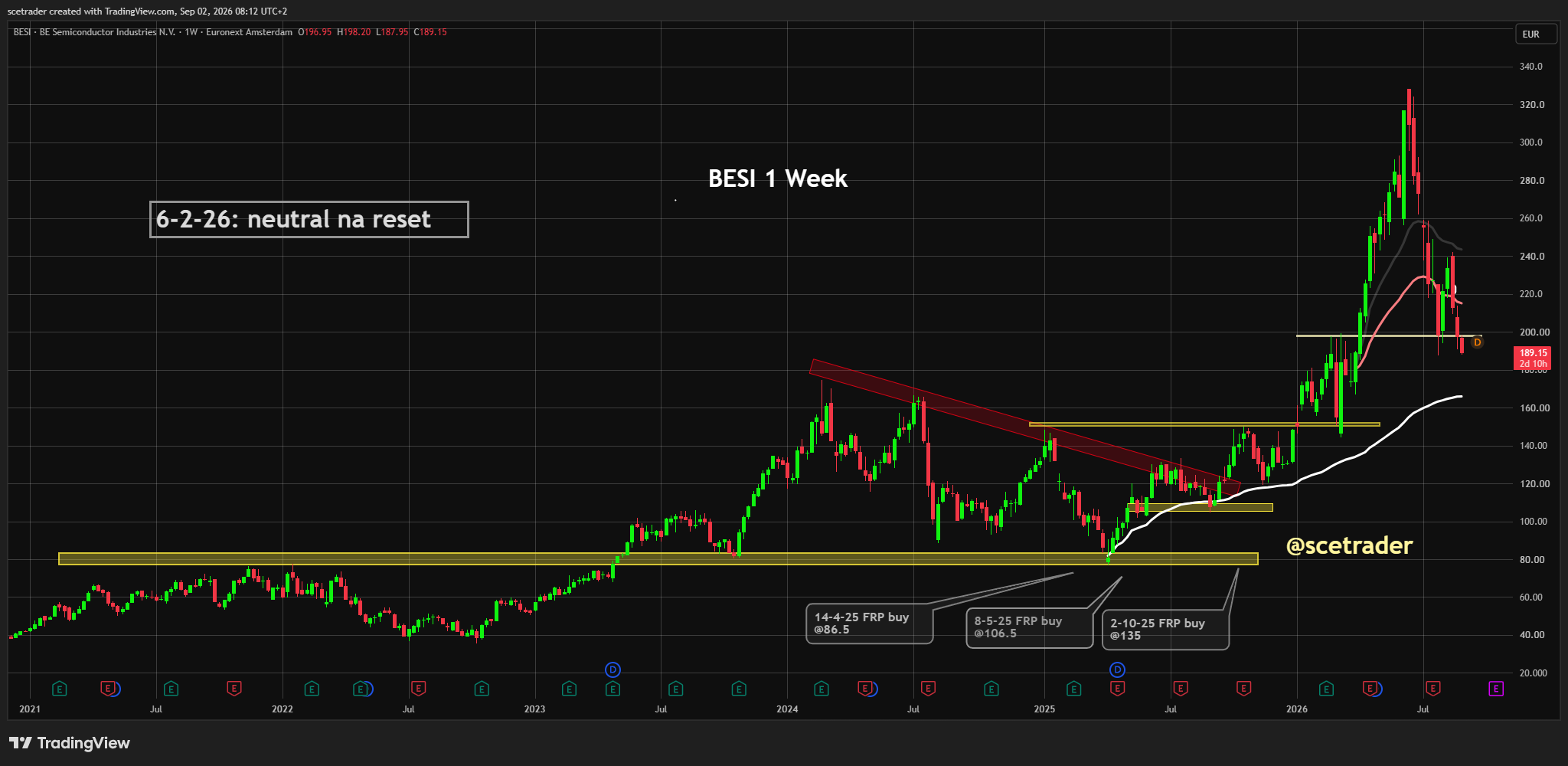
Wij lezen het nieuws als negatief voor de korte termijn, maar niet als een structurele breuk in de case van Besi. De markt had gerekend op een relatief snelle adoptie van hybrid bonding binnen HBM en juist dat pad lijkt nu minder direct te worden. Als HBM4 en HBM4E langer met microbumps kunnen blijven werken, schuift een deel van de verwachte hybrid-bondingomzet verder naar achteren.
Dat is relevant omdat Besi niet wordt gewaardeerd als een traditioneel cyclisch back-end equipmentbedrijf. Een belangrijk deel van de premie in de waardering komt voort uit de verwachting dat advanced packaging en hybrid bonding structureel sneller groeien dan de bredere semiconductor equipmentmarkt. Wanneer een belangrijke toekomstige markt als HBM later materialiseert, kan die premie tijdelijk onder druk komen. Dat betekent niet dat de fundamentele waarde van Besi direct sterk daalt, maar beleggers kunnen wel minder bereid zijn om vandaag al te betalen voor winst die pas later zichtbaar wordt.
Technisch blijft daarom ruimte bestaan voor een verdere terugval. Bij een negatieve lezing van de chart achten wij een beweging richting ongeveer €165 mogelijk, gemeten aan de relevante VWAP-lijnen. Wij zien dat niet als een hard koersdoel, maar wel als een reële technische zone waar opnieuw steun kan ontstaan wanneer de verkoopdruk doorzet. Het belangrijkste wordt dan hoe de koers rond die VWAP-zones reageert. Stabilisatie en het terugwinnen van belangrijke technische niveaus zouden belangrijker zijn dan het exacte getal.
Tegelijkertijd verwachten wij nog steeds een nieuwe rally wanneer het algemene sentiment in de chipsector verbetert. De structurele vraag naar AI-compute, HBM, chiplets en advanced packaging blijft groot en Besi blijft sterk gepositioneerd in het deel van de keten waar steeds hogere precisie nodig is. Wij zien de huidige zwakte daarom vooral als een combinatie van timingrisico, hoge verwachtingen en zwakker sentiment, niet als het einde van de groeicase. Voor een nieuwe rally willen wij wel eerst zien dat de koers stabiliseert en belangrijke niveaus weet terug te winnen.
Waarom dit nieuws voor Besi negatief wordt gelezen
Besi is een van de belangrijkste leveranciers van apparatuur voor geavanceerde chipassemblage. Het bedrijf verkoopt onder meer die attach, thermo-compression bonding en hybrid-bondingapparatuur. Vooral hybrid bonding is strategisch belangrijk, omdat deze technologie steeds relevanter wordt naarmate chips dichter op elkaar moeten worden geplaatst en het aantal elektrische verbindingen verder stijgt.
Een belangrijk onderdeel van de beurscase was de verwachting dat HBM een volgende grote volumemarkt voor hybrid bonding zou worden. AI-accelerators hebben steeds meer geheugenbandbreedte nodig en HBM-stacks worden hoger, complexer en dichter bedraad. Vanuit technisch oogpunt lijkt een overgang naar direct copper-to-copper bonding daarom logisch.
Het probleem is dat technisch logisch niet hetzelfde is als snel in massaproductie. TSMC en SK hynix laten nu zien dat de bestaande microbump-technologie langer kan worden doorontwikkeld dan sommige beleggers hadden verwacht. Voor Besi verdwijnt daarmee niet de uiteindelijke kans, maar wel een deel van de snelheid waarmee de markt die kans in de cijfers wilde zien.
TSMC houdt voorlopig vast aan microbumps
Om de betekenis van het nieuws goed te begrijpen, moeten twee verschillende delen van de HBM-keten uit elkaar worden gehouden. Geheugenmakers zoals SK hynix, Samsung en Micron stapelen zelf de afzonderlijke DRAM-dies tot een HBM-kubus. TSMC neemt die afgewerkte HBM-kubus vervolgens mee in zijn CoWoS-proces en plaatst deze samen met de GPU of accelerator op een silicon interposer.
Het recente signaal van TSMC gaat vooral over dat tweede deel. Voor de koppeling van HBM en accelerator aan de interposer wil TSMC voorlopig microbumps blijven gebruiken en die verder verkleinen richting ongeveer 5 micrometer.
Dat is technisch geen kleine stap. Hoe kleiner de bump, hoe meer verbindingen op dezelfde oppervlakte kunnen worden geplaatst en hoe lager de totale packagehoogte kan blijven. Tegelijkertijd wordt het productieproces steeds moeilijker. Uitlijning wordt kritischer, underfill moet zonder luchtbellen worden aangebracht en kleine afwijkingen kunnen direct leiden tot yieldverlies.
Dat TSMC deze route nog verder wil optimaliseren, laat zien dat de bestaande technologie nog voldoende speelruimte heeft om langer mee te gaan. Voor Besi betekent dit dat hybrid bonding op deze interface later noodzakelijk kan worden dan eerder door de markt werd gehoopt.
SK hynix schuift hybrid bonding verder naar achteren
Hetzelfde beeld ontstaat binnen de HBM-stack zelf. SK hynix heeft aangegeven dat het zijn huidige MR-MUF-proces met microbumps wil blijven gebruiken voor HBM4 en HBM4E. Hybrid bonding wordt nadrukkelijker gekoppeld aan HBM5 en aan stacks met meer dan 20 lagen.
Dat is een belangrijk signaal omdat SK hynix een leidende positie heeft in HBM voor AI-toepassingen. Wanneer juist deze producent zijn bestaande proces langer wil gebruiken, verschuift het moment waarop hybrid bonding echt op grote schaal nodig wordt.
Een deel van de verklaring ligt bij de hogere toegestane stackhoogte. Daardoor hebben geheugenmakers meer ruimte gekregen om bestaande microbump-processen verder te verfijnen zonder direct naar een volledig nieuwe bondingmethode te hoeven overstappen.
Voor Besi betekent dit vooral dat het eerste grote HBM-volumemoment voor hybrid bonding later kan komen. De technologische noodzaak verdwijnt niet, maar de industrie heeft zichzelf opnieuw meer tijd gekocht.
Microbumps en hybrid bonding: het technische verschil
Microbumps zijn zeer kleine metalen verbindingen tussen chips of dies. Ze bestaan doorgaans uit koper met een soldeerlaag en creëren zowel het elektrische contact als een kleine fysieke ruimte tussen de componenten. Die ruimte wordt vervolgens gevuld met underfill om de constructie mechanisch te versterken en thermische spanningen op te vangen.
Deze aanpak is volwassen en in hoge volumes bewezen. Fabrikanten weten hoe het proces zich gedraagt, hoe yields kunnen worden beheerst en hoe fouten kunnen worden opgespoord. Dat is een belangrijke reden waarom bestaande microbump-processen niet zomaar worden vervangen.
De keerzijde is dat iedere bump hoogte en ruimte inneemt. Naarmate HBM-stacks hoger worden en de I/O-dichtheid verder stijgt, wordt dat steeds problematischer. Daarnaast voegen soldeer en underfill extra elektrische en thermische weerstand toe.
Hybrid bonding verwijdert de bump volledig. De koperpads van twee oppervlakken worden extreem vlak gemaakt, gereinigd, nauwkeurig uitgelijnd en direct met elkaar verbonden. Daardoor kan de pitch veel kleiner worden en neemt de totale hoogte van de verbinding sterk af.
Technisch biedt dat grote voordelen. Er passen meer verbindingen op dezelfde oppervlakte, de elektrische eigenschappen verbeteren en warmte kan efficiënter worden afgevoerd. Daar staat tegenover dat oppervlakken extreem schoon en vlak moeten zijn en dat een fout in de bonding direct een duur onderdeel kan beschadigen. Juist die yield-risico's maken fabrikanten terughoudend om sneller over te stappen dan noodzakelijk.
Wat TCB precies doet en waarom Besi daar ook actief is
Thermo-compression bonding, of TCB, is een techniek waarbij twee componenten onder zeer nauwkeurig gecontroleerde druk en temperatuur met elkaar worden verbonden. Naarmate microbumps kleiner worden, wordt TCB belangrijker omdat de marges voor foutieve uitlijning steeds kleiner worden.
Besi is niet alleen actief in hybrid bonding. Het bedrijf heeft met TC Next ook hoogwaardige thermo-compression equipment. Dat maakt het recente nieuws minder zwart-wit dan het op het eerste gezicht lijkt.
Wanneer de industrie microbumps langer blijft gebruiken maar deze wel verder verkleint, stijgen de eisen aan precisie, temperatuurcontrole en processtabiliteit. Dat kan juist vraag creëren naar geavanceerdere TCB-systemen.
Voor Besi kan de omzetmix daardoor anders uitvallen dan eerder werd gedacht. Minder snelle hybrid-bondingadoptie betekent niet dat alle advanced-packagingvraag verdwijnt. Een deel kan verschuiven naar andere apparatuurcategorieën waarin het bedrijf eveneens actief is.
Waarom 5 micrometer microbumps technisch belangrijk zijn
De stap richting ongeveer 5 micrometer is veel meer dan een kleine verbetering van een bestaande technologie. HBM3E werkt nog met grotere microbumps, HBM4 beweegt richting ongeveer 10 micrometer en TSMC vraagt nu om verdere ontwikkeling naar een nog fijnere generatie.
Dat is nodig omdat HBM-stacks steeds meer lagen bevatten terwijl de totale hoogte begrensd blijft. Iedere extra laag vraagt daarom om dunnere dies, kleinere tussenruimtes en compactere verbindingen.
Tegelijkertijd groeit het aantal I/O-connecties tussen geheugen en accelerator. Meer verbindingen binnen dezelfde oppervlakte betekent dat de pitch verder omlaag moet.
De moeilijkheid verschuift daardoor steeds meer naar procescontrole. Underfill moet zonder voids tussen extreem kleine ruimtes terechtkomen, fluxresten moeten onder controle blijven en alignment moet op micrometerniveau reproduceerbaar zijn.
Voor apparatuurleveranciers betekent dat hogere technische eisen. De industrie kiest dus niet voor stilstand, maar voor een verdere verfijning van de bestaande productiemethode.
De echte teleurstelling zit in de timing van HBM
Voor beleggers zit de kern daarom niet in de vraag of hybrid bonding uiteindelijk belangrijk wordt. De teleurstelling zit vooral in het moment waarop HBM daadwerkelijk grote volumes voor deze technologie gaat opleveren.
Wanneer de markt rekening hield met een eerste bredere adoptie rond HBM4E en die overgang nu meer richting HBM5 schuift, kan een deel van de verwachte omzet één of twee jaar later zichtbaar worden. Dat raakt vooral verwachtingen voor de tussenliggende jaren.
Dat effect kan relatief groot zijn voor een aandeel waarvan de waardering mede gebaseerd is op toekomstige groei. De technologie kan volledig succesvol zijn en toch kan de koers tijdelijk onder druk staan wanneer beleggers langer op de winst moeten wachten.
Dat is precies hoe wij het huidige nieuws lezen.
Wat dit niet betekent voor de lange termijn case
De fundamentele redenen waarom hybrid bonding uiteindelijk aantrekkelijk wordt, zijn niet veranderd. HBM-stacks worden hoger, het aantal I/O-verbindingen neemt toe en de eisen aan warmteafvoer en elektrische prestaties worden steeds zwaarder.
Microbumps kunnen nog verder worden verkleind, maar die route kent grenzen. Naarmate de pitch afneemt en de stacks hoger worden, worden yield, underfill en thermische problemen steeds moeilijker te beheersen.
Op een bepaald punt wordt direct copper-to-copper bonding technisch en economisch aantrekkelijker dan het verder verfijnen van een steeds complexer microbump-proces.
De markt lijkt dat punt nu verder in de toekomst te moeten plaatsen, maar de onderliggende fysica is niet veranderd. Het nieuws is daarom vooral vertragingsnieuws en geen bewijs dat hybrid bonding binnen HBM niet nodig zal zijn.
Logica en photonics blijven belangrijke groeigebieden
Besi is bovendien geen onderneming waarvan de volledige hybrid-bondingcase afhankelijk is van HBM. De technologie wordt ook gebruikt of ontwikkeld voor logic stacking, chiplets, photonics en co-packaged optics.
TSMC gebruikt hybrid bonding al binnen zijn SoIC-platform voor logica-op-logica toepassingen. Naarmate processors steeds vaker uit meerdere gespecialiseerde chiplets bestaan, wordt de kwaliteit van de verbinding tussen afzonderlijke dies steeds belangrijker.
Ook photonics kan een grotere markt worden. Datacenters hebben steeds meer bandbreedte nodig en optische verbindingen bewegen dichter richting de compute. Dat vraagt eveneens om extreem nauwkeurige assemblage.
De groeikansen van Besi blijven daardoor breder dan alleen de timing van HBM.
Waarom fijnere microbumps Besi niet alleen maar schaden
De keuze om microbumps langer te gebruiken betekent niet dat de industrie technologisch stilstaat. Integendeel, de stap richting 5 micrometer maakt de bestaande technologie veel complexer.
Hoe kleiner de bump, hoe hoger de eisen aan plaatsingsnauwkeurigheid en procescontrole. Daar ligt juist een belangrijke expertise van Besi.
Dat betekent niet dat TCB dezelfde economische upside heeft als een snelle massale overstap naar hybrid bonding. Het betekent wel dat het recente nieuws niet uitsluitend omzet uit de markt wegneemt. Een deel van de vraag kan verschuiven naar andere high-end packaging equipment.
Voor de belegger is daarom vooral de productmix van belang. Hybrid bonding kan later komen, terwijl andere onderdelen van het portfolio in de tussenperiode profiteren van de verdere verfijning van microbump-technologie.
Wat we nu willen zien
De komende periode letten wij in de eerste plaats op de koers. Wij willen zien of Besi rond de belangrijke VWAP-zones stabiliseert en of de reeks van lagere toppen en lagere bodems begint te verzwakken. Een beweging richting €165 is mogelijk, maar interessanter is wat het aandeel vervolgens rond die zone doet.
Daarnaast blijft het brede chipsentiment bepalend. Besi is gevoelig voor risicobereidheid binnen semiconductors en kan daardoor hard herstellen zodra de sector opnieuw momentum krijgt.
Fundamenteel willen we meer duidelijkheid over de timing van HBM5, nieuwe hybrid-bondingkwalificaties en de orderontwikkeling rond zowel hybrid bonding als TCB. Nieuwe concrete orders kunnen de markt snel opnieuw laten vooruitkijken.
Belangrijkste risico's
■ Hybrid bonding binnen HBM kan één tot twee jaar later op grote schaal komen dan eerder door sommige beleggers werd verwacht.
■ Geheugenmakers kunnen bestaande microbump-processen langer blijven gebruiken en meerdere leveranciers inzetten voor TCB en andere packaging equipment.
■ De hoge verwachtingen rond advanced packaging maken Besi gevoelig voor verschuivingen in de timing van toekomstige omzet.
■ Een zwak chipsentiment kan de koers verder richting de relevante VWAP-zones drukken.
■ Concurrenten kunnen profiteren wanneer bestaande microbump-technologie langer dominant blijft.
■ Een uiteindelijke overstap naar hybrid bonding vereist hoge yields en betrouwbare massaproductie voordat klanten echt op grote schaal kunnen opschalen.
Conclusie
Het nieuwe HBM-nieuws is negatief voor de timing van Besi's hybrid-bondinggroei, maar niet voor de structurele richting van de technologie. TSMC en SK hynix laten vooral zien dat microbumps langer meegaan dan de markt had gehoopt.
Bij aanhoudende zwakte blijft technisch een terugval richting ongeveer €165 mogelijk. Toch verwachten wij nog steeds een nieuwe rally wanneer het sentiment in chips verbetert. De komende fase draait daarom minder om de vraag óf hybrid bonding belangrijk wordt en vooral om wanneer de grote HBM-volumes daadwerkelijk beginnen.
🔵 English version
Besi takes another hit from HBM, but the structural hybrid-bonding case remains intact
No time to read the full article? Use the five bullets below for the key points.
■ TSMC intends to continue using increasingly fine microbumps for the HBM connection within CoWoS rather than moving immediately to hybrid bonding. This is negative in the short term for the timing of an important future volume market for Besi.
■ SK hynix also appears prepared to extend microbump technology through HBM4 and HBM4E, while hybrid bonding shifts more clearly toward HBM5 and stacks above 20 layers. This pushes part of the expected HBM hybrid-bonding volume further into the future.
■ This does not mean Besi's hybrid-bonding case is broken. The technology remains important for logic stacking, photonics and other advanced-packaging applications, while its physical advantages remain intact as density and stack height increase.
■ Finer microbumps are not purely negative for Besi either. Moving toward roughly 5-micrometer bumps requires extremely accurate thermo-compression equipment, a market in which Besi is also active through TC Next.
■ Our Investment view therefore remains nuanced. Under a negative technical interpretation, the shares could move back toward approximately €165 based on the relevant VWAP lines. Even so, we still expect another rally if semiconductor sentiment improves.
The latest developments around HBM and advanced packaging initially look negative for Besi. TSMC does not appear ready to accelerate the transition from microbumps to hybrid bonding for attaching HBM to the interposer within CoWoS. Instead, it has asked suppliers to develop microbumps down toward roughly 5 micrometers. At the same time, SK hynix has indicated that it intends to extend microbump-based solutions further and position hybrid bonding more clearly around HBM5 and taller stacks.
For investors, timing is the most important issue. Over recent years, the market has increasingly valued Besi on the assumption that hybrid bonding will become a major next growth market within HBM and AI infrastructure. That scenario has not disappeared, but it appears to be moving further out. The distinction between delay and cancellation is therefore essential to our current view of Besi.
Investment view
We read the news as negative for the short term, but not as a structural break in Besi's investment case. The market had expected relatively rapid adoption of hybrid bonding within HBM and that path now appears less direct. If HBM4 and HBM4E can continue using microbumps for longer, part of the expected hybrid-bonding revenue moves further into the future.
This matters because Besi is not valued like a traditional cyclical back-end equipment company. A meaningful part of the premium reflects expectations that advanced packaging and hybrid bonding will structurally outgrow the broader semiconductor equipment market. If a major future market such as HBM materializes later, that premium can temporarily come under pressure. This does not mean Besi's fundamental value suddenly collapses, but investors may become less willing to pay today for earnings that arrive later.
From a technical perspective, there is therefore room for further downside. Under a negative reading of the chart, we believe a move toward approximately €165 remains possible based on the relevant VWAP lines. We do not view this as a fixed price target, but as a realistic technical zone where support could reappear if selling pressure continues. The key issue will be how the shares respond around those VWAP levels. Stabilization and a recovery through important technical levels would matter more than the exact number.
At the same time, we still expect another rally if broader semiconductor sentiment improves. Structural demand for AI compute, HBM, chiplets and advanced packaging remains strong, and Besi is well positioned in the part of the supply chain where ever greater precision is required. We therefore view the current weakness mainly as a combination of timing risk, high expectations and weaker sentiment rather than the end of the growth case. For a new rally, however, we first want to see the shares stabilize and reclaim key levels.
Why this news is being read negatively for Besi
Besi is one of the leading suppliers of equipment for advanced semiconductor assembly. The company sells die attach, thermo-compression bonding and hybrid-bonding systems. Hybrid bonding is especially important because the technology becomes increasingly relevant as chips need to be positioned closer together and require more electrical connections.
A major part of the investment case has been the expectation that HBM would become the next important volume market for hybrid bonding. AI accelerators need greater memory bandwidth, while HBM stacks are becoming taller, more complex and more densely connected. From a technical perspective, direct copper-to-copper bonding therefore looks like a logical destination.
The problem is that technically logical does not mean immediate in high-volume manufacturing. TSMC and SK hynix are now showing that existing microbump technology can be extended further than some investors had assumed. For Besi, the eventual opportunity remains, but part of the speed at which investors expected to see that opportunity in the financial numbers has disappeared.
TSMC is sticking with microbumps for now
To understand the significance of the news, it is important to separate two different parts of the HBM supply chain. Memory makers such as SK hynix, Samsung and Micron stack the individual DRAM dies into an HBM cube themselves. TSMC then takes that finished HBM cube and places it alongside the GPU or accelerator on a silicon interposer through its CoWoS process.
The recent TSMC signal mainly concerns this second stage. For connecting HBM and the accelerator to the interposer, TSMC intends to continue using microbumps and shrink them toward roughly 5 micrometers.
That is technically meaningful. Smaller bumps allow more connections within the same area and help reduce total package height. At the same time, the manufacturing process becomes increasingly difficult. Alignment becomes more critical, underfill must be applied without voids and small deviations can immediately reduce yield.
TSMC's decision to keep optimizing this route suggests that existing technology still has enough headroom to remain competitive for longer. For Besi, that means hybrid bonding on this interface may become necessary later than the market had hoped.
SK hynix is also pushing hybrid bonding further out
The same picture is emerging inside the HBM stack itself. SK hynix has indicated that it intends to continue using its current MR-MUF process with microbumps for HBM4 and HBM4E. Hybrid bonding is positioned more clearly around HBM5 and stacks above 20 layers.
This is an important signal because SK hynix has a leading position in HBM for AI applications. If this producer continues to extend its existing process, the point at which hybrid bonding becomes necessary at scale moves further into the future.
Part of the explanation lies in the higher allowable stack height. This gives memory producers additional room to refine existing microbump processes without immediately moving to an entirely new bonding method.
For Besi, the main implication is that the first major HBM volume opportunity for hybrid bonding could arrive later. The technological need does not disappear, but the industry has again bought itself more time.
Microbumps versus hybrid bonding
Microbumps are extremely small metal connections between chips or dies. They typically use copper with a solder layer and provide both the electrical connection and a small physical gap between components. That gap is then filled with underfill to strengthen the structure mechanically and absorb thermal stress.
This approach is mature and proven in high-volume manufacturing. Manufacturers understand the process, know how yields behave and have established inspection methods. That is a major reason why existing microbump technology is not replaced lightly.
The disadvantage is that every bump consumes height and space. As HBM stacks become taller and I/O density increases, this becomes more problematic. Solder and underfill also introduce additional electrical and thermal resistance.
Hybrid bonding removes the bump entirely. Copper pads on two surfaces are made extremely flat, cleaned, aligned with high precision and then directly bonded. This allows a much smaller pitch and sharply reduces connection height.
Technically, the advantages are significant. More connections can fit within the same area, electrical performance improves and heat can be transferred more efficiently. The trade-off is that surfaces must be exceptionally clean and flat, while a bonding defect can immediately damage an expensive component. These yield risks are precisely why manufacturers are reluctant to switch faster than necessary.
What TCB does and why Besi is also active there
Thermo-compression bonding, or TCB, is a process in which two components are joined under tightly controlled pressure and temperature. As microbumps become smaller, TCB becomes increasingly important because the tolerance for placement errors becomes narrower.
Besi is not only active in hybrid bonding. Through TC Next, the company also supplies high-end thermo-compression equipment. This makes the recent news less black-and-white than it initially appears.
If the industry extends the use of microbumps while continuing to shrink them, requirements for precision, temperature control and process stability increase. That can create additional demand for advanced TCB equipment.
The revenue mix for Besi may therefore develop differently from earlier expectations. Slower hybrid-bonding adoption does not mean all advanced-packaging demand disappears. Part of that demand can move toward other equipment categories in which Besi also participates.
Why 5-micrometer microbumps matter
Moving toward approximately 5 micrometers is far more than a small improvement to an existing technology. HBM3E still uses larger microbumps, HBM4 is moving toward roughly 10 micrometers and TSMC is now asking suppliers to develop an even finer generation.
This is necessary because HBM stacks contain more layers while total height remains constrained. Every additional layer therefore requires thinner dies, smaller gaps and more compact connections.
At the same time, the number of I/O connections between memory and accelerator continues to rise. More connections within the same area require pitch to shrink further.
The difficulty therefore increasingly shifts toward process control. Underfill must reach extremely small spaces without voids, flux residue must be tightly controlled and alignment must be reproducible at micrometer scale.
For equipment suppliers, this means higher technical requirements. The industry is therefore not standing still but continuing to push existing technology to much more demanding limits.
The real disappointment is HBM timing
For investors, the key question is not whether hybrid bonding ultimately becomes important. The disappointment is mainly about when HBM will actually generate major volume for the technology.
If the market had expected broader adoption around HBM4E and that transition now shifts more toward HBM5, part of the expected revenue may appear one or two years later. This mainly affects assumptions for the intervening years.
That effect can be meaningful for a stock whose valuation partly reflects future growth. The technology can ultimately be successful while the shares still come under temporary pressure because investors have to wait longer for the earnings.
That is how we read the current news.
What this does not mean for the long-term case
The fundamental reasons why hybrid bonding eventually becomes attractive have not changed. HBM stacks are getting taller, the number of I/O connections is increasing and thermal and electrical requirements are becoming more demanding.
Microbumps can be refined further, but that route has limits. As pitch shrinks and stacks become taller, yield, underfill and thermal challenges become increasingly difficult to manage.
At some point, direct copper-to-copper bonding becomes technically and economically more attractive than continuing to optimize an increasingly complex microbump process.
The market may now need to place that point further into the future, but the underlying physics has not changed. The latest news is therefore primarily about delay, not evidence that hybrid bonding will not be needed in HBM.
Logic and photonics remain important growth areas
Besi's entire hybrid-bonding case is not dependent on HBM. The technology is also being used or developed for logic stacking, chiplets, photonics and co-packaged optics.
TSMC already uses hybrid bonding within its SoIC platform for logic-on-logic applications. As processors increasingly consist of multiple specialized chiplets, the quality of the connection between individual dies becomes more important.
Photonics could also become a larger market. Data centers need more bandwidth and optical connections are moving closer to compute. That also requires extremely precise assembly.
Besi's structural growth opportunities therefore extend beyond HBM timing alone.
Why finer microbumps are not only negative for Besi
The decision to continue using microbumps does not mean the industry is standing still. On the contrary, moving toward 5 micrometers makes existing technology considerably more complex.
The smaller the bump, the greater the requirements for placement accuracy and process control. These are precisely areas where Besi has expertise.
This does not mean TCB offers the same economic upside as a rapid mass transition to hybrid bonding. It does mean that the latest news does not simply remove equipment demand from the market. Some of the demand may shift toward other high-end packaging systems.
For investors, product mix therefore matters. Hybrid bonding may come later while other parts of Besi's portfolio benefit from further refinement of microbump technology.
What we want to see next
Over the coming period, our first focus is the share price. We want to see whether Besi stabilizes around the important VWAP zones and whether the sequence of lower highs and lower lows begins to weaken. A move toward €165 is possible, but the more important question is how the shares behave around that area.
Broader semiconductor sentiment also remains crucial. Besi is sensitive to risk appetite within the sector and can recover quickly when momentum returns to chip stocks.
Fundamentally, we want greater clarity on HBM5 timing, new hybrid-bonding qualifications and order development across both hybrid bonding and TCB. New concrete orders could quickly encourage the market to look forward again.
Key risks
■ Large-scale hybrid-bonding adoption in HBM may arrive one to two years later than some investors previously expected.
■ Memory manufacturers may continue using existing microbump processes for longer and use multiple suppliers for TCB and other packaging equipment.
■ High expectations around advanced packaging make Besi sensitive to changes in the timing of future revenue.
■ Weak semiconductor sentiment could push the shares further toward the relevant VWAP zones.
■ Competitors may benefit if existing microbump technology remains dominant for longer.
■ A future transition toward hybrid bonding still requires strong yields and reliable mass production before customers can scale rapidly.
Conclusion
The latest HBM news is negative for the timing of Besi's hybrid-bonding growth, but not for the structural direction of the technology. TSMC and SK hynix are mainly showing that microbumps can remain viable for longer than investors had hoped.
If weakness continues, a technical move toward approximately €165 remains possible. Even so, we still expect another rally if semiconductor sentiment improves. The next phase is therefore less about whether hybrid bonding becomes important and more about when the major HBM volumes actually begin.
Disclaimer Aan de door ons opgestelde informatie kan op geen enkele wijze rechten worden ontleend. Alle door ons verstrekte informatie en analyses zijn geheel vrijblijvend. Alle consequenties van het op welke wijze dan ook toepassen van de informatie blijven volledig voor uw eigen rekening.
Wij aanvaarden geen aansprakelijkheid voor de mogelijke gevolgen of schade die zouden kunnen voortvloeien uit het gebruik van de door ons gepubliceerde informatie. U bent zelf eindverantwoordelijk voor de beslissingen die u neemt met betrekking tot uw beleggingen.


