☕️ Morning Call en📞 Podcast maandag 22 november - Kans op zwakke rebound

Meer op onze website, waar we vandaag weer aan verschillende zaken aandacht besteden. Let op, dit bericht kan overlappen met een aantal berichten die wij ook op de website publiceren.
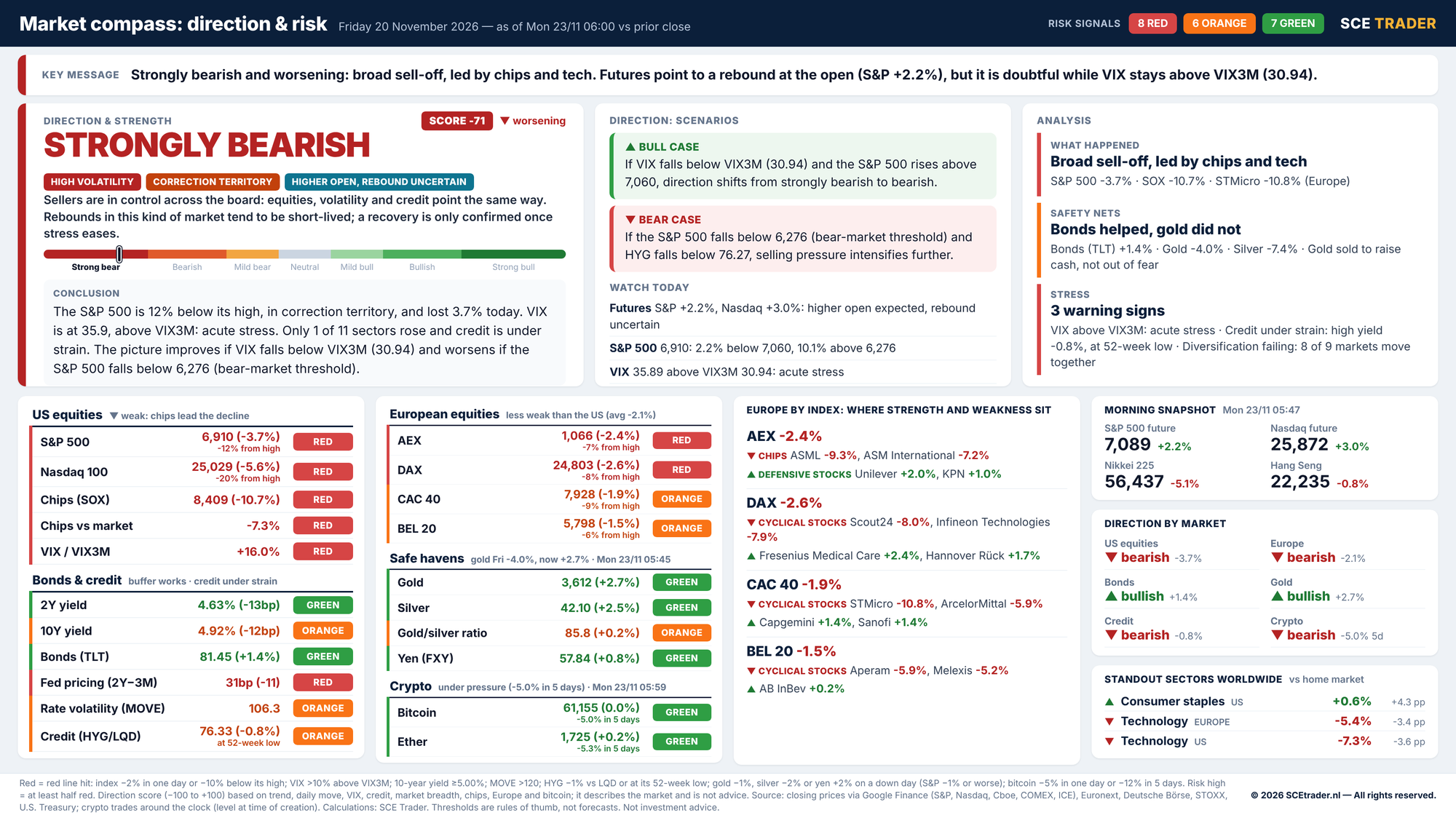
■ Openingsprognose: Europa krijgt maandag ruimte voor een herstelpoging, maar de bevestiging ontbreekt nog. S&P 500-futures staan circa 2,3% hoger en Nasdaq 100-futures ongeveer 3,2% in de plus, terwijl Euro Stoxx-futures slechts ongeveer 0,35% hoger staan. Azië reageert veel minder overtuigend. Wij behandelen de Amerikaanse futures voorlopig als een technische tegenreactie en nog niet als bevestiging dat de bodem is gezet.
 Hoofdredactie

■ Investment View: Tactisch blijven wij bearish op chips en houden wij vast aan sell-on-rally. De drie belangrijkste risico’s zijn nieuwe verkoop tijdens herstel, verslechterende financieringsvoorwaarden voor AI-infrastructuur en toenemende onzekerheid over orders, regelgeving en China. Lange termijn blijven wij juist duidelijk positief op de chipcyclus. HBM, server-DRAM, compute en verschillende delen van de serverketen blijven structureel sterk en uiteindelijk verwachten wij dat de sterkste chipbedrijven opnieuw richting recordniveaus kunnen bewegen.
■ Marktbeeld: Vrijdag was geen normale winstneming. De SOX verloor ongeveer 11%, de Nasdaq 5,3% en de S&P 500 3,7%, terwijl SMH eveneens ruim 10% daalde. De Nasdaq verloor over de week circa 10%, de zwaarste week sinds 2020, en gaf daarmee zijn winst over 2026 prijs. De markt heeft de AI-handel serieus teruggeschroefd.
■ Futures: De Amerikaanse futures veren hard terug, maar de omvang van de rally moet in perspectief worden geplaatst. Na zulke zware verliezen zijn forse technische rallies normaal. De belangrijkste vraag is niet hoeveel procent de futures vanochtend stijgen, maar of beleggers de hogere koersen gebruiken om opnieuw risico te kopen of juist om resterende posities af te bouwen.
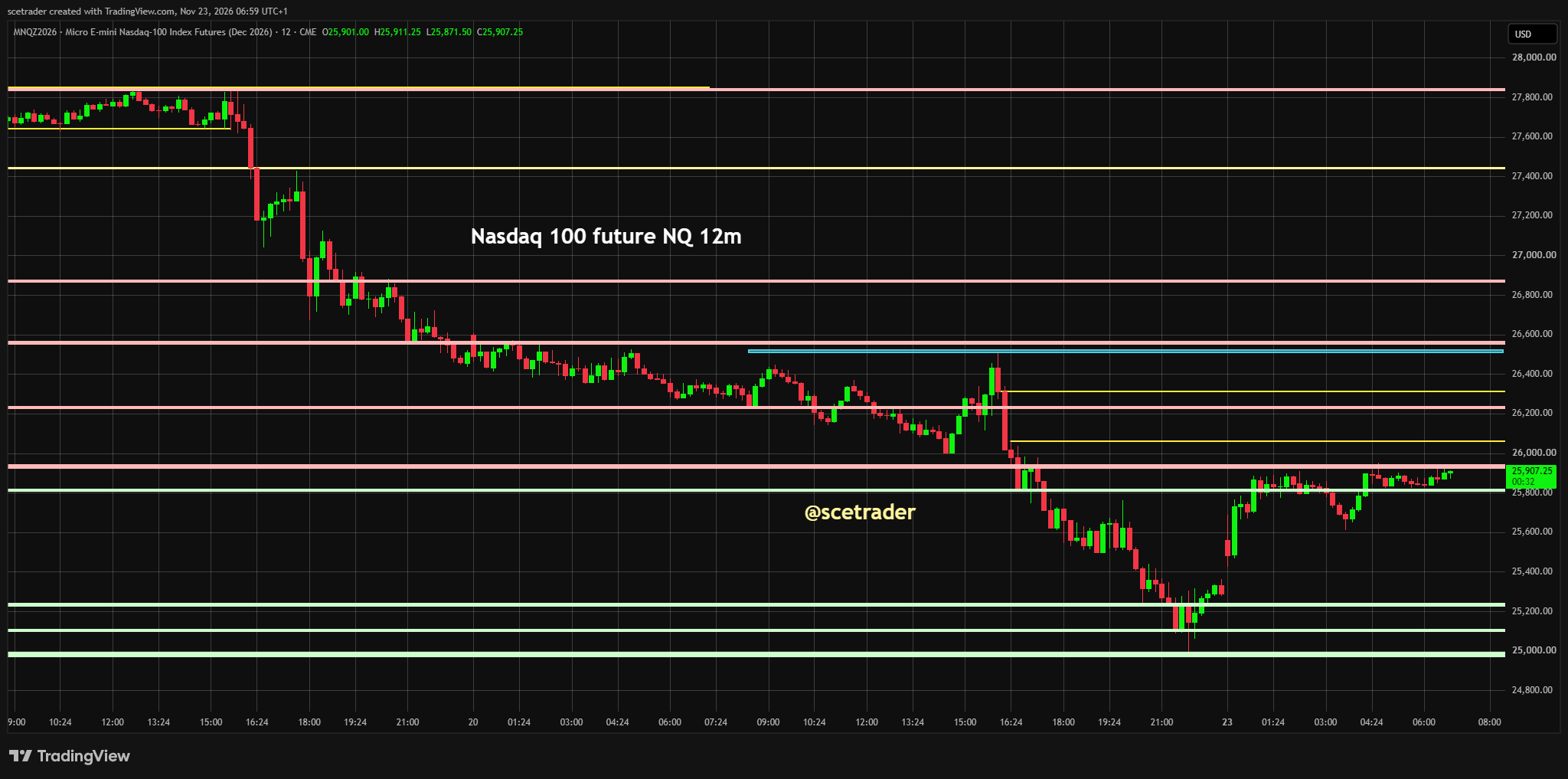
■ Nasdaq 100-techniek: Het dalende korte termijn patroon blijft ondanks het herstel intact. Volgens de huidige chart ligt een zwaardere technische weerstand nog ongeveer 500 tot 600 punten boven het huidige futuresniveau. Zelfs een veel grotere rally kan daardoor plaatsvinden zonder dat de neerwaartse korte termijn trend daadwerkelijk is gebroken.
■ Azië: Azië geeft een gemengd maar nog niet overtuigend herstelbeeld. De KOSPI verliest circa 2,8%, Taiwan wint ongeveer 2,3% en Hongkong blijft zwak. Japan is gesloten. Dat is duidelijk beter dan de paniek van vrijdag, maar onvoldoende om de sterke Amerikaanse futures volledig te bevestigen.
■ Steunmaatregelen Azië: Zuid-Korea bereidt marktsteun voor, Taiwan heeft de regels rond short selling aangescherpt en China versoepelt voorwaarden voor marginfinanciering. Dat kan de verkoop technisch afremmen, maar laat tegelijk zien hoeveel druk er op de markten is ontstaan.
■ VIX: De VIX sloot vrijdag rond 36 en steeg ruim 25%. Zolang de index ruim boven 30 blijft moeten wij rekening houden met uitzonderlijk grote bewegingen in beide richtingen. Een futuresrally van 2% of 3% is in zo’n volatiliteitsregime veel minder overtuigend dan tijdens normale handelsdagen.
■ Rente: De Amerikaanse tienjaarsrente daalde vrijdag ongeveer 12 basispunten naar rond 4,9%. Amerikaanse staatsobligaties worden als veilige haven gekocht. Dat helpt de waardering van technologie op papier, maar de reden achter de rentedaling is minder positief omdat zorgen over economische groei en demand destruction een belangrijke rol spelen.
■ Federal Reserve: De markt rekent nog op een renteverhoging in december, maar verwachtingen voor een stap van 50 basispunten zijn vrijwel verdwenen. Nieuwe inflatiecijfers later deze week worden daardoor extra belangrijk. Hardnekkige inflatie kan de rente opnieuw omhoog sturen en een herstel in technologie snel onder druk zetten.
■ Valuta: eurusd noteert rond 1,099, afgerond 1,10. USDJPY beweegt rond 159. De dollar blijft daarmee relatief sterk, ondanks de daling van de Amerikaanse lange rente.
■ Olie: Olie beweegt rond $84 tot $85 per vat en noteert ongeveer vlak. Nieuwe spanningen tussen de Verenigde Staten en Iran zorgen nauwelijks voor een krachtige prijsreactie. Dat is opvallend en suggereert dat zorgen over economische groei en een mogelijk zwakkere vraag momenteel minstens zo zwaar wegen als de geopolitieke risicopremie.
■ Goud: Goud stijgt circa 2,5% naar ongeveer $3.622 per troyounce. Na de forse verkoop is daar technisch ruimte voor. Wij zien dit voorlopig als herstel binnen het bestaande patroon en nog niet als bevestiging van een nieuwe opwaartse trend.
■ Zilver: Zilver stijgt circa 3,6% naar ongeveer $42,75. De reactie is fors, maar na de eerdere daling nog onvoldoende om van een structurele draai te spreken. Eerst moet het opwaartse momentum overtuigend terugkomen.
■ Koper: Koper probeert eveneens te herstellen, maar de eerdere zwakte blijft belangrijk. Koper is zowel een graadmeter voor industrie en economische groei als een cruciale grondstof voor stroomnetten en datacenters. Een duurzame stijging zou daarom veel meer zeggen dan één groene sessie.
■ Midden-Oosten: De spanningen rond Iran blijven een risico. Daarnaast blijven aanvallen op scheepvaart en olie-infrastructuur in de Golf een geopolitieke premie in energie ondersteunen. Dat olie desondanks nauwelijks stijgt, bevestigt dat de markt momenteel ook serieus rekening houdt met zwakkere economische vraag.
■ Europa: Europese futures staan slechts ongeveer 0,35% hoger en reageren daarmee veel minder sterk dan de Amerikaanse futures. Technologie en chips kunnen bij de opening hard herstellen, maar juist daar blijft de kans groot dat beleggers hogere koersen gebruiken om risico af te bouwen. Defensie en gezondheidszorg kunnen relatief beter blijven liggen wanneer technologie opnieuw verzwakt. Banken zijn door de oplopende kredietstress minder vanzelfsprekend een veilige sector.
■ Europa vandaag: De Europese bedrijfsagenda is relatief rustig. Daardoor worden de richting van Wall Street, chips, kredietmarkten, rente en volatiliteit belangrijker dan de meeste individuele bedrijfsupdates.
■ Drax: Drax komt met een handelsupdate. De markt kijkt vooral naar stroomprijzen, productie, kasstroom en de investeringsverwachtingen.
■ Partners Group Private Equity: Partners Group Private Equity rapporteert over het derde kwartaal. Portefeuillewaarderingen en ontwikkelingen in private markten krijgen extra gewicht na de scherpe daling van beurswaarderingen.
■ Carclo: Carclo publiceert halfjaarcijfers. Marges, schuld en de vooruitzichten voor de tweede helft van het jaar zijn de belangrijkste punten.
■ Cerillion: Cerillion komt met jaarcijfers. Groei, winstgevendheid en nieuwe opdrachten staan centraal.
■ DSW Capital: DSW Capital rapporteert halfjaarcijfers. De markt kijkt vooral naar adviesinkomsten en de vooruitzichten voor transactieactiviteit.
■ Banken: Een technische rebound bij banken is mogelijk, maar de onderliggende kredietstress verdwijnt daarmee niet. De markt gaat steeds scherper kijken naar welke AI- en datacenterleningen banken op hun balans hebben, hoeveel risico zij proberen door te verkopen en tegen welke prijs beleggers bereid zijn dat krediet over te nemen.
■ Luxe: Ook luxe kan technisch herstellen, maar wij verwachten voorlopig geen overtuigende trendomslag. De sector blijft gevoelig voor een zwakkere wereldeconomie, minder risicobereidheid en de ontwikkeling van de Aziatische consument. Een groene dag verandert dat beeld niet.
■ Industrie: Europese industriële aandelen worden een belangrijke graadmeter voor de bredere economische gevolgen van de AI-correctie. Wanneer ook deze sector zich steeds duidelijker gaat positioneren voor lagere groei, bevestigt dat dat de zorgen niet langer alleen over technologie gaan.
■ Wall Street: Vrijdag trok de verkoop vanuit AI en chips uiteindelijk een groter deel van de Amerikaanse markt mee. De herstelpoging van vandaag moet daarom niet alleen door de grote technologiebedrijven worden gedragen. Marktbreedte wordt belangrijk. Een rally die uitsluitend uit enkele megacaps bestaat overtuigt ons veel minder.
■ HPE: Hewlett Packard Enterprise rapporteert na het Amerikaanse slot. Na de AI-correctie kijkt de markt extra scherp naar AI-servers, netwerkapparatuur, marges en nieuwe orders. Sterke vraag alleen is niet voldoende. Beleggers willen ook zien wat die groei kost en welk rendement daar tegenover staat.
■ Symbotic: Symbotic komt nabeurs met kwartaal- en jaarcijfers. Na de forse daling van AI-aandelen moeten omzetgroei en nieuwe orders sterk genoeg blijven om de waardering te ondersteunen.
■ Agilent: Agilent rapporteert eveneens. De aandacht ligt bij laboratoriumapparatuur, biotechnologie en het herstel van de vraag in China. Het aandeel is minder direct gekoppeld aan AI, maar geeft informatie over de bredere investeringscyclus.
■ Chips: Chips blijven voor ons op korte termijn sell-on-rally. De fundamentele behoefte aan rekenkracht verdwijnt niet en de technologische ontwikkeling gaat door. Juist daarom verwachten wij op langere termijn opnieuw grote kansen en uiteindelijk nieuwe records bij de sterkste bedrijven. Op korte termijn kan de sector echter nog verder dalen zolang geldstromen ontbreken en de markt niet weet hoeveel slecht nieuws nog moet worden verwerkt.
■ Broadcom: Volgens supply-chainonderzoek dat door Barron’s werd aangehaald zou Google de geplande leveringen van Broadcom-ontworpen TPU 8i-chips voor 2027 met ongeveer 1 miljoen stuks, circa 20%, hebben verlaagd. Google en Broadcom hebben dit niet bevestigd. Wij behandelen het daarom als een relevant signaal om te volgen en niet als vastgesteld feit.
■ NVIDIA: NVIDIA verloor vrijdag ongeveer 14% en blijft de belangrijkste graadmeter voor de AI- en chiphandel. De SEC onderzoekt mogelijke accountingkwesties en Washington wil duidelijkheid over de verantwoordelijkheid binnen NVIDIA voor China-compliance. Er is geen vastgestelde overtreding. De markt kijkt daarnaast steeds kritischer naar financiële relaties, wederzijdse investeringen, circulaire financiering en de kwaliteit van aangekondigde orders.
■ Anthropic: Anthropic verloor vrijdag ongeveer 9% na de zeer hoge waardering bij de beursgang. Volgens de aangeleverde informatie kwam de totale kapitaalopbrengst na volledige uitoefening van de greenshoe uit op ongeveer $93,5 miljard. Dat onderstreept hoeveel kapitaal sterke AI-verhalen nog kunnen aantrekken, maar de koersreactie bevestigt dat beleggers niet meer iedere waardering automatisch accepteren.
■ AI-financiering: Kapitaal is nog beschikbaar, maar financiers stellen strengere voorwaarden. De aandacht verschuift naar schuld, leaseverplichtingen, garanties, onderpand en de vraag welke contracten werkelijk hard zijn. De belangrijkste vraag is niet langer alleen hoeveel AI-capaciteit wordt gebouwd, maar wie uiteindelijk het financiële risico draagt wanneer een project tegenvalt.
■ SpaceX: SpaceX heeft circa $44 miljard aan GPU-financiering geprijsd. Dat laat zien dat enorme bedragen nog altijd beschikbaar zijn voor AI-capaciteit, maar ook hoe groot de financiële verplichtingen rond hardware inmiddels worden. Sterke vraag naar rekenkracht betekent niet automatisch dat de financieringsstructuur eenvoudig of laag risico is.
■ CoreWeave: CoreWeave rapporteert ongeveer $47,5 miljard schuld. Het bedrijf blijft daarmee een belangrijke graadmeter voor de kredietkant van AI-infrastructuur. Sterke compute-vraag kan samengaan met een balans die steeds gevoeliger wordt voor rente, herfinanciering en lagere waarderingen.
■ Datacenters: Veel projecten rekenen op jarenlang zeer sterke vraag, hoge bezettingsgraden en betaalbare financiering. Wanneer één van die aannames tegenvalt kan het verwachte rendement snel verslechteren. De aandelenmarkt en de kredietmarkt beginnen dat risico nu duidelijker in te prijzen.
■ Krediet: De kredietmarkt is nog niet op slot, maar functioneert duidelijk minder soepel. Financiers vragen hogere vergoedingen, meer bescherming en betere garanties. Krediet is voor ons belangrijk omdat het vaak eerder verslechtert dan aandelen en ook eerder kan aangeven wanneer de stress begint af te nemen.
■ ING / AI-krediet: ING probeert volgens de ochtendupdate ongeveer $500 miljoen aan Stargate-gerelateerde datacenterleningen van de balans te halen. Verkoop tegen de gewenste prijs is nog niet gelukt. Potentiële kopers willen dus een lagere prijs betalen. Dat is een concreet voorbeeld van stress in de secundaire markt voor AI-gerelateerd krediet.
■ Hyperscaler-capex: Een van de grootste fundamentele neerwaartse risico’s is dat een grote hyperscaler expliciet zijn AI-investeringen verlaagt. Dan verandert de discussie onmiddellijk van financieringsstress naar daadwerkelijke eindvraag. Zo’n aankondiging kan AI-aandelen, datacenterleveranciers en chips opnieuw hard raken.
■ AI en economie: De Amerikaanse economie is inmiddels sterk verweven met de AI-investeringscyclus. Een vertraging raakt niet alleen datacenters en chips, maar ook stroom, koeling, bouw, netwerken, servers en andere industrie. Daardoor kan een forse AI-capexvertraging uiteindelijk merkbaar worden in de bredere economische groei.
■ Geheugen: De geheugenmarkt is niet uniform. DRAM blijft krap, vooral binnen servers en AI, terwijl NAND in 2027 juist richting overaanbod kan bewegen. Prijzen en winstgevendheid kunnen daardoor binnen dezelfde geheugensector sterk uiteenlopen.
■ Serverketen: Serverleveranciers proberen forse stijgingen van geheugen- en andere componentkosten door te berekenen. Dat ondersteunt leveranciers zolang de vraag sterk blijft, maar verhoogt tegelijkertijd de totale kosten van nieuwe AI-capaciteit en kan het rendement voor klanten verslechteren.
■ Liquiditeit: Geldstromen blijven voor ons belangrijker dan één spectaculaire futuresrally. Zeer sterke bedrijven kunnen verder dalen wanneer beleggers liquiditeit uit de sector halen. Voor een overtuigender bodem willen wij daadwerkelijk zien dat kapitaal terugkeert naar chips en andere risicovolle delen van de markt.
■ Crypto: Bitcoin en crypto-aandelen proberen na de zware verkoop te stabiliseren. Tijdens de eerdere daling werd ongeveer $1,8 miljard aan posities met geleend geld geliquideerd. Dat verklaart een deel van het scherpe herstel, maar laat ook zien hoeveel hefboom uit de markt moest worden gehaald.
■ Bitcoin: Bitcoin noteert rond $61.760. Een verdere tussentijdse rally is mogelijk, maar technisch is ook een veel zwakker scenario richting ongeveer $51.000 nog niet verdwenen. Dat is geen koersdoel, maar een neerwaarts scenario waarmee wij rekening houden zolang geen overtuigende bodem is gevormd.
■ Circle: Circle is na de zware correctie sterk teruggevallen en wordt daardoor interessanter om te volgen. Wij zien nog onvoldoende bewijs dat de huidige bodemzone standhoudt. Voorlopig blijft het een watchlistnaam en nog geen koop.
■ Macro: Nieuwe Amerikaanse inflatie- en economische cijfers later deze week worden belangrijk. Na de zware verkoop kan ieder cijfer dat wijst op hardnekkige inflatie opnieuw druk zetten op rentegevoelige technologie.
■ Technologie deze week: Dell en andere grote technologiebedrijven rapporteren later deze week. De lat is veranderd. Goede omzet alleen is niet meer genoeg. De markt wil omzet, marge, vrije kasstroom en een aantoonbaar rendement op AI-investeringen zien.
■ Richting: Wij zien ruimte voor een stevige technische rebound, maar blijven tactisch voorzichtig en bearish op chips. Amerikaanse futures staan sterk hoger, terwijl Azië, krediet en volatiliteit nog geen overtuigende bodem bevestigen. Vooral chips moeten laten zien dat hogere koersen nieuwe kopers aantrekken en niet alleen verkopers een betere uitstap geven.
■ Bodemsignaal: Voor ons zijn er drie hoofdvoorwaarden. Geldstromen moeten terugkeren, kredietstress moet duidelijk afnemen en nieuw slecht nieuws mag nauwelijks nog nieuwe dieptepunten veroorzaken. De omvang van tussentijdse rallies is minder belangrijk. Een duurzame bodem wordt geloofwaardiger wanneer de markt negatieve headlines kan absorberen zonder opnieuw hard weg te zakken.
■ Surprise: De positieve verrassing is een brede rally waarin chips herstellen, de VIX snel terugloopt en kredietmarkten stabiliseren. Een extreem positief scenario ontstaat wanneer financiële stress ooit zo groot wordt dat beleidsmakers liquiditeit of andere steun moeten geven, maar daar zijn we nu nog niet. De negatieve verrassing is dat de futuresrally opnieuw wordt verkocht of dat een grote hyperscaler zijn capex verlaagt en daarmee een nieuwe verkoopgolf in AI ontketent.
■ Desk-view: De Amerikaanse futuresrally is sterk, maar bewijst op zichzelf weinig. Lange termijn blijven wij positief op AI en de sterkste delen van de chipketen. Korte termijn zijn financiering, krediet, liquiditeit en waardering de zwakke schakels. ING dat zijn Stargate-leningen niet tegen de gewenste prijs kan verkopen vinden wij belangrijker dan een paar procent hogere futures. Nog belangrijker wordt hoe de markt op het volgende negatieve bericht reageert. Zolang kredietstress aanhoudt, geldstromen niet overtuigend terugkeren en slecht nieuws nog steeds nieuwe dieptepunten veroorzaakt, blijven chips voor ons sell-on-rally. De bodem wordt pas echt interessant wanneer slecht nieuws nauwelijks nog effect heeft.
🔵 English version
■ Opening forecast: Europe has room for a rebound on Monday, but confirmation is still lacking. S&P 500 futures are up roughly 2.3% and Nasdaq 100 futures around 3.2%, while Euro Stoxx futures indicate only around 0.35% gains. Asia is responding much less convincingly. For now, we treat the US futures move as a technical counter-reaction rather than confirmation that a bottom has been reached.
■ Investment View: We remain tactically bearish on semiconductors and maintain a sell-on-rally stance. The three main risks are renewed selling during rebounds, deteriorating financing conditions for AI infrastructure and rising uncertainty around orders, regulation and China. Long term, however, we remain clearly constructive on the semiconductor cycle. HBM, server DRAM, compute and several parts of the server supply chain remain structurally strong and we ultimately expect the strongest semiconductor companies to move toward record levels again.
■ Market picture: Friday was not normal profit taking. The SOX lost around 11%, the Nasdaq 5.3% and the S&P 500 3.7%, while SMH also fell more than 10%. The Nasdaq lost roughly 10% for the week, its worst week since 2020, and surrendered its 2026 gain. Markets seriously reduced exposure to the AI trade.
■ Futures: US futures are rebounding sharply, but the size of the move needs perspective. Strong technical rallies are normal after losses of Friday's magnitude. The key question is not how many percentage points futures gain this morning, but whether investors use higher prices to rebuild risk or reduce remaining positions.
■ Nasdaq 100 technicals: The short-term downtrend remains intact despite the recovery. According to the current chart, a heavier resistance area remains roughly 500 to 600 points above the current futures level. An even larger rally can therefore occur without actually breaking the declining short-term trend.
■ Asia: Asia is showing a mixed but still unconvincing recovery. The KOSPI is down roughly 2.8%, Taiwan is up around 2.3% and Hong Kong remains weak. Japan is closed. That is clearly better than Friday's panic but insufficient to fully confirm strong US futures.
■ Asian support measures: South Korea is preparing market support, Taiwan has tightened short-selling rules and China is easing margin-financing requirements. That can technically slow selling, while simultaneously showing how much pressure has developed across markets.
■ VIX: The VIX closed Friday around 36 and rose more than 25%. While it remains well above 30, exceptionally large moves in both directions should be expected. A 2% or 3% futures rally carries much less significance in this volatility regime than during normal market conditions.
■ Rates: The US 10-year yield fell roughly 12 basis points on Friday to around 4.9%. US government bonds are being bought as a safe haven. That helps technology valuations on paper, but the reason behind the yield decline is less positive because concerns about economic growth and demand destruction are playing an important role.
■ Federal Reserve: Markets still expect a December rate increase, but expectations for a 50-basis-point move have largely disappeared. Fresh inflation data later this week therefore becomes especially important. Persistent inflation could push yields higher again and quickly pressure a technology recovery.
■ FX: eurusd trades around 1.099, roughly 1.10. USDJPY is near 159. The dollar therefore remains relatively firm despite lower US long-term yields.
■ Oil: Oil is trading around $84 to $85 per barrel and is roughly flat. Renewed tensions between the United States and Iran are generating little upward price response. That is notable and suggests concerns about economic growth and potentially weaker demand are currently carrying at least as much weight as the geopolitical risk premium.
■ Gold: Gold is up roughly 2.5% near $3,622 per troy ounce. After the heavy selloff there is technical room for recovery. For now, we view this as a rebound within the existing pattern rather than confirmation of a new uptrend.
■ Silver: Silver is up roughly 3.6% near $42.75. The reaction is powerful but following the earlier decline remains insufficient to establish a structural turn. Upward momentum first needs to return convincingly.
■ Copper: Copper is also trying to recover, but earlier weakness remains important. Copper is both a gauge for industry and economic growth and a crucial input for power grids and datacenters. A sustained rise would therefore matter far more than one green session.
■ Middle East: Tensions around Iran remain a risk. Attacks on shipping and oil infrastructure in the Gulf also continue to support a geopolitical premium in energy. The fact that oil is barely rising despite that confirms that markets are simultaneously taking weaker economic demand seriously.
■ Europe: European futures are only around 0.35% higher and therefore reacting much less strongly than US futures. Technology and semiconductors can rebound sharply at the open, but those areas also remain most exposed to investors using higher prices to reduce risk. Defence and healthcare may hold up relatively better if technology weakens again. Banks are less obviously defensive because of rising credit stress.
■ Europe today: The European corporate calendar is relatively quiet. Wall Street, semiconductors, credit markets, rates and volatility therefore matter more than most individual company updates.
■ Drax: Drax issues a trading update. Markets will focus mainly on power prices, generation, cash flow and investment expectations.
■ Partners Group Private Equity: Partners Group Private Equity reports third-quarter results. Portfolio valuations and developments in private markets carry extra weight following the sharp decline in public-market valuations.
■ Carclo: Carclo publishes half-year results. Margins, debt and the outlook for the second half are the key points.
■ Cerillion: Cerillion reports full-year results. Growth, profitability and new orders are central.
■ DSW Capital: DSW Capital reports half-year results. Markets will focus mainly on advisory revenue and the outlook for transaction activity.
■ Banks: A technical rebound in banks is possible, but underlying credit stress does not disappear with one green session. Markets are increasingly scrutinising which AI and datacenter loans banks hold on balance sheet, how much risk they are trying to distribute and at what price investors are willing to take that credit.
■ Luxury: Luxury can also recover technically, but we do not yet expect a convincing trend reversal. The sector remains sensitive to weaker global growth, reduced risk appetite and developments in Asian consumer demand. One green session does not change that picture.
■ Industrials: European industrial equities are becoming an important gauge for the broader economic consequences of the AI correction. If the sector increasingly starts pricing lower growth, that would confirm that concerns are spreading beyond technology.
■ Wall Street: Friday's selling spread from AI and semiconductors into the broader US market. Today's recovery therefore needs to be supported by more than a handful of large technology stocks. Market breadth matters. A rally driven only by a few megacaps would be far less convincing.
■ HPE: Hewlett Packard Enterprise reports after the US close. Following the AI correction, investors will focus closely on AI servers, networking equipment, margins and new orders. Strong demand alone is no longer enough. Markets also want to know what that growth costs and what returns it generates.
■ Symbotic: Symbotic reports quarterly and full-year results after the close. Following the sharp AI decline, revenue growth and new orders need to remain strong enough to support the valuation.
■ Agilent: Agilent also reports. Attention will focus on laboratory equipment, biotechnology and the recovery in Chinese demand. The stock is less directly linked to AI but provides information about the broader investment cycle.
■ Semiconductors: Semiconductors remain sell-on-rally for us in the short term. Structural demand for compute has not disappeared and technological development continues. That is precisely why we expect major opportunities to return over the longer term and ultimately new highs for the strongest companies. In the short term, however, the sector can fall further while capital flows remain absent and markets remain uncertain about how much bad news is still to come.
■ Broadcom: According to supply-chain research cited by Barron's, Google may have reduced planned 2027 deliveries of Broadcom-designed TPU 8i chips by around 1 million units, or roughly 20%. Google and Broadcom have not confirmed this. We therefore treat it as a relevant signal to monitor rather than established fact.
■ NVIDIA: NVIDIA lost around 14% on Friday and remains the key gauge for the AI and semiconductor trade. The SEC is investigating possible accounting issues and Washington wants clarity over responsibility inside NVIDIA for China compliance. No violation has been established. Markets are also scrutinising financial relationships, reciprocal investment, circular financing and the quality of announced orders much more closely.
■ Anthropic: Anthropic lost around 9% on Friday following its very high IPO valuation. According to the information provided, total proceeds after full exercise of the greenshoe reached roughly $93.5 billion. That highlights how much capital strong AI stories can still attract, while the share-price reaction confirms investors no longer automatically accept every valuation.
■ AI financing: Capital remains available, but lenders are imposing stricter terms. Attention is shifting toward debt, lease obligations, guarantees, collateral and which contracts are genuinely firm. The key question is no longer only how much AI capacity gets built, but who ultimately carries the financial risk when a project disappoints.
■ SpaceX: SpaceX has priced roughly $44 billion of GPU financing. That shows enormous amounts of capital remain available for AI capacity, while also demonstrating how large hardware-related financial obligations have become. Strong compute demand does not automatically make the financing structure simple or low-risk.
■ CoreWeave: CoreWeave reports roughly $47.5 billion of debt. The company therefore remains an important gauge for the credit side of AI infrastructure. Strong compute demand can coexist with a balance sheet that becomes increasingly sensitive to rates, refinancing and lower valuations.
■ Datacenters: Many projects assume years of extremely strong demand, high utilisation and affordable financing. If one of those assumptions disappoints, expected returns can deteriorate quickly. Both equity and credit markets are beginning to price that risk more clearly.
■ Credit: Credit markets are not closed, but they are clearly functioning less smoothly. Lenders are demanding higher compensation, greater protection and stronger guarantees. Credit matters because it often deteriorates before equities and can also provide an early signal when stress begins to ease.
■ ING / AI credit: According to the morning update, ING is trying to move roughly $500 million of Stargate-related datacenter loans off its balance sheet. It has not managed to sell them at the desired price. Potential buyers therefore want to pay less. That is a concrete example of stress in the secondary market for AI-related credit.
■ Hyperscaler capex: One of the largest fundamental downside risks is for a major hyperscaler to explicitly reduce AI investment. That would immediately turn the debate from financing stress toward actual end demand. Such an announcement could hit AI equities, datacenter suppliers and semiconductors hard again.
■ AI and the economy: The US economy has become deeply intertwined with the AI investment cycle. A slowdown affects not only datacenters and chips, but also power, cooling, construction, networks, servers and other industries. A major AI capex slowdown could therefore become visible in broader economic growth.
■ Memory: The memory market is not uniform. DRAM remains tight, particularly within servers and AI, while NAND could move toward oversupply in 2027. Pricing and profitability can therefore diverge significantly within the same memory industry.
■ Server supply chain: Server vendors are attempting to pass through substantial increases in memory and other component costs. That supports suppliers while demand remains strong, but simultaneously raises the total cost of new AI capacity and can reduce customer returns.
■ Liquidity: Capital flows remain more important to us than one spectacular futures rally. Very strong companies can continue falling when investors withdraw liquidity from the sector. For a more convincing bottom, we want to see capital actually return to semiconductors and other risk assets.
■ Crypto: Bitcoin and crypto-related equities are attempting to stabilise after the heavy selloff. Roughly $1.8 billion in leveraged positions were liquidated during the earlier decline. That explains part of the sharp recovery and also shows how much leverage had to be removed from the market.
■ Bitcoin: Bitcoin trades around $61,760. A further interim rally is possible, but technically a much weaker scenario toward roughly $51,000 has not disappeared. That is not a price target, but a downside scenario we continue to consider while a convincing bottom has not formed.
■ Circle: Circle has fallen sharply during the correction and is therefore becoming more interesting to monitor. We still see insufficient evidence that the current bottoming area will hold. For now, it remains a watchlist name rather than a buy.
■ Macro: Fresh US inflation and economic data later this week become important. After the heavy selloff, any indication that inflation remains persistent could again pressure rate-sensitive technology.
■ Technology this week: Dell and other major technology companies report later this week. The bar has changed. Strong revenue alone is no longer enough. Markets want revenue, margins, free cash flow and demonstrable returns on AI investment.
■ Direction: We see room for a strong technical rebound but remain tactically cautious and bearish on semiconductors. US futures are sharply higher while Asia, credit and volatility have yet to confirm a convincing bottom. Semiconductors in particular need to show that higher prices attract fresh buyers rather than merely offering sellers a better exit.
■ Bottom signal: We focus on three main conditions. Capital flows need to return, credit stress needs to decline clearly and fresh bad news must stop producing new lows. The size of interim rallies matters less. A durable bottom becomes more credible when markets can absorb negative headlines without another sharp decline.
■ Surprise: The positive surprise would be a broad rally in which semiconductors recover, the VIX falls quickly and credit markets stabilise. An extreme positive scenario would emerge if financial stress ever became large enough to trigger policy liquidity or other support, but we are far from that today. The negative surprise would be for the futures rally to be sold again or for a major hyperscaler to cut capex and trigger another wave of AI selling.
■ Desk-view: The US futures rally is powerful but proves little by itself. Long term, we remain constructive on AI and the strongest parts of the semiconductor chain. In the short term, financing, credit, liquidity and valuation are the weak links. ING being unable to sell its Stargate loans at the desired price matters more to us than a few percentage points of higher futures. Even more important is how markets react to the next negative headline. While credit stress persists, capital flows fail to return convincingly and bad news can still generate new lows, semiconductors remain sell-on-rally for us. The bottom becomes genuinely interesting when bad news starts having little or no effect.
Disclaimer Aan de door ons opgestelde informatie kan op geen enkele wijze rechten worden ontleend. Alle door ons verstrekte informatie en analyses zijn geheel vrijblijvend. Alle consequenties van het op welke wijze dan ook toepassen van de informatie blijven volledig voor uw eigen rekening.
Wij aanvaarden geen aansprakelijkheid voor de mogelijke gevolgen of schade die zouden kunnen voortvloeien uit het gebruik van de door ons gepubliceerde informatie. U bent zelf eindverantwoordelijk voor de beslissingen die u neemt met betrekking tot uw beleggingen.

