💫 Memory chips en CXMT: Van DRAM, HBM, NAND en veel meer - HERHALING
Dit bericht is eerder in de feed geplaatst en wordt nu herhaald.
Dit rapport behandelt Micron, de nieuwe AI-memorycyclus en de vraag waarom beleggers extra capaciteit en CXMT mogelijk verkeerd interpreteren. We leggen uit hoe DRAM, HBM, NAND en enterprise SSD’s verschillen, waarom memory een strategische bottleneck wordt en waar de kansen en risico’s voor Micron liggen. De kern: een stevige correctie kan juist interessant worden als de markt commodity-memory verwart met premium AI-memory.
Laten we beginnen
De memorymarkt is opnieuw een van de belangrijkste thema’s binnen technologie. Niet omdat geheugen nieuw is, maar omdat memory is verschoven van een gewone component naar een strategische bottleneck in AI-infrastructuur.
Wil je alle artikelen kunnen lezen en elke podcast beluisteren? Neem dan een abonnement en krijg toegang tot alle artikelen en de database met duizenden berichten.
■ Micron kan op korte termijn fors corrigeren als beleggers extra capaciteit en CXMT-toetreding te simpel lezen als het einde van het memorytekort.
■ Die correctie kan juist een koopkans worden als de daling vooral komt door verwarring tussen gewone DRAM en hoogwaardige AI-memory.
■ CXMT wordt een serieuze speler in gewone DRAM, maar lost de schaarste in HBM, high-end server-DRAM en enterprise SSD’s niet zomaar op.
■ De AI-memorymarkt splitst in twee werelden: commodity-memory blijft cyclisch, terwijl premium-memory strategischer, schaarser en contractueler wordt.
■ Micron blijft volatiel, maar de huidige cyclus heeft een structurelere onderlaag door AI, langlopende klantcontracten, HBM, datacenteropslag en de groei van inference.
Zonder voldoende geheugen, bandbreedte en opslag kunnen GPU’s, AI-accelerators, cloudplatformen en datacenters hun capaciteit niet volledig benutten. Micron staat precies in het midden van die verschuiving: nog altijd cyclisch, maar steeds belangrijker voor HBM, server-DRAM, enterprise SSD’s en AI-datacenters.
Investment view
Onze investment view is dat Micron kwetsbaar blijft voor een stevige correctie, maar dat juist zo’n daling interessant kan worden als zij voortkomt uit een verkeerde marktinterpretatie.
De koers is hard opgelopen door AI, HBM, stijgende DRAM-prijzen, oplopende NAND-prijzen en grote klantcommitments. Daardoor ligt de lat hoog. Zodra beleggers berichten krijgen over extra capaciteit bij Samsung, SK Hynix, Micron en vooral CXMT, kan de markt terugvallen in de oude memoryreflex.
Die reflex is bekend: meer capaciteit betekent meer aanbod, meer aanbod betekent lagere prijzen en lagere prijzen drukken de marges. Dat blijft een risico. Micron is geen defensief aandeel en memory blijft een sector waarin sentiment snel draait. Toch is deze cyclus anders, omdat de winstpool niet meer alleen wordt bepaald door gewone DRAM voor pc’s en smartphones.
Het verschil zit in de mix. Aan de onderkant blijft gewone DRAM gevoelig voor China, capaciteit, prijsdruk en voorraadcycli. Aan de bovenkant worden HBM, server-DRAM en enterprise storage strategischer. Daar gaat het niet alleen om prijs per bit, maar om beschikbaarheid, bandbreedte, packaging, energieverbruik, klantkwalificatie en leveringszekerheid.
Precies daar kan de markt Micron verkeerd prijzen. Als een headline over CXMT of extra capaciteit wordt gelezen als bewijs dat het hele memorytekort voorbij is, kan de koers hard dalen. Maar als die nieuwe capaciteit vooral gewone DRAM raakt en niet de premiumlaag van AI-memory, kan de fundamentele schade veel kleiner zijn dan de koersreactie suggereert.
De strategie is daarom om niet achter elke rally aan te lopen. De betere strategie is wachten op het moment waarop de markt het oude commodityverhaal te agressief toepast op een sector die aan de bovenkant structureel veranderd is. Een stevige daling bij Micron kan dan geen einde van de bullcase zijn, maar een reset van de waardering.
De nieuwe feiten uit juni 2026
De memorymarkt is in juni 2026 in een nieuwe fase gekomen. Het meest opvallende signaal is dat Apple toestemming zoekt om memorychips van CXMT te kunnen kopen.
Apple is een van de sterkste inkopers ter wereld en staat bekend om harde supply chain-discipline. Als zelfs Apple alternatieve memorybronnen onderzoekt, zegt dat iets over de ernst van de krapte.
Apple kijkt niet naar CXMT omdat de markt ontspannen is. Het bedrijf wordt geraakt door stijgende memory- en opslagkosten, waardoor de druk op MacBooks en iPads oploopt. Daarmee verschuift het verhaal van een puur datacenterthema naar een bredere hardwarekwestie. AI-servers trekken memorycapaciteit naar zich toe, memoryprijzen stijgen en uiteindelijk voelen ook consumentenproducten de rekening.
Tegelijk is CXMT niet langer een speler die beleggers kunnen negeren. De Chinese fabrikant groeit snel in DRAM-capaciteit en kan in gewone DRAM een echte prijsfactor worden. Dat geldt vooral voor DDR4, mainstream DDR5, pc-geheugen en mogelijk LPDDR. Voor Micron is dat een reëel risico aan de commoditykant van het bedrijf.
Maar wafercapaciteit is niet hetzelfde als hoogwaardige AI-memorycapaciteit. CXMT kan groeien in gewone DRAM, maar HBM op topniveau leveren aan NVIDIA, AMD of hyperscaler-ASIC’s is een veel zwaardere discipline.
Daar tellen stacking, TSV’s, packaging, thermiek, yields, energieverbruik, betrouwbaarheid, klantkwalificatie en geopolitieke toestemming.
Aan de andere kant laat Micron zien dat de markt niet meer uitsluitend draait op korte contractcycli en spotprijzen. Het bedrijf heeft strategische klantafspraken gemeld met miljarden aan commitments, inclusief structuren zoals take-or-pay, cash deposits en prijsbodems. Dat geeft aan dat klanten niet alleen chips willen kopen, maar toegang tot supply willen veiligstellen.
De kern uit juni 2026 is dus dat de memorymarkt in twee richtingen tegelijk beweegt. Aan de onderkant komt er meer Chinese concurrentie. Aan de bovenkant worden HBM, server-DRAM en enterprise SSD’s schaarser, strategischer en contractueler. Micron zit precies tussen die twee werelden.
Harde data: marktaandelen, resultaten en guidance
De actuele marktstructuur onderstreept waarom beleggers memory niet als één homogene markt moeten behandelen.
In DRAM blijft Samsung marktleider met ongeveer 38% marktaandeel, gevolgd door SK Hynix met circa 29%. Micron zit rond 22 tot 25%, terwijl CXMT inmiddels richting 8% is gegroeid.
■ DRAM-marktaandelen: Samsung circa 38%, SK Hynix circa 29%, Micron circa 22–25% en CXMT circa 8%.
■ HBM-marktaandelen: SK Hynix circa 61%, Micron circa 21% en Samsung circa 17%.
■ Micron Q3 FY2026: 41,46 miljard dollar omzet, 84,9% non-GAAP brutomarge en 25,11 dollar non-GAAP EPS.
■ Micron Q4 FY2026 outlook: circa 50 miljard dollar omzet, ongeveer 86% brutomarge en 31 dollar non-GAAP EPS.
■ De kernvraag is niet alleen of memoryprijzen hoog zijn, maar welk deel van de winst uit premium AI-memory en datacenterstorage komt.
Dat maakt CXMT serieus genoeg om de onderkant van de DRAM-markt te beïnvloeden, maar nog niet dominant genoeg om de volledige marktbalans te bepalen.
In HBM ligt de machtsverhouding anders. SK Hynix blijft dominant met een marktaandeel rond 61%. Micron is sterk gegroeid en wordt in recente marktdata rond 21% geplaatst, terwijl Samsung rond 17% zit en terrein probeert terug te winnen. Dat verschil is belangrijk: CXMT wordt relevanter in gewone DRAM, maar de HBM-markt blijft voorlopig geconcentreerd bij SK Hynix, Micron en Samsung.
Micron’s eigen cijfers laten zien hoe uitzonderlijk deze cyclus is geworden. In Q3 FY2026 rapporteerde het bedrijf 41,46 miljard dollar omzet, een non-GAAP brutomarge van 84,9% en 25,11 dollar non-GAAP winst per aandeel. Voor Q4 FY2026 gaf Micron een outlook af van ongeveer 50 miljard dollar omzet, een brutomarge rond 86% en circa 31 dollar non-GAAP winst per aandeel.
Ook de productkant is belangrijk. Micron meldde dat HBM4 in high-volume shipments is voor de lead customer-platformen en dat HBM4E in ontwikkeling is met volumestart in 2027.
Daarnaast noemt Micron high-performance PCIe Gen6 SSD’s, high-capacity QLC SSD’s en nieuwe DDR5/LPDDR-producten. Dat bevestigt dat het bedrijf niet alleen profiteert van klassieke DRAM-prijzen, maar steeds dieper in de AI-infrastructuurstack komt te zitten.
Deze cijfers maken de beleggingscase scherper. Aan de onderkant groeit CXMT en neemt het risico op prijsdruk in gewone DRAM toe. Aan de bovenkant blijven HBM, datacenter-DRAM en enterprise SSD’s schaars, technisch complex en geconcentreerd bij een kleine groep spelers. Precies dat verschil bepaalt of een correctie in Micron een waarschuwing is of juist een koopmoment.
De rekening van jarenlang goedkope memory
De botsing tussen Apple en de memoryleveranciers laat goed zien hoe de markt veranderd is. Apple wil stijgende kosten voor memory en opslag niet volledig dragen en zoekt daarom alternatieve bronnen.
Vanuit Apple is dat logisch: het bedrijf wil margecontrole houden, zeker bij producten zoals MacBooks en iPads waar componentkosten direct doorwerken in de verkoopprijs.
Voor memoryleveranciers ligt het verhaal anders. De sector heeft nog maar kort geleden een diepe neergang doorgemaakt waarin prijzen extreem laag waren en winsten hard onder druk stonden. In zulke periodes wordt investeren moeilijker.
Als memory jarenlang te goedkoop is, komt er uiteindelijk te weinig rendabele capaciteit bij. Zodra AI de vraag vervolgens explodeert, ontstaat een tekort dat niet in één of twee kwartalen kan worden opgelost.
Dit is de rekening van goedkope chips. Jarenlang profiteerden hardwaremakers van lage memoryprijzen. Nu AI-servers HBM, DRAM en NAND-capaciteit naar zich toe trekken, verschuift de onderhandelingsmacht tijdelijk richting memoryleveranciers. Consumentenproducten krijgen hogere componentkosten, hardwaremakers verliezen margecontrole en memorybedrijven kunnen supplyzekerheid, prijsbodems en langlopende afspraken afdwingen.
Voor Micron is dit cruciaal. De krapte bestaat niet alleen op papier. Zij raakt echte prijsvorming, echte productprijzen en echte supply chain-beslissingen. Als Apple al naar alternatieve leveranciers kijkt, is dat geen bewijs dat memory ruim beschikbaar is. Het is juist bewijs dat de bestaande supplyketen onder druk staat.
Zuid-Korea maakt memory tot nationaal AI-project
De memorycyclus wordt niet alleen door bedrijven gestuurd. Steeds duidelijker wordt dat landen memory zien als strategische infrastructuur. Zuid-Korea is daarvan het beste voorbeeld.
■ Zuid-Korea’s investeringsplannen bevestigen dat memory een nationaal strategisch thema is geworden.
■ De bedragen wijzen op een meerjarige AI-capexcyclus, niet op een korte voorraadpiek.
■ Beleggers kunnen zulke plannen verkeerd lezen als bewijs voor snelle overcapaciteit.
■ Voor HBM en AI-memory blijft de bottleneck niet alleen fabcapaciteit, maar ook packaging, yields en klantkwalificatie.
■ Dit ondersteunt de visie dat Micron, SK Hynix en Samsung steeds meer als AI-infrastructuurspelers moeten worden bekeken.
Samsung Group zou volgens recente berichtgeving een investeringsplan van ongeveer 1.000 biljoen won, omgerekend circa 648 miljard dollar, in Zuid-Korea voorbereiden. Daarbij zou ook een mogelijke 300 biljoen won voor nieuwe chipfabrieken in het zuidwesten van het land horen.
Tegelijk spreekt de Zuid-Koreaanse overheid met Samsung en SK Hynix over de volgende fase van grootschalige chipinvesteringen.
Dat is belangrijk voor de hele memorycase. Dit soort bedragen worden niet vrijgemaakt omdat de sector een korte, eenmalige piek ziet. Ze worden voorbereid omdat AI, datacenters, high-performance computing en nationale technologische autonomie de vraag naar memory structureel veranderen. Memory wordt daarmee onderdeel van industriebeleid, net zoals energie, defensie en infrastructuur dat zijn.
Voor beleggers is dit dubbel. Aan de ene kant bevestigt het de structurele vraag. Aan de andere kant kan dezelfde headline op korte termijn angst voor overcapaciteit oproepen. Precies daar kan de marktfout ontstaan.
Extra capaciteit betekent namelijk niet automatisch dat het tekort in HBM en hoogwaardige AI-memory snel verdwijnt. Nieuwe fabs kosten jaren, equipment moet worden geïnstalleerd, yields moeten omhoog, HBM vraagt geavanceerde packaging en grote klanten moeten nieuwe producten kwalificeren.
Voor Micron is dit relevant omdat het laat zien dat de strijd om memory geen gewone commoditystrijd meer is. Samsung en SK Hynix worden door Zuid-Korea behandeld als strategische pijlers van de AI-economie. Micron heeft in de Verenigde Staten een vergelijkbare rol binnen de westerse supply chain.
De sector beweegt naar een wereld waarin memory niet alleen wordt gewaardeerd op prijs per bit, maar ook op geopolitieke waarde, leveringszekerheid en positie binnen AI-infrastructuur.
De visie: memory wordt de nieuwe olie van AI
De markt heeft jarenlang vooral naar GPU’s gekeken. Dat was logisch, want NVIDIA werd de zichtbare winnaar van de AI-revolutie. Maar de volgende fase van AI draait niet alleen om wie de snelste accelerator heeft.
Zij draait om wie voldoende memory, storage, stroom, koeling en netwerkcapaciteit kan organiseren om die accelerators volledig te benutten.
Een AI-chip zonder voldoende HBM is als een fabriek zonder grondstoffen. De rekenkracht is aanwezig, maar de data kan niet snel genoeg worden aangevoerd.
Een datacenter zonder voldoende enterprise SSD’s kan modellen, datasets, logs en vector databases niet efficiënt opslaan en ophalen. Een cloudplatform zonder voldoende server-DRAM kan zijn capaciteit niet optimaal verdelen.
Daarmee verschuift de macht in de AI-keten. Nvidia blijft cruciaal, maar SK Hynix, Micron en Samsung worden eveneens poortwachters. Zij leveren niet zomaar componenten; zij leveren de bandbreedte en opslaglaag die bepaalt hoeveel AI-capaciteit echt beschikbaar komt.
Voor Micron betekent dit dat het bedrijf niet meer alleen als klassieke DRAM-speler bekeken moet worden. Micron zit op het snijvlak van drie grote trends: AI-memory, datacenterstorage en de herprijzing van supplyzekerheid. Dat maakt het aandeel interessant, maar ook complex.
De markt kan het aandeel nog steeds behandelen als oude commodity-DRAM, terwijl het winstprofiel steeds meer verschuift naar premiumproducten.
Waarom memory niet één markt is
De grootste fout die beleggers kunnen maken, is memory behandelen als één homogene productgroep. Dat gebeurt vaak omdat de sector historisch bekendstaat als cyclisch en prijsgevoelig. In oude cycli was dat begrijpelijk. Als er te veel DRAM-capaciteit kwam, daalden prijzen. Als pc’s of smartphones tegenvielen, liepen voorraden op. Als producenten tegelijk uitbreidden, volgde margedruk.
Die klassieke cyclus bestaat nog steeds, maar AI heeft een nieuwe laag toegevoegd. High-end accelerators hebben HBM nodig. Servers hebben meer DDR5 en server-DRAM nodig. Datacenters hebben enterprise SSD’s nodig. AI-bedrijven moeten trainingdata, modelgewichten, checkpoints, logs, embeddings en vector databases opslaan.
Daardoor is memory niet langer alleen een volumeproduct, maar ook een strategische infrastructuurlaag.
Daarom moet de belegger segmenteren. Een prijsdaling in DDR4 zegt weinig over HBM. Extra aanbod in mainstream DDR5 betekent niet automatisch dat er genoeg memorybandbreedte is voor zware AI-clusters. Meer NAND-capaciteit lost geen tekort aan server-DRAM op. En CXMT-capaciteit in gewone DRAM betekent niet dat Micron zijn positie in HBM direct verliest.
Wie memory blijft zien als één markt, kan Micron te vroeg afschrijven. Wie de markt splitst in commodity-memory en premium-AI-memory, ziet waarom een koerscorrectie fundamenteel overdreven kan worden.
De belangrijkste memorytypes
SRAM
SRAM is zeer snel geheugen dat dicht op de processor, GPU of accelerator zit. Het wordt gebruikt als cache, zodat een chip snel toegang heeft tot data die vaak nodig is. SRAM is extreem snel, maar duur en groot. Het neemt veel chipoppervlak in en is daardoor niet geschikt als massaal werkgeheugen of opslag.
De belangrijkste spelers bij SRAM zijn vooral chipontwerpers en foundries: NVIDIA, AMD, Intel, Apple, Qualcomm, Broadcom, Google, Amazon, Microsoft, TSMC, Samsung Foundry en Intel Foundry. Voor Micron is SRAM niet het hoofdverhaal. De grote bottleneck in AI zit vooral in HBM, server-DRAM, snelle interconnects en datacenterstorage.
DRAM
DRAM is klassiek werkgeheugen. Het wordt gebruikt in pc’s, smartphones, servers, datacenters, netwerkapparatuur en AI-systemen. DRAM is vluchtig geheugen: data verdwijnt zodra de stroom uitvalt. Het is dus bedoeld om actief met data te werken, niet om data permanent te bewaren.
De belangrijkste spelers zijn Samsung, SK Hynix en Micron. CXMT is de snelgroeiende Chinese uitdager. Daarnaast spelen Nanya en Winbond een rol in kleinere of gespecialiseerde segmenten. Historisch was DRAM de kern van de boom-bustcyclus in memory.
Deze cyclus is anders omdat AI, cloud, servers en datacenters de hoogwaardige kant van DRAM omhoogtrekken. Voor Micron is daarom vooral de mix belangrijk: gewone consumer-DRAM is minder waardevol dan server-DRAM, DDR5 en HBM.
DDR4
DDR4 is een oudere generatie DRAM. Het wordt nog veel gebruikt in oudere servers, pc’s, industriële toepassingen, netwerkapparatuur en embedded systemen. Veel bedrijven vervangen hun infrastructuur niet in één keer, waardoor DDR4 langer relevant blijft dan beleggers soms denken.
De belangrijkste spelers zijn Samsung, SK Hynix, Micron en CXMT. Juist in DDR4 kan CXMT sneller impact krijgen, omdat de technologie ouder en minder complex is dan HBM. Als CXMT meer DDR4 levert, kan dat de onderkant van de markt verlichten en prijsdruk veroorzaken. Voor Micron is dit een risico in commodity-DRAM, maar geen directe breuk in de AI-case.
DDR5
DDR5 is de nieuwe standaard voor moderne pc’s en servers. Het biedt meer snelheid, meer capaciteit en betere efficiëntie dan DDR4. DDR5 is belangrijk voor cloudplatformen, AI-pc’s, nieuwe servergeneraties en datacenters.
De belangrijkste spelers zijn Samsung, SK Hynix en Micron. CXMT probeert ook in DDR5 sterker te worden. DDR5 ondersteunt het systeem, maar HBM voedt de accelerator met extreem hoge bandbreedte. Een AI-server heeft beide nodig, maar de strategische bottleneck zit vooral bij de memory die direct rond de accelerator wordt geplaatst.
Voor Micron is DDR5 positief voor de mix, omdat het waardevoller is dan oudere DRAM. Tegelijk moeten beleggers blijven onderscheiden tussen mainstream DDR5, dat gevoeliger kan worden voor concurrentie, en premium AI-memory, waar technische eisen veel hoger liggen.
LPDDR
LPDDR staat voor low-power DRAM. Het wordt gebruikt in smartphones, tablets, ultrabooks, AI-pc’s en edge-AI-apparaten. Het is ontworpen voor laag stroomverbruik, waardoor het belangrijk is in apparaten waar batterijduur en warmteontwikkeling zwaar wegen.
De belangrijkste producenten zijn Samsung, SK Hynix en Micron. Grote klanten zijn Apple, Qualcomm, MediaTek, Samsung Mobile, Xiaomi, Oppo, Vivo en laptopfabrikanten.
CXMT kan op termijn ook in LPDDR groeien, maar premiumklanten letten scherp op stroomverbruik, betrouwbaarheid, compatibiliteit en supply chain-risico. Voor Micron is LPDDR relevant als onderdeel van de bredere memorymix en als mogelijke groeilaag bij on-device AI.
GDDR
GDDR is grafisch geheugen. Het wordt gebruikt in grafische kaarten, gameconsoles en sommige accelerators. Het is snel en geschikt voor grafische toepassingen, gaming en bepaalde compute-workloads. De belangrijkste spelers zijn Samsung, SK Hynix en Micron.
Klanten zijn NVIDIA, AMD, gameconsoleplatformen en fabrikanten van grafische kaarten. GDDR blijft belangrijk, maar heeft niet dezelfde strategische positie als HBM in de nieuwste AI-datacenters. Voor goedkopere AI-oplossingen, lokale accelerators en gaming-GPU’s blijft er wel vraag buiten de HBM-top.
HBM
HBM is de premiumcategorie binnen memory. HBM staat voor High Bandwidth Memory. Dit geheugen wordt gestapeld en dicht bij de AI-accelerator geplaatst. Het levert extreem hoge bandbreedte en is cruciaal voor moderne AI-systemen.
De belangrijkste spelers zijn SK Hynix, Samsung en Micron. SK Hynix heeft een sterke positie opgebouwd door vroege leveringen aan NVIDIA. Samsung probeert terrein terug te winnen. Micron groeit agressief in HBM en probeert zijn rol in de AI-memorymarkt te vergroten.
HBM is technisch complex. Het vraagt geavanceerde DRAM-dies, stacking, TSV’s, packaging, yields, thermisch beheer en nauwe kwalificatie met klanten. Dit is geen gewone DRAM in een ander jasje. HBM gebruikt bovendien veel wafercapaciteit. Als Samsung, SK Hynix en Micron meer HBM produceren, blijft er minder capaciteit over voor gewone DRAM. Daardoor kan zelfs conventionele DRAM krapper blijven dan beleggers verwachten.
De visionaire betekenis van HBM is groot. HBM wordt de snelweg tussen data en compute. Zonder die snelweg staat de AI-fabriek vast. Landen en hyperscalers die geen toegang hebben tot voldoende HBM, lopen achter in AI-capaciteit.
HBM3E, HBM4 en HBM4E
Binnen HBM verschuift de markt naar nieuwere generaties. HBM3E is belangrijk voor de huidige AI-platformen. HBM4 en HBM4E worden belangrijk voor de volgende generatie accelerators.
De belangrijkste spelers blijven SK Hynix, Samsung en Micron. De strijd gaat niet alleen om volume, maar om snelheid, energieverbruik, thermiek, yields, packaging en goedkeuring door grote klanten.
Nieuwe HBM-generaties maken AI-systemen efficiënter, maar betekenen niet dat de vraag daalt. Vaak gebeurt het tegenovergestelde: elke nieuwe accelerator krijgt meer HBM per chip.
Voor Micron is dit cruciaal. Als het bedrijf marktaandeel wint in HBM3E, HBM4 en latere generaties, wordt Micron minder gezien als gewone DRAM-speler en meer als strategische AI-infrastructuurleverancier.
NAND
NAND is opslaggeheugen. Het bewaart data ook als de stroom uitstaat. NAND zit in SSD’s, smartphones, pc’s, datacenters, auto’s en industriële toepassingen.
De belangrijkste spelers zijn Samsung, SK Hynix/Solidigm, Micron, Kioxia, Western Digital/SanDisk en YMTC. NAND is geen werkgeheugen zoals DRAM, maar wordt steeds belangrijker door AI. Trainingdata, modelgewichten, checkpoints, logs, embeddings, vector databases en back-ups moeten allemaal ergens worden opgeslagen.
Voor Micron is NAND belangrijk omdat het bedrijf niet alleen memory voor verwerking levert, maar ook opslag voor datacenters. In de oude cyclus draaide NAND sterk op smartphones, pc’s en consumentenelektronica. In de nieuwe cyclus wordt datacenterstorage belangrijker.
Enterprise SSD
Enterprise SSD’s zijn hoogwaardige opslagproducten voor datacenters. Ze zijn sneller, betrouwbaarder en duurder dan consumenten-SSD’s. Door AI worden zij belangrijker, omdat bedrijven grotere modellen trainen, meer modelversies bewaren, meer data opslaan en retrieval-systemen bouwen waarmee AI-modellen bedrijfsdata kunnen doorzoeken.
De belangrijkste spelers zijn Samsung, SK Hynix/Solidigm, Micron, Kioxia, Western Digital/SanDisk en controller- en storagepartijen zoals Phison, Silicon Motion en Marvell. Aan de systeemkant spelen Dell Technologies, HPE, Pure Storage en NetApp een rol.
Voor Micron is enterprise SSD een tweede AI-spoor naast HBM. AI vraagt niet alleen chips die rekenen, maar ook infrastructuur die data kan opslaan, verplaatsen en opnieuw beschikbaar maken. Dat maakt de AI-memorycyclus breder dan alleen HBM.
CXL en tiered memory
CXL staat voor Compute Express Link. Het maakt het mogelijk om geheugen flexibeler te delen tussen servers, accelerators en andere componenten. Dat kan belangrijk worden voor long-contextmodellen, agentic AI en grote inference-workloads.
Belangrijke spelers zijn Samsung, SK Hynix, Micron, Intel, AMD, Broadcom, Marvell en hyperscalers. CXL vervangt HBM niet direct. HBM blijft nodig dicht bij de accelerator voor de hoogste bandbreedte. Maar CXL kan helpen om grotere memorypools te bouwen en datacenters efficiënter te maken.
Voor Micron is CXL relevant omdat het bedrijf kan profiteren van nieuwe memorymodules en datacenteroplossingen. CXL is dus niet automatisch bearish voor memory. Het kan memory efficiënter gebruiken, maar ook nieuwe AI-toepassingen mogelijk maken.
Specialty memory
Specialty memory, waaronder NOR Flash en andere embedded geheugenvormen, wordt gebruikt in auto’s, industriële systemen, netwerkapparatuur, consumentenelektronica en embedded toepassingen. Dit is niet de kern van de AI-boom, maar het laat wel zien hoe breed de krapte kan worden.
Belangrijke spelers zijn Winbond, Macronix, Infineon, GigaDevice, ISSI en andere gespecialiseerde leveranciers. Als grote leveranciers capaciteit verschuiven naar HBM, server-DRAM en advanced NAND, kan mature memory juist schaarser worden. Voor Micron is dit niet het hoofdverhaal, maar voor de totale supply chain is het relevant.
De belangrijkste spelers per segment
De belegger moet niet vragen wie “memory” maakt, maar wie welk type memory maakt en waar de marge zit. Bij SRAM domineren vooral chipontwerpers en foundries. Bij gewone DRAM domineren Samsung, SK Hynix en Micron, met CXMT als snelgroeiende uitdager. Bij HBM draait het vooral om SK Hynix, Samsung en Micron. Bij NAND en enterprise SSD’s spelen ook Kioxia, Western Digital/SanDisk, Solidigm en YMTC een belangrijke rol.
■ SRAM: Nvidia, AMD, Intel, Apple, Qualcomm, Broadcom, Google, Amazon, Microsoft, TSMC, Samsung Foundry en Intel Foundry.
■ DRAM en DDR4: Samsung, SK Hynix, Micron, CXMT, Nanya en Winbond.
■ DDR5 en LPDDR: Samsung, SK Hynix, Micron en in toenemende mate CXMT aan de onderkant of in geselecteerde markten.
■ HBM: SK Hynix, Samsung en Micron.
■ NAND en enterprise SSD: Samsung, SK Hynix/Solidigm, Micron, Kioxia, Western Digital/SanDisk, YMTC, Phison, Silicon Motion en Marvell.
Waarom CXMT het probleem maar deels oplost
CXMT wordt een serieuze factor. Als CXMT richting honderden duizenden wafers per maand groeit, kan het de balans in gewone DRAM veranderen. Vooral DDR4, mainstream DDR5 en mogelijk LPDDR kunnen geraakt worden. Dat kan prijsdruk veroorzaken bij pc’s, laptops, consumentenelektronica en bepaalde niet-Amerikaanse markten.
■ CXMT kan gewone DRAM verlichten en later prijsdruk geven in DDR4, mainstream DDR5 en mogelijk LPDDR.
■ CXMT kan voor Apple, pc-makers en bepaalde niet-Amerikaanse markten aantrekkelijk worden als memorykosten te hard stijgen.
■ CXMT lost niet automatisch HBM-schaarste op, omdat HBM veel complexere productie, packaging en klantkwalificatie vraagt.
■ CXMT raakt het Micron-verhaal vooral als beleggers commodity-DRAM verwarren met AI-memory.
■ CXMT kan de extreme bullcase in gewone DRAM afremmen, maar is geen directe killer van de AI-memorycase.
Maar CXMT lost het AI-memoryprobleem slechts gedeeltelijk op. De echte bottleneck zit in HBM, high-end server-DRAM, enterprise SSD’s, packaging en kwalificatie bij grote klanten. Een pc-maker kan sneller alternatieve DRAM testen dan Nvidia of een hyperscaler een nieuw HBM-platform goedkeurt voor een high-end AI-cluster.
De juiste conclusie is dat CXMT vooral een risico vormt voor commodity-DRAM, terwijl de AI-premiumlaag voorlopig sterker bij SK Hynix, Samsung en Micron blijft liggen. Dat betekent niet dat Micron geen last kan krijgen van CXMT. Het betekent wel dat beleggers moeten begrijpen welk deel van de markt geraakt wordt.
Waarom extra capaciteit niet automatisch overcapaciteit is
Meer capaciteit komt eraan. Samsung, SK Hynix, Micron en CXMT bouwen uit. Maar nieuwe capaciteit is niet meteen bruikbare AI-capaciteit. Fabs bouwen kost jaren. Equipment installeren kost tijd. Yields moeten omhoog. Klanten moeten chips kwalificeren. HBM vraagt bovendien geavanceerde packaging en nauwe samenwerking met AI-chipmakers.
Daarnaast wordt nieuwe capaciteit deels opgeslokt door groeiende vraag. AI is geen statische markt. Als er meer memory beschikbaar komt, worden clusters groter, contextvensters langer, inferencevolumes hoger en enterprise AI-toepassingen breder uitgerold. De markt moet dus niet alleen kijken naar aanbod, maar ook naar de snelheid waarmee vraag meegroeit.
Daarom kan prijsnormalisatie later komen zonder dat de winstcyclus meteen breekt. Lagere prijzen kunnen zelfs extra vraag losmaken. Als AI goedkoper wordt, gaan bedrijven meer AI gebruiken. Dan daalt het memoryverbruik per taak misschien, maar stijgt het aantal taken. Dat is de Jevons-laag van AI: efficiëntere infrastructuur verlaagt de kosten per taak, maar verhoogt vaak het totale gebruik.
Waarom AI de vraag blijft aanjagen
AI vraagt memory en storage op meerdere niveaus. Trainingdata moet worden opgeslagen en verwerkt. Modelgewichten moeten beschikbaar zijn tijdens inference. Checkpoints moeten worden bewaard tijdens training. KV-cache groeit bij lange context en agentic AI. Vector databases worden gebruikt om bedrijfsdata doorzoekbaar te maken voor AI-modellen. Logs, prompts, outputs en compliance-data moeten worden opgeslagen.
AI produceert dus niet alleen antwoorden. AI produceert ook nieuwe data. Die data vraagt opslag, memory en infrastructuur. Daarom is het verkeerd om alleen naar GPU’s te kijken. De AI-stack bestaat uit compute, memory, storage, netwerk en energie. Memory zit in het midden van die stack.
De grote verandering is dat AI de vraag naar memory niet alleen cyclisch, maar ook functioneel verhoogt. Meer AI betekent meer data in beweging, meer modellen in productie, meer inference, meer opslag, meer caching en meer datacentercomplexiteit. Dat is een andere vraagcurve dan de oude smartphone- of pc-cyclus.
Efficiency helpt, maar maakt markt niet automatisch kleiner
Er komen steeds meer technieken die AI efficiënter maken. Quantization verlaagt het aantal bits waarmee modellen werken. KV-cache-compressie verlaagt de geheugendruk bij lange context. Mixture-of-Experts activeert niet het hele model bij elke taak. Distillation maakt kleinere modellen mogelijk. Speculative decoding versnelt inference. CXL en tiered memory maken datacenters flexibeler.
Deze technieken kunnen de kosten per AI-taak verlagen, maar dat betekent niet automatisch dat de totale memoryvraag daalt. Als AI goedkoper wordt, gaan bedrijven het vaker gebruiken. Meer agents, meer toepassingen, meer documenten, meer gebruikers en meer automatisering kunnen de vraag juist verhogen.
Efficiency is dus een risico voor extreme prijsniveaus, maar niet automatisch bearish voor de totale memorymarkt. De waarschijnlijkere uitkomst is dat efficiency de markt groter maakt, terwijl zij de winst per eenheid later kan normaliseren.
Waarom memory minder cyclisch kan worden
Memory blijft cyclisch. Hoge prijzen lokken aanbod uit. Als klanten te veel voorraad opbouwen, kan later een correctie volgen. Als AI-capex vertraagt, kan de sector hard geraakt worden. Dat oude risico is niet verdwenen.
Maar de cyclus is minder simpel dan vroeger. Vroeger draaide memory vooral op pc’s, smartphones en algemene elektronica. Nu komt daar AI bovenop. Klanten willen levering veiligstellen, sluiten langere contracten en accepteren prijsbodems of deposits omdat zonder memory hun datacenters niet volledig draaien.
De juiste formulering is daarom niet dat memory niet cyclisch meer is. De juiste formulering is dat memory cyclisch blijft, maar dat de bovenkant van de markt strategischer en minder makkelijk vervangbaar wordt.
Dit is precies waarom Micron interessant is: het bedrijf is niet ontsnapt aan de oude cyclus, maar profiteert wel van de nieuwe premiumlaag.
Wat betekent dit voor Micron?
Micron zit op het snijvlak van de oude en de nieuwe memorycyclus. Aan de ene kant blijft het bedrijf gevoelig voor prijsdalingen, voorraadcorrecties, overcapaciteit en winstnemingen. Aan de andere kant profiteert Micron van HBM, server-DRAM, DDR5, enterprise SSD’s en AI-gerelateerde vraag.
■ Bij een correctie door CXMT-angst moeten beleggers kijken welk segment werkelijk geraakt wordt.
■ Bij een correctie door dalende HBM-prijzen of lagere AI-capex wordt het risico fundamenteel groter.
■ Bij aanhoudende klantcommitments, sterke HBM-vraag en hoge enterprise-SSD-vraag blijft de bullcase overeind.
■ Micron blijft geen defensief aandeel, maar kan wel een strategische koopkans worden bij verkeerde marktinterpretatie.
De markt kan Micron op korte termijn verkeerd verkopen als beleggers denken dat CXMT en extra capaciteit het hele probleem oplossen. Zo’n correctie kan fors zijn. Juist omdat het aandeel hard is opgelopen, kan de daling technisch en emotioneel worden versterkt.
Maar als HBM, server-DRAM en enterprise SSD’s krap blijven, is zo’n daling mogelijk eerder een reset dan het einde van de bullcase. Voor beleggers is de vraag dus niet alleen of Micron daalt.
De betere vraag is waarom Micron daalt. Een daling door echte verslechtering in HBM, AI-capex of datacenterstorage is fundamenteel anders dan een daling door algemene angst voor extra DRAM-capaciteit.
De asymmetrie zit in het verschil tussen koersreactie en fundamentele schade. De koers kan hard dalen op een headline. De fundamentele schade is veel kleiner als die headline vooral gewone DRAM raakt en niet de premiumlaag van AI-memory.
Micron: waardering, koerspotentieel en het belang van geduld
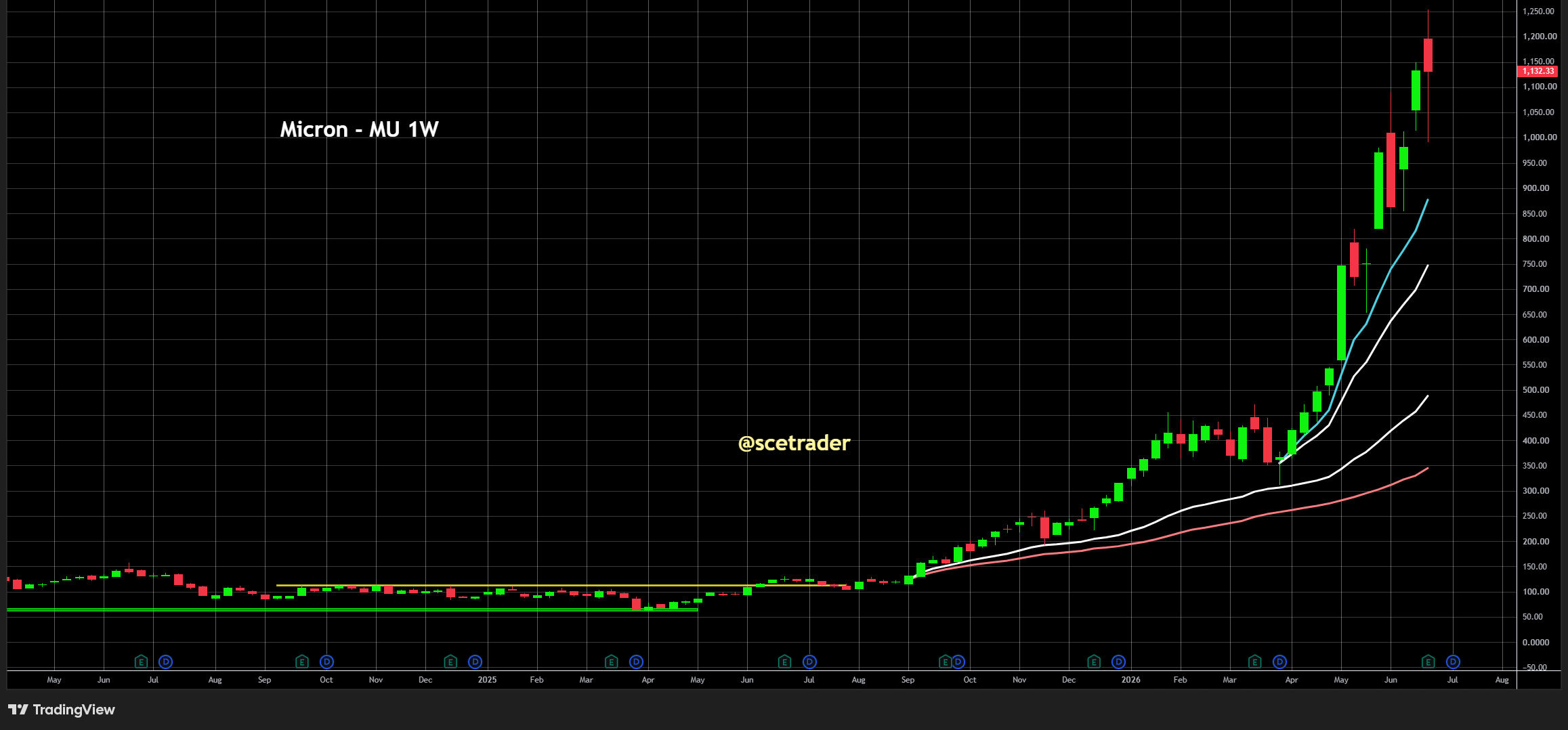
Voor Micron ligt de aantrekkelijkheid niet alleen in het structurele memoryverhaal, maar ook in de mogelijke asymmetrie tussen koersrisico op korte termijn en winstpotentieel op middellange termijn. Als de winstverwachtingen voor FY2027 verder omhoog moeten door HBM, server-DRAM, enterprise SSD’s en langdurige klantcontracten, kan de markt het aandeel opnieuw hoger gaan waarderen.
■ Bij een sterke correctie door CXMT- of capaciteitsangst kan Micron opnieuw interessant worden als HBM en enterprise SSD’s sterk blijven.
■ Een terugval van 10 tot 30 procent zou niet automatisch het einde van de bullcase betekenen.
■ Vanaf het huidige niveau blijft een stijging van 50 tot 100 procent realistisch als winstverwachtingen verder omhoog worden bijgesteld.
■ De grootste kans ligt niet in achter de rally aanlopen, maar in gedisciplineerd kopen wanneer de markt het verhaal verkeerd leest.
■ Beste technische koopzone op basis van VWAP: ongeveer 900 tot 760 dollar.
■ Er zijn geen garanties: lagere AI-capex, echte HBM-prijsdruk, overcapaciteit of zwakkere klantcontracten zouden de thesis duidelijk verzwakken.
Een scenario dat momenteel in de markt wordt besproken, gaat uit van ongeveer 110 dollar winst per aandeel in FY2027. Als daar een multiple van 35 keer op wordt gezet, komt men theoretisch uit op een koersdoel richting 3.900 dollar.
Dat klinkt extreem, maar de achterliggende gedachte is dat de bestaande taxaties mogelijk te laag zijn als Micron in één kwartaal al richting 31 dollar winst per aandeel kan sturen. In dat geval zullen FY2027-ramingen waarschijnlijk opnieuw fors omhoog moeten.
Wij presenteren dit niet als basisscenario of garantie. Wel laat het zien hoe groot de hefboom kan worden als de markt Micron niet langer waardeert als klassieke commodity-DRAM-speler, maar als strategische AI-memoryleverancier.
In dat geval is vanaf het huidige niveau een stijging van 50 tot 100 procent niet onrealistisch, mits de AI-memorycyclus intact blijft en de winstverwachtingen verder omhoog worden aangepast.
Tegelijk blijft timing belangrijk. Juist omdat Micron hard is opgelopen en omdat beleggers nieuws over CXMT, extra capaciteit en mogelijke prijsnormalisatie verkeerd kunnen interpreteren, kan het aandeel eerst nog een stevige correctie laten zien.
Een terugval van 10 tot 30 procent zou in dat scenario geen verrassing zijn. Als de fundamentele HBM- en datacentertrends overeind blijven, kunnen zulke correcties juist de betere koopmomenten worden.
Technisch gezien ligt het aantrekkelijkste koopgebied niet per se op het huidige niveau. Op basis van de langere VWAP-structuur lijkt vooral de zone tussen ongeveer 900 en 760 dollar interessant als betere risico-rendementszone.
Dat zou neerkomen op een stevige correctie, maar juist zo’n daling kan passen bij het scenario waarin beleggers CXMT, extra capaciteit en mogelijke prijsnormalisatie te negatief interpreteren.
Daarmee ontstaat een duidelijk handelingskader. Een kleine startpositie kan verdedigbaar zijn voor wie het aandeel actief wil volgen, maar de echte risico-rendementskans ligt waarschijnlijk lager. De zone 900 tot 760 dollar kan op basis van VWAP een aantrekkelijker instapgebied worden, vooral als de correctie wordt veroorzaakt door headline-angst en niet door fundamentele verslechtering.
Wat kan de bullcase breken?
De bullcase kan wel degelijk breken. Overcapaciteit vanaf 2028–2030 blijft mogelijk als Samsung, SK Hynix, Micron en CXMT tegelijk te veel capaciteit online brengen.
AI-capex kan vertragen als hyperscalers kritischer worden op rendement. Efficiencytechnieken kunnen de memory-intensiteit per taak verlagen. Prijsweerstand kan ontstaan bij consumenten, pc-makers en cloudklanten. Geopolitiek kan CXMT, YMTC, exportregels en klantrelaties verstoren. Voorraadopbouw kan later tot een klassieke memorycorrectie leiden.
Micron is dus geen risicoloos aandeel. Het blijft volatiel en gevoelig voor sentiment. Toch is het verschil met oude cycli duidelijk.
De markt kan dalingen veroorzaken op basis van oude aannames, terwijl de nieuwe AI-gedreven vraaglaag sterker blijft dan verwacht. Dat maakt timing belangrijker dan de simpele vraag of memory cyclisch is.
De belangrijkste risico-indicatoren zijn daarom niet alleen DRAM-spotprijzen. Beleggers moeten kijken naar HBM-contracten, capexplannen van hyperscalers, enterprise-SSD-prijzen, servervraag, voorraadniveaus bij klanten, CXMT-kwalificatie bij grote westerse klanten en de snelheid waarmee nieuwe capaciteit echt productief wordt.
Conclusie
Micron zit in een uitzonderlijke memorycyclus, maar de weg omhoog zal niet recht zijn. Op korte termijn kan het aandeel fors corrigeren als beleggers extra capaciteit en mogelijke toelating van CXMT verkeerd lezen als het einde van het memorytekort.
Fundamenteel is dat beeld te simpel, omdat CXMT vooral gewone DRAM kan verlichten en niet zomaar het tekort aan HBM, high-end server-DRAM en enterprise SSD’s oplost.
De memorymarkt splitst in twee werelden: aan de onderkant blijft memory cyclisch en gevoelig voor China, capaciteit en prijsdruk, terwijl de bovenkant strategischer wordt door AI, langlopende klantcontracten, packagingcomplexiteit en datacenteropslag. Juist dat verschil maakt Micron interessant.
De echte beleggerskans zit niet in blind achter de rally aanlopen, maar in wachten op een verkeerde marktinterpretatie en die correctie gebruiken zolang de fundamentele AI-memorycase overeind blijft.
🔵 English version
Micron, memory chips and the major mistake investors may make
This report covers Micron, the new AI-memory cycle and the question of why investors may misinterpret additional capacity and CXMT. We explain how DRAM, HBM, NAND and enterprise SSDs differ, why memory is becoming a strategic bottleneck and where the opportunities and risks for Micron lie. The core point: a sharp correction may become interesting if the market confuses commodity memory with premium AI memory.
■ Micron could correct sharply in the short term if investors read additional capacity and CXMT’s rise too simplistically as the end of the memory shortage.
■ That correction could become a buying opportunity if the decline is mainly caused by confusion between ordinary DRAM and high-end AI memory.
■ CXMT is becoming a serious player in ordinary DRAM, but it does not simply solve the shortage in HBM, high-end server DRAM and enterprise SSDs.
■ The AI-memory market is splitting into two worlds: commodity memory remains cyclical, while premium memory becomes more strategic, scarcer and more contract-driven.
■ Micron remains volatile, but the current cycle has a more structural foundation through AI, long-term customer contracts, HBM, data center storage and the growth of inference.
The memory market has again become one of the most important themes in technology. Not because memory is new, but because it has shifted from an ordinary component to a strategic bottleneck in AI infrastructure. Without enough memory, bandwidth and storage, GPUs, AI accelerators, cloud platforms and data centers cannot fully use their capacity. Micron stands exactly in the middle of that shift: still cyclical, but increasingly important for HBM, server DRAM, enterprise SSDs and AI data centers.
Investment view
Our investment view is that Micron remains vulnerable to a sharp correction, but that such a decline may become interesting if it results from a wrong market interpretation. The share price has risen sharply because of AI, HBM, rising DRAM prices, rising NAND prices and large customer commitments. That means expectations are high. As soon as investors receive headlines about additional capacity at Samsung, SK Hynix, Micron and especially CXMT, the market may fall back into the old memory reflex.
That reflex is familiar: more capacity means more supply, more supply means lower prices and lower prices pressure margins. That remains a risk. Micron is not a defensive stock and memory remains a sector in which sentiment can turn quickly. Still, this cycle is different because the profit pool is no longer determined only by ordinary DRAM for PCs and smartphones.
The difference lies in the mix. At the lower end, ordinary DRAM remains sensitive to China, capacity, price pressure and inventory cycles. At the upper end, HBM, server DRAM and enterprise storage are becoming more strategic. In those segments, the issue is not only price per bit, but also availability, bandwidth, packaging, power efficiency, customer qualification and supply security.
That is exactly where the market can misprice Micron. If a headline about CXMT or additional capacity is read as proof that the entire memory shortage is over, the stock can fall sharply. But if that new capacity mainly affects ordinary DRAM and not the premium layer of AI memory, the fundamental damage can be much smaller than the share-price reaction suggests.
The strategy is therefore not to blindly chase the rally. The better strategy is to wait for the moment when the market applies the old commodity story too aggressively to a sector that has structurally changed at the high end. A sharp decline in Micron may then be less the end of the bull case and more a valuation reset.
The new facts from June 2026
The memory market entered a new phase in June 2026. The most striking signal is that Apple is seeking approval to buy memory chips from CXMT. Apple is one of the strongest buyers in the world and is known for strict supply chain discipline. If even Apple is exploring alternative memory sources, that says something about the severity of the shortage.
Apple is not looking at CXMT because the market is relaxed. The company is being hit by rising memory and storage costs, putting pressure on MacBooks and iPads. This shifts the story from a purely data-center theme to a broader hardware issue. AI servers are pulling memory capacity toward themselves, memory prices are rising and eventually consumer products also feel the bill.
At the same time, CXMT is no longer a player investors can ignore. The Chinese manufacturer is expanding quickly in DRAM capacity and can become a real pricing factor in ordinary DRAM. That applies especially to DDR4, mainstream DDR5, PC memory and possibly LPDDR. For Micron, this is a real risk on the commodity side of the business.
But wafer capacity is not the same as high-end AI-memory capacity. CXMT can grow in ordinary DRAM, but supplying top-level HBM for Nvidia, AMD or hyperscaler ASICs is a much harder discipline. Stacking, TSVs, packaging, thermals, yields, power efficiency, reliability, customer qualification and geopolitical approval all matter.
On the other hand, Micron shows that the market is no longer driven only by short contract cycles and spot prices. The company has reported strategic customer agreements with billions in commitments, including structures such as take-or-pay, cash deposits and price floors. That indicates customers do not only want to buy chips; they want to secure access to supply.
The core message from June 2026 is therefore that the memory market is moving in two directions at the same time. At the lower end, Chinese competition is increasing. At the upper end, HBM, server DRAM and enterprise SSDs are becoming scarcer, more strategic and more contract-driven. Micron sits exactly between those two worlds.
Hard data: market shares, results and guidance
The current market structure underlines why investors should not treat memory as one homogeneous market. In DRAM, Samsung remains the market leader with roughly 38% market share, followed by SK Hynix at about 29%. Micron sits around 22% to 25%, while CXMT has grown toward 8%. That makes CXMT serious enough to influence the lower end of the DRAM market, but not dominant enough to determine the entire market balance.
■ DRAM market shares: Samsung around 38%, SK Hynix around 29%, Micron around 22–25% and CXMT around 8%.
■ HBM market shares: SK Hynix around 61%, Micron around 21% and Samsung around 17%.
■ Micron Q3 FY2026: $41.46 billion revenue, 84.9% non-GAAP gross margin and $25.11 non-GAAP EPS.
■ Micron Q4 FY2026 outlook: roughly $50 billion revenue, around 86% gross margin and $31 non-GAAP EPS.
■ The key question is not only whether memory prices are high, but how much of the profit comes from premium AI memory and data-center storage.
In HBM, the power structure is different. SK Hynix remains dominant with a market share of around 61%. Micron has grown strongly and is placed around 21% in recent market data, while Samsung is around 17% and trying to regain ground. That difference matters: CXMT is becoming more relevant in ordinary DRAM, but the HBM market remains concentrated for now among SK Hynix, Micron and Samsung.
Micron’s own numbers show how exceptional this cycle has become. In Q3 FY2026, the company reported $41.46 billion in revenue, a non-GAAP gross margin of 84.9% and non-GAAP EPS of $25.11. For Q4 FY2026, Micron guided for roughly $50 billion in revenue, a gross margin of around 86% and non-GAAP EPS of about $31.
The product side is also important. Micron said HBM4 is in high-volume shipments for lead customer platforms and that HBM4E is in development with volume ramp planned for 2027. The company also refers to high-performance PCIe Gen6 SSDs, high-capacity QLC SSDs and new DDR5/LPDDR products. This confirms that Micron is not only benefiting from classic DRAM pricing, but is moving deeper into the AI-infrastructure stack.
These numbers sharpen the investment case. At the lower end, CXMT is growing and the risk of price pressure in ordinary DRAM is increasing. At the upper end, HBM, data-center DRAM and enterprise SSDs remain scarce, technically complex and concentrated among a small group of players. That difference determines whether a correction in Micron is a warning signal or a buying opportunity.
Apple, Micron and years of cheap memory
The clash between Apple and memory suppliers shows clearly how the market has changed. Apple does not want to fully absorb rising memory and storage costs and is therefore looking for alternative sources. From Apple’s perspective, that is logical: the company wants to maintain margin control, especially in products such as MacBooks and iPads where component costs flow directly into selling prices.
For memory suppliers, the story is different. The sector only recently went through a deep downturn in which prices were extremely low and profits were under severe pressure. In such periods, investment becomes more difficult. If memory is too cheap for years, eventually too little profitable capacity is added. Once AI demand then explodes, a shortage emerges that cannot be solved in one or two quarters.
This is the bill for cheap chips. For years, hardware makers benefited from low memory prices. Now that AI servers are pulling HBM, DRAM and NAND capacity toward themselves, bargaining power is temporarily shifting toward memory suppliers. Consumer products face higher component costs, hardware makers lose margin control and memory companies can demand supply security, price floors and long-term agreements.
For Micron, this is crucial. The shortage does not exist only on paper. It affects real pricing, real product prices and real supply chain decisions. If Apple is already looking at alternative suppliers, that is not proof that memory is widely available. It is proof that the existing supply chain is under pressure.
South Korea turns memory into a national AI project
The memory cycle is not driven only by companies. It is becoming increasingly clear that countries see memory as strategic infrastructure. South Korea is the best example. According to recent reports, Samsung Group is preparing an investment plan of about 1,000 trillion won, equivalent to roughly $648 billion, in South Korea. That could include a possible 300 trillion won for new chip fabs in the southwest of the country. At the same time, the South Korean government is speaking with Samsung and SK Hynix about the next phase of large-scale chip investments.
■ South Korea’s investment plans confirm that memory has become a national strategic theme.
■ The amounts point to a multi-year AI capex cycle, not a short inventory peak.
■ Investors may misread such plans as evidence of rapid overcapacity.
■ For HBM and AI memory, the bottleneck remains not only fab capacity, but also packaging, yields and customer qualification.
■ This supports the view that Micron, SK Hynix and Samsung should increasingly be viewed as AI-infrastructure players.
That matters for the entire memory case. These kinds of amounts are not being prepared because the sector sees a short, one-off peak. They are being prepared because AI, data centers, high-performance computing and national technological autonomy are structurally changing demand for memory. Memory is becoming part of industrial policy, just like energy, defense and infrastructure.
For investors, this cuts both ways. On the one hand, it confirms structural demand. On the other hand, the same headline can create short-term fear of overcapacity. That is exactly where the market mistake can occur. Additional capacity does not automatically mean that the shortage in HBM and high-end AI memory disappears quickly. New fabs take years, equipment must be installed, yields must rise, HBM requires advanced packaging and major customers must qualify new products.
For Micron, this matters because it shows that the battle for memory is no longer an ordinary commodity fight. Samsung and SK Hynix are treated by South Korea as strategic pillars of the AI economy. Micron has a comparable role in the United States within the western supply chain. The sector is moving toward a world in which memory is valued not only on price per bit, but also on geopolitical value, supply security and position within AI infrastructure.
Memory becomes the new oil of AI
The market has focused mainly on GPUs for years. That made sense, because Nvidia became the visible winner of the AI revolution. But the next phase of AI is not only about who has the fastest accelerator. It is about who can organize enough memory, storage, power, cooling and network capacity to fully utilize those accelerators.
An AI chip without enough HBM is like a factory without raw materials. The compute power is present, but the data cannot be delivered fast enough. A data center without enough enterprise SSDs cannot efficiently store and retrieve models, datasets, logs and vector databases. A cloud platform without enough server DRAM cannot allocate its capacity optimally.
This shifts power in the AI chain. Nvidia remains crucial, but SK Hynix, Micron and Samsung are also becoming gatekeepers. They are not merely supplying components; they are supplying the bandwidth and storage layer that determines how much AI capacity can actually be brought online.
For Micron, this means the company should no longer be viewed only as a classic DRAM player. Micron sits at the intersection of three major trends: AI memory, data-center storage and the repricing of supply security. That makes the stock interesting, but also complex. The market may still treat it as old commodity DRAM, while the profit profile is increasingly shifting toward premium products.
Why memory is not one market
The biggest mistake investors can make is to treat memory as one homogeneous product group. This often happens because the sector has historically been known as cyclical and price-sensitive. In old cycles, that was understandable. When too much DRAM capacity came online, prices fell. When PCs or smartphones disappointed, inventories rose. When producers expanded at the same time, margin pressure followed.
That classic cycle still exists, but AI has added a new layer. High-end accelerators need HBM. Servers need more DDR5 and server DRAM. Data centers need enterprise SSDs. AI companies must store training data, model weights, checkpoints, logs, embeddings and vector databases. As a result, memory is no longer only a volume product, but also a strategic infrastructure layer.
That is why investors must segment the market. A price decline in DDR4 says little about HBM. Additional supply in mainstream DDR5 does not automatically mean there is enough memory bandwidth for heavy AI clusters. More NAND capacity does not solve a shortage in server DRAM. And CXMT capacity in ordinary DRAM does not mean Micron immediately loses its position in HBM.
Investors who continue to see memory as one market may write off Micron too early. Investors who split the market into commodity memory and premium AI memory can see why a share-price correction may become fundamentally exaggerated.
The main memory types
SRAM
SRAM is very fast memory located close to the processor, GPU or accelerator. It is used as cache, giving a chip fast access to data that is frequently needed. SRAM is extremely fast, but expensive and large. It takes up a lot of chip area and is therefore not suitable as mass working memory or storage.
The key players in SRAM are mainly chip designers and foundries: Nvidia, AMD, Intel, Apple, Qualcomm, Broadcom, Google, Amazon, Microsoft, TSMC, Samsung Foundry and Intel Foundry. For Micron, SRAM is not the main story. The major bottleneck in AI is mainly in HBM, server DRAM, fast interconnects and data-center storage.
DRAM
DRAM is classic working memory. It is used in PCs, smartphones, servers, data centers, networking equipment and AI systems. DRAM is volatile memory: data disappears when power is lost. It is therefore designed to actively work with data, not to store data permanently.
The main players are Samsung, SK Hynix and Micron. CXMT is the fast-growing Chinese challenger. Nanya and Winbond also play a role in smaller or more specialized segments. Historically, DRAM was the core of the boom-bust cycle in memory. This cycle is different because AI, cloud, servers and data centers are pulling up the high-end side of DRAM. For Micron, the mix is therefore crucial: ordinary consumer DRAM is less valuable than server DRAM, DDR5 and HBM.
DDR4
DDR4 is an older generation of DRAM. It is still widely used in older servers, PCs, industrial applications, networking equipment and embedded systems. Many companies do not replace their infrastructure all at once, which means DDR4 remains relevant longer than investors sometimes think.
The main players are Samsung, SK Hynix, Micron and CXMT. It is precisely in DDR4 that CXMT can have a faster impact, because the technology is older and less complex than HBM. If CXMT supplies more DDR4, it can ease the lower end of the market and create price pressure. For Micron, this is a risk in commodity DRAM, but not a direct break in the AI case.
DDR5
DDR5 is the new standard for modern PCs and servers. It offers more speed, more capacity and better efficiency than DDR4. DDR5 is important for cloud platforms, AI PCs, new server generations and data centers.
The main players are Samsung, SK Hynix and Micron. CXMT is also trying to become stronger in DDR5. DDR5 supports the system, but HBM feeds the accelerator with extremely high bandwidth. An AI server needs both, but the strategic bottleneck is mainly the memory placed directly around the accelerator.
For Micron, DDR5 is positive for the mix because it is more valuable than older DRAM. At the same time, investors must keep distinguishing between mainstream DDR5, which can become more sensitive to competition, and premium AI memory, where technical requirements are much higher.
LPDDR
LPDDR stands for low-power DRAM. It is used in smartphones, tablets, ultrabooks, AI PCs and edge-AI devices. It is designed for low power consumption, making it important in devices where battery life and heat are major constraints.
The main producers are Samsung, SK Hynix and Micron. Major customers include Apple, Qualcomm, MediaTek, Samsung Mobile, Xiaomi, Oppo, Vivo and laptop manufacturers. CXMT can also grow in LPDDR over time, but premium customers pay close attention to power consumption, reliability, compatibility and supply chain risk. For Micron, LPDDR is relevant as part of the broader memory mix and as a potential growth layer in on-device AI.
GDDR
GDDR is graphics memory. It is used in graphics cards, game consoles and some accelerators. It is fast and suitable for graphics applications, gaming and certain compute workloads.
The main players are Samsung, SK Hynix and Micron. Customers include Nvidia, AMD, game-console platforms and graphics-card manufacturers. GDDR remains important, but it does not have the same strategic position as HBM in the newest AI data centers. For cheaper AI solutions, local accelerators and gaming GPUs, however, demand outside the HBM top remains relevant.
HBM
HBM is the premium category within memory. HBM stands for High Bandwidth Memory. This memory is stacked and placed close to the AI accelerator. It delivers extremely high bandwidth and is crucial for modern AI systems.
The main players are SK Hynix, Samsung and Micron. SK Hynix has built a strong position through early deliveries to Nvidia. Samsung is trying to regain ground. Micron is growing aggressively in HBM and trying to expand its role in the AI-memory market.
HBM is technically complex. It requires advanced DRAM dies, stacking, TSVs, packaging, yields, thermal management and close customer qualification. This is not ordinary DRAM in another form. HBM also consumes a lot of wafer capacity. If Samsung, SK Hynix and Micron produce more HBM, less capacity remains available for ordinary DRAM. As a result, even conventional DRAM can remain tighter than investors expect.
The visionary significance of HBM is large. HBM becomes the highway between data and compute. Without that highway, the AI factory stalls. Countries and hyperscalers without access to enough HBM fall behind in AI capacity.
HBM3E, HBM4 and HBM4E
Within HBM, the market is shifting toward newer generations. HBM3E is important for current AI platforms. HBM4 and HBM4E will be important for the next generation of accelerators.
The key players remain SK Hynix, Samsung and Micron. The battle is not only about volume, but also about speed, power efficiency, thermals, yields, packaging and approval by major customers. New HBM generations make AI systems more efficient, but that does not mean demand falls. Often the opposite happens: every new accelerator gets more HBM per chip.
For Micron, this is crucial. If the company gains share in HBM3E, HBM4 and later generations, Micron becomes less of an ordinary DRAM player and more of a strategic AI-infrastructure supplier.
NAND
NAND is storage memory. It keeps data even when power is turned off. NAND is found in SSDs, smartphones, PCs, data centers, cars and industrial applications.
The main players are Samsung, SK Hynix/Solidigm, Micron, Kioxia, Western Digital/SanDisk and YMTC. NAND is not working memory like DRAM, but it is becoming increasingly important because of AI. Training data, model weights, checkpoints, logs, embeddings, vector databases and backups all have to be stored somewhere.
For Micron, NAND matters because the company does not only supply memory for processing, but also storage for data centers. In the old cycle, NAND depended heavily on smartphones, PCs and consumer electronics. In the new cycle, data-center storage is becoming more important.
Enterprise SSD
Enterprise SSDs are high-end storage products for data centers. They are faster, more reliable and more expensive than consumer SSDs. AI makes them more important because companies train larger models, store more model versions, keep more data and build retrieval systems that allow AI models to search corporate data.
The main players are Samsung, SK Hynix/Solidigm, Micron, Kioxia, Western Digital/SanDisk and controller and storage names such as Phison, Silicon Motion and Marvell. On the systems side, Dell Technologies, HPE, Pure Storage and NetApp play a role.
For Micron, enterprise SSD is a second AI track next to HBM. AI does not only need chips that compute; it also needs infrastructure that can store, move and retrieve data. That makes the AI-memory cycle broader than HBM alone.
CXL and tiered memory
CXL stands for Compute Express Link. It makes it possible to share memory more flexibly between servers, accelerators and other components. This can become important for long-context models, agentic AI and large inference workloads.
Important players include Samsung, SK Hynix, Micron, Intel, AMD, Broadcom, Marvell and hyperscalers. CXL does not directly replace HBM. HBM remains necessary close to the accelerator for the highest bandwidth. But CXL can help build larger memory pools and make data centers more efficient.
For Micron, CXL is relevant because the company can benefit from new memory modules and data-center solutions. CXL is therefore not automatically bearish for memory. It can use memory more efficiently, but also enable new AI applications.
Specialty memory
Specialty memory, including NOR Flash and other embedded memory forms, is used in cars, industrial systems, networking equipment, consumer electronics and embedded applications. This is not the core of the AI boom, but it does show how broad the shortage can become.
Important players include Winbond, Macronix, Infineon, GigaDevice, ISSI and other specialized suppliers. If major suppliers shift capacity toward HBM, server DRAM and advanced NAND, mature memory can actually become tighter. For Micron, this is not the main story, but it is relevant for the overall supply chain.
The main players by segment
Investors should not ask who makes “memory”, but who makes which type of memory and where the margin lies. In SRAM, chip designers and foundries dominate. In ordinary DRAM, Samsung, SK Hynix and Micron dominate, with CXMT as the fast-growing challenger. In HBM, the key players are mainly SK Hynix, Samsung and Micron. In NAND and enterprise SSDs, Kioxia, Western Digital/SanDisk, Solidigm and YMTC also play an important role.
■ SRAM: Nvidia, AMD, Intel, Apple, Qualcomm, Broadcom, Google, Amazon, Microsoft, TSMC, Samsung Foundry and Intel Foundry.
■ DRAM and DDR4: Samsung, SK Hynix, Micron, CXMT, Nanya and Winbond.
■ DDR5 and LPDDR: Samsung, SK Hynix, Micron and increasingly CXMT at the lower end or in selected markets.
■ HBM: SK Hynix, Samsung and Micron.
■ NAND and enterprise SSD: Samsung, SK Hynix/Solidigm, Micron, Kioxia, Western Digital/SanDisk, YMTC, Phison, Silicon Motion and Marvell.
Why CXMT only partly solves the problem
CXMT is becoming a serious factor. If CXMT grows toward hundreds of thousands of wafers per month, it can change the balance in ordinary DRAM. DDR4, mainstream DDR5 and possibly LPDDR are especially exposed. That can create price pressure in PCs, laptops, consumer electronics and certain non-US markets.
■ CXMT can ease ordinary DRAM and later create price pressure in DDR4, mainstream DDR5 and possibly LPDDR.
■ CXMT can become attractive for Apple, PC makers and certain non-US markets if memory costs rise too sharply.
■ CXMT does not automatically solve HBM scarcity because HBM requires much more complex production, packaging and customer qualification.
■ CXMT mainly affects the Micron story if investors confuse commodity DRAM with AI memory.
■ CXMT can slow the extreme bull case in ordinary DRAM, but it is not a direct killer of the AI-memory case.
But CXMT only partly solves the AI-memory problem. The real bottleneck is in HBM, high-end server DRAM, enterprise SSDs, packaging and qualification at major customers. A PC maker can test alternative DRAM faster than Nvidia or a hyperscaler can approve a new HBM platform for a high-end AI cluster.
The correct conclusion is that CXMT is mainly a risk for commodity DRAM, while the AI-premium layer remains more strongly concentrated at SK Hynix, Samsung and Micron for now. That does not mean Micron cannot be affected by CXMT. It means investors must understand which part of the market is being affected.
Additional capacity not automatically overcapacity
More capacity is coming. Samsung, SK Hynix, Micron and CXMT are expanding. But new capacity is not immediately usable AI capacity. Fabs take years to build. Equipment installation takes time. Yields must improve. Customers must qualify chips. HBM also requires advanced packaging and close cooperation with AI-chip makers.
In addition, new capacity is partly absorbed by growing demand. AI is not a static market. If more memory becomes available, clusters become larger, context windows become longer, inference volumes rise and enterprise AI applications are rolled out more broadly. The market must therefore look not only at supply, but also at the speed at which demand grows with it.
That is why price normalization can come later without immediately breaking the profit cycle. Lower prices can even release additional demand. If AI becomes cheaper, companies will use more AI. Memory consumption per task may decline, but the number of tasks can rise. That is the Jevons layer of AI: more efficient infrastructure lowers the cost per task, but often increases total usage.
Why AI continues to drive demand
AI requires memory and storage at multiple levels. Training data must be stored and processed. Model weights must be available during inference. Checkpoints must be saved during training. KV-cache grows with long context and agentic AI. Vector databases are used to make corporate data searchable for AI models. Logs, prompts, outputs and compliance data must be stored.
AI therefore does not only produce answers. It also produces new data. That data requires storage, memory and infrastructure. This is why looking only at GPUs is wrong. The AI stack consists of compute, memory, storage, networking and energy. Memory sits in the middle of that stack.
The major change is that AI raises demand for memory not only cyclically, but also functionally. More AI means more data in motion, more models in production, more inference, more storage, more caching and more data-center complexity. That is a different demand curve from the old smartphone or PC cycle.
Efficiency helps, but does not automatically shrink the market
More and more techniques are making AI more efficient. Quantization lowers the number of bits with which models operate. KV-cache compression lowers memory pressure in long context. Mixture-of-Experts does not activate the entire model for every task. Distillation makes smaller models possible. Speculative decoding accelerates inference. CXL and tiered memory make data centers more flexible.
These techniques can lower the cost per AI task, but that does not automatically mean total memory demand falls. If AI becomes cheaper, companies use it more often. More agents, more applications, more documents, more users and more automation can actually increase demand.
Efficiency is therefore a risk for extreme price levels, but not automatically bearish for the overall memory market. The more likely outcome is that efficiency makes the market larger, while it can normalize profit per unit later.
Why memory can become less cyclical
Memory remains cyclical. High prices attract supply. If customers build too much inventory, a correction can follow later. If AI capex slows, the sector can be hit hard. That old risk has not disappeared.
But the cycle is less simple than it used to be. In the past, memory was driven mainly by PCs, smartphones and general electronics. Now AI is added on top. Customers want to secure supply, sign longer contracts and accept price floors or deposits because without memory their data centers cannot operate at full capacity.
The right formulation is therefore not that memory is no longer cyclical. The right formulation is that memory remains cyclical, but that the upper end of the market becomes more strategic and less easily replaceable. This is exactly why Micron is interesting: the company has not escaped the old cycle, but it does benefit from the new premium layer.
What does this mean for Micron?
Micron sits at the intersection of the old and the new memory cycle. On one hand, the company remains sensitive to price declines, inventory corrections, overcapacity and profit-taking. On the other hand, Micron benefits from HBM, server DRAM, DDR5, enterprise SSDs and AI-related demand.
■ In a correction driven by CXMT fear, investors must examine which segment is actually being affected.
■ In a correction driven by falling HBM prices or lower AI capex, the fundamental risk becomes larger.
■ With continued customer commitments, strong HBM demand and strong enterprise SSD demand, the bull case remains intact.
■ Micron is not a defensive stock, but it can become a strategic buying opportunity when the market misreads the story.
The market may sell Micron incorrectly in the short term if investors believe that CXMT and additional capacity solve the entire problem. Such a correction can be sharp. Precisely because the stock has risen strongly, the decline can be amplified technically and emotionally.
But if HBM, server DRAM and enterprise SSDs remain tight, such a decline may be more of a reset than the end of the bull case. For investors, the question is therefore not only whether Micron falls. The better question is why Micron falls. A decline caused by real deterioration in HBM, AI capex or data-center storage is fundamentally different from a decline caused by general fear of additional DRAM capacity.
The asymmetry lies in the difference between share-price reaction and fundamental damage. The stock can fall sharply on a headline. The fundamental damage is much smaller if that headline mainly affects ordinary DRAM and not the premium layer of AI memory.
Micron: valuation, upside and the importance of patience
For Micron, the appeal lies not only in the structural memory story, but also in the possible asymmetry between short-term share-price risk and medium-term earnings potential. If FY2027 earnings estimates must move higher because of HBM, server DRAM, enterprise SSDs and long-term customer contracts, the market may re-rate the stock.
■ In a sharp correction driven by CXMT or capacity fear, Micron can become interesting again if HBM and enterprise SSDs remain strong.
■ A 10% to 30% pullback would not automatically mean the end of the bull case.
■ From current levels, a 50% to 100% rise remains realistic if earnings expectations continue to move higher.
■ The biggest opportunity lies not in chasing the rally, but in buying with discipline when the market misreads the story.
■ Best technical buying zone based on VWAP: roughly $900 to $760.
■ There are no guarantees: lower AI capex, real HBM price pressure, overcapacity or weaker customer contracts would clearly weaken the thesis
One scenario currently discussed in the market assumes roughly $110 in earnings per share in FY2027. If a 35x multiple is applied to that, the theoretical share-price target moves toward $3,900.
That sounds extreme, but the underlying idea is that current estimates may be too low if Micron can guide toward $31 in EPS in a single quarter. In that case, FY2027 estimates will probably need to be revised sharply higher.
We do not present this as a base case or a guarantee. It does show how large the leverage can become if the market stops valuing Micron as a classic commodity-DRAM player and starts valuing it as a strategic AI-memory supplier. In that scenario, a 50% to 100% rise from current levels is not unrealistic, provided the AI-memory cycle remains intact and earnings expectations are revised higher.
At the same time, timing remains important. Precisely because Micron has risen sharply and because investors may misinterpret news about CXMT, additional capacity and possible price normalization, the stock can first see a major correction. A 10% to 30% pullback would not be surprising in that scenario. If the fundamental HBM and data-center trends remain intact, such corrections can become the better buying opportunities.
Technically, the most attractive buying area is not necessarily at the current level. Based on the longer VWAP structure, the zone between roughly $900 and $760 looks especially interesting as a better risk-reward area. That would imply a significant correction, but exactly such a decline could fit the scenario in which investors interpret CXMT, additional capacity and possible price normalization too negatively.
That creates a clear trading framework. A small starter position can be defensible for those who want to follow the stock actively, but the real risk-reward opportunity probably lies lower. Based on VWAP, the $900 to $760 zone may become a more attractive entry area, especially if the correction is caused by headline fear and not by fundamental deterioration..
What can break the bull case?
The bull case can definitely break. Overcapacity from 2028–2030 remains possible if Samsung, SK Hynix, Micron and CXMT all bring too much capacity online at the same time. AI capex can slow if hyperscalers become more critical about returns. Efficiency techniques can lower memory intensity per task. Price resistance can emerge among consumers, PC makers and cloud customers. Geopolitics can disrupt CXMT, YMTC, export rules and customer relationships. Inventory build-up can later lead to a classic memory correction.
Micron is therefore not a risk-free stock. It remains volatile and sentiment-sensitive. Still, the difference from old cycles is clear. The market can create declines based on old assumptions, while the new AI-driven demand layer remains stronger than expected. That makes timing more important than the simple question of whether memory is cyclical.
The key risk indicators are therefore not only DRAM spot prices. Investors must watch HBM contracts, hyperscaler capex plans, enterprise SSD prices, server demand, customer inventory levels, CXMT qualification at major western customers and the speed at which new capacity actually becomes productive.
Conclusion
Micron is in an exceptional memory cycle, but the path higher will not be straight. In the short term, the stock can correct sharply if investors misread additional capacity and the possible approval of CXMT as the end of the memory shortage. Fundamentally, that view is too simplistic, because CXMT can mainly ease ordinary DRAM and does not simply solve the shortage in HBM, high-end server DRAM and enterprise SSDs.
The memory market is splitting into two worlds: at the lower end, memory remains cyclical and sensitive to China, capacity and price pressure, while the upper end becomes more strategic through AI, long-term customer contracts, packaging complexity and data-center storage. That difference is exactly what makes Micron interesting.
The real investment opportunity is not in blindly chasing the rally, but in waiting for a wrong market interpretation and using that correction as long as the fundamental AI-memory case remains intact.
Disclaimer Aan de door ons opgestelde informatie kan op geen enkele wijze rechten worden ontleend. Alle door ons verstrekte informatie en analyses zijn geheel vrijblijvend. Alle consequenties van het op welke wijze dan ook toepassen van de informatie blijven volledig voor uw eigen rekening.
Wij aanvaarden geen aansprakelijkheid voor de mogelijke gevolgen of schade die zouden kunnen voortvloeien uit het gebruik van de door ons gepubliceerde informatie. U bent zelf eindverantwoordelijk voor de beslissingen die u neemt met betrekking tot uw beleggingen.


