Qualcomm met cijfers en 13% hoger: Zitten long via optieconstructie

◼ Wij zitten long via een optieconstructie en spelen op verdere stijging
◼ Aandeel stijgt circa 13% ondanks zwakke onderliggende cijfers
◼ Handsetsegment daalt 13% maar nadert een cyclische bodem
◼ AI en datacenter verschuiven het waarderingskader structureel
Qualcomm presenteert cijfers die op operationeel niveau onder druk staan, maar de koers reageert met een stijging van circa 13%. De omzet daalt licht en de winstgevendheid verslechtert, terwijl de vooruitzichten voor het komende kwartaal onder de verwachtingen liggen. Toch wordt de koers niet meer gedreven door deze cijfers, maar door de volgende fase waarin AI, datacenter en diversificatie centraal staan.
● Omzet komt uit op $10,6 miljard, een daling van circa 3% op jaarbasis
● Operationele winst daalt naar $2,3 miljard door lagere volumes en hogere kosten
● Handsetomzet daalt met 13% naar circa $6,0 miljard en blijft de grootste zwakke factor
De zwakte in de cijfers zit volledig in de traditionele kernbusiness. Hogere geheugenprijzen en zwakke vraag drukken volumes, vooral in China. Dit is geen structureel probleem, maar een late fase van de cyclus. Het bedrijf geeft zelf aan dat deze markt mogelijk een bodem bereikt in het komende kwartaal, wat betekent dat de neerwaartse druk begint af te nemen.
Investment view
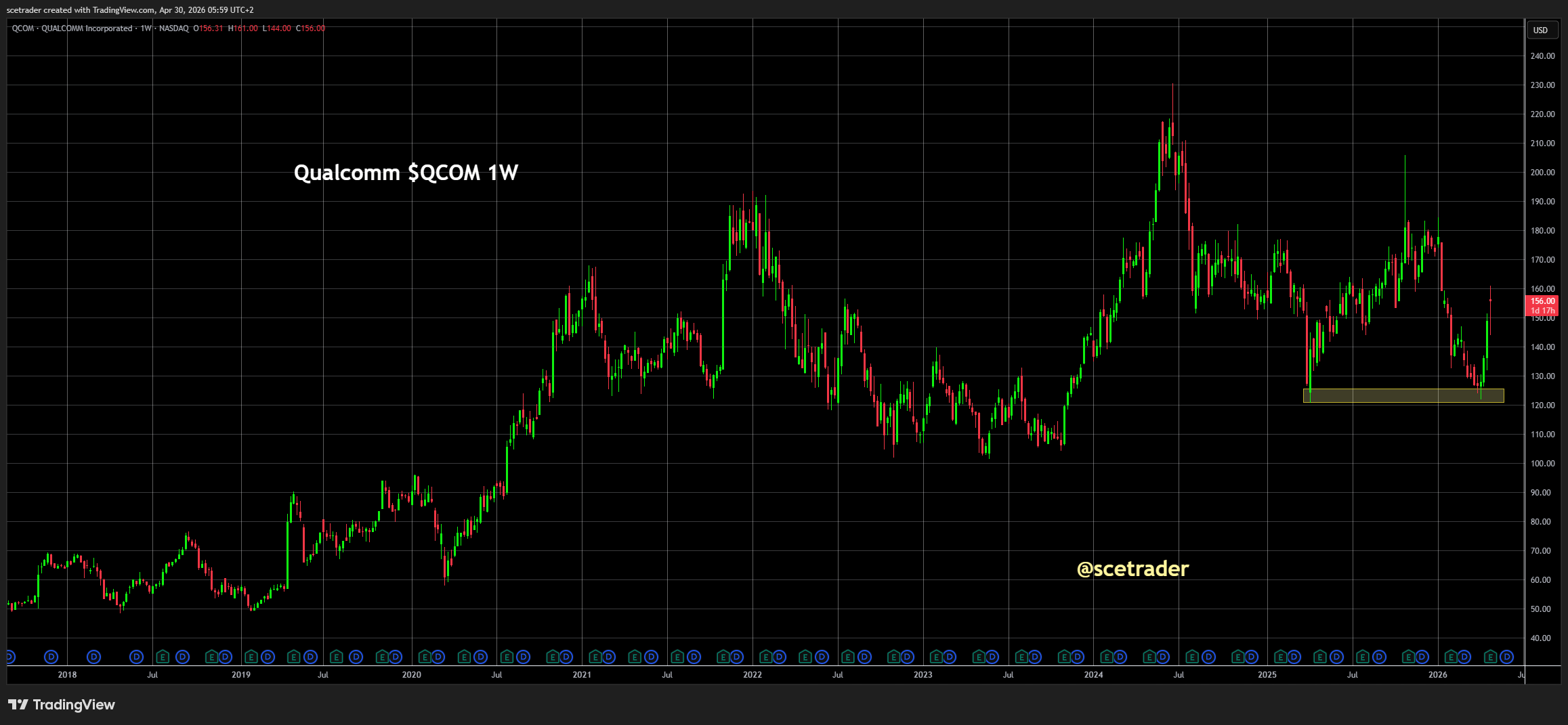
Wij zitten long via een optieconstructie en blijven dat, omdat hier een zeldzame dislocatie zichtbaar is tussen wat het bedrijf vandaag rapporteert en hoe de markt het aandeel waardeert. De koers beweegt al op basis van de volgende cyclus, terwijl de cijfers nog volledig de oude cyclus reflecteren, en juist dat spanningsveld creëert een setup waarin de kans op een versnelling omhoog groter is dan het neerwaartse risico.
🟪 De optieconstructie is opgezet om te profiteren van een versnelling die niet door huidige cijfers wordt verklaard
🟪 De markt prijst AI- en datacentergroei vooruit, nog voordat deze zichtbaar wordt in de resultaten
🟪 De combinatie van een cyclische bodem en nieuwe groei creëert een uitzonderlijke asymmetrische kans
De eerste laag van de analyse zit in de winstkwaliteit. Operationeel staan marges onder druk en de groei ontbreekt in de kernbusiness. De nettowinst wordt bovendien kunstmatig verhoogd door een belastingbate, waardoor het gerapporteerde beeld sterker lijkt dan de werkelijkheid. In een normaal scenario zou dit leiden tot een daling van het aandeel. Dat gebeurt niet. Dat is het eerste signaal dat de markt een andere variabele prijst.
De tweede laag zit in de waarderingsshift. Qualcomm wordt historisch gezien gewaardeerd als een cyclisch semiconductoraandeel dat sterk afhankelijk is van smartphones. Die perceptie verandert. Door de combinatie van AI, edge computing en datacenterchips verschuift het bedrijf richting markten met hogere marges, langere groeicycli en structurele vraag. Dit leidt niet alleen tot groei, maar tot een andere multiple die beleggers bereid zijn te betalen.
De derde laag is timing. De handsetmarkt is zwak, maar nadert een omslagpunt. Qualcomm zelf geeft aan dat deze markt mogelijk een bodem bereikt in het komende kwartaal en daarna weer groeit. Dit betekent dat de grootste negatieve factor uit de cijfers verdwijnt op het moment dat nieuwe groeigebieden beginnen bij te dragen. Dit is precies het punt waarop markten vaak het hardst bewegen, omdat beide richtingen elkaar kruisen.
De vierde laag is positionering van kapitaal. De stijging van circa 13% laat zien dat grote partijen zich al herpositioneren. Dit gebeurt niet op basis van de huidige cijfers, maar op basis van toekomstige cashflows. Dat betekent dat de beweging nog niet klaar hoeft te zijn. In veel gevallen begint de herwaardering voordat de cijfers verbeteren, en versnelt deze juist zodra de eerste signalen van herstel zichtbaar worden.
De optieconstructie speelt exact op deze combinatie in. De kans is groot dat de koers sneller beweegt dan de fundamentele verbetering zichtbaar wordt, omdat de markt vooruitloopt. Tegelijkertijd wordt de downside beperkt door bodemvorming in de handsetmarkt en ondersteuning vanuit kapitaalallocatie. Dit creëert een profiel waarin convexiteit de juiste strategie is.
De essentie van deze Investment view is dat dit geen trade is op cijfers, maar op een verschuiving in hoe het aandeel wordt geprijsd. Dat maakt de setup sterker, omdat het niet afhankelijk is van één kwartaal, maar van een structurele verandering in perceptie en positionering.
AI
AI vormt de kern van deze herwaardering en verandert de economische structuur van het bedrijf. De vraag verschuift naar chips die lokaal AI kunnen verwerken, wat de waarde per chip verhoogt en nieuwe toepassingen mogelijk maakt. Qualcomm speelt hierop in door AI-functionaliteit direct te integreren in devices.
De stap naar datacenters is strategisch nog belangrijker. Dit opent een markt met hogere marges en structurele groei. De levering aan een hyperscaler bevestigt dat Qualcomm daadwerkelijk toetreedt tot deze markt en niet alleen experimenteert. De samenwerking met OpenAI versterkt dit en positioneert het bedrijf in meerdere lagen van de AI-keten.
De economische waarde zit in de combinatie van compute, connectiviteit en AI. Dit zorgt voor een verschuiving van een volumegedreven model naar een waardegedreven model, wat direct impact heeft op marges en waardering.
Positieve en negatieve catalysts
🟩 Start van leveringen van datacenterchips aan hyperscalers
🟩 Bodemvorming in handsetmarkt en herstel van volumes
🟩 Structurele groei in automotive en IoT
🟥 Aanhoudende zwakte in smartphonevraag op korte termijn
🟥 Druk op marges door stijgende geheugenprijzen
🟥 Execution risico in opschaling van nieuwe markten
Cijfers en outlook
De omzet komt uit op $10,6 miljard, een daling van circa 3% op jaarbasis. De operationele winst bedraagt circa $2,3 miljard en staat onder druk door lagere volumes en hogere kosten. De nettowinst wordt sterk beïnvloed door een belastingbate van $5,7 miljard, wat het beeld vertekent.
Binnen de QCT-divisie komt de omzet uit op circa $9,1 miljard. Handsets dalen naar ongeveer $6,0 miljard, terwijl automotive groeit naar circa $1,3 miljard en IoT naar circa $1,7 miljard. Dit bevestigt de verschuiving in de omzetmix.
Voor het volgende kwartaal verwacht Qualcomm een omzet tussen $9,2 miljard en $10,0 miljard. De verwachting voor QCT ligt tussen $7,9 miljard en $8,5 miljard en voor QTL tussen $1,15 miljard en $1,35 miljard. De winst per aandeel wordt verwacht tussen $1,26 en $1,46 op GAAP-basis en tussen $2,10 en $2,30 op non-GAAP-basis.
Slotvisie
Dit is een overgangsfase waarin de cijfers nog zwak zijn, maar de waardering al verandert. De markt kijkt vooruit en prijst de volgende groeicyclus in voordat deze zichtbaar wordt in de resultaten. De stijging van circa 13% is een eerste bevestiging dat deze beweging gestart is. Binnen dit profiel ontstaat een zeldzame dislocatie tussen huidige fundamentals en toekomstige waarde. Dat is precies het type setup waar wij long willen zitten. Daarom blijven wij gepositioneerd via een optieconstructie en spelen wij op verdere stijging.
🔵 English version
Qualcomm: market looks ahead, we are long via options in a rare dislocation
◼ We are long via an option structure targeting further upside
◼ Stock rises approximately 13% despite weak underlying results
◼ Handset segment declines 13% but approaches a cyclical bottom
◼ AI and data center structurally shift the valuation framework
Qualcomm reports results that are operationally weak, yet the stock rises approximately 13%. Revenue declines slightly and profitability deteriorates, while the outlook for the next quarter comes in below expectations. However, the stock is no longer driven by current results, but by the next phase where AI, data center and diversification take the lead.
● Revenue comes in at $10.6 billion, down approximately 3% year over year
● Operating income declines to $2.3 billion due to lower volumes and higher costs
● Handset revenue declines 13% to approximately $6.0 billion and remains the main weakness
The weakness in results is entirely concentrated in the core business. Higher memory prices and weak demand reduce volumes, especially in China. This is not structural but a late-cycle phase. The company indicates that this segment may bottom in the coming quarter, meaning downside pressure is easing.
Investment view
We are long via an option structure and remain positioned for further upside because there is a rare dislocation between what the company reports today and how the market values the stock. The price is already moving on the next cycle while the financials still reflect the old cycle, and this tension creates a setup where upside acceleration outweighs downside risk.
🟪 The option structure is designed to capture acceleration not explained by current results
🟪 The market is pricing AI and data center growth ahead of visible fundamentals
🟪 The combination of a cyclical bottom and new growth creates strong asymmetry
The first layer of analysis is earnings quality. Operationally, margins are under pressure and growth is absent in the core business. Net income is artificially boosted by a tax benefit, making the reported picture stronger than reality. In a normal scenario, this would lead to downside. That does not happen, which signals that the market is pricing a different variable.
The second layer is valuation shift. Qualcomm has historically been valued as a cyclical semiconductor company tied to smartphones. That perception is changing. Through AI, edge computing and data center expansion, the company is moving into markets with higher margins and structural demand. This not only drives growth but also multiple expansion.
The third layer is timing. The handset market is weak but approaching an inflection point. The company indicates that this segment may bottom in the coming quarter and return to growth. This means the largest negative factor is fading just as new growth drivers emerge. This is typically when markets move the most.
The fourth layer is capital positioning. The approximately 13% move shows that large players are already repositioning. This is not based on current results but on future cash flows. In many cases, re-rating begins before fundamentals improve and accelerates once early signs of recovery appear.
The option structure captures this exact setup. The market is likely to move faster than fundamentals as expectations shift. Downside is limited by a potential bottom in handsets and supported by capital allocation. This creates a profile where convexity is the correct strategy.
The essence of this investment view is that this is not a trade on current earnings but on a shift in valuation framework. That makes the setup stronger because it is not dependent on a single quarter but on a structural change in perception and positioning.
AI
AI is the core of the re-rating and fundamentally changes the economic structure of the company. Demand is shifting toward chips capable of local AI processing, increasing value per chip and enabling new applications. Qualcomm is integrating AI directly into devices to capture this shift.
The move into data centers is even more important. It opens access to higher-margin and structurally growing markets. The hyperscaler engagement confirms real entry into this space. The collaboration with OpenAI reinforces positioning across multiple layers of the AI value chain.
The economic value lies in the combination of compute, connectivity and AI, shifting the model from volume-driven to value-driven, directly impacting margins and valuation.
Positive and negative catalysts
🟩 Data center chip shipments to hyperscalers begin
🟩 Handset market bottoming and recovery in volumes
🟩 Structural growth in automotive and IoT
🟥 Ongoing weakness in smartphone demand in the near term
🟥 Margin pressure from rising memory costs
🟥 Execution risk in scaling new markets
Financials and outlook
Revenue comes in at $10.6 billion, down approximately 3% year over year. Operating income is approximately $2.3 billion and under pressure due to lower volumes and higher costs. Net income is heavily influenced by a $5.7 billion tax benefit, distorting the underlying picture.
Within QCT, revenue is approximately $9.1 billion. Handsets decline to around $6.0 billion, while automotive grows to approximately $1.3 billion and IoT to approximately $1.7 billion, confirming the shift in revenue mix.
For the next quarter, Qualcomm expects revenue between $9.2 billion and $10.0 billion. QCT is expected between $7.9 billion and $8.5 billion and QTL between $1.15 billion and $1.35 billion. EPS is expected between $1.26 and $1.46 GAAP and $2.10 to $2.30 non-GAAP.
Final view
This is a transition phase where results remain weak but valuation is already shifting. The market is forward-looking and pricing the next growth cycle before it becomes visible in results. The approximately 13% move confirms that this process has started. This creates a rare dislocation between current fundamentals and future value. That is exactly the type of setup where we want to be long. We remain positioned via an option structure targeting further upside.
Disclaimer Aan de door ons opgestelde informatie kan op geen enkele wijze rechten worden ontleend. Alle door ons verstrekte informatie en analyses zijn geheel vrijblijvend. Alle consequenties van het op welke wijze dan ook toepassen van de informatie blijven volledig voor uw eigen rekening.
Wij aanvaarden geen aansprakelijkheid voor de mogelijke gevolgen of schade die zouden kunnen voortvloeien uit het gebruik van de door ons gepubliceerde informatie. U bent zelf eindverantwoordelijk voor de beslissingen die u neemt met betrekking tot uw beleggingen.


