Prosus: Omzet groeit hard, maar winstkwaliteit en grafiek blijven zwak - Wij blijven weg

Geen tijd om het hele artikel te lezen? Dit zijn de punten die voor beleggers het verschil maken.
■ Prosus: De omzet stijgt fors en adjusted earnings per aandeel groeien 12%, maar gewone winst per aandeel daalt, de groep draait operationeel verlies en de vrije kasstroom loopt terug. De headline is dus beter dan de kwaliteit van de winst.
■ Investment View: Wegblijven. Tencent blijft sterk, JET laat eerste herstel zien en iFood verdedigt zijn dominante positie, maar wij willen eerst hogere operationele winst, stabiliserende vrije kasstroom en een duidelijke draai in de grafiek zien.
■ Omzet: De omzet stijgt van $3,62 miljard naar $5,75 miljard. Die groei is sterk, maar acquisities en consolidatie spelen mee en daarom behandelen wij dit niet als bijna 60% autonome groei.
■ Winst: Adjusted earnings per N-aandeel stijgen van 179 naar 201 dollarcent, terwijl gewone earnings per aandeel dalen van 253 naar 193 dollarcent. Dat verschil laat zien waarom wij niet alleen naar de aangepaste winstmaatstaf kijken.
■ Operationeel: Het bedrijfsresultaat draait van $219 miljoen winst naar $133 miljoen verlies. Dat is voor ons belangrijker dan de mooie adjusted EPS-headline omdat hier zichtbaar wordt wat de nieuwe investeringsfase werkelijk kost.
■ Cash: Vrije kasstroom daalt van $1,30 miljard naar $1,06 miljard. Een onderneming die steeds groter wordt en AI op grote schaal inzet moet uiteindelijk meer cash genereren, niet structureel minder.
■ JET: Orders groeien voor het eerst in 55 maanden weer op jaarbasis. Dat is een belangrijke verbetering, maar Prosus investeert opnieuw zwaar in technologie, logistiek, product en marketing om die turnaround vast te houden.
■ iFood: iFood houdt ongeveer 80% marktaandeel in de Braziliaanse appmarkt en blijft sterk groeien buiten traditionele maaltijdbezorging. De kwaliteit is hoog, maar Prosus kiest bewust voor verdere investeringen in groei en nieuwe categorieën in plaats van maximale cash op korte termijn.
■ Tencent: Tencent blijft de belangrijkste motor achter de equity-accounted winst. Dat blijft een enorme asset, maar de huidige cijfers laten tegelijk zien dat de eigen Prosus-bedrijven Tencent nog niet als winstbron hebben vervangen.
■ Buyback: De aandeleninkoop creëert waarde per aandeel zolang Prosus met grote korting op NAV noteert. Toch blijft de korting enorm: de consensus-NAV bedroeg op 24 november €53,10 per aandeel tegenover €30,79 beurskoers, ongeveer 42% korting.
■ AI: 20 biljoen AI-tokens per maand en Toqan bij meer dan 100.000 restaurants zijn operationeel interessant. Voor ons wordt AI pas een sterker beursargument wanneer het zichtbaar leidt tot hogere marges, meer vrije kasstroom en betere rendementen op het geïnvesteerde kapitaal.
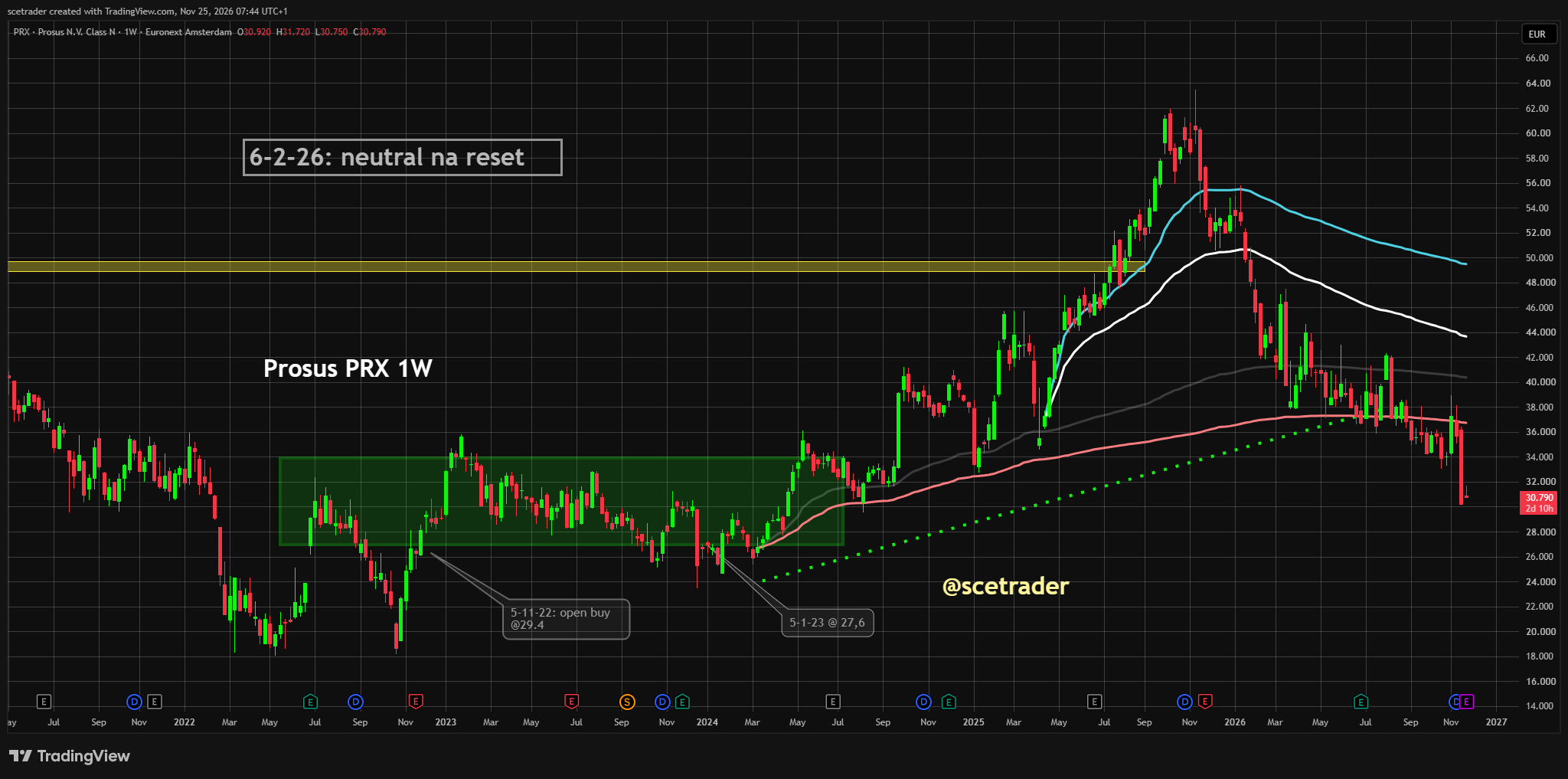
■ Grafiek: Prosus sloot 24 november op €30,79, tegenover €30,19 op 20 november. Het aandeel verloor ruim 10% in een week, ongeveer 18,5% in drie maanden en ruim 41% sinds begin 2026, waardoor de technische trend duidelijk zwak blijft.
■ Desk-view: Prosus bezit sterke bedrijven en noteert met een enorme korting, maar goedkoop is voor ons nog geen koopsignaal. Zolang de operationele winst verslechtert, cashflow terugloopt en de grafiek geen hogere bodem laat zien, blijven wij weg.
De headline is mooi, maar daar begint onze analyse pas
Prosus presenteert cijfers die op het eerste gezicht overtuigend ogen. De omzet stijgt van $3,62 miljard naar $5,75 miljard en adjusted earnings per gewoon N-aandeel lopen 12% op van 179 naar 201 dollarcent.
Dat zijn goede cijfers, maar ze vertellen niet het volledige verhaal. Gewone earnings per aandeel dalen tegelijkertijd van 253 naar 193 dollarcent en het geconsolideerde operationele resultaat draait van $219 miljoen winst naar $133 miljoen verlies.
Dat verschil is voor ons belangrijker dan de headline. Een adjusted winstmaatstaf kan nuttig zijn om een technologieportfolio door verschillende investeringscycli heen te volgen, maar uiteindelijk willen wij zien dat de ondernemingen zelf steeds meer operationele winst en vrije cash produceren.
Dat gebeurt in deze periode niet. Prosus kiest bewust opnieuw voor zwaardere investeringen, vooral rond JET en iFood, waardoor de omzet sneller groeit dan de winst die onderaan de operationele rekening overblijft.
Wij vinden dat geen bewijs dat de strategie mislukt. Het betekent wel dat beleggers opnieuw vooruit moeten betalen voor rendementen die pas later zichtbaar moeten worden.
De omzetgroei is sterk, maar niet volledig autonoom
Een omzetstijging van $3,62 miljard naar $5,75 miljard is indrukwekkend. Op papier groeit de bovenkant van de winst-en-verliesrekening daarmee met bijna 60%.
Die vergelijking moet alleen zorgvuldig worden gelezen. Prosus heeft zijn Europese ecosysteem met JET veel groter gemaakt en acquisities veranderen de consolidatiebasis, waardoor gerapporteerde groei niet hetzelfde is als autonome groei van de bestaande activiteiten.
Dat maakt de extra omzet niet minder echt. Het verandert wel de vraag die wij als belegger stellen: hoeveel extra winst en cash levert iedere nieuwe omzetdollar uiteindelijk op?
Daar zit vandaag de zwakke plek. De groepsomzet stijgt fors, maar het operationele resultaat beweegt de andere kant op.
Voor een bedrijf dat midden in een nieuwe investeringsfase zit kan dat tijdelijk logisch zijn. Voor het aandeel betekent het dat wij niet bereid zijn alleen op basis van de omzetgroei vooruit te lopen op een toekomstige margeverbetering.
Adjusted EPS stijgt terwijl gewone EPS fors daalt
Het verschil tussen adjusted en gewone winst per aandeel verdient een eigen blok. Adjusted earnings per aandeel stijgen 12%, maar gewone earnings per aandeel dalen ongeveer 24%.
De adjusted winst wordt geholpen door de sterke winstgevendheid van equity-accounted investments, met Tencent als belangrijkste bijdrage. Daarnaast werkt de voortdurende aandeleninkoop in het voordeel van de winst per aandeel doordat dezelfde economische waarde over minder Prosus-aandelen wordt verdeeld.
Dat is echte waardecreatie en wij doen daar niets aan af. Prosus koopt eigen aandelen terug tegen een forse korting op de geschatte intrinsieke waarde en verhoogt daarmee mechanisch de NAV per resterend aandeel.
Maar het verklaart ook waarom adjusted EPS niet hetzelfde signaal geeft als het operationele resultaat. De winstmaatstaf profiteert van Tencent en buybacks terwijl de geconsolideerde activiteiten opnieuw een investeringsfase ingaan.
Daarom gebruiken wij adjusted EPS als één onderdeel van het verhaal en niet als eindconclusie.
De operationele terugval is het cijfer dat wij het zwaarst wegen
De omslag van $219 miljoen operationele winst naar $133 miljoen verlies is voor ons het belangrijkste zwakke cijfer uit de resultaten.
Prosus zegt duidelijk waarom dit gebeurt. De groep investeert in JET en iFood om de Europese en Latijns-Amerikaanse ecosystemen sneller te laten groeien en sterker aan elkaar te koppelen.
Strategisch is dat verdedigbaar. Prosus heeft jarenlang geprobeerd van een holding rond Tencent te veranderen in een actieve operator van eigen platformbedrijven en daar hoort kapitaalallocatie naar de beste groeikansen bij.
De timing is alleen lastig voor aandeelhouders. Na jaren waarin de markt juist wachtte op structurele winstgevendheid van het eigen portfolio begint opnieuw een periode waarin huidige winst wordt ingeruild voor toekomstige schaal.
Dat kan uiteindelijk uitstekende rendementen opleveren. Wij willen eerst bewijs zien dat die nieuwe investeringen inderdaad hogere structurele marges opleveren voordat we het aandeel opnieuw aantrekkelijk vinden.
Ook de vrije kasstroom gaat achteruit
De vrije kasstroom daalt van $1,30 miljard naar $1,06 miljard. Dat is ongeveer 18% minder cash ondanks de sterke gerapporteerde omzetgroei.
Voor Prosus vormt dat geen acute financieringscrisis. De groep beschikt over omvangrijke assets, toegang tot de kapitaalmarkt en een zeer waardevol belang in Tencent.
Voor de waardering is de richting alleen wél belangrijk. Een steeds groter digitaal ecosysteem met groeiende schaal en steeds meer AI-automatisering moet uiteindelijk een steeds betere cashmachine worden.
Dat bewijs ontbreekt nu. De nieuwe investeringen trekken juist cash uit de onderneming voordat duidelijk is hoeveel structurele winstgroei daar later tegenover staat.
Wij willen daarom een duidelijke bodem in vrije kasstroom zien. Zolang omzet groeit maar cashflow terugloopt, vinden wij het te vroeg om de operationele hefboom als bewezen te beschouwen.
JET draait eindelijk, maar één groeimaand is nog geen volledige turnaround
JET is waarschijnlijk het meest interessante operationele onderdeel van de nieuwe Prosus-fase. Toen Prosus de onderneming overnam, daalden de orders nog ongeveer 9% op jaarbasis.
In september kwam daar een belangrijke verandering in. JET liet voor het eerst in 55 maanden weer ordergroei op jaarbasis zien, waarmee Prosus voor het eerst concreet bewijs levert dat de nieuwe aanpak effect heeft.
Die aanpak is breed. Prosus investeert in technologie, logistiek, product, customer experience en marketing en probeert de lessen uit iFood naar Europa te brengen.
Dat vinden wij inhoudelijk interessant. JET hoeft niet opnieuw de grootste Europese bezorger te worden om waarde te creëren, maar moet aantonen dat ordergroei gepaard kan gaan met betere economics per bestelling.
Daar ligt de volgende test. Groei die alleen kan worden gekocht met steeds hogere marketing- en logistieke uitgaven is veel minder waardevol dan groei die uiteindelijk de marge en vrije kasstroom optrekt.
Prosus zelf zegt dat de focus nu ligt op het vasthouden van de groei én het verbeteren van de winstgevendheid. Dat is precies het bewijs dat wij nog willen zien voordat JET een reden wordt om het aandeel te kopen.
iFood blijft het beste operationele bewijsstuk
iFood heeft een andere kwaliteit dan JET. Het platform houdt volgens Prosus ongeveer 80% marktaandeel in de Braziliaanse appmarkt ondanks agressieve concurrentie en heeft zijn positie tijdens zware concurrentiële investeringen weten te verdedigen.
Daarbij groeit het bedrijf steeds verder buiten klassieke restaurantbezorging. Nieuwe categorieën en financiële diensten worden belangrijker, waardoor iFood steeds meer op een breed lokaal commerceplatform begint te lijken.
Dat maakt iFood voor ons één van de sterkste assets buiten Tencent. Het combineert schaal, distributie, data en een diep netwerk van restaurants en consumenten.
De keerzijde is dat Prosus die voorsprong niet gratis krijgt. Management kiest ervoor opnieuw te investeren om het ecosysteem breder te maken en de concurrentie structureel achter zich te houden.
Dat kan een rationele keuze zijn. Voor aandeelhouders betekent het alleen dat een deel van de huidige winst wordt opgeofferd om toekomstige waarde te bouwen.
Daarom zijn wij positief over iFood als bedrijf, maar niet automatisch positief over Prosus als aandeel op dit moment.
Tencent blijft het vangnet én de afhankelijkheid
Tencent blijft economisch de belangrijkste asset onder Prosus. De stijging van adjusted earnings wordt in belangrijke mate gedragen door de winstgevendheid van equity-accounted investments en Tencent staat daar centraal in.
Dat blijft een enorme kracht. Prosus bezit via Tencent blootstelling aan één van de sterkste digitale ecosystemen ter wereld en gebruikt een deel van die waarde om eigen ecosystemen op te bouwen en aandelen in te kopen.
Tegelijk blijft dit de oude Prosus-vraag. Hoeveel van de beurswaarde kan uiteindelijk worden gedragen door de eigen operationele ondernemingen, zonder dat beleggers telkens weer terugvallen op Tencent als belangrijkste winstbron?
De huidige cijfers geven daar nog geen definitief antwoord op. Het eigen geconsolideerde resultaat draait naar verlies terwijl de adjusted winst dankzij equity-accounted earnings stijgt.
Voor ons moet die verhouding uiteindelijk kantelen. Prosus wordt interessanter wanneer JET, iFood, OLX, PayU en andere bedrijven zelfstandig steeds meer winst en cash genereren en Tencent daardoor minder bepalend wordt voor de groepswinst.
De buyback doet precies wat hij moet doen
De open aandeleninkoop blijft financieel één van de sterkste onderdelen van het verhaal. Wanneer Prosus ruim onder de intrinsieke waarde noteert, koopt iedere ingetrokken aandeel een groter deel van de bestaande assetwaarde voor de overblijvende aandeelhouders.
De actuele korting is enorm. Prosus publiceerde op 24 november een consensus-NAV van €53,10 per aandeel, opgebouwd uit een totale NAV van $120,9 miljard na $7,7 miljard netto schuld.
Tegen een slotkoers van €30,79 noteert het aandeel daarmee ongeveer 42% onder die consensus-NAV.
Op papier is dat aantrekkelijk. Iedere euro die Prosus tegen zo'n korting inzet voor buybacks verhoogt de intrinsieke waarde per resterend aandeel.
Maar de korting vertelt ook iets anders. Na jaren van grote aandeleninkopen weigert de markt Prosus nog steeds tegen iets in de buurt van zijn berekende NAV te waarderen.
Dat is geen toeval dat wij zomaar negeren. De markt vraagt een structurele korting voor complexiteit, kapitaalallocatie, Tencent-afhankelijkheid en onzekerheid over de uiteindelijke rendementen van de eigen ecosystemen.
De buyback is dus een sterk instrument. Hij is geen bewijs dat de holdingkorting vanzelf verdwijnt.
De NAV-korting is groot genoeg om interessant te worden, maar niet genoeg om de grafiek te negeren
Een korting van ongeveer 42% trekt vanzelf aandacht. Op een spreadsheet lijkt Prosus daardoor goedkoop.
Dat maakt het aandeel voor ons alleen nog geen koop. Een holding kan jarenlang met een forse korting handelen wanneer beleggers onvoldoende vertrouwen hebben in de manier waarop de onderliggende waarde uiteindelijk naar de aandeelhouder stroomt.
Dat is precies waarom wij koers en fundamentals samen willen zien draaien. Als de NAV stijgt, de buyback doorgaat, het operationele resultaat verbetert en de grafiek begint hogere bodems te zetten, ontstaat een veel krachtiger combinatie.
Vandaag ontbreekt die bevestiging. De korting is groot, maar het operationele resultaat verslechtert en de koers zoekt opnieuw de onderkant van zijn bandbreedte op.
Goedkoop kan dus nog goedkoper worden. Wij hoeven niet de eerste koper te zijn alleen omdat de spreadsheet aantrekkelijk oogt.
AI is inhoudelijk interessant, maar moet nu geld gaan opleveren
Prosus zet AI diep in zijn operationele model. De groep spreekt over ongeveer 20 biljoen AI-tokens per maand en heeft Toqan inmiddels uitgerold naar meer dan 100.000 restaurants.
Dat past strategisch bij Prosus. JET, iFood, OLX en PayU beschikken over enorme hoeveelheden commerce-data en miljoenen dagelijkse interacties waarin AI werkelijk operationele waarde kan creëren.
AI kan orderrouting verbeteren, marketing personaliseren, restauranthouders helpen met planning en pricing en interne processen automatiseren. Dat zijn veel concretere toepassingen dan een onderneming die alleen een generiek model bovenop bestaande software zet.
Voor beleggers blijft de eindtest alleen hetzelfde. Meer AI-gebruik moet uiteindelijk resulteren in hogere omzet per gebruiker, lagere kosten per transactie, betere marges en hogere vrije kasstroom.
De huidige cijfers laten die eindfase nog niet overtuigend zien. Vrije kasstroom daalt juist terwijl Prosus het gebruik van AI sterk opschaalt.
Daarom geven wij de technologie waarde, maar nog geen grote beursmultiple. Eerst willen we de economische opbrengst terugzien.
De grafiek geeft geen reden om de bodem te gokken
Hier wordt onze positie het duidelijkst. Prosus sloot op 24 november op €30,79, nadat het aandeel op 20 november nog €30,19 aantikte.
Over één week bedraagt de daling ruim 10%. Over drie maanden staat het aandeel ongeveer 18,5% lager en sinds begin 2026 ruim 41% lager.
Dat is geen neutrale consolidatie. Het is een zwakke middellange trend waarin verkopers herhaaldelijk lagere niveaus accepteren.
Ook de korte opleving van 23 november veranderde dat niet. Prosus herstelde die dag naar €31,47, maar zakte een dag later alweer terug naar €30,79.
De eerste harde technische referentie ligt daarom rond €30,19. Een overtuigende breuk daaronder zou de neerwaartse trend opnieuw bevestigen.
Aan de bovenkant willen wij eerst herstel boven ongeveer €32 zien en daarna een serie hogere bodems richting de oude zone rond €34 tot €35. Pas dan begint de markt te bewijzen dat de verkoopdruk werkelijk afneemt.
Tot die tijd gaan wij geen vallend mes proberen te vangen.
De grafiek en de cijfers vertellen op dit moment hetzelfde verhaal
Het sterke punt van onze negatieve positionering is dat we fundamenteel en technisch niet tegen elkaar hoeven in te handelen.
Fundamenteel groeit de omzet, maar verslechteren operationele winst en vrije kasstroom. Technisch noteert het aandeel vrijwel op zijn recente bodem en blijft de middellange trend neerwaarts.
Dat is precies het soort combinatie waarbij wij liever wachten. Een aandeel kan goedkoop ogen en toch verder dalen wanneer de markt verwacht dat de winstkwaliteit eerst verder verslechtert voordat de nieuwe investeringen resultaat opleveren.
Prosus kan uiteraard hard herstellen wanneer JET sneller draait, Tencent sterk blijft en de markt meer vertrouwen krijgt in de nieuwe investeringscyclus. Maar dan krijgen wij later nog steeds een kans om in te stappen.
Wij hoeven de bodem niet exact te raden om uiteindelijk een goede trade te hebben.
Wat moet veranderen voordat wij Prosus opnieuw interessant vinden?
De eerste voorwaarde is simpel: het operationele resultaat moet weer duidelijk positief worden. Wij willen zien dat de nieuwe investeringsfase niet alleen meer omzet, maar ook aantoonbaar meer bedrijfswinst creëert.
De tweede voorwaarde is vrije kasstroom. $1,06 miljard blijft veel geld, maar de richting moet weer omhoog wanneer de investeringen beginnen te renderen.
De derde voorwaarde is JET. Eén maand ordergroei na 55 maanden daling is belangrijk, maar wij willen meerdere kwartalen zien waarin groei samengaat met een betere marge.
De vierde voorwaarde is de eigen winstbijdrage buiten Tencent. Hoe groter het deel van adjusted earnings dat uit de eigen ecosystemen komt, hoe sterker het argument wordt dat Prosus eindelijk meer is dan een complexe verpakking rond Tencent.
De vijfde voorwaarde is technisch. Eerst een hogere bodem, daarna herstel boven de eerste weerstand en vervolgens bewijs dat eerdere verkopers niet opnieuw direct de controle overnemen.
Wanneer meerdere van die signalen tegelijk draaien, kan een korting van ongeveer 42% heel interessant worden.
Vandaag zijn we daar nog niet.
Desk-view: goedkoop, maar nog niet goed genoeg
Prosus heeft genoeg sterke assets om niet zomaar afgeschreven te worden. Tencent blijft een enorme winstmachine, iFood is een sterke marktleider, JET begint voor het eerst in jaren weer te groeien en de buyback creëert daadwerkelijk waarde per aandeel.
Daar staat een minder mooie werkelijkheid tegenover. Gewone EPS daalt, de groep draait operationeel verlies en vrije kasstroom loopt terug omdat Prosus opnieuw zwaar investeert in toekomstige groei.
De grote NAV-korting maakt het aandeel optisch goedkoop. Maar een korting van ruim 40% die jarenlang blijft bestaan vertelt ook dat beleggers nog steeds onvoldoende vertrouwen hebben dat alle theoretische waarde efficiënt naar het aandeel stroomt.
De grafiek bevestigt die twijfel. Prosus staat vrijwel op de recente bodem, ruim 10% lager in een week en meer dan 40% lager sinds het begin van het jaar.
Daar hoeven wij niet tegenin.
Wij blijven weg.
Niet omdat Prosus geen goede bedrijven bezit, maar omdat het aandeel ons op dit moment onvoldoende betaalt voor dalende cashflow, opnieuw oplopende investeringen en een technisch beeld dat nog steeds naar beneden wijst.
Eerst winstherstel.
Dan cashflow.
Dan een draai in de grafiek.
Pas daarna wordt de enorme korting interessant genoeg om opnieuw naar een positie te kijken.
🔵 English version
Prosus: revenue is growing fast, but earnings quality and the chart remain weak - we stay away
No time to read the full article? These are the points that matter.
■ Prosus: Revenue rises sharply and adjusted earnings per share increase 12%, but ordinary EPS declines, the group moves into an operating loss and free cash flow falls. The headline therefore looks better than the underlying earnings quality.
■ Investment View: Stay away. Tencent remains strong, JET is showing early signs of recovery and iFood is defending its dominant position, but we first want higher operating profit, stabilizing free cash flow and a clear turn in the chart.
■ Revenue: Revenue increases from $3.62 billion to $5.75 billion. That is strong growth, but acquisitions and consolidation contribute and we therefore do not treat this as almost 60% autonomous growth.
■ Earnings: Adjusted earnings per N share rise from 179 to 201 US cents, while ordinary earnings per share fall from 253 to 193 cents. That gap is exactly why we refuse to rely on the adjusted earnings measure alone.
■ Operating result: The group moves from $219 million of operating profit to a $133 million loss. For us, this is more important than the attractive adjusted EPS headline because it shows the real cost of the new investment phase.
■ Cash: Free cash flow declines from $1.30 billion to $1.06 billion. A company becoming larger and deploying AI at scale ultimately needs to generate more cash, not structurally less.
■ JET: Orders grew year on year for the first time in 55 months. That is meaningful progress, but Prosus is again investing heavily in technology, logistics, product and marketing to sustain the turnaround.
■ iFood: iFood retains roughly 80% market share in Brazil's app market and continues expanding beyond traditional food delivery. The asset quality is high, but Prosus is deliberately prioritizing additional growth and new categories over maximizing near-term cash.
■ Tencent: Tencent remains the largest driver of equity-accounted earnings. It is an exceptional asset, but the current results also show that Prosus's own operating businesses have not yet replaced Tencent as the main earnings engine.
■ Buyback: Share repurchases create value per share while Prosus trades at a large discount to NAV. Yet the discount remains enormous: consensus NAV was €53.10 per share on November 24 versus a €30.79 share price, roughly a 42% discount.
■ AI: Twenty trillion AI tokens per month and Toqan across more than 100,000 restaurants are operationally interesting. AI becomes a stronger equity argument for us when it visibly produces higher margins, greater free cash flow and better returns on invested capital.
■ Chart: Prosus closed November 24 at €30.79, compared with €30.19 on November 20. The shares lost more than 10% in one week, around 18.5% in three months and more than 41% since the start of 2026, leaving the technical trend clearly weak.
■ Desk view: Prosus owns strong businesses and trades at an enormous discount, but cheap is not yet a buy signal for us. As long as operating profit deteriorates, cash flow declines and the chart fails to produce a higher low, we stay away.
The headline looks good, but that is only where our analysis begins
Prosus reports numbers that initially look compelling. Revenue rises from $3.62 billion to $5.75 billion and adjusted earnings per ordinary N share increase 12% from 179 to 201 US cents.
Those are strong numbers, but they do not tell the complete story. Ordinary earnings per share simultaneously fall from 253 to 193 cents and consolidated operating profit swings from a $219 million gain to a $133 million loss.
That gap matters more to us than the headline. An adjusted earnings measure can be useful for tracking a technology portfolio through different investment cycles, but ultimately we want the underlying businesses to generate increasing amounts of operating profit and free cash.
That is not happening during this period. Prosus is deliberately entering another heavier investment phase, particularly around JET and iFood, allowing revenue to grow faster than the earnings remaining at the operating level.
We do not regard that as proof the strategy is failing. It does mean investors are once again paying today for returns that need to appear later.
Revenue growth is strong, but not entirely autonomous
The jump from $3.62 billion to $5.75 billion is impressive. On paper the top line increases by almost 60%.
The comparison requires care, however. Prosus has materially expanded its European ecosystem through JET and acquisitions have changed the consolidation base, meaning reported growth is not the same thing as autonomous growth from the existing portfolio.
That does not make the extra revenue less real. It changes the investor question: how much additional profit and cash does every new revenue dollar ultimately produce?
That is the weak point today. Group revenue rises sharply while the operating result moves in the opposite direction.
For a company entering a new investment cycle that can make sense temporarily. For the equity, it means we are unwilling to price future margin improvement simply from top-line growth.
Adjusted EPS rises while ordinary EPS falls sharply
The gap between adjusted and ordinary EPS deserves separate attention. Adjusted EPS rises 12%, while ordinary EPS falls roughly 24%.
Adjusted earnings benefit from strong profitability at equity-accounted investments, with Tencent the largest contributor. The ongoing buyback further increases per-share earnings because the same economic value is spread across fewer Prosus shares.
That is real value creation and we do not dismiss it. Prosus is repurchasing its own shares at a large discount to estimated intrinsic value and therefore mechanically increasing NAV per remaining share.
It also explains why adjusted EPS sends a different signal from operating profit. The adjusted measure benefits from Tencent and buybacks while consolidated businesses enter another investment phase.
We therefore use adjusted EPS as one part of the story rather than the final conclusion.
The operating deterioration is the number we weigh most heavily
The swing from $219 million of operating profit to a $133 million loss is the most important weak number in the results for us.
Prosus is clear about why this is happening. The group is investing in JET and iFood to accelerate growth and deepen the European and Latin American ecosystems.
Strategically, that is defensible. Prosus has spent years trying to evolve from a holding company built around Tencent into an active operator of its own platforms, and capital allocation toward the best growth opportunities is part of that transition.
The timing is simply more difficult for shareholders. After years of waiting for structural profitability across the portfolio, another period begins in which current earnings are exchanged for future scale.
That can eventually produce excellent returns. We first want evidence that those investments actually create higher structural margins before viewing the stock as attractive again.
Free cash flow is moving in the wrong direction as well
Free cash flow declines from $1.30 billion to $1.06 billion. That is roughly 18% less cash despite strong reported revenue growth.
This does not create an immediate financing problem for Prosus. The group owns substantial assets, has capital-market access and continues to hold an extremely valuable Tencent stake.
Direction still matters for valuation. A larger digital ecosystem with increasing scale and growing AI automation should ultimately become a better cash-generation machine.
That evidence is currently missing. The new investment cycle is consuming cash before the eventual structural earnings benefit has been demonstrated.
We therefore want to see a clear bottom in free cash flow. As long as revenue grows while cash generation declines, we consider it too early to call the operating leverage proven.
JET is finally turning, but one month of growth is not a complete turnaround
JET may be the most interesting operating experiment in Prosus's new phase. When Prosus acquired the business, orders were still declining by roughly 9% year on year.
September brought an important change. JET delivered year-on-year order growth for the first time in 55 months, giving Prosus the first tangible evidence that its new operating approach is having an effect.
That approach is broad. Prosus is investing in technology, logistics, product, customer experience and marketing while attempting to transfer lessons from iFood into Europe.
We find that operationally interesting. JET does not need to become Europe's largest delivery platform again to create value, but it must demonstrate that order growth can coexist with improving economics per order.
That is the next test. Growth purchased through permanently higher marketing and logistics spending is far less valuable than growth that ultimately lifts margins and free cash flow.
Prosus itself says the focus is now on sustaining the growth and improving profitability. That is exactly the evidence we still want before JET becomes a reason to buy the stock.
iFood remains the strongest operating proof point
iFood has a different quality from JET. According to Prosus, the platform retains roughly 80% market share in Brazil's app market despite aggressive competition and has defended its position throughout heavy competitor spending.
The company is also moving beyond conventional restaurant delivery. New categories and financial services are becoming more important, turning iFood increasingly into a broad local-commerce platform.
That makes iFood one of the strongest assets outside Tencent in our view. It combines scale, distribution, data and a deep network of restaurants and consumers.
The advantage is not free. Prosus is deliberately choosing to invest again in order to broaden the ecosystem and maintain its structural lead.
That can be rational capital allocation. For shareholders it means part of today's earnings is being sacrificed in order to build future value.
We are therefore positive on iFood as a business without automatically becoming positive on Prosus shares today.
Tencent remains both the safety net and the dependency
Tencent remains the most important economic asset underneath Prosus. Growth in adjusted earnings is materially supported by equity-accounted profits and Tencent is central to that contribution.
That remains an enormous strength. Prosus owns exposure to one of the world's strongest digital ecosystems and can use part of that value to build its own businesses and repurchase shares.
It also leaves the old Prosus question unresolved. How much of the listed value can eventually be supported by the operating portfolio itself without investors constantly falling back on Tencent as the primary earnings engine?
The current numbers do not yet provide a definitive answer. Consolidated operating profit turns negative while adjusted earnings rise partly because of equity-accounted profits.
Eventually we want that relationship to change. Prosus becomes more interesting when JET, iFood, OLX, PayU and the rest of the portfolio independently carry a larger share of earnings and cash generation.
The buyback is doing exactly what it should
The open-ended share repurchase remains one of the strongest financial elements of the story. When Prosus trades materially below intrinsic value, every share retired increases the percentage ownership of the existing asset base for remaining shareholders.
The current discount is enormous. Prosus published consensus NAV of €53.10 per share on November 24, representing total NAV of $120.9 billion after $7.7 billion of net debt.
Against a €30.79 closing price, that represents a discount of roughly 42%.
On paper that is attractive. Every euro used for repurchases at such a discount creates NAV accretion for the remaining shares.
The discount also sends another message. After years of significant buybacks, the market still refuses to value Prosus anywhere close to estimated NAV.
We do not dismiss that as irrational. Investors continue demanding a structural discount for complexity, capital allocation, Tencent dependence and uncertainty around the final returns produced by Prosus's own ecosystems.
The buyback is therefore a strong instrument. It is not evidence that the holding-company discount automatically disappears.
A 42% NAV discount is interesting, but not enough to ignore the chart
A discount of roughly 42% naturally attracts attention. On a spreadsheet, Prosus looks inexpensive.
That alone does not make the stock a buy for us. Holding companies can trade at large discounts for years when investors lack confidence that theoretical underlying value will efficiently reach shareholders.
That is why we want the fundamentals and the chart to turn together. If NAV rises, the buyback continues, operating earnings improve and the shares start forming higher lows, the setup becomes much more powerful.
That confirmation is missing today. The discount is large, but operating profit is deteriorating and the stock is again testing the bottom of its recent range.
Cheap can become cheaper. We do not need to be the first buyer simply because the spreadsheet looks attractive.
AI is strategically interesting, but it now needs to produce cash
Prosus is embedding AI deeply in its operating model. The group refers to roughly 20 trillion AI tokens per month and Toqan deployment across more than 100,000 restaurants.
That makes strategic sense. JET, iFood, OLX and PayU hold enormous commerce datasets and millions of daily interactions where AI can create real operating value.
AI can improve routing, personalize marketing, help restaurants with planning and pricing and automate internal processes. These are far more tangible applications than simply placing a generic model on top of existing software.
For investors, the final test remains unchanged. Greater AI usage must eventually generate higher revenue per user, lower transaction costs, stronger margins and greater free cash flow.
The current numbers do not yet show that final step clearly. Free cash flow is falling while Prosus is scaling AI usage.
We therefore assign strategic value to the technology but not yet a major equity multiple. We first want to see the economics.
The chart gives us no reason to guess the bottom
This is where our stance becomes clearest. Prosus closed November 24 at €30.79 after touching €30.19 on November 20.
The stock is down more than 10% in one week, roughly 18.5% over three months and more than 41% since the beginning of 2026.
That is not a neutral consolidation. It is a weak medium-term trend in which sellers repeatedly accept lower prices.
The brief rebound on November 23 did not change that structure. Prosus recovered to €31.47 and then slipped back to €30.79 a day later.
The first hard technical reference is therefore around €30.19. A convincing break below that level would reinforce the downtrend.
On the upside, we first want to see recovery above roughly €32 and then a series of higher lows toward the previous €34 to €35 zone. Only then would the market begin proving that selling pressure is genuinely easing.
Until that happens, we are not interested in trying to catch a falling knife.
The chart and the fundamentals currently tell the same story
The strength of our negative positioning is that technicals and fundamentals are not fighting each other.
Fundamentally, revenue is growing while operating profit and free cash flow deteriorate. Technically, the stock trades near its recent low and the medium-term trend remains down.
That is exactly the combination where we prefer patience. A stock can look cheap and continue falling when the market expects earnings quality to deteriorate further before new investments start paying off.
Prosus can certainly rebound sharply if JET improves faster, Tencent remains strong and investors become more confident in the new investment cycle. We will still have opportunities to participate later.
We do not need to identify the precise bottom in order to make a good trade eventually.
What needs to change before Prosus becomes interesting again?
The first condition is simple: operating earnings need to turn clearly positive again. We want the new investment phase to create not only additional revenue but demonstrably higher business profit.
The second condition is free cash flow. $1.06 billion remains substantial, but the direction needs to turn upward once current investments begin generating returns.
The third condition is JET. One month of growth after 55 months of decline matters, but we want several quarters in which growth coincides with better margins.
The fourth condition is greater earnings contribution outside Tencent. The more adjusted earnings come from Prosus's own ecosystems, the stronger the case becomes that Prosus is finally more than a complex wrapper around Tencent.
The fifth condition is technical. We first want a higher low, then recovery through initial resistance and finally evidence that previous sellers do not immediately regain control.
If several of those signals turn together, a roughly 42% discount can become extremely interesting.
Today, we are not there yet.
Desk-view: cheap, but not good enough yet
Prosus owns enough strong assets that the company should not be dismissed. Tencent remains a major earnings machine, iFood is a high-quality market leader, JET is growing again for the first time in years and the buyback creates genuine value per share.
The weaker reality sits underneath those positives. Ordinary EPS declines, consolidated operations move into a loss and free cash flow falls because Prosus is once again investing heavily for future growth.
The NAV discount makes the stock look optically cheap. Yet a discount above 40% that persists for years also tells us investors remain unconvinced that all theoretical underlying value will efficiently reach the listed share price.
The chart confirms that doubt. Prosus is trading almost directly on its recent low, down more than 10% in a week and more than 40% since the start of the year.
We do not need to fight that.
Our stance remains stay away.
Not because Prosus lacks good businesses, but because the equity currently does not compensate us sufficiently for declining cash generation, another heavy investment phase and a technical trend that remains clearly negative.
First earnings recovery.
Then cash flow.
Then a turn in the chart.
Only then does the enormous discount become interesting enough for us to consider a position again.
Disclaimer Aan de door ons opgestelde informatie kan op geen enkele wijze rechten worden ontleend. Alle door ons verstrekte informatie en analyses zijn geheel vrijblijvend. Alle consequenties van het op welke wijze dan ook toepassen van de informatie blijven volledig voor uw eigen rekening.
Wij aanvaarden geen aansprakelijkheid voor de mogelijke gevolgen of schade die zouden kunnen voortvloeien uit het gebruik van de door ons gepubliceerde informatie. U bent zelf eindverantwoordelijk voor de beslissingen die u neemt met betrekking tot uw beleggingen.

