NVIDIA: Infographic: NVIDIA’s AI Investment Strategy in 2026
For our international clients: a full English version follows after the Dutch text.
Dit artikel is opgesteld aan de hand van informatie en inzichten van Anthony Schmitt.
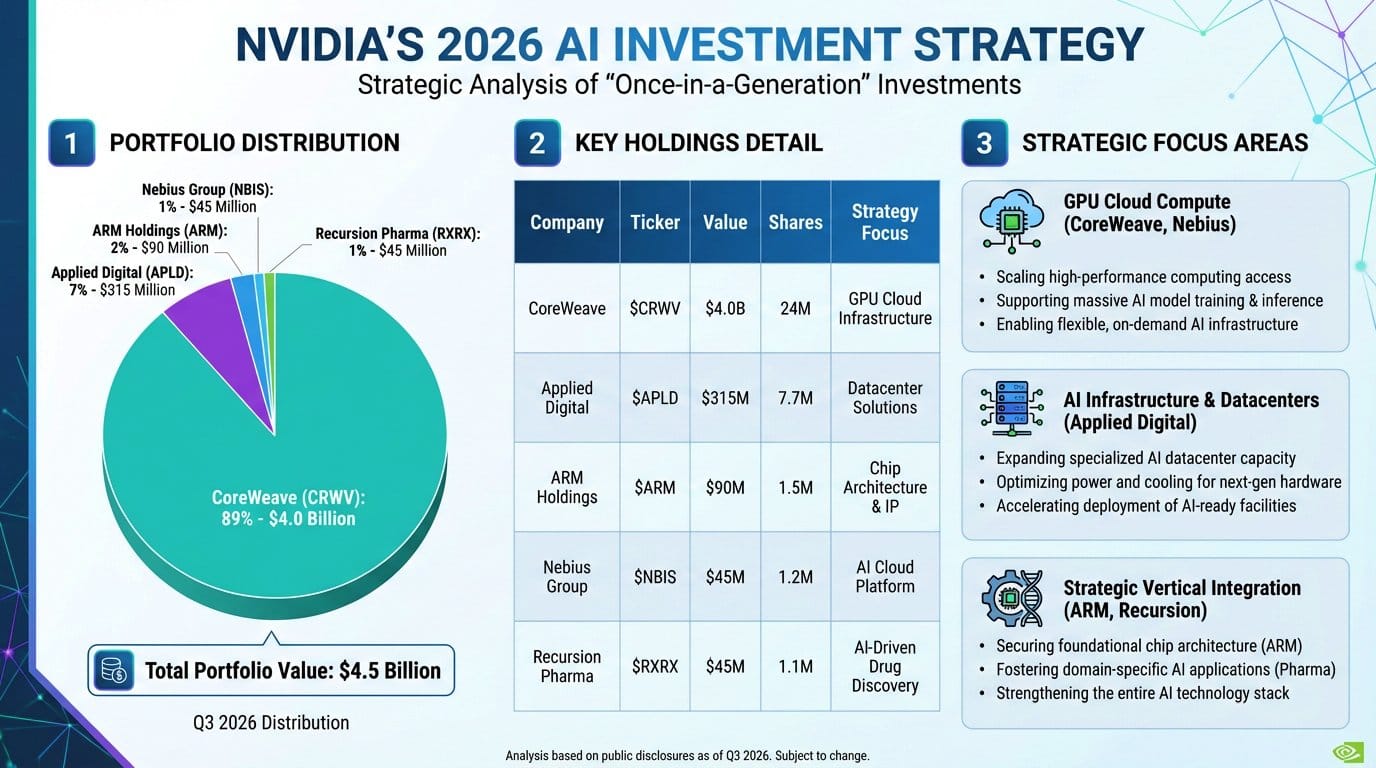
De infographic laat zien hoe NVIDIA zich in 2026 strategisch heeft gepositioneerd binnen het mondiale AI-landschap.
Waar veel grote technologiebedrijven hun focus leggen op het ontwikkelen van eigen AI-modellen en toepassingen, heeft NVIDIA bewust gekozen voor een fundamenteel andere rol. Het bedrijf richt zich primair op infrastructuur, schaal en structurele vraagcreatie, en niet op het eindproduct.
Die positionering maakt NVIDIA tot een structurele spil in het AI-ecosysteem. Niet het beste model bepaalt de machtsverhoudingen, maar toegang tot rekenkracht, energie, datacentercapaciteit en schaalbaarheid. NVIDIA heeft deze realiteit vroeg onderkend en heeft onder meer geïnvesteerd in bedrijven die deze vraag actief aanjagen. Daarmee profiteert het bedrijf van vrijwel elke vorm van AI-adoptie, ongeacht welke toepassing of welk model uiteindelijk domineert.
Kern van NVIDIA’s investeringsstrategie in 2026:
- Focus op infrastructuur en GPU-vraag, niet op AI-modelontwikkeling
- Investeringen in bedrijven die directe en schaalbare AI-capaciteit ontsluiten
- Positionering als neutrale leverancier binnen het volledige ecosysteem
- Sterke nadruk op datacenters, energie en cloudinfrastructuur
- Creëren van structurele afhankelijkheid van NVIDIA-hardware
De infographic maakt concreet duidelijk dat NVIDIA onder meer in de onderstaande bedrijven heeft geïnvesteerd, met een duidelijke hiërarchie tussen een dominante kernpositie en kleinere, strategische belangen.
- CoreWeave – grootste investering
CoreWeave is een pure AI-infrastructuurspeler die GPU-capaciteit levert voor grootschalige training en inferentie. Deze investering onderstreept NVIDIA’s focus op volumegroei, hoge bezettingsgraad en langdurige, structurele vraag naar GPU’s. - Applied Digital – middelgrote investering
Gericht op datacenters en energie-intensieve infrastructuur. In een markt waarin stroomvoorziening, koeling en fysieke capaciteit bepalend zijn voor schaal, is dit een logisch strategisch verlengstuk. - ARM Holdings – kleinere, strategische investering
Exposure naar fundamentele chiparchitectuur en intellectueel eigendom. Dit versterkt NVIDIA’s positie aan de onderkant van de technologiestack en vergroot de strategische flexibiliteit richting toekomstige compute-architecturen. - Nebius Group – kleine investering
Een AI-cloud- en infrastructuurplatform dat past binnen de strategie om meerdere infrastructuurlagen te ondersteunen, zonder zelf als cloudprovider te opereren. - Recursion Pharmaceuticals – kleine investering
Een voorbeeld van een verticale AI-toepassing. Niet omdat NVIDIA actief wil worden in biotech, maar omdat dit type bedrijf extreem afhankelijk is van rekenkracht en daarmee direct verbonden is aan NVIDIA’s platform.
Gezamenlijk laten deze investeringen zien dat NVIDIA zijn kapitaal zeer doelgericht inzet. Het bedrijf investeert niet in de uiteindelijke winnaars van AI-applicaties, maar onder meer in de fundamenten die ervoor zorgen dat AI kan draaien, opschalen en versnellen.
De rode draad in de visie van Anthony Schmitt is helder. NVIDIA heeft zich in 2026 definitief gepositioneerd als ecosysteemarchitect en infrastructuurleverancier. In die rol fungeert het bedrijf als de “AI arms dealer” van deze cyclus. Welke modellen, sectoren of toepassingen ook domineren, NVIDIA zit structureel aan de basis van de waardecreatie.
🔵 English version
Infographic: NVIDIA’s AI Investment Strategy in 2026
This article is based on information and strategic insights from Anthony Schmitt.
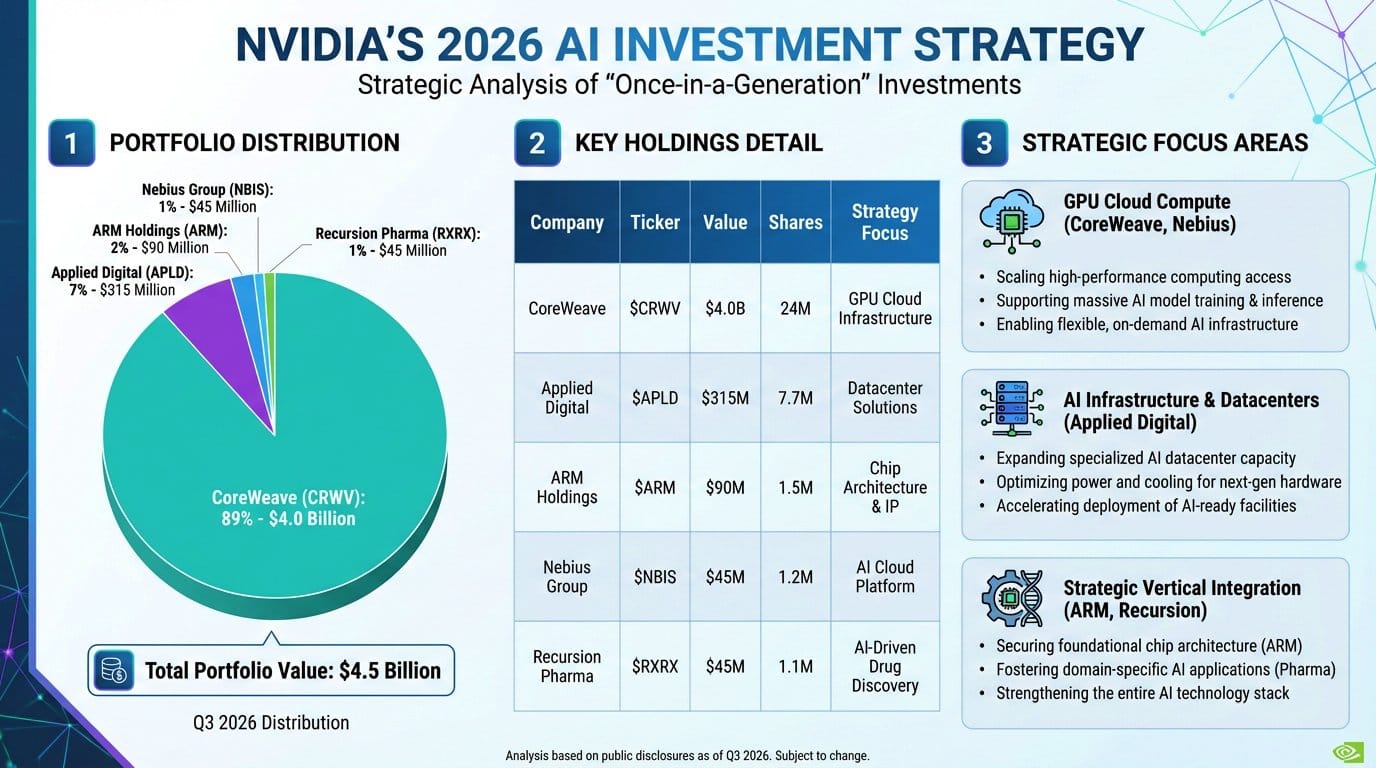
The infographic illustrates how NVIDIA is positioned in 2026 within the global AI landscape. While many large technology companies have focused their capital allocation on developing proprietary AI models and end-user applications, NVIDIA has deliberately chosen a different role. The company is primarily focused on infrastructure, scale, and structural demand creation rather than competing at the application layer.
This positioning makes NVIDIA a structural cornerstone of the AI ecosystem. In practice, market power is not defined by having the best model, but by access to compute, energy, data center capacity, and scalability. NVIDIA recognized this dynamic early and has invested, among others, in companies that actively generate and accelerate this demand. As a result, the company benefits from virtually every form of AI adoption, regardless of which model or application ultimately leads the market.
Core elements of NVIDIA’s investment strategy in 2026:
- Emphasis on infrastructure and GPU-driven demand rather than model development
- Investments in companies that unlock scalable AI compute capacity
- Positioning as a neutral supplier across the entire ecosystem
- Strong exposure to data centers, energy, and cloud infrastructure
- Creating long-term structural dependence on NVIDIA hardware
The infographic clearly shows that NVIDIA has invested, among others, in the following companies, with a clear distinction between a dominant core position and smaller, strategic stakes.
- CoreWeave – largest investment
CoreWeave is a pure-play AI infrastructure provider delivering GPU capacity for large-scale training and inference workloads. This investment highlights NVIDIA’s focus on volume growth, high utilization rates, and sustained structural demand for GPUs. - Applied Digital – mid-sized investment
Focused on data centers and energy-intensive infrastructure. In a market where power availability, cooling, and physical capacity are becoming the key constraints to scaling AI, this represents a logical strategic extension. - ARM Holdings – smaller, strategic investment
Exposure to foundational chip architecture and intellectual property. This strengthens NVIDIA’s position at the base of the technology stack and preserves strategic flexibility for future compute architectures. - Nebius Group – small investment
An AI cloud and infrastructure platform that fits NVIDIA’s strategy of supporting multiple infrastructure layers without operating as a cloud provider itself. - Recursion Pharmaceuticals – small investment
An example of a vertical AI application. Not because NVIDIA aims to be active in biotech, but because such companies are extremely compute-intensive and therefore tightly linked to NVIDIA’s platform.
Taken together, these investments show a highly disciplined capital allocation strategy. NVIDIA is not investing in the eventual winners of AI applications, but rather in the foundational layers that allow AI to operate, scale, and accelerate.
The common thread in Anthony Schmitt’s analysis is clear. In 2026, NVIDIA has firmly positioned itself as the ecosystem architect and infrastructure supplier of the AI cycle. In this role, the company functions as the “AI arms dealer.” Regardless of which models, sectors, or applications ultimately dominate, NVIDIA remains structurally embedded at the point where value is created.
Disclaimer Aan de door ons opgestelde informatie kan op geen enkele wijze rechten worden ontleend. Alle door ons verstrekte informatie en analyses zijn geheel vrijblijvend. Alle consequenties van het op welke wijze dan ook toepassen van de informatie blijven volledig voor uw eigen rekening.
Wij aanvaarden geen aansprakelijkheid voor de mogelijke gevolgen of schade die zouden kunnen voortvloeien uit het gebruik van de door ons gepubliceerde informatie. U bent zelf eindverantwoordelijk voor de beslissingen die u neemt met betrekking tot uw beleggingen.


