Datacenters: VS wil Chinese componenten weren - Coherent en Lumentum winnen
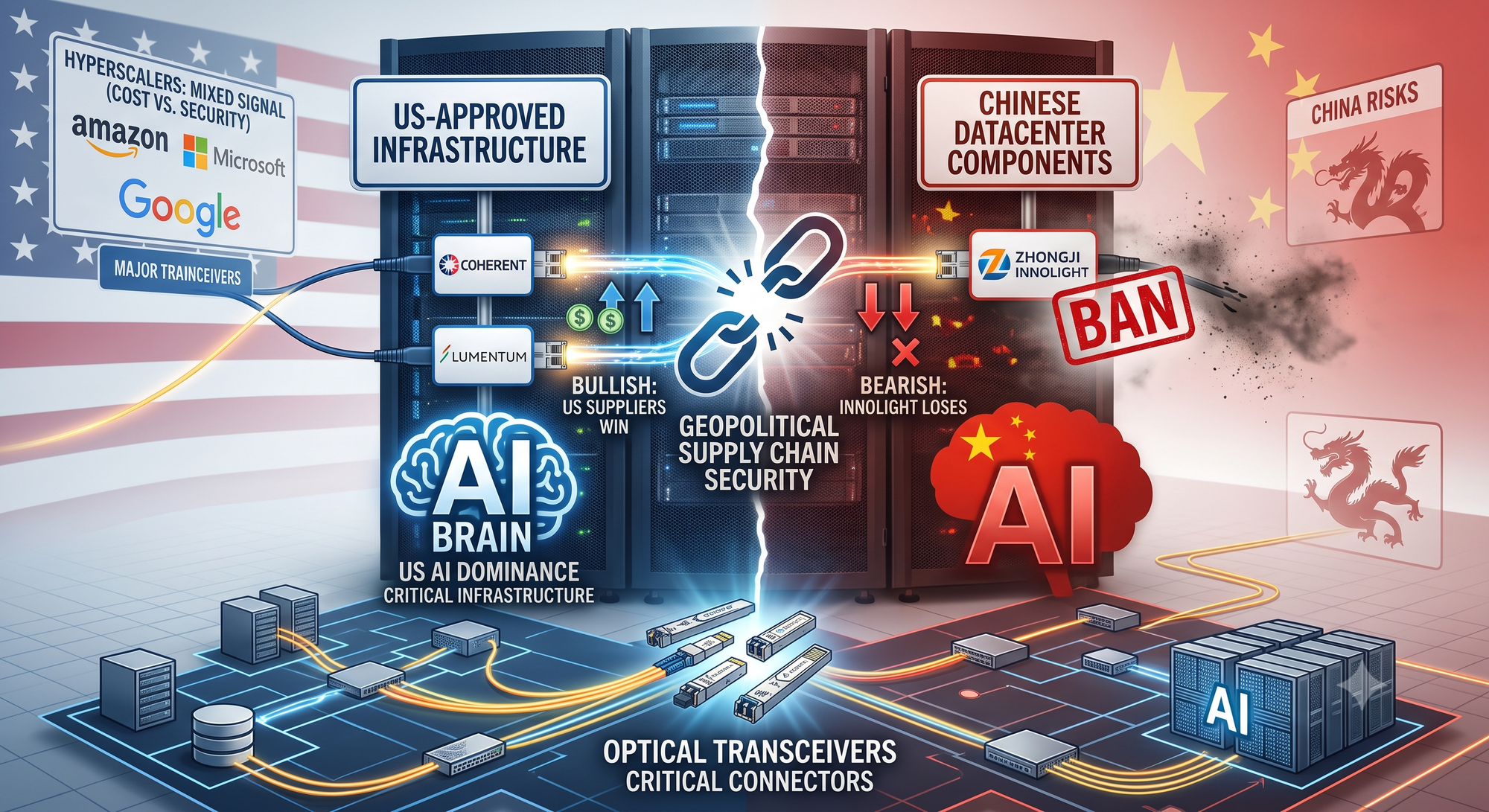
De Amerikaanse regering werkt volgens Reuters aan een importverbod op nieuwe Chinese datacentercomponenten. De maatregel zou vooral gericht zijn op Chinese optical transceivers, kleine maar cruciale onderdelen die dataverkeer via glasvezel binnen datacenters mogelijk maken.
De plannen zijn nog niet definitief. De FCC kan de maatregel nog aanpassen of intrekken, maar de richting is duidelijk: Washington wil voorkomen dat Chinese technologie diep wordt ingebouwd in de kritieke infrastructuur achter de AI-boom.
■ De VS werkt aan een mogelijk verbod op nieuwe Chinese datacentercomponenten.
■ De focus ligt op optical transceivers voor AI-datacenters.
■ De FCC wil de maatregel mogelijk dit jaar publiceren.
■ Het doel is bescherming van kritieke Amerikaanse AI-infrastructuur.
■ Zhongji Innolight lijkt de meest directe verliezer.
■ Coherent en Lumentum worden genoemd als mogelijke winnaars.
■ Hyperscalers kunnen tijdelijk hogere kosten krijgen.
■ China waarschuwt dat het zal reageren als zijn belangen worden geraakt.
Investment view
Wij zien dit als bullish voor Coherent en Lumentum, en bearish voor Zhongji Innolight. Voor Amerikaanse hyperscalers is het beeld gemengd: strategisch veiliger, maar op korte termijn mogelijk duurder.
🟪 Coherent kan profiteren als Amerikaanse datacenters minder Chinese transceivers mogen gebruiken.
🟪 Lumentum krijgt dezelfde positieve read-through als alternatieve niet-Chinese leverancier.
🟪 Zhongji Innolight wordt direct geraakt, omdat het een grote speler is in datacentertransceivers.
🟪 Amazon, Microsoft en Alphabet kunnen hogere componentkosten krijgen.
🟪 CoreWeave en Nebius zijn gevoeliger voor capexdruk en timingrisico.
🟪 De bredere niet-Chinese AI-infrastructuurketen wordt strategisch belangrijker.
De kern is dat dit geen gewone handelspolitieke maatregel is. Dit gaat over controle over de fysieke infrastructuur achter AI. Datacenters zijn de motor onder AI-modellen, cloudplatforms en digitale economie. Als de VS Chinese componenten uit die laag wil weren, verschuift waarde naar Amerikaanse en westerse leveranciers.
Voor beleggers is vooral de richting belangrijk. Washington wil niet opnieuw een Huawei-situatie, waarbij Chinese technologie eerst diep in infrastructuur terechtkomt en daarna langzaam, duur en onvolledig moet worden verwijderd. Daarom probeert de VS nu eerder in de supply chain in te grijpen.
Waarom optical transceivers zo belangrijk zijn
Optical transceivers zorgen ervoor dat data met hoge snelheid via glasvezel door datacenters beweegt. Ze verbinden servers, storage, switches en AI-clusters.
Bij AI draait niet alles alleen om GPU’s. De chips moeten ook razendsnel met elkaar communiceren. Hoe groter de AI-modellen worden, hoe zwaarder de belasting op netwerken en optische verbindingen.
Daarom kijkt Washington nu ook naar componenten die minder zichtbaar zijn dan NVIDIA-GPU’s, maar technisch essentieel zijn voor datacenterprestaties.
Waarom de VS wil ingrijpen
De Amerikaanse overheid vreest dat Chinese componenten kunnen worden gebruikt voor datadiefstal, malware of verstoring van diensten. Dat wordt extra gevoelig omdat deze onderdelen terechtkomen in datacenters waar AI-modellen worden getraind en uitgevoerd.
Het gaat dus om supply-chain security. De VS wil voorkomen dat Chinese leveranciers een vaste plek krijgen in infrastructuur die later als strategisch kwetsbaar wordt gezien.
Dat maakt de maatregel belangrijker dan alleen een importverbod. Het is onderdeel van de bredere strijd om AI, data, cloudcapaciteit en digitale veiligheid.
Innolight is de duidelijke verliezer
Zhongji Innolight lijkt de meest directe verliezer. Het bedrijf heeft volgens het bericht een leidend aandeel van 27% in de wereldwijde markt voor datacentertransceivers.
Daarnaast haalt Innolight 90% van zijn omzet buiten China. Een Amerikaanse ban kan dus rechtstreeks raken aan internationale groei, klantrelaties en waardering.
Het bedrijf stond bovendien al op een Pentagon-lijst van vermeende Chinese militaire banden. Dat vergroot de kans dat de markt dit niet ziet als een geïsoleerd risico, maar als voorbode van strengere Amerikaanse maatregelen.
Coherent en Lumentum krijgen de positieve read-through
Coherent en Lumentum worden genoemd als alternatieve leveranciers. Dat maakt de beurslogica helder: als Chinese transceivers worden geweerd, moeten Amerikaanse cloudbedrijven naar andere partijen kijken.
Coherent en Lumentum leveren competitieve optische technologie. Zij kunnen profiteren van hogere vraag, meer strategische aandacht en mogelijk betere prijskracht.
De beperking zit in schaal. Volgens het aangehaalde rapport hebben Coherent en Lumentum niet dezelfde capaciteit om Chinese leveranciers volledig te vervangen. Dat kan de omzetimpact vertragen, maar tegelijk de waarde van beschikbare capaciteit verhogen.
Hyperscalers krijgen een gemengd signaal
Voor Amazon Web Services, Microsoft Azure en Google Cloud is dit nieuws niet eenduidig positief of negatief.
Strategisch is een schonere en veiligere supply chain positief. Grote cloudbedrijven willen niet afhankelijk zijn van componenten die later onder sancties, importverboden of nationale veiligheidsregels vallen.
Financieel kan het op korte termijn minder gunstig zijn. Als Chinese leveranciers wegvallen, kunnen prijzen stijgen en kan de uitvoering van datacenterprojecten complexer worden.
Neoclouds zijn kwetsbaarder voor kosten
Voor CoreWeave, Nebius en andere AI-cloudbedrijven is het risico vooral praktisch. Deze bedrijven groeien agressief, bouwen veel capaciteit en zijn gevoeliger voor hogere capex dan de grootste hyperscalers.
Als optische componenten duurder of schaarser worden, kan dat de uitrol van nieuwe capaciteit vertragen of marges onder druk zetten.
Dat maakt het nieuws voor neoclouds niet direct structureel bearish, maar wel een extra onzekerheid in een markt waar beleggers al kritisch kijken naar financiering en investeringsdruk.
Brede AI-infrastructuur krijgt geopolitieke waarde
De maatregel raakt niet alleen transceivers. Het signaal is breder: de VS wil de volledige AI-infrastructuurketen veiliger en minder Chinees maken.
Dat is indirect positief voor westerse spelers in datacenternetwerken, switching, interconnects, custom silicon en hoogwaardige infrastructuur. Namen als Broadcom, Marvell en Arista passen in die bredere strategische keten, al zijn zij niet de directe optical-transceiver pure plays in dit bericht.
De markt kan dit daarom lezen als een nieuwe supply-chain security trade binnen AI.
NVIDIA blijft vooral buiten schot
Voor NVIDIA verandert de structurele vraag naar AI-chips niet direct. De maatregel richt zich niet op GPU’s, maar op datacentercomponenten die de infrastructuur verbinden.
Wel kan er indirect frictie ontstaan als datacenterbouw duurder of trager wordt. Dat is een timingrisico, geen breuk in het AI-verhaal.
NVIDIA blijft daarom eerder neutraal tot licht gemengd in deze specifieke context.
China-risico blijft aanwezig
De Chinese ambassade waarschuwt dat China zal reageren als zijn belangen materieel worden geraakt. Dat maakt het dossier gevoelig voor tegenmaatregelen.
Eerdere spanningen rond rare earths hebben laten zien dat China ook eigen drukmiddelen heeft. Daardoor kan het thema zorgen voor extra volatiliteit in de hele AI-supply chain.
Voor beleggers betekent dit dat de winnaars en verliezers op papier duidelijk zijn, maar dat het handelsverloop grillig kan worden.
Waarom dit nieuws groter is dan één component
De VS heeft eerder ook maatregelen genomen tegen Chinese drones, routers, robots en inverters. Optical transceivers passen in dezelfde lijn.
Washington wil kritieke infrastructuur beschermen voordat Chinese leveranciers onmisbaar worden. Dat is de les van Huawei.
Daarom is dit bericht belangrijk voor de hele AI-keten. Niet alleen rekenkracht telt, maar ook politieke acceptatie, herkomst van componenten en leveringszekerheid.
Risico’s
Het eerste risico is dat de maatregel nog niet definitief is. De FCC kan het voorstel aanpassen of intrekken.
Het tweede risico is schaal. Coherent en Lumentum kunnen profiteren, maar moeten voldoende capaciteit hebben om extra vraag op te vangen.
Het derde risico is kosteninflatie. Als Chinese leveranciers wegvallen, kunnen cloudbedrijven meer betalen voor kritieke onderdelen.
Het vierde risico is Chinese vergelding. Tegenmaatregelen kunnen het sentiment rond AI-infrastructuur tijdelijk raken.
Conclusie
De mogelijke Amerikaanse ban op Chinese datacentertransceivers is bearish voor Zhongji Innolight en andere Chinese leveranciers. De VS wil voorkomen dat Chinese componenten een vaste plek krijgen in kritieke AI-infrastructuur.
Voor Coherent en Lumentum is dit bullish. Zij worden genoemd als alternatieven en kunnen profiteren van een verschuiving naar niet-Chinese leveranciers. Voor hyperscalers is het beeld gemengd: de supply chain wordt veiliger, maar mogelijk ook duurder. De bredere boodschap is duidelijk: AI-datacenters worden geopolitiek terrein.
🔵 English version
U.S. wants to block Chinese data center components: Coherent and Lumentum win, Innolight loses
The U.S. administration is reportedly drafting an import ban on new Chinese data center components. The measure would mainly target Chinese optical transceivers, small but crucial components that enable data to move through fiber inside data centers.
The plans are not final yet. The FCC could still modify or shelve the measure, but the direction is clear: Washington wants to prevent Chinese technology from becoming deeply embedded in the critical infrastructure behind the AI boom.
■ The U.S. is working on a possible ban on new Chinese data center components.
■ The focus is on optical transceivers for AI data centers.
■ The FCC may publish the measure this year.
■ The goal is to protect critical U.S. AI infrastructure.
■ Zhongji Innolight looks like the most direct loser.
■ Coherent and Lumentum are named as potential winners.
■ Hyperscalers may face higher costs temporarily.
■ China warns it will respond if its interests are harmed.
Investment view
We see this as bullish for Coherent and Lumentum, and bearish for Zhongji Innolight. For U.S. hyperscalers, the picture is mixed: strategically safer, but potentially more expensive in the short term.
🟪 Coherent can benefit if U.S. data centers use fewer Chinese transceivers.
🟪 Lumentum gets the same positive read-through as an alternative non-Chinese supplier.
🟪 Zhongji Innolight is directly exposed as a major player in data center transceivers.
🟪 Amazon, Microsoft and Alphabet may face higher component costs.
🟪 CoreWeave and Nebius are more sensitive to capex pressure and timing risk.
🟪 The broader non-Chinese AI infrastructure chain becomes strategically more important.
The key point is that this is not a normal trade measure. This is about control over the physical infrastructure behind AI. Data centers are the engine behind AI models, cloud platforms and the digital economy. If the U.S. wants to remove Chinese components from that layer, value shifts toward American and Western suppliers.
For investors, the direction matters most. Washington does not want another Huawei situation, where Chinese technology first becomes deeply embedded in infrastructure and then has to be removed slowly, expensively and incompletely. That is why the U.S. is trying to intervene earlier in the supply chain.
Why optical transceivers are so important
Optical transceivers allow data to move at high speed through fiber inside data centers. They connect servers, storage, switches and AI clusters.
AI is not only about GPUs. The chips also need to communicate with each other at extremely high speed. The larger AI models become, the heavier the burden on networks and optical links.
That is why Washington is also looking at components that are less visible than NVIDIA GPUs, but technically essential for data center performance.
Why the U.S. wants to act
The U.S. government fears that Chinese components could be used for data theft, malware or service disruption. That becomes especially sensitive because these parts sit inside data centers where AI models are trained and run.
This is about supply-chain security. The U.S. wants to prevent Chinese suppliers from gaining a permanent place in infrastructure that may later be seen as strategically vulnerable.
That makes the measure more important than a simple import ban. It is part of the broader battle over AI, data, cloud capacity and digital security.
Innolight is the clear loser
Zhongji Innolight appears to be the most direct loser. According to the report, the company has a leading 27% share of the global data center transceiver market.
It also generates 90% of its revenue outside China. A U.S. ban could therefore directly affect international growth, customer relationships and valuation.
The company was already placed on a Pentagon list of alleged Chinese military-linked firms. That increases the chance that the market views this not as an isolated risk, but as a sign of tougher U.S. action ahead.
Coherent and Lumentum get the positive read-through
Coherent and Lumentum are named as alternative suppliers. That makes the market logic clear: if Chinese transceivers are excluded, U.S. cloud companies need to look elsewhere.
Coherent and Lumentum provide competitive optical technology. They can benefit from higher demand, more strategic attention and potentially better pricing power.
The limitation is scale. According to the cited report, Coherent and Lumentum do not have the same capacity to fully replace Chinese vendors. That may slow the revenue impact, but it can also increase the value of available capacity.
Hyperscalers get a mixed signal
For Amazon Web Services, Microsoft Azure and Google Cloud, this news is not clearly positive or negative.
Strategically, a cleaner and safer supply chain is positive. Major cloud companies do not want to depend on components that later fall under sanctions, import bans or national security rules.
Financially, the short-term picture can be less favorable. If Chinese suppliers are removed, prices may rise and data center projects may become more complex.
Neoclouds are more exposed to cost pressure
For CoreWeave, Nebius and other AI cloud companies, the risk is mainly practical. These companies are growing aggressively, building a lot of capacity and are more sensitive to higher capex than the largest hyperscalers.
If optical components become more expensive or less available, new capacity deployment can slow or margins can come under pressure.
That does not make the news directly structurally bearish for neoclouds, but it adds uncertainty in a market where investors are already focused on financing and investment pressure.
Broader AI infrastructure gains geopolitical value
The measure does not only affect transceivers. The signal is broader: the U.S. wants the full AI infrastructure chain to become safer and less Chinese.
That is indirectly positive for Western players in data center networking, switching, interconnects, custom silicon and high-end infrastructure. Names such as Broadcom, Marvell and Arista fit into that broader strategic chain, even though they are not the direct optical-transceiver pure plays in this report.
The market can therefore read this as a new supply-chain security trade within AI.
NVIDIA remains mostly outside the direct impact
For NVIDIA, the structural demand for AI chips does not change directly. The measure does not target GPUs, but the data center components that connect the infrastructure.
There can be indirect friction if data center construction becomes more expensive or slower. That is a timing risk, not a break in the AI story.
NVIDIA is therefore more neutral to slightly mixed in this specific context.
China risk remains present
The Chinese embassy warns that China will respond if its interests are materially harmed. That makes the dossier vulnerable to countermeasures.
Earlier tensions around rare earths have shown that China also has leverage. That means the theme can create additional volatility across the AI supply chain.
For investors, the winners and losers look clear on paper, but trading can become volatile.
Why this news is bigger than one component
The U.S. has already taken action against Chinese drones, routers, robots and inverters. Optical transceivers fit into the same pattern.
Washington wants to protect critical infrastructure before Chinese suppliers become indispensable. That is the Huawei lesson.
That is why this report matters for the entire AI chain. It is not only compute power that matters, but also political acceptability, component origin and supply security.
Risks
The first risk is that the measure is not final. The FCC can still modify or shelve the proposal.
The second risk is scale. Coherent and Lumentum can benefit, but they need enough capacity to absorb additional demand.
The third risk is cost inflation. If Chinese suppliers are removed, cloud companies may pay more for critical parts.
The fourth risk is Chinese retaliation. Countermeasures could temporarily hit sentiment around AI infrastructure.
Conclusion
A possible U.S. ban on Chinese data center transceivers is bearish for Zhongji Innolight and other Chinese suppliers. The U.S. wants to prevent Chinese components from gaining a permanent place inside critical AI infrastructure.
For Coherent and Lumentum, this is bullish. They are named as alternatives and can benefit from a shift toward non-Chinese suppliers. For hyperscalers, the picture is mixed: the supply chain becomes safer, but potentially more expensive. The broader message is clear: AI data centers are becoming geopolitical terrain.
Disclaimer Aan de door ons opgestelde informatie kan op geen enkele wijze rechten worden ontleend. Alle door ons verstrekte informatie en analyses zijn geheel vrijblijvend. Alle consequenties van het op welke wijze dan ook toepassen van de informatie blijven volledig voor uw eigen rekening.
Wij aanvaarden geen aansprakelijkheid voor de mogelijke gevolgen of schade die zouden kunnen voortvloeien uit het gebruik van de door ons gepubliceerde informatie. U bent zelf eindverantwoordelijk voor de beslissingen die u neemt met betrekking tot uw beleggingen.


