Apple zakt nabeurs 8%: De markt heeft het mis, dit is een koopkans

Geen tijd om het volledige artikel te lezen? Gebruik dan de vijf onderstaande bullets voor de belangrijkste punten.
■ Apple daalde nabeurs ongeveer 8%, nadat beleggers de Q4-nuance rond supply constraints negatief uitlegden.
■ De cijfers zelf waren sterk: de omzet steeg met 16% naar $109,4 miljard en de winst per aandeel steeg met 29% naar $2,02.
■ iPhone, Mac en Services zetten alle drie een record neer voor een juni-kwartaal.
■ Apple blijft financieel veel lichter dan de AI-hyperscalers: over negen maanden lag de capex op slechts $6,8 miljard.
■ Onze Investment view op Apple is bullish: wij zien de daling als koopkans, omdat de markt een aanbodprobleem verwart met zwakke vraag.
Wil je alle artikelen kunnen lezen en elke podcast beluisteren? Neem dan een abonnement en krijg toegang tot alle artikelen en de database met duizenden berichten.
Apple rapporteerde het sterkste juni-kwartaal uit de geschiedenis van het bedrijf. De omzet bereikte $109,4 miljard, met groei in alle geografische segmenten en nieuwe juni-kwartaalrecords voor iPhone, Mac en Services. De brutomarge werd wel geholpen door tariff refunds, maar de onderliggende prestatie blijft sterk. Toch ging de koers nabeurs ongeveer 8% lager, doordat beleggers vooral keken naar de voorzichtige Q4-boodschap en opmerkingen over supply constraints.
Investment view
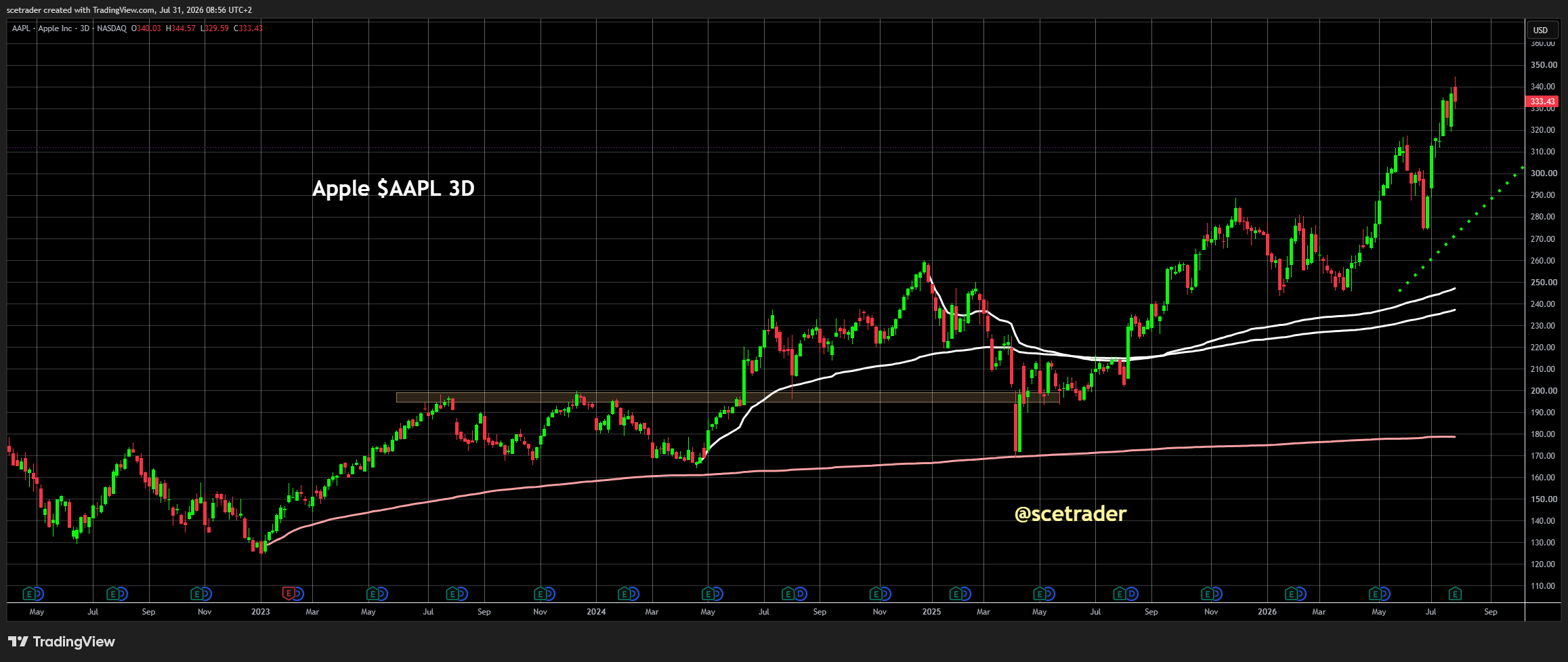
Onze Investment view op Apple is bullish. De nabeursdaling van ongeveer 8% zien wij als koopkans, omdat de markt de cijfers volgens ons verkeerd interpreteert.
De kern is dat Apple niet werd afgestraft omdat de vraag zwak is. Apple werd afgestraft omdat de markt bang is dat supply constraints de Q4-omzet kunnen beperken. Dat is een belangrijk verschil. Een vraagprobleem betekent dat klanten niet willen kopen. Een aanbodprobleem betekent dat Apple onvoldoende kan leveren om volledig aan de vraag te voldoen. Voor een belegger is dat fundamenteel een veel beter probleem.
Daarom vinden wij de reactie overdreven. Apple liet dubbelcijferige omzetgroei zien, zette records neer bij iPhone, Mac en Services, genereerde enorme operationele kasstroom en bleef zeer gedisciplineerd met capex. Dit is geen onderneming die met honderden miljarden aan infrastructuurinvesteringen moet bewijzen dat de AI-vraag groot genoeg is. Apple heeft een andere route: AI via devices, software, Siri, Services en de installed base.
Dat is strategisch belangrijk. Alphabet, Meta, Microsoft en Amazon zitten veel dieper in de AI-infrastructuurcyclus. Daar draait de discussie om datacenters, chips, memory, networking, stroom, vrije kasstroom en rendement op capex. Apple hoeft dat spel niet op dezelfde manier te spelen. Apple bezit de eindgebruiker, de hardwarelaag, het besturingssysteem, de App Store, de betaalrelatie en de distributie van software naar honderden miljoenen apparaten.
De markt lijkt Apple nu te straffen omdat het minder hard in AI-infrastructuur investeert dan hyperscalers. Wij zien dat juist als een voordeel. Apple investeert wel degelijk in AI, maar doet dat vooral via R&D en productintegratie. Dat houdt de vrije kasstroom sterk en beperkt het risico dat beleggers later gaan twijfelen aan het rendement op een enorme datacenteruitbouw.
Daarom is dit voor ons geen reden om Apple af te bouwen. Integendeel. Bij een daling van 8% ontstaat een aantrekkelijker instapmoment in een bedrijf dat nog altijd uitzonderlijke pricing power, distributiekracht, cashgeneratie en ecosysteemcontrole heeft.
Extra punten
■ Koersreactie: Apple nabeurs ongeveer 8% lager.
■ Omzet Q3: $109,4 miljard.
■ Omzetgroei: 16% op jaarbasis.
■ Verwaterde winst per aandeel: $2,02.
■ Groei winst per aandeel: 29% op jaarbasis.
■ iPhone-omzet: $54,3 miljard.
■ Mac-omzet: $10,4 miljard.
■ Services-omzet: $30,7 miljard.
■ Capex over negen maanden: $6,8 miljard.
■ Inkoop eigen aandelen over negen maanden: $62,1 miljard.
De strategische kern: Apple verkoopt geen ruwe AI-capaciteit, maar bezit de distributielaag
De belangrijkste strategische vraag is niet of Apple evenveel datacenters bouwt als de hyperscalers. De vraag is waar Apple waarde kan halen uit AI.
Apple zit niet primair in de markt voor ruwe compute. Apple zit bij de eindgebruiker. Dat is een andere machtspositie. De iPhone, Mac, iPad, Apple Watch, App Store, Services en Siri vormen samen een distributielaag die rechtstreeks in het dagelijks gebruik van consumenten en bedrijven zit.
Dat maakt de AI-case bij Apple minder kapitaalintensief. Apple hoeft AI niet alleen te verkopen als infrastructuurcapaciteit. Het kan AI verpakken in productfuncties, software-updates, abonnementen, privacy, on-device intelligentie en een betere gebruikerservaring. Dat kan leiden tot langere vervangingscycli, hogere loyaliteit en meer Services-omzet.
Daarom is het verschil met de hyperscalers zo belangrijk. Bij Amazon, Meta, Alphabet en Microsoft draait de discussie nu steeds meer om de vraag hoeveel geld er nodig is om AI-capaciteit te bouwen en hoe snel die investeringen rendement opleveren. Bij Apple ligt de strategische hefboom elders: distributie, hardware-integratie, softwarecontrole en installed base.
Apple hoeft dus niet de grootste AI-infrastructuurspeler te worden om een grote AI-winnaar te blijven. Het moet AI goed genoeg integreren om het ecosysteem sterker te maken. Dat is een veel lichtere en financieel aantrekkelijkere route.
Supply constraints: de markt straft Apple alsof de vraag zwak is
De nabeursdaling lijkt vooral te komen door de Q4-nuance rond supply constraints.
Dat verdient onderscheid. Supply constraints kunnen omzet in een kwartaal beperken. Dat is vervelend. Maar het betekent niet dat klanten afhaken. Het betekent dat Apple mogelijk niet genoeg product kan leveren om volledig aan de vraag te voldoen.
Dat is precies waarom wij de marktinterpretatie te negatief vinden. Als de Q4-groei tijdelijk wordt begrensd door aanbod, kan een deel van de vraag doorschuiven. Bij echte vraagzwakte verdwijnt die vraag. Dat verschil is groot.
De cijfers ondersteunen het idee dat de vraag niet zwak is. iPhone-omzet steeg naar $54,3 miljard, Mac naar $10,4 miljard en Services naar $30,7 miljard. Apple meldde bovendien een nieuwe all-time high voor de installed base van actieve apparaten.
Daarom is de daling volgens ons geen fundamentele afwijzing van Apple, maar een combinatie van hoge verwachtingen, voorzichtigheid rond Q4 en een markt die na een drukke techweek snel straft.
Cijfers en outlook
Apple rapporteerde in Q3 een omzet van $109,4 miljard, tegenover $94,0 miljard vorig jaar. De productomzet bedroeg $78,7 miljard en Services kwam uit op $30,7 miljard. De brutomarge kwam uit op $54,8 miljard en de operationele winst bedroeg $35,7 miljard.
De nettowinst steeg naar $29,8 miljard, tegenover $23,4 miljard vorig jaar. De verwaterde winst per aandeel kwam uit op $2,02, tegen $1,57 vorig jaar.
Per categorie was iPhone de grootste motor met $54,3 miljard omzet. Mac kwam uit op $10,4 miljard. Services groeide naar $30,7 miljard. iPad daalde naar $6,2 miljard en Wearables, Home and Accessories steeg licht naar $7,9 miljard.
Geografisch was de groei breed. Americas kwam uit op $45,8 miljard, Europe op $29,4 miljard, Greater China op $18,8 miljard, Japan op $6,6 miljard en Rest of Asia Pacific op $8,9 miljard.
De nuance zit in de marge. Apple gaf aan dat de brutomarge ongeveer 2 procentpunt voordeel had van tariff refunds. Ook de winst per aandeel kreeg ongeveer $0,11 steun van dat effect. Dat maakt het kwartaal niet zwak, maar het voorkomt wel dat beleggers de volledige margeverbetering één-op-één extrapoleren.
De vergelijking met andere megacap-techbedrijven
De timing van deze reactie is belangrijk.
In dezelfde week kwamen meerdere grote techbedrijven met cijfers waarin AI-capex, datacenters, memory, chips en vrije kasstroom centraal stonden. De markt is daardoor gevoeliger geworden voor alles wat ruikt naar zwakke guidance, hogere kosten of onzeker rendement.
Apple zit in een andere positie. Het bedrijf gaf over de eerste negen maanden $6,8 miljard uit aan property, plant and equipment. Tegelijk genereerde Apple $117,0 miljard aan operationele kasstroom. Dat verschil is extreem belangrijk.
Apple hoeft dus niet dezelfde kapitaalintensieve infrastructuurroute te volgen om relevant te blijven. Het bedrijf verhoogde wel de R&D-uitgaven naar $11,7 miljard in Q3, tegenover $8,9 miljard vorig jaar. Dat wijst op investeringen in productontwikkeling, software, AI en ecosysteeminnovatie, maar zonder de vrije kasstroom zwaar te beschadigen.
Daarom is de strategische vergelijking gunstig. Waar hyperscalers enorme bedragen moeten inzetten om toekomstige AI-vraag te bedienen, kan Apple AI via bestaande apparaten en software naar gebruikers brengen. Dat maakt het rendement op AI-investeringen mogelijk minder zichtbaar in één kwartaal, maar financieel wel robuuster.
Geen paper gains, maar winst uit de eigen operatie
Een ander belangrijk punt is de kwaliteit van de winst.
Apple rapporteerde geen kwartaal dat afhankelijk is van grote niet-operationele winsten uit AI-belangen. De winst komt uit de eigen activiteiten: iPhone, Mac, Services, software, ecosysteemkracht en operationele discipline.
Dat onderscheid is belangrijk in deze markt. Beleggers moeten steeds beter kijken naar de vraag waar winst vandaan komt. Is het operationele winst uit de kernactiviteit, of komt een groot deel uit waardestijgingen van externe belangen?
Bij Apple is het antwoord helder. De nettowinst van $29,8 miljard komt uit de bedrijfsvoering. Dat maakt de winstkwaliteit sterk en veel schoner dan bij bedrijven waar grote paper gains het beeld vertroebelen.
Balans, cashflow en kapitaalallocatie
De financiële positie blijft een van de sterkste argumenten voor Apple.
Over de eerste negen maanden genereerde Apple $117,0 miljard aan operationele kasstroom. De investeringen in property, plant and equipment bedroegen slechts $6,8 miljard. Dat laat zien hoe licht het model blijft vergeleken met AI-infrastructuurbedrijven.
Apple kocht in dezelfde periode voor $62,1 miljard aan eigen aandelen in en betaalde $11,8 miljard aan dividend en dividend equivalents. Tegelijkertijd loste het bedrijf $8,1 miljard aan term debt en $5,9 miljard aan commercial paper af.
De balans bevatte aan het einde van het kwartaal $39,5 miljard aan cash and cash equivalents, $22,9 miljard aan kortlopende marketable securities en $84,1 miljard aan langlopende marketable securities. Samen is dat ruim $146 miljard aan cash en verhandelbare effecten.
Deze balans geeft Apple strategische vrijheid. Het bedrijf kan investeren in AI, nieuwe producten, Services, buybacks, dividend en schuldenafbouw zonder het risicoprofiel wezenlijk te veranderen.
Siri AI en de installed base
De introductie van de nieuwe Siri AI op WWDC26 is strategisch relevanter dan de markt nu lijkt te waarderen.
Apple hoeft geen losstaande AI-app te winnen. Het hoeft AI vooral beter te integreren in de apparaten die klanten al gebruiken. Dat is een groot verschil. De installed base van actieve apparaten bereikte opnieuw een recordniveau. Daarmee heeft Apple een distributieplatform dat andere AI-bedrijven moeilijk kunnen kopiëren.
Als Siri AI beter wordt geïntegreerd in iPhone, Mac, iPad, Services en apps, kan Apple de waarde van het ecosysteem verhogen. Dat kan leiden tot hogere klantloyaliteit, meer Services-gebruik en mogelijk een sterkere upgradecyclus.
Dit is waarschijnlijk geen verhaal dat in één kwartaal volledig zichtbaar wordt. Maar voor lange termijnbeleggers is het wel belangrijk. Apple heeft tijd, cash, distributie en gebruikersvertrouwen. Dat zijn strategische assets.
Positieve katalysatoren
■ Apple rapporteerde het sterkste juni-kwartaal ooit.
■ De omzet groeide met 16% naar $109,4 miljard.
■ De winst per aandeel steeg met 29% naar $2,02.
■ iPhone, Mac en Services bereikten juni-kwartaalrecords.
■ De installed base bereikte een nieuwe all-time high.
■ Services blijft een sterke terugkerende inkomstenmotor.
■ De capex blijft laag vergeleken met hyperscalers.
■ De operationele kasstroom over negen maanden bedroeg $117,0 miljard.
■ Apple kocht voor $62,1 miljard eigen aandelen in.
■ Siri AI kan de waarde van het ecosysteem verhogen.
Negatieve katalysatoren
■ De koers daalde nabeurs ongeveer 8%.
■ De Q4-guidance werd zwakker ontvangen dan de cijfers zelf.
■ Supply constraints kunnen omzet naar latere kwartalen verschuiven.
■ De brutomarge kreeg steun van tariff refunds.
■ De winst per aandeel kreeg ongeveer $0,11 steun van tariff refunds.
■ iPad bleef achter bij de belangrijkste groeicategorieën.
■ Beleggers blijven kritisch op Apple’s AI-tempo.
■ De lat voor de volgende kwartalen ligt hoger na dit recordkwartaal.
■ Een zwakker marktsentiment kan het aandeel tijdelijk blijven raken.
■ De overgang van Tim Cook naar executive chairman kan kortetermijnruis geven.
Strategie voor het aandeel
Wij zouden de nabeursdaling gebruiken als koopkans.
De koersreactie is volgens ons te hard, omdat de markt een tijdelijk aanbodprobleem verwart met zwakke vraag. Dat is een klassieke fout bij een kwaliteitsbedrijf. Als de vraag intact is en de beperking vooral aan de aanbodkant zit, dan is de lange termijncase niet gebroken.
Apple blijft daarnaast financieel veel sterker dan de meeste megacap-techbedrijven. De onderneming genereert enorme kasstromen, houdt capex laag, koopt fors eigen aandelen in en behoudt een zeer sterke balans.
Dat betekent niet dat er geen risico’s zijn. Q4 kan tijdelijk minder sterk zijn, supply constraints kunnen omzet doorschuiven en de markt kan blijven twijfelen aan Apple’s AI-tempo. Maar voor de lange termijn wegen deze risico’s niet zwaarder dan de kwaliteit van het ecosysteem, de installed base en de kasstroom.
Daarom is onze strategie bullish: kopen op zwakte, met een lange termijnhorizon.
Conclusie
Apple daalde nabeurs ongeveer 8%, maar wij zien die beweging als overdreven. De markt reageert op supply constraints en voorzichtigheid rond Q4, terwijl de onderliggende cijfers sterk zijn.
Onze Investment view op Apple is bullish. De omzet steeg met 16%, de winst per aandeel met 29% en iPhone, Mac en Services zetten records neer voor een juni-kwartaal. De winst komt uit de eigen operatie en niet uit grote paper gains op AI-investeringen.
Strategisch blijft Apple aantrekkelijk omdat het geen hyperscalerachtige capexgolf hoeft te financieren om relevant te blijven in AI. Apple bezit de distributielaag naar de eindgebruiker en kan AI integreren in hardware, software, Siri en Services.
Daarom zien wij de daling als koopkans. Dit is geen zwak vraagverhaal. Dit is een sterk bedrijf dat tijdelijk wordt afgestraft omdat de markt supply constraints verkeerd uitlegt.
🔵 English version
Apple falls 8% after hours on supply constraints, but this looks more like excess demand than weak demand
No time to read the full article? Use the five bullets below for the key points.
■ Apple fell about 8% after hours after investors interpreted the Q4 nuance around supply constraints negatively.
■ The numbers themselves were strong: revenue rose 16% to $109.4 billion and EPS rose 29% to $2.02.
■ iPhone, Mac and Services all set new June-quarter records.
■ Apple remains financially much lighter than the AI hyperscalers: capex over nine months was only $6.8 billion.
■ Our Investment view on Apple is bullish: we see the decline as a buying opportunity because the market is confusing a supply problem with weak demand.
Apple reported the strongest June quarter in the company’s history. Revenue reached $109.4 billion, with growth across all geographic segments and new June-quarter records for iPhone, Mac and Services. Gross margin did benefit from tariff refunds, but the underlying performance remains strong. Still, the stock fell about 8% after hours as investors focused on the more cautious Q4 message and comments about supply constraints.
Investment view
Our Investment view on Apple is bullish. We see the roughly 8% after-hours decline as a buying opportunity because we believe the market is misinterpreting the numbers.
The key point is that Apple was not punished because demand is weak. Apple was punished because the market fears supply constraints could limit Q4 revenue. That is an important distinction. A demand problem means customers do not want to buy. A supply problem means Apple cannot deliver enough to fully meet demand. For investors, that is fundamentally a much better problem.
That is why we find the reaction excessive. Apple delivered double-digit revenue growth, set records in iPhone, Mac and Services, generated enormous operating cash flow and remained highly disciplined on capex. This is not a company that needs hundreds of billions of dollars in infrastructure spending to prove AI demand exists. Apple has a different route: AI through devices, software, Siri, Services and the installed base.
That is strategically important. Alphabet, Meta, Microsoft and Amazon are much deeper in the AI infrastructure cycle. Their debate is about data centers, chips, memory, networking, power, free cash flow and return on capex. Apple does not need to play that game in the same way. Apple owns the end user, the hardware layer, the operating system, the App Store, the payment relationship and software distribution to hundreds of millions of devices.
The market appears to be punishing Apple because it is investing less aggressively in AI infrastructure than the hyperscalers. We see that as an advantage. Apple is investing in AI, but mainly through R&D and product integration. That keeps free cash flow strong and limits the risk that investors later question the return on a huge data center build-out.
That is why this is not a reason for us to reduce Apple. On the contrary. An 8% decline creates a more attractive entry point in a company that still has exceptional pricing power, distribution strength, cash generation and ecosystem control.
Extra points
■ Stock reaction: Apple down about 8% after hours.
■ Q3 revenue: $109.4 billion.
■ Revenue growth: 16% year over year.
■ Diluted EPS: $2.02.
■ EPS growth: 29% year over year.
■ iPhone revenue: $54.3 billion.
■ Mac revenue: $10.4 billion.
■ Services revenue: $30.7 billion.
■ Capex over nine months: $6.8 billion.
■ Share repurchases over nine months: $62.1 billion.
The strategic core: Apple does not sell raw AI capacity, it owns the distribution layer
The key strategic question is not whether Apple builds as many data centers as the hyperscalers. The question is where Apple can extract value from AI.
Apple is not primarily in the market for raw compute. Apple sits with the end user. That is a different power position. The iPhone, Mac, iPad, Apple Watch, App Store, Services and Siri together form a distribution layer that sits directly inside consumers’ and businesses’ daily usage.
This makes the AI case at Apple less capital-intensive. Apple does not need to sell AI only as infrastructure capacity. It can package AI into product features, software updates, subscriptions, privacy, on-device intelligence and a better user experience. That can support longer upgrade cycles, higher loyalty and more Services revenue.
This is why the difference with the hyperscalers matters. At Amazon, Meta, Alphabet and Microsoft, the debate is increasingly about how much capital is needed to build AI capacity and how quickly those investments generate returns. Apple’s strategic leverage sits elsewhere: distribution, hardware integration, software control and installed base.
Apple therefore does not need to become the largest AI infrastructure player to remain a major AI winner. It needs to integrate AI well enough to strengthen the ecosystem. That is a much lighter and financially more attractive route.
Supply constraints: the market is punishing Apple as if demand were weak
The after-hours decline appears to be mainly driven by the Q4 nuance around supply constraints.
This requires a distinction. Supply constraints can limit revenue in a quarter. That is inconvenient. But it does not mean customers are walking away. It means Apple may not be able to supply enough product to fully meet demand.
That is exactly why we find the market interpretation too negative. If Q4 growth is temporarily constrained by supply, part of the demand can shift into later quarters. With real demand weakness, that demand disappears. The difference is significant.
The numbers support the view that demand is not weak. iPhone revenue rose to $54.3 billion, Mac to $10.4 billion and Services to $30.7 billion. Apple also reported a new all-time high in its active device installed base.
That is why we see the decline not as a fundamental rejection of Apple, but as a combination of high expectations, caution around Q4 and a market that quickly punishes nuance after a heavy tech earnings week.
Numbers and outlook
Apple reported Q3 revenue of $109.4 billion, compared with $94.0 billion last year. Product revenue was $78.7 billion and Services reached $30.7 billion. Gross margin was $54.8 billion and operating income was $35.7 billion.
Net income rose to $29.8 billion, compared with $23.4 billion last year. Diluted EPS was $2.02, compared with $1.57 last year.
By category, iPhone was the largest engine at $54.3 billion in revenue. Mac came in at $10.4 billion. Services grew to $30.7 billion. iPad declined to $6.2 billion and Wearables, Home and Accessories rose slightly to $7.9 billion.
Geographically, growth was broad. Americas reached $45.8 billion, Europe $29.4 billion, Greater China $18.8 billion, Japan $6.6 billion and Rest of Asia Pacific $8.9 billion.
The nuance is margin. Apple said gross margin benefited by about 2 percentage points from tariff refunds. EPS also received about $0.11 of benefit from that effect. This does not make the quarter weak, but it does prevent investors from extrapolating the full margin improvement one-for-one.
The comparison with other megacap tech companies
The timing of this reaction matters.
In the same week, several large tech companies reported numbers where AI capex, data centers, memory, chips and free cash flow were central. The market has therefore become more sensitive to anything that looks like weaker guidance, higher costs or uncertain returns.
Apple is in a different position. Over the first nine months, the company spent $6.8 billion on property, plant and equipment. At the same time, Apple generated $117.0 billion of operating cash flow. That gap is extremely important.
Apple therefore does not need to follow the same capital-intensive infrastructure route to remain relevant. The company did increase R&D expenses to $11.7 billion in Q3, compared with $8.9 billion last year. That points to investment in product development, software, AI and ecosystem innovation, but without heavily damaging free cash flow.
This is why the strategic comparison is favourable. While hyperscalers must commit enormous amounts of capital to serve future AI demand, Apple can bring AI to users through existing devices and software. The return on AI investment may be less visible in a single quarter, but the financial model is more robust.
No paper gains, but earnings from the core business
Another important point is earnings quality.
Apple did not report a quarter dependent on large non-operating gains from AI stakes. Earnings came from its own operations: iPhone, Mac, Services, software, ecosystem strength and operating discipline.
That distinction matters in this market. Investors increasingly need to ask where earnings are coming from. Are they operating earnings from the core business, or are they partly valuation gains from external stakes?
For Apple, the answer is clear. Net income of $29.8 billion came from the business. That makes earnings quality strong and much cleaner than at companies where large paper gains cloud the picture.
Balance sheet, cash flow and capital allocation
Apple’s financial position remains one of the strongest arguments for the stock.
Over the first nine months, Apple generated $117.0 billion of operating cash flow. Investments in property, plant and equipment were only $6.8 billion. This shows how asset-light the model remains compared with AI infrastructure companies.
Apple repurchased $62.1 billion of stock over the same period and paid $11.8 billion in dividends and dividend equivalents. At the same time, the company repaid $8.1 billion of term debt and $5.9 billion of commercial paper.
The balance sheet contained $39.5 billion in cash and cash equivalents, $22.9 billion in current marketable securities and $84.1 billion in non-current marketable securities at quarter-end. Combined, that is more than $146 billion in cash and marketable securities.
This gives Apple strategic freedom. The company can invest in AI, new products, Services, buybacks, dividends and debt reduction without materially changing its risk profile.
Siri AI and the installed base
The introduction of the new Siri AI at WWDC26 is strategically more relevant than the market currently appears to recognise.
Apple does not need to win with a standalone AI app. It mainly needs to integrate AI better into the devices customers already use. That is a major difference. The installed base of active devices reached a new all-time high. That gives Apple a distribution platform that other AI companies cannot easily replicate.
If Siri AI is better integrated into iPhone, Mac, iPad, Services and apps, Apple can increase the value of the ecosystem. That can support customer loyalty, more Services usage and potentially a stronger upgrade cycle.
This is probably not a story that becomes fully visible in one quarter. But for long-term investors, it matters. Apple has time, cash, distribution and user trust. Those are strategic assets.
Positive catalysts
■ Apple delivered its strongest June quarter ever.
■ Revenue grew 16% to $109.4 billion.
■ EPS rose 29% to $2.02.
■ iPhone, Mac and Services set June-quarter records.
■ The installed base reached a new all-time high.
■ Services remains a strong recurring revenue engine.
■ Capex remains low compared with hyperscalers.
■ Operating cash flow over nine months was $117.0 billion.
■ Apple repurchased $62.1 billion of stock.
■ Siri AI can increase the value of the ecosystem.
Negative catalysts
■ The stock fell about 8% after hours.
■ Q4 guidance was received more weakly than the numbers themselves.
■ Supply constraints can shift revenue into later quarters.
■ Gross margin received support from tariff refunds.
■ EPS received about $0.11 of benefit from tariff refunds.
■ iPad lagged the main growth categories.
■ Investors remain critical of Apple’s AI pace.
■ The bar for the coming quarters is higher after this record quarter.
■ Weaker market sentiment can keep temporary pressure on the stock.
■ Tim Cook’s move to executive chairman can create short-term noise.
Strategy for the stock
We would use the after-hours decline as a buying opportunity.
The share price reaction is too harsh in our view, because the market is confusing a temporary supply problem with weak demand. That is a classic mistake with a quality company. If demand is intact and the constraint is mainly on the supply side, the long-term case is not broken.
Apple also remains financially much stronger than most megacap tech companies. It generates enormous cash flow, keeps capex low, buys back significant amounts of stock and maintains a very strong balance sheet.
That does not mean there are no risks. Q4 can be temporarily less strong, supply constraints can shift revenue and the market can continue to question Apple’s AI pace. But for the long term, those risks do not outweigh the quality of the ecosystem, installed base and cash flow.
Our strategy is therefore bullish: buy on weakness, with a long-term horizon.
Conclusion
Apple fell about 8% after hours, but we see that move as excessive. The market is reacting to supply constraints and caution around Q4, while the underlying numbers are strong.
Our Investment view on Apple is bullish. Revenue rose 16%, EPS rose 29% and iPhone, Mac and Services set June-quarter records. Earnings came from Apple’s own operations, not from large paper gains on AI investments.
Strategically, Apple remains attractive because it does not need to finance a hyperscaler-style capex wave to remain relevant in AI. Apple owns the distribution layer to the end user and can integrate AI into hardware, software, Siri and Services.
That is why we see the decline as a buying opportunity. This is not a weak demand story. It is a strong company being temporarily punished because the market is misreading supply constraints.
Disclaimer Aan de door ons opgestelde informatie kan op geen enkele wijze rechten worden ontleend. Alle door ons verstrekte informatie en analyses zijn geheel vrijblijvend. Alle consequenties van het op welke wijze dan ook toepassen van de informatie blijven volledig voor uw eigen rekening.
Wij aanvaarden geen aansprakelijkheid voor de mogelijke gevolgen of schade die zouden kunnen voortvloeien uit het gebruik van de door ons gepubliceerde informatie. U bent zelf eindverantwoordelijk voor de beslissingen die u neemt met betrekking tot uw beleggingen.


