ABN AMRO: Halvering staatsbelang tijdelijke rem en structureel bullish trend
■ De Nederlandse Staat wil het belang in ABN AMRO via NLFI terugbrengen van 20,7% naar 10,5%. Op korte termijn kan de markt daardoor met extra aanbod worden geconfronteerd en kan de koers tijdelijk achterblijven. Voor de onderliggende trend beoordelen wij de stap echter duidelijk bullish: de structurele staats-overhang wordt bijna gehalveerd, de free float neemt fors toe en ABN AMRO beweegt opnieuw richting een normale beursgenoteerde aandeelhoudersstructuur.
■ Voor actieve handelaren kan juist de overgangsfase interessant worden. Een daling die voortkomt uit de distributie van een groot aandelenpakket is fundamenteel iets anders dan koersdruk door oplopende kredietverliezen, verslechterende winst of een zwakkere kapitaalpositie. Zolang die fundamentele variabelen intact blijven, kan bij ABN AMRO het buy on dips-principe relevant worden wanneer het NLFI-aanbod tijdelijk voor prijsdruk zorgt.
■ De daling naar 10,5% heeft ook bestuurlijke betekenis. Onder 15% verdwijnen bijzondere informatierechten van NLFI en onder 10% eindigt de Relationship Agreement grotendeels. De nieuwe doelstelling ligt dus zeer dicht bij een tweede belangrijke grens, zonder dat daaruit mag worden afgeleid dat een nieuwe verkoopronde of een strategische transactie al vaststaat.
■ De timing van de verkoop is belangrijk. ABN AMRO bevindt zich niet in een kapitaalcrisis: de meest recente cijfers lieten een CET1-ratio van 15,9%, 12,1% rendement op eigen vermogen en slechts 4 basispunten risicokosten zien. De verkoop door NLFI verandert de eigendom van de stukken, maar brengt geen kapitaal uit de bank en weerspiegelt op zichzelf geen stress in het kredietboek.
■ CEO Marguerite Bérard schetst bovendien een relatief geruststellend beeld van het kredietboek en de recente cijfers ondersteunen dat beeld. ABN AMRO kwalificeert de kredietkwaliteit als robuust en rapporteerde slechts 4 basispunten aan risicokosten. Er zijn daarmee op dit moment geen aanwijzingen voor brede stress in het kredietboek. Dat is belangrijk voor de handelscase, omdat eventuele koersdruk door de verkoop van NLFI-aandelen dan eerder technisch dan fundamenteel kan zijn. Juist die combinatie ondersteunt het buy on dips-principe en onze bullish visie op de onderliggende trend.
Investment view
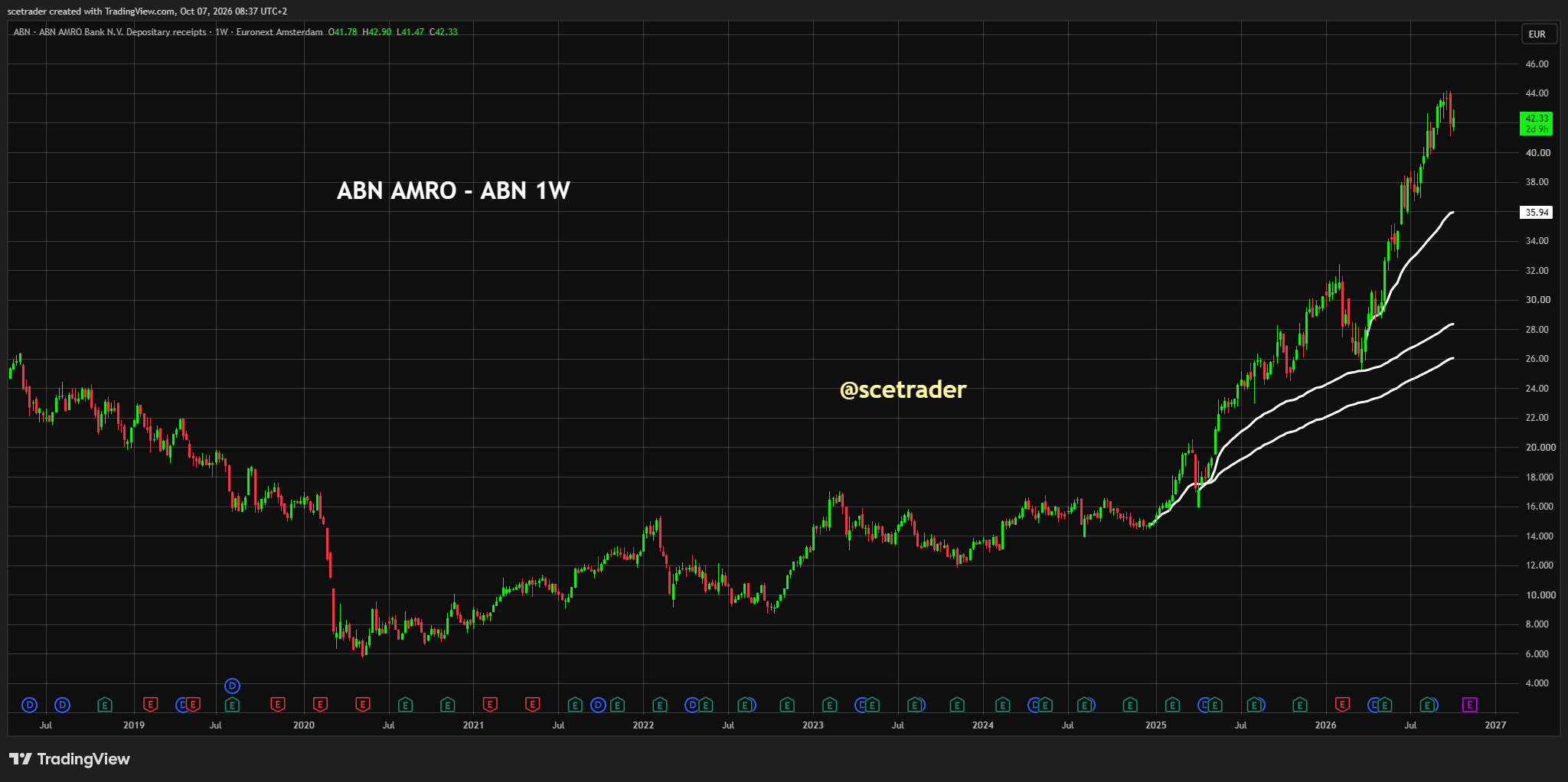
De halvering van het resterende Nederlandse staatsbelang is naar onze mening duidelijk positief voor de onderliggende trend van ABN AMRO, ook al kan het verkoopproces op korte termijn precies het tegenovergestelde effect op de koers hebben. Die ogenschijnlijke tegenstelling is de kern van de analyse. De markt krijgt eerst te maken met extra aanbod, terwijl de uiteindelijke aandeelhoudersstructuur juist aantrekkelijker wordt zodra dat aanbod is geabsorbeerd.
Dat onderscheid tussen de handelsstroom en de structurele situatie na afloop is essentieel. NLFI verkoopt niet omdat ABN AMRO nieuwe kapitaalbehoefte heeft, omdat de kwaliteit van het kredietboek plotseling is verslechterd of omdat de bank zelf aandelen moet uitgeven. Een bestaande aandeelhouder brengt bestaande stukken naar de markt. Het aantal economische activiteiten van ABN AMRO verandert daardoor niet, de winst per aandeel wordt niet mechanisch verwaterd en de CET1-ratio krijgt niet ineens een andere basis.
De korte termijn kan hierdoor technisch lastiger worden dan de fundamentele ontwikkeling rechtvaardigt. Juist daarin kan voor actieve handel een kans ontstaan. Als de koers door het NLFI-aanbod corrigeert terwijl risicokosten, kapitaal, winst en funding gezond blijven, kan prijs tijdelijk sneller dalen dan de onderliggende waarde. Wij vinden daarom dat buy on dips bij ABN AMRO de komende periode een relevante strategie kan worden, mits duidelijk onderscheid wordt gemaakt tussen technische verkoopdruk en fundamentele verslechtering.
Op langere termijn is de stap nog belangrijker. Een staatsbelang van 20,7% is groot genoeg om permanent onderdeel te zijn van de waarderingsdiscussie. Bij 10,5% verandert dat karakter. De Staat blijft aandeelhouder, maar de hoeveelheid toekomstige aandelen die nog boven de markt hangt is veel kleiner, de bijzondere governance wordt verder afgebouwd en ABN AMRO komt dichter bij het punt waarop de privatisering institutioneel vrijwel is genormaliseerd.
Eerst komt het aanbod, daarna verdwijnt een groot deel van de overhang
Een verkoop van ruim 10 procentpunt van het aandelenkapitaal is groot genoeg om de microstructuur van een aandeel tijdelijk te beïnvloeden. Marktpartijen weten dat er gedurende het programma een structurele verkoper bestaat. Dat kan kopers geduldiger maken en stijgingen tijdelijk afremmen, omdat er bij hogere koersen opnieuw aanbod in de markt kan verschijnen.
Dat effect kan vooral zichtbaar zijn op dagen waarop de algemene markt al zwak is. Een bestaande verkoopstroom kan dan extra druk geven, terwijl een sterkere beursdag juist minder koersreactie oplevert dan normaal omdat nieuwe vraag deels wordt gebruikt om het NLFI-aanbod op te nemen. Voor korte termijn handel is het daarom goed mogelijk dat de koers gedurende de verkoopperiode minder schoon reageert op fundamenteel nieuws.
Maar iedere verkochte tranche heeft twee effecten. Zij creëert vandaag aanbod en vermindert tegelijkertijd de hoeveelheid aanbod die morgen nog kan komen. Dat maakt het programma fundamenteel anders dan bijvoorbeeld structurele verwatering door voortdurende kapitaaluitgifte. Naarmate de distributie vordert, wordt de oorspronkelijke overhang kleiner.
Na afronding blijft bovendien een aanzienlijk grotere free float achter. Het tijdelijke nadeel en het structurele voordeel zijn dus twee kanten van dezelfde transactie.
Waarom wij dit bullish vinden voor de trend
De bull case begint niet bij een voorspelling dat het aandeel direct stijgt. Zij begint bij de constatering dat een structurele waarderingsfrictie kleiner wordt. Zolang de Nederlandse Staat meer dan een vijfde van ABN AMRO bezit, weet iedere belegger dat verdere privatisering uiteindelijk opnieuw aandelen naar de markt kan brengen. Die onzekerheid kan in de waardering blijven hangen, zelfs wanneer de bank operationeel goed presteert.
Na de stap naar 10,5% is de resterende overhang veel kleiner. De markt heeft dan bijna de helft van het huidige staatsbelang geabsorbeerd en het punt van verdere normalisering ligt veel dichterbij. Dat maakt ABN AMRO op termijn eenvoudiger vergelijkbaar met Europese banken zonder een vergelijkbare staatsconstructie.
De verbeterde free float kan daarnaast de investeerbaarheid vergroten. Grote professionele portefeuilles kijken niet alleen naar fundamentele waardering, maar ook naar liquiditeit en de mogelijkheid om een substantiële positie op te bouwen zonder zelf de koers te veel te beïnvloeden. Een groter vrij verhandelbaar deel van het kapitaal helpt daarbij.
Daarom is een tijdelijk lagere koers tijdens de distributie niet automatisch strijdig met een bullish trendvisie. De transactie kan de koers eerst remmen terwijl zij tegelijkertijd één van de structurele redenen voor die rem aan het verwijderen is.
10,5% ligt strategisch dicht tegen een belangrijke governancegrens
De keuze voor een eindniveau van 10,5% is vooral interessant omdat verschillende rechten van NLFI aan eigendomsdrempels zijn gekoppeld. Onder 15% verdwijnen de bijzondere informatierechten. Onder 10% eindigt de Relationship Agreement grotendeels en vervallen opnieuw bijzondere elementen van de relatie tussen NLFI en de bank.
Daaruit mag niet worden geconcludeerd dat NLFI bewust 10,5% kiest als voorportaal van een onmiddellijke nieuwe verkoop. Evenmin bewijst de afstand van slechts een halve procentpunt dat Nederland binnenkort volledig uitstapt. Wat wel objectief verandert, is dat ABN AMRO na dit programma veel dichter bij een aandeelhoudersstructuur komt waarin de speciale relatie met de Staat nog slechts een beperkte rol speelt.
Dat is vooral belangrijk voor strategische flexibiliteit. Een partij die met ABN AMRO over een grote transactie zou willen spreken, krijgt een ander bestuurlijk uitgangspunt wanneer de Staat 10,5% bezit dan wanneer die nog ruim 20% controleert. Het aantal andere obstakels blijft groot, maar één specifiek obstakel wordt substantieel kleiner.
De governance-normalisering kan daarom uiteindelijk een gedeelte van de historische staatskorting uit de waardering halen, mits de operationele prestaties tegelijkertijd voldoende sterk blijven.
Minder staatsinvloed betekent niet dat ABN AMRO morgen eenvoudig kan worden overgenomen
Het zou te gemakkelijk zijn om de verkoop van NLFI rechtstreeks door te trekken naar een overnameverhaal. ABN AMRO behoudt andere beschermingsmechanismen, waaronder de structuur rond STAK AAB. Daarnaast is een Europese bankfusie onderworpen aan aanzienlijk meer voorwaarden dan een reguliere bedrijfsovername.
Kapitaal, liquiditeit, resolutie, governance, mededinging en prudentiële risico's moeten uitvoerig worden beoordeeld. Daar komt bij dat ABN AMRO systeemrelevant is voor Nederland, met een grote positie in hypotheken, deposito's en zakelijke kredietverlening. Ook bij een kleiner staatsbelang verdwijnen nationale gevoeligheden niet.
Dat maakt de juiste conclusie juist sterker. De huidige stap maakt een grensoverschrijdende transactie niet waarschijnlijk op korte termijn, maar verwijdert geleidelijk een historisch bijzondere laag uit de eigendomsstructuur. Het verschil zit dus in optionaliteit, niet in waarschijnlijkheid op korte termijn.
ABN AMRO krijgt een grotere set mogelijke strategische uitkomsten zonder dat één daarvan vandaag hoeft te worden gekozen.
Marguerite Bérard stuurt nadrukkelijk op rendement in plaats van alleen op schaal
De strategische koers onder Marguerite Bérard sluit goed aan op die veranderende aandeelhoudersstructuur. ABN AMRO wil in 2028 minimaal 12% rendement op eigen vermogen realiseren, de cost/income ratio onder 55% brengen en de inkomstenbasis verder uitbouwen, terwijl een CET1-ratio boven de langetermijndoelstelling moet zorgen voor voldoende prudentiële ruimte.
De belangrijke verschuiving is dat omvang niet het primaire doel vormt. De nadruk ligt op winstgevende groei, kapitaalefficiëntie en activiteiten waarin ABN AMRO daadwerkelijk een aantrekkelijke return kan behalen. Dat omvat de Nederlandse kernfranchise, Wealth Management, geselecteerde zakelijke activiteiten en uitbreiding in Noordwest-Europa.
Deze discipline is ook voor M&A relevant. Een overname die alleen omzet of activa toevoegt maar onvoldoende rendement oplevert, past niet bij het strategische raamwerk. Een transactie moet daarom worden beoordeeld op synergieën, rendement op het ingezette kapitaal, uitvoeringsrisico en de invloed op kapitaaluitkeringen.
Dat vergroot de geloofwaardigheid van toekomstige strategische opties. Een bank die schaal niet als doel op zichzelf behandelt, kan selectiever zijn in wat zij koopt en onder welke voorwaarden zij zelf onderdeel van een combinatie zou willen worden.
HAL en NIBC zijn geen losse transacties maar bouwstenen van een bredere Noordwest-Europese strategie
De integratie van Hauck Aufhäuser Lampe versterkt ABN AMRO in het Duitse vermogensbeheer en vergroot de aanwezigheid bij vermogende klanten, ondernemers en families. Duitsland wordt daarmee strategisch belangrijker naast Nederland.
NIBC voegt een ander type schaal toe. Hypotheken en spaargelden versterken de Nederlandse funding- en retailbasis, terwijl gespecialiseerde kredietactiviteiten aanvullende niches creëren waarin expertise en klantrelaties belangrijker zijn dan pure omvang.
De twee transacties samen laten zien dat ABN AMRO bereid is extern kapitaal in te zetten wanneer een activiteit aansluit op de gewenste franchise. Tegelijkertijd vergroten zij het belang van execution. Integraties moeten eerst daadwerkelijk synergieën, klantretentie en rendement opleveren voordat een veel grotere nieuwe transactie logisch wordt.
Dat is een belangrijke reden om niet te speculeren op een snelle megafusie. De veel sterkere case is dat ABN AMRO de bestaande acquisities goed integreert, zijn rendement verder verhoogt en ondertussen een aandeelhoudersstructuur krijgt die toekomstige strategische keuzes minder gecompliceerd maakt.
ABN AMRO kan zowel consolidator als consolidatiekandidaat zijn
De toekomstige M&A-discussie hoeft daarom niet uitsluitend te gaan over een buitenlandse bank die ABN AMRO koopt. De bank kan zelf eveneens consolidator blijven. Met een sterke Nederlandse fundingbasis, een grotere positie in Duitse Wealth Management, NIBC en geselecteerde Corporate Banking-activiteiten heeft ABN AMRO verschillende platforms waarop verdere groei mogelijk is.
Dat maakt het verdwijnen van de staats-overhang ook vanuit het perspectief van ABN AMRO als koper relevant. Een normalere aandeelhoudersbasis legt meer nadruk op rendement, kapitaalallocatie en waardecreatie en minder op de historische bijzondere positie van de Staat.
Aan de andere kant kan een grotere Europese partij op termijn eveneens strategische waarde zien in ABN AMRO. Nederlandse deposito's, hypotheken, vermogensbeheer en zakelijke klantrelaties zijn aantrekkelijke assets, vooral wanneer daar een efficiëntere kostenbasis en een sterk kapitaalprofiel tegenover staan.
Welke richting uiteindelijk ontstaat, is niet te voorspellen. De positieve ontwikkeling is dat de set realistische opties groter wordt.
Het kredietboek geeft momenteel geen aanleiding om de NLFI-verkoop als waarschuwing te lezen
De belangrijkste bescherming voor de bullish trendvisie blijft de kwaliteit van de bank zelf. Een technische overhang is alleen interessant wanneer de onderliggende franchise voldoende gezond is.
CEO Marguerite Bérard heeft een relatief geruststellend beeld van het kredietboek geschetst en de meest recente financiële cijfers ondersteunen dat beeld. ABN AMRO realiseerde €781 miljoen nettowinst in Q2 en een rendement op eigen vermogen van 12,1%. De CET1-ratio bedroeg 15,9% en de risicokosten slechts 4 basispunten. De bank kwalificeert de kredietkwaliteit als robuust en er zijn op dit moment geen aanwijzingen voor brede stress in het kredietboek.
Die 4 basispunten moeten niet worden geëxtrapoleerd alsof kredietverliezen permanent vrijwel nihil blijven. Een zwakkere economie, hogere werkloosheid of problemen in specifieke zakelijke sectoren kunnen de impairments later verhogen. Maar het huidige niveau geeft geen signaal van uitzonderlijke stress in het kredietboek.
De NLFI-verkoop vindt daarmee plaats tegen een achtergrond van solide asset quality in plaats van een verslechterende kredietcyclus. Dat ondersteunt het onderscheid tussen technische koersdruk door een grote verkoper en fundamentele koersdruk door een verzwakkende bank.
Juist daarom kan buy on dips interessant worden
Voor actieve handel is het onderscheid tussen de oorzaak van een daling belangrijker dan de daling zelf. Wanneer ABN AMRO 3% of 5% daalt omdat risicokosten fors oplopen en de winstverwachting daalt, is de lagere koers fundamenteel gerechtvaardigd. Wanneer dezelfde koersdaling ontstaat terwijl NLFI stukken distribueert en de financiële outlook onveranderd blijft, is de analyse totaal anders.
In het tweede geval kan tijdelijk een marktverstoring ontstaan. De marginale verkoper handelt dan niet noodzakelijk vanuit een oordeel over de intrinsieke waarde van ABN AMRO, maar vanuit het beleidsdoel om het staatsbelang te reduceren.
Dat is precies het type situatie waarin buy on dips aantrekkelijk kan worden. De aanpak moet wel selectief blijven. Een dip heeft alleen waarde wanneer de operationele thesis intact blijft en niet wanneer er gelijktijdig nieuwe negatieve fundamentele informatie verschijnt.
Voor traders is daarom niet alleen de koers relevant, maar vooral de combinatie van prijs, nieuwsflow, kredietontwikkeling en de mate waarin de markt het NLFI-aanbod absorbeert.
Marktabsorptie kan zelf een nuttig signaal worden
De manier waarop het aandeel zich gedraagt tijdens het verkoopprogramma kan aanvullende informatie geven over de onderliggende vraag.
Wanneer een groot pakket naar de markt wordt gebracht en ABN AMRO desondanks relatief sterk blijft liggen, betekent dat dat andere beleggers bereid zijn het aanbod op te nemen. Dat kan uiteindelijk een krachtiger bullish signaal zijn dan een stijging in een markt zonder grote verkoper.
Omgekeerd kan langdurige zwakte ondanks goede cijfers erop wijzen dat de hoeveelheid aanbod groter is dan de markt op dat moment gemakkelijk kan absorberen. Dat hoeft de fundamentele thesis niet te breken, maar kan wel betekenen dat de technische fase langer duurt.
De situatie kan daardoor zichzelf geleidelijk verbeteren. Naarmate meer aandelen worden verdeeld, neemt het resterende NLFI-aanbod af en wordt een steeds groter gedeelte van het kapitaal gedragen door marktpartijen die bewust voor ABN AMRO hebben gekozen.
De kapitaalpositie is sterk genoeg om strategische vrijheid daadwerkelijk waarde te geven
Strategische optionaliteit heeft alleen waarde wanneer een bank financieel in staat is die opties te benutten. Met een CET1-ratio van 15,9% staat ABN AMRO daar momenteel relatief sterk voor.
Niet het volledige verschil tussen 15,9% en de langetermijndoelstelling kan zonder meer als overtollig kapitaal worden gezien. NIBC moet worden geïntegreerd, regelgeving kan veranderen en een prudentiële buffer blijft noodzakelijk. Maar het uitgangspunt is duidelijk anders dan bij een bank die nauwelijks boven zijn minimumeisen opereert.
ABN AMRO kan daardoor organische groei financieren, integraties uitvoeren en tegelijkertijd aandeelhouderskapitaal blijven beheren. Wanneer de winstgevendheid verder stijgt en de kapitaalratio ruim blijft, wordt de discussie over distributie van overtollig kapitaal opnieuw belangrijker.
Een kleiner staatsbelang en een sterke kapitaalbasis versterken elkaar daarmee. De governance wordt flexibeler op hetzelfde moment dat de bank financieel meer mogelijkheden heeft om kapitaal rationeel in te zetten.
De verkoop door NLFI verandert niets aan het kapitaal van de bank zelf
Dit punt verdient nadruk omdat het voor de interpretatie essentieel is. De opbrengst van de verkoop gaat naar de Nederlandse Staat en niet naar ABN AMRO. De bank geeft geen nieuwe aandelen uit en haalt geen nieuw eigen vermogen op.
Er is dus geen verwatering door een kapitaalverhoging. De CET1-ratio verandert niet simpelweg omdat een bestaand certificaat van de Staat naar een andere belegger gaat. De activiteiten, activa en verplichtingen van ABN AMRO blijven door de transactie in beginsel gelijk.
Daarom is de economische impact indirect: meer free float, andere governance, een kleiner staatsbelang en meer strategische flexibiliteit.
Dat is precies waarom een eventuele koersdaling door de plaatsing fundamenteel anders moet worden behandeld dan een koersdaling na een emergency rights issue of onverwacht grote kredietverliezen.
De 2028-doelen worden belangrijker wanneer de staatskorting afneemt
Privatisering alleen creëert geen operationele waarde. Uiteindelijk moet ABN AMRO voldoende winst verdienen op het eigen vermogen. De combinatie van een kleinere staats-overhang en een hoger structureel rendement is daarom veel belangrijker dan één van beide afzonderlijk.
Een duurzaam rendement op eigen vermogen van minimaal 12%, een cost/income ratio onder 55% en een robuuste kapitaalratio zouden ABN AMRO qua economische kwaliteit dichter richting de betere Europese banken bewegen. Als tegelijkertijd het staatsbelang nog maar 10,5% of later mogelijk minder bedraagt, verdwijnen twee verschillende redenen voor een waarderingskorting tegelijkertijd.
Daarmee ontstaat potentieel een dubbel effect. De winst per euro eigen vermogen stijgt, terwijl de markt tegelijkertijd minder reden heeft om vanwege de bijzondere eigendomsstructuur een extra discount toe te passen.
Dat is de basis waarop een structurele herwaardering kan ontstaan zonder dat daarvoor een overname nodig is.
De standalone case moet altijd belangrijker blijven dan de overname-optie
Een fout in dergelijke situaties is dat de M&A-speculatie uiteindelijk het hele verhaal gaat domineren. Dat zou bij ABN AMRO onjuist zijn.
De bank moet zelfstandig aantrekkelijk genoeg zijn om de investering te rechtvaardigen. Een eventuele fusie, overname of grotere Europese combinatie moet aanvullende optionaliteit zijn en geen noodzakelijke voorwaarde voor een hogere koers.
Daarom zijn de 2028-doelen, kostenontwikkeling, kapitaaldiscipline, kredietkwaliteit en integratie van NIBC en HAL belangrijker dan een hypothetische biedpremie.
Juist wanneer de standalone case sterker wordt, neemt paradoxaal genoeg ook de strategische aantrekkelijkheid toe. Een potentiële partner koopt liever een bank met een sterke franchise, goede kapitaalpositie en efficiënte kostenbasis dan een onderneming die alleen goedkoop is omdat zij operationeel zwak presteert.
Een grensoverschrijdende fusie blijft complex, maar wordt iets minder complex
Europese bankconsolidatie kent een fundamentele economische logica. Technology, cybersecurity, compliance, data en regelgeving creëren hoge vaste kosten, terwijl grotere depositobases, bredere fee-inkomsten en meer schaal die kosten over een grotere franchise kunnen verdelen.
Toch blijven grensoverschrijdende transacties moeilijk. Nationale toezichthouders, liquiditeitsregels, depositogarantie, resolutieplanning, politieke belangen, IT-platforms en verschillende klantmodellen creëren grote uitvoeringsrisico's.
Het reduceren van NLFI naar 10,5% lost geen van die structurele Europese problemen op. Het verwijdert wel een extra laag die specifiek bij ABN AMRO hoorde.
Daarom zien wij de kans op een combinatie niet plotseling als hoog. We zien wel dat één van de redenen waarom ABN AMRO historisch minder eenvoudig in zo'n scenario paste, geleidelijk kleiner wordt.
De risico's moeten serieus blijven worden genomen
De eerste risicofactor is de technische verkoopdruk zelf. Een grote distributie kan langer duren dan beleggers verwachten en gedurende die periode de koers blijven afremmen, zelfs wanneer de fundamentele cijfers goed zijn.
Een tweede risico is dat het huidige uitzonderlijk lage niveau van risicokosten normaliseert. Vier basispunten is bijzonder laag en hoeft niet representatief te zijn voor een volledige economische cyclus. Hogere kredietverliezen kunnen de winst en kapitaalvorming later drukken.
Een derde risico is execution. HAL en NIBC moeten goed worden geïntegreerd, terwijl ABN AMRO tegelijkertijd kosten verlaagt, digitaliseert en zijn organisatie verandert. Te veel verandering op hetzelfde moment kan operationele frictie veroorzaken.
Een vierde risico is dat Europese consolidatie veel langer uitblijft dan de markt hoopt. De huidige sell-down moet daarom nooit worden gekocht op basis van de verwachting dat een overname vanzelf volgt.
De bull case moet overeind blijven zonder M&A. Naar onze mening doet zij dat momenteel.
Waarom het huidige nieuws per saldo duidelijk bullish is
Het belangrijkste economische effect van de transactie is dat Nederland bijna de helft van zijn huidige resterende belang naar de markt brengt. Tijdens de uitvoering ontstaat aanbod, maar na de uitvoering is de Staat veel kleiner, de free float groter en de bijzondere governance verder verminderd.
Tegelijkertijd staat ABN AMRO er fundamenteel veel sterker voor dan tijdens eerdere fasen van zijn geschiedenis. De bank genereert een rendement op eigen vermogen rond de strategische doelstelling, heeft een ruime CET1-buffer en toont volgens Bérard en de recente kredietcijfers geen aanwijzingen voor brede stress in het kredietboek.
Daarbovenop bouwt Bérard een duidelijker rendementsmodel. De bank richt zich sterker op kapitaalefficiëntie, kosten, winstgevende groei en Noordwest-Europa. HAL en NIBC maken duidelijk dat externe groei binnen dat raamwerk mogelijk is.
Dat alles maakt de verkoop voor ons niet bearish maar bullish voor de onderliggende trend. Het extra aanbod is tijdelijk. De normalisering van eigendom, governance en strategische vrijheid is structureler.
Waarom buy on dips de komende periode relevant kan worden
De meest aantrekkelijke handelsmomenten kunnen juist ontstaan wanneer de structurele bull case en de tijdelijke technische druk met elkaar botsen. Wanneer NLFI verkoopt en de koers daardoor terugvalt zonder een gelijktijdige verslechtering van winst, kredietkwaliteit, kapitaal of funding, kan de markt een discount creëren die vooral uit flow voortkomt.
Daarom zouden wij een zwakke koers niet onmiddellijk interpreteren als bewijs dat de markt de transactie negatief beoordeelt. Het is mogelijk dat de markt simpelweg tijd nodig heeft om een groot pakket te absorberen.
Wanneer zulke dips vervolgens kopers aantrekken en de koers relatief snel stabiliseert, wordt dat een belangrijke aanwijzing dat de onderliggende vraag sterk genoeg is om de distributie op te nemen.
Voor actieve traders kan het buy on dips-principe bij ABN AMRO daardoor juist tijdens deze overgangsfase aantrekkelijker worden, terwijl voor een langere horizon vooral de structureel kleinere staats-overhang van belang is.
Conclusie
Wij beoordelen de halvering van het NLFI-belang van 20,7% naar 10,5% duidelijk als bullish voor de onderliggende trend van ABN AMRO. De koers kan op korte termijn onder technische verkoopdruk komen te staan, maar juist die druk kan buy on dips-kansen creëren zolang kredietkwaliteit, winstgevendheid en kapitaal sterk blijven. Na afronding resteert een veel kleinere staats-overhang, een grotere free float en een governance-structuur die dichter bij volledige normalisering ligt, terwijl Bérard tegelijkertijd bouwt aan een beter renderende Noordwest-Europese bank. Een grensoverschrijdende fusie of overname is daarmee niet ineens waarschijnlijk, maar de strategische optionaliteit wordt wel groter. Het belangrijkste is dat de standalone case deze ontwikkeling al kan dragen; eventuele M&A is aanvullende upside en niet de noodzakelijke basis van de bullish visie.
English version
ABN AMRO: halving the State stake is a temporary technical headwind, but structurally bullish for the trend
■ The Dutch State intends to reduce its stake in ABN AMRO through NLFI from 20.7% to 10.5%. In the short term, that can create additional supply and temporarily weigh on the shares. For the underlying trend, however, we view the move as clearly bullish: the structural State overhang is almost halved, free float increases materially and ABN AMRO takes another major step toward a normal publicly listed shareholder structure.
■ For active traders, the transition itself may create opportunities. A decline caused by distribution of a large block of shares is fundamentally different from weakness driven by rising credit losses, deteriorating earnings or weaker capital. As long as those underlying variables remain intact, the buy-on-dips principle can become relevant when NLFI supply temporarily pressures the share price.
■ The reduction to 10.5% also has governance implications. Below 15%, NLFI's special information rights disappear, while below 10% the Relationship Agreement largely terminates. The new target therefore sits very close to a second important threshold, without implying that another sell-down or strategic transaction has already been decided.
■ The timing of the sale matters. ABN AMRO is not in a capital crisis: the latest reported figures showed a 15.9% CET1 ratio, 12.1% return on equity and only 4 basis points of cost of risk. NLFI's sale changes ownership of the shares but does not remove capital from the bank and does not in itself signal stress in the loan book.
■ CEO Marguerite Bérard has also presented a relatively reassuring picture of the loan book, and the recent numbers support that assessment. ABN AMRO describes credit quality as robust and reported only 4 basis points of cost of risk. There are currently no indications of broad stress across the loan book. This matters for the trading case because any pressure caused by NLFI selling would therefore be more likely to be technical than fundamental. That combination supports the buy-on-dips thesis and our bullish view of the underlying trend.
Investment View
We regard the reduction of Dutch State ownership as clearly positive for ABN AMRO's underlying trend, even though the execution of the sell-down can initially have exactly the opposite impact on the share price. That apparent contradiction is central to the analysis. The market first has to absorb additional supply, while the resulting ownership structure becomes more attractive once that supply has been distributed.
The distinction between trading flow and the structural situation after completion is crucial. NLFI is not selling because ABN AMRO needs fresh capital, because the loan book has suddenly deteriorated or because the bank itself is issuing shares. An existing shareholder is selling existing securities. The economic activities of ABN AMRO do not change, earnings per share are not mechanically diluted and the CET1 ratio does not acquire a new basis simply because ownership changes hands.
The short term can therefore become technically more difficult than the fundamental picture would justify. This is precisely where an opportunity can emerge for active traders. If the shares fall because of NLFI distribution while credit costs, capital, earnings and funding remain healthy, price can temporarily decline faster than underlying value. We therefore believe buy on dips can become a relevant strategy in ABN AMRO during the coming period, provided technical selling pressure is clearly distinguished from fundamental deterioration.
Over the longer term, the transaction is even more important. A State holding of 20.7% is large enough to remain permanently part of the valuation discussion. At 10.5%, the character changes substantially. The State remains a shareholder, but the potential future supply overhang is much smaller, exceptional governance is further reduced and ABN AMRO moves closer to the point where privatisation is institutionally almost normalised.
Supply comes first, but a large part of the overhang disappears afterwards
A sale representing more than ten percentage points of the share capital is large enough to influence trading microstructure temporarily. Market participants know there is a structural seller. That can make buyers more patient and cap rallies because additional stock may come to market at higher prices.
The effect can be especially visible during weak broader market sessions. Existing supply may amplify downside, while good market days can produce less upside than usual because new demand is partly used to absorb NLFI stock. For short-term trading, the shares may therefore react less cleanly to fundamental news while the programme is active.
Every tranche sold, however, has two effects. It creates supply today while reducing the amount of supply that can still arrive tomorrow. This makes the programme fundamentally different from structural dilution through repeated capital issuance. As distribution progresses, the original overhang shrinks.
Once the programme is complete, the market is left with a materially larger free float. The temporary disadvantage and the structural advantage are therefore two sides of the same transaction.
Why we view the trend as bullish
The bullish thesis does not begin with a prediction that the stock rises immediately. It begins with the observation that a structural valuation friction is being reduced. As long as the Dutch State owns more than one fifth of ABN AMRO, every investor knows that further privatisation can eventually bring more stock to market. That uncertainty can remain embedded in valuation even when operating performance is strong.
At 10.5%, the remaining overhang is much smaller. The market will have absorbed almost half of the current State position and full ownership normalisation comes much closer. This makes ABN AMRO progressively easier to compare with European banks without a similar State structure.
The larger free float can also improve investability. Large professional portfolios care not only about fundamental value but also about liquidity and the ability to establish a meaningful position without creating excessive price impact. A larger freely tradable share base helps.
Temporary weakness during distribution is therefore not inconsistent with a bullish trend view. The transaction can restrain the share price today while simultaneously removing one of the structural reasons for that restraint.
The 10.5% level sits strategically close to an important governance threshold
The size of the transaction is not the only relevant factor. The end level matters because several NLFI rights are linked to ownership thresholds. Below 15%, special information rights disappear. Below 10%, the Relationship Agreement largely terminates and additional exceptional elements of the relationship between NLFI and ABN AMRO fall away.
This does not justify concluding that NLFI deliberately selected 10.5% as a staging point for another immediate sale. Nor does the half-percentage-point distance prove that the Netherlands will shortly exit entirely. What objectively changes is that, once the programme is complete, ABN AMRO will be much closer to an ownership structure in which the special relationship with the State plays only a limited role.
That is especially relevant to strategic flexibility. A party considering a major transaction with ABN AMRO faces a different governance environment when the State owns 10.5% than when it controls more than 20%. Many other obstacles remain, but one specific obstacle becomes materially smaller.
Governance normalisation can therefore eventually reduce part of the historic State discount, provided operating performance remains strong enough.
Less State ownership does not make ABN AMRO an easy takeover target
It would be too simplistic to translate the NLFI sell-down directly into a takeover story. ABN AMRO retains other protective mechanisms, including the STAK AAB structure. A European banking merger is also subject to far more conditions than an ordinary corporate acquisition.
Capital, liquidity, resolution, governance, competition and prudential risks all require extensive scrutiny. ABN AMRO is also systemically important to the Netherlands, with significant positions in mortgages, deposits and corporate lending. National sensitivities do not disappear simply because the State owns fewer shares.
This makes the correct conclusion more robust. The current transaction does not make a cross-border deal likely in the short term; it gradually removes one historically exceptional layer from the ownership structure. The change is therefore about optionality rather than near-term probability.
ABN AMRO gains a wider set of possible strategic outcomes without having to select any one of them today.
Marguerite Bérard is explicitly focused on returns rather than scale alone
The strategic direction under Marguerite Bérard fits well with the changing ownership structure. ABN AMRO targets at least 12% return on equity by 2028, a cost/income ratio below 55% and a stronger revenue base, while maintaining sufficient CET1 strength.
The important shift is that size is not the primary objective. The emphasis is on profitable growth, capital efficiency and businesses where ABN AMRO can genuinely earn an attractive return. That includes the Dutch core franchise, Wealth Management, selected corporate activities and expansion across Northwest Europe.
This discipline is also relevant to M&A. A transaction that merely adds assets or revenue but produces insufficient returns would not fit the strategic framework. Any deal therefore needs to be assessed on synergies, returns on capital, execution risk and its effect on future capital distributions.
That makes future strategic options more credible. A bank that does not treat scale as an objective in itself can be more selective about what it buys and about the conditions under which it might itself participate in a larger combination.
HAL and NIBC are building blocks of a broader Northwest European strategy
The integration of Hauck Aufhäuser Lampe strengthens ABN AMRO in German wealth management and increases its position with wealthy clients, entrepreneurs and families. Germany therefore becomes strategically more relevant alongside the Netherlands.
NIBC adds a different type of scale. Mortgages and savings strengthen the Dutch funding and retail base, while specialist lending activities add niches where expertise and customer relationships matter more than size alone.
Together, the transactions demonstrate that ABN AMRO is willing to deploy external capital when an asset fits the desired franchise. At the same time, they increase the importance of execution. Integration must actually deliver synergies, client retention and returns before a substantially larger transaction becomes logical.
This is an important reason not to speculate on an immediate megamerger. The stronger case is that ABN AMRO first integrates its existing acquisitions effectively, increases returns further and simultaneously obtains an ownership structure that makes future strategic choices less complicated.
ABN AMRO can be both consolidator and consolidation candidate
The future M&A debate therefore does not need to focus solely on a foreign bank acquiring ABN AMRO. ABN AMRO can itself remain a consolidator. With a strong Dutch funding base, a larger German wealth franchise, NIBC and selected Corporate Banking capabilities, the bank has several platforms from which further growth can occur.
The reduction of the State overhang also matters from the perspective of ABN AMRO as a buyer. A more conventional shareholder base places greater emphasis on returns, capital allocation and value creation and less on the historic special position of the State.
Conversely, a larger European institution could eventually see strategic value in ABN AMRO. Dutch deposits, mortgages, wealth management and corporate relationships are attractive assets, particularly when combined with a more efficient cost base and strong capital profile.
Which direction ultimately emerges cannot be predicted. The positive development is that the set of realistic options becomes larger.
The loan book currently gives no reason to interpret the NLFI sale as a warning
The main protection for the bullish trend thesis remains the quality of the bank itself. A technical overhang only becomes interesting if the underlying franchise remains sufficiently healthy.
CEO Marguerite Bérard has presented a relatively reassuring picture of the loan book, and the latest financial figures support that view. ABN AMRO generated €781 million of net profit in Q2 and a 12.1% return on equity. CET1 was 15.9% and cost of risk only 4 basis points. The bank describes credit quality as robust and there are currently no indications of broad stress across the loan book.
Those 4 basis points should not be extrapolated as though credit losses will remain close to zero permanently. A weaker economy, higher unemployment or problems in specific corporate sectors could raise impairments later. But the current figure does not indicate exceptional stress in the loan book.
NLFI is therefore selling against a backdrop of solid asset quality rather than a deteriorating credit cycle. This reinforces the distinction between technical selling pressure from a large shareholder and fundamental pressure caused by a weakening bank.
That is why buy on dips can become relevant
For active trading, the cause of a decline matters more than the decline itself. If ABN AMRO falls 3% or 5% because credit costs rise sharply and earnings expectations fall, the lower price may be fundamentally justified. If the same move occurs while NLFI distributes shares and the financial outlook remains unchanged, the analysis is entirely different.
In the second case, a temporary pricing distortion can occur. The marginal seller is not necessarily acting on a judgement about ABN AMRO's intrinsic value, but on the policy objective of reducing the State stake.
That is precisely the type of environment in which buy on dips can become attractive. The strategy still needs to remain selective. Weakness only represents value when the operating thesis remains intact, not when new negative fundamental information emerges at the same time.
For traders, the relevant information therefore includes not only the price but also the news flow, credit development and the extent to which the market is absorbing NLFI supply.
Market absorption can itself become an important signal
The way the shares behave during distribution can provide additional information about underlying demand.
If a large amount of stock reaches the market and ABN AMRO nevertheless trades relatively firmly, other investors are clearly willing to absorb that supply. That can ultimately be a stronger bullish signal than a rally in a market without a large seller.
Conversely, prolonged weakness despite good results can indicate that the supply is temporarily larger than the market can comfortably absorb. That does not necessarily break the fundamental thesis, but it can mean the technical phase lasts longer.
The situation can therefore gradually improve itself. As more shares are distributed, remaining NLFI supply falls and a larger proportion of the share capital is held by investors who have actively chosen to own ABN AMRO.
Capital strength gives strategic flexibility real value
Strategic optionality only matters when a bank is financially capable of using it. With CET1 at 15.9%, ABN AMRO is currently in a relatively strong position.
Not all of the difference between 15.9% and the longer-term target can simply be treated as distributable excess capital. NIBC needs to be integrated, regulatory requirements can change and a prudent buffer remains necessary. The starting point is nevertheless very different from that of a bank operating only marginally above minimum requirements.
ABN AMRO can therefore finance organic growth, execute integrations and continue managing shareholder capital while maintaining a robust prudential profile. If profitability rises further and capital remains strong, capital distributions can become more important again.
A smaller State holding and strong capital therefore reinforce each other. Governance becomes more flexible at the same time as the bank has greater financial capacity to allocate capital rationally.
NLFI's sale does not change the bank's own capital
This point is essential to interpretation. Proceeds from the sale go to the Dutch State rather than ABN AMRO. The bank is not issuing new shares and is not raising fresh equity.
There is no dilution through a capital increase. CET1 does not change merely because an existing depositary receipt moves from the State to another investor. ABN AMRO's operating assets and liabilities remain unchanged by the ownership transfer.
The economic impact is therefore indirect: larger free float, different governance, lower State ownership and greater strategic flexibility.
That is exactly why a share-price decline related to the placement should be treated very differently from weakness following an emergency rights issue or unexpectedly large credit losses.
The 2028 targets become more important as the State discount shrinks
Privatisation alone does not create operating value. ABN AMRO ultimately needs to generate sufficient returns on equity. The combination of a smaller State overhang and higher sustainable returns is therefore much more important than either factor in isolation.
A sustainable return on equity of at least 12%, a cost/income ratio below 55% and robust capital would move ABN AMRO economically closer to stronger European banking franchises. If that is achieved while State ownership falls to 10.5% or potentially lower in future, two different reasons for a valuation discount disappear simultaneously.
The effect can therefore be twofold. Earnings generated per euro of equity improve while the market has less reason to apply an additional discount for the exceptional ownership structure.
That is the basis for a structural rerating even without a takeover.
The standalone case must remain more important than takeover optionality
A common mistake in situations like this is to allow M&A speculation to dominate the entire thesis. That would be inappropriate for ABN AMRO.
The bank needs to be attractive enough on a standalone basis to justify the investment. A possible merger, acquisition or broader European combination should represent additional optionality, not a necessary condition for a higher share price.
This is why the 2028 targets, cost development, capital discipline, credit quality and integration of NIBC and HAL matter more than a hypothetical takeover premium.
Paradoxically, a stronger standalone case also makes the bank strategically more attractive. A potential partner would rather acquire a franchise with strong earnings, a good capital position and an efficient cost base than a company that is cheap solely because it performs poorly.
A cross-border merger remains complicated, but slightly less complicated
European banking consolidation has a fundamental economic logic. Technology, cybersecurity, compliance, data and regulation carry large fixed costs, while larger deposit bases, broader fee franchises and greater scale can spread those costs across more business.
The practical obstacles remain substantial. National supervision, capital and liquidity requirements, deposit insurance, resolution planning, political interests, IT platforms and different customer models make cross-border bank mergers far more difficult than conventional industrial transactions.
Reducing NLFI to 10.5% solves none of those structural European challenges. It does, however, gradually remove an additional layer that was specific to ABN AMRO.
We therefore do not see the probability of a combination suddenly becoming high. We do believe one historical reason why ABN AMRO was more difficult to fit into such a scenario is becoming less important.
The risks still matter
The first risk is the technical selling pressure itself. A large distribution can last longer than investors expect and restrain the share price even if fundamental results remain strong.
The second risk is normalisation of the exceptionally low current cost of risk. Four basis points is unusually low and should not be treated as a full-cycle assumption. Higher credit losses could later reduce earnings and capital generation.
The third risk is execution. HAL and NIBC need to be integrated while ABN AMRO is simultaneously reducing costs, digitalising and changing its organisation. Too much change at once can generate operational friction.
The fourth risk is that European banking consolidation takes far longer than the market expects. The current sell-down should therefore never be bought on the assumption that a takeover automatically follows.
The bullish case needs to work without M&A. In our view, it currently does.
Why the current news is clearly bullish overall
The main economic effect of the transaction is that the Netherlands is bringing almost half of its current remaining stake to market. While the programme is being executed, that creates supply. Once completed, the State is much smaller, free float larger and special governance reduced further.
At the same time, ABN AMRO is fundamentally in a much stronger position than during earlier phases of its history. The bank is generating a return on equity around its strategic target, holds a substantial CET1 buffer and, according to Bérard and the recent credit metrics, currently shows no indications of broad stress in the loan book.
Bérard is also building a clearer returns-oriented model. The bank is focusing more heavily on capital efficiency, costs, profitable growth and Northwest Europe. HAL and NIBC demonstrate that external growth can fit within that framework.
This is why we do not view the sell-down as bearish but as bullish for the underlying trend. The additional supply is temporary. The normalisation of ownership, governance and strategic freedom is much more structural.
Why buy on dips can become relevant in the coming period
The most attractive trading opportunities may arise precisely when the structural bullish thesis and temporary technical pressure collide. If NLFI sells and the share price weakens without a simultaneous deterioration in earnings, credit quality, capital or funding, the market can create a discount driven largely by flow.
We would therefore not automatically interpret a weak share price as evidence that the market views the transaction negatively. The market may simply require time to absorb a large block.
If those dips then attract buyers and the shares stabilise relatively quickly, that becomes an important indication that underlying demand is strong enough to absorb the distribution.
For active traders, the buy-on-dips principle in ABN AMRO can therefore become particularly attractive during this transition, while for a longer horizon the structurally smaller State overhang matters more.
Conclusion
We view the reduction of NLFI's stake from 20.7% to 10.5% as clearly bullish for ABN AMRO's underlying trend. The shares may experience temporary technical selling pressure, but precisely that pressure can create buy-on-dips opportunities as long as credit quality, profitability and capital remain strong. Once completed, the transaction leaves a much smaller State overhang, a larger free float and governance that is much closer to full normalisation, while Bérard is simultaneously building a more profitable Northwest European bank. A cross-border merger or acquisition does not suddenly become likely, but strategic optionality clearly increases. Most importantly, the standalone case can already support the thesis; any future M&A represents additional upside rather than the necessary foundation of the bullish view.
Disclaimer Aan de door ons opgestelde informatie kan op geen enkele wijze rechten worden ontleend. Alle door ons verstrekte informatie en analyses zijn geheel vrijblijvend. Alle consequenties van het op welke wijze dan ook toepassen van de informatie blijven volledig voor uw eigen rekening.
Wij aanvaarden geen aansprakelijkheid voor de mogelijke gevolgen of schade die zouden kunnen voortvloeien uit het gebruik van de door ons gepubliceerde informatie. U bent zelf eindverantwoordelijk voor de beslissingen die u neemt met betrekking tot uw beleggingen.


