🤖 Robotics wordt het nieuwe machtsdossier tussen Amerika en China
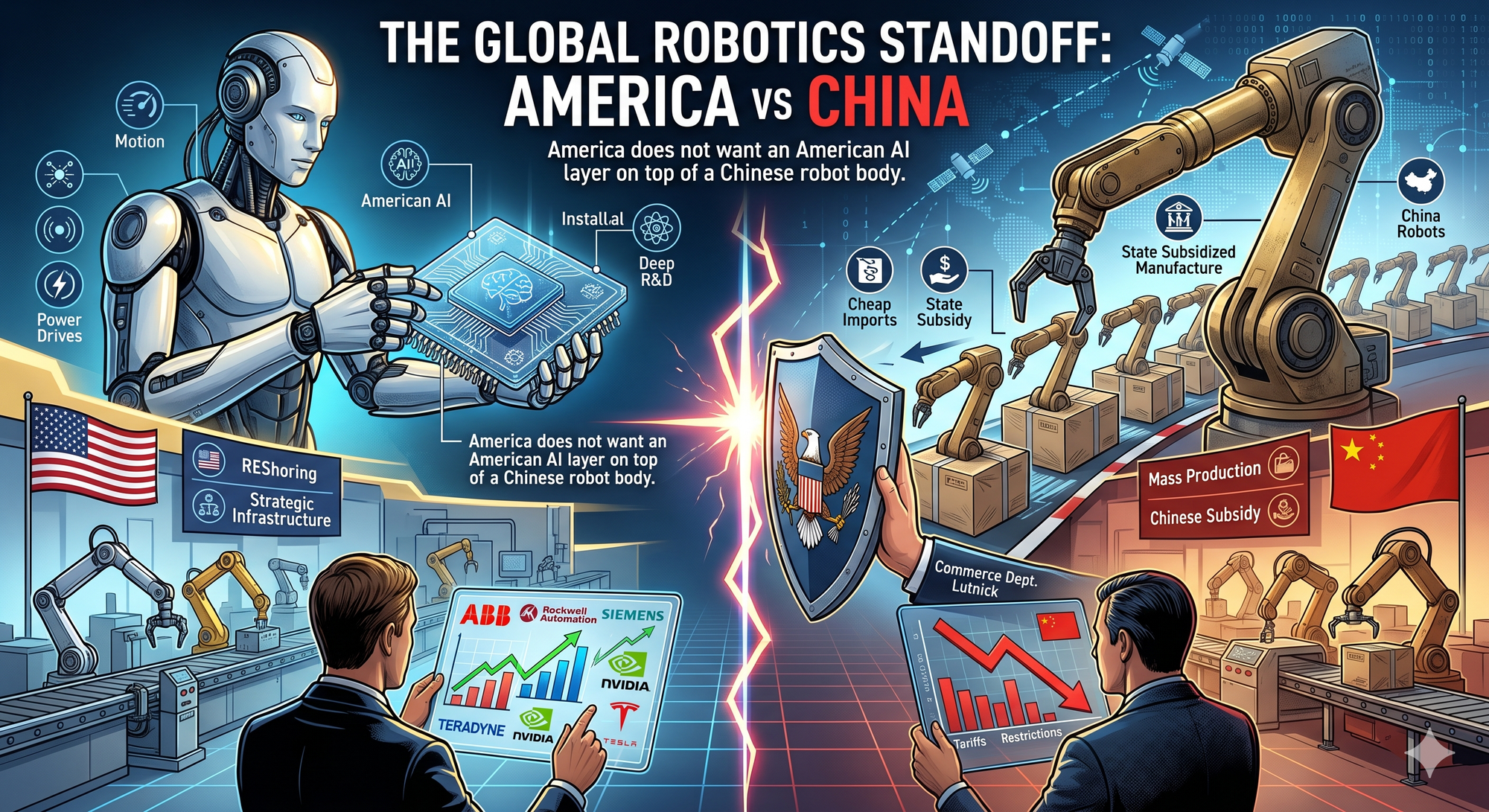
Amerika kijkt steeds scherper naar Chinese robotica. Volgens Politico heeft minister van Handel Howard Lutnick topbestuurders achter gesloten deuren gewaarschuwd dat zijn ministerie onderzoek doet naar door China gesubsidieerde robots. Washington wil voorkomen dat goedkope Chinese robotica de markt binnenkomt voordat Amerikaanse producenten voldoende schaal hebben.
■ Robotica verschuift van industriële automatisering naar strategische infrastructuur.
■ Chinese subsidies kunnen Amerikaanse en westerse producenten onder druk zetten.
■ Extra importmaatregelen of tarieven worden daardoor realistischer.
■ De VS wil productie, componenten en robotica dichter bij huis opbouwen.
■ Voor beleggers ontstaat een nieuw thema naast AI-chips, defensie en reshoring.
De belangrijkste zin uit het overleg is dat Amerika niet wil eindigen met een Amerikaanse AI-laag op een Chinees robotlichaam. Daarmee gaat het niet alleen om software of chips, maar ook om robotarmen, sensoren, aandrijving, fabrieken en productiecapaciteit.
Investment view
Wij zien dit als positief voor westerse robotica- en automatiseringsbedrijven. Niet als directe kooptrigger voor de hele sector, maar wel als extra strategische steun voor bedrijven die al actief zijn in robotica, fabrieksautomatisering, industriële software en AI-infrastructuur.
🟪 Robotica kan dezelfde beleidsmatige aandacht krijgen als chips, batterijen en defensie.
🟪 De beste namen zitten bij echte automatisering, robotica, motion control, simulatie en industriële software.
🟪 Wij kijken vooral naar Rockwell Automation, Siemens, ABB, Teradyne, NVIDIA en Tesla.
De beleggingscase draait om selectiviteit. Kleine roboticanamen kunnen hard bewegen op hype, maar de sterkere kansen liggen bij bedrijven met bestaande klanten, schaal, technologie en kasstroom. Rockwell, Siemens en ABB zijn de industriële automatiseringsnamen. Teradyne geeft blootstelling aan collaboratieve robots. NVIDIA levert de AI-infrastructuur. Tesla is de speculatieve humanoïde robotica-case.
Rockwell Automation $ROK
Rockwell Automation is één van de meest directe Amerikaanse namen binnen fabrieksautomatisering. Het bedrijf levert besturingssystemen, industriële software en technologie voor productieprocessen. Als de VS meer productie wil terughalen, past Rockwell direct in dat beleid.
De kracht zit in de praktische toepassing. Nieuwe fabrieken moeten efficiënter draaien, minder afhankelijk zijn van arbeid en meer automatisering gebruiken. Rockwell levert precies die laag tussen machines, software en productie.
Het aandeel blijft wel cyclisch. Bij lagere industriële investeringen kan de groei afkoelen. Toch hoort Rockwell bovenaan de watchlist als robotica en automatisering meer politieke steun krijgen.
Siemens $SIE
Siemens is één van de sterkste Europese namen in industriële automatisering. Het bedrijf is actief in factory automation, industrial software, digital twins, elektrificatie en slimme productie.
De kracht van Siemens zit in de complete fabriek. Robots functioneren niet los van de rest van het systeem. Ze hebben software, sensoren, stroomvoorziening, data en aansturing nodig. Siemens levert veel van die bouwstenen.
De directe steun vanuit Amerikaans beleid is minder groot dan bij Amerikaanse bedrijven. Toch blijft Siemens een logische Europese naam voor beleggers die willen inspelen op meer automatisering in de industrie.
ABB $ABBN
ABB is een gevestigde speler in robotica, elektrificatie en industriële automatisering. Het bedrijf levert al jaren technologie voor fabrieksrobots en productieomgevingen.
De combinatie van robotica en elektrificatie maakt ABB sterk. Fabrieken die moderner en lokaler worden gebouwd, hebben beide nodig. Dat geeft ABB een duidelijke plek in de reshoringtrend.
Het aandeel is geen pure Amerikaanse beleidscase, maar wel een echte robotica- en automatiseringsnaam. Daarom hoort ABB in dit thema thuis.
Teradyne $TER
Teradyne is interessant door Universal Robots en MiR. Daarmee heeft het bedrijf directe blootstelling aan collaboratieve robots en autonome mobiele robots.
Het aandeel is niet puur robotica, want Teradyne blijft ook sterk verbonden met halfgeleidertestapparatuur. Dat maakt de resultaten gevoeliger voor de chipcyclus. De robotica-activiteiten kunnen juist extra waardering krijgen als beleggers opnieuw zoeken naar beursgenoteerde robotica-exposure.
Teradyne is daardoor geen defensieve naam, maar wel één van de relevantere aandelen binnen dit thema.
NVIDIA $NVDA
NVIDIA levert de AI-laag onder moderne robotica. Robots hebben rekenkracht nodig voor training, simulatie, vision, inference en edge AI.
De link is simpel. Zonder sterke AI blijft een robot vooral een machine. Met vision, taalbegrip, besluitvorming en simulatie wordt het een intelligent platform. NVIDIA zit precies in die overgang.
Datacenters blijven de kern van de NVIDIA-case, maar robotica kan later een extra groeipijler worden. Daarom blijft NVIDIA een logische naam binnen dit thema.
Tesla $TSLA
Tesla is de meest speculatieve robotican naam in dit overzicht. Optimus past direct in het verhaal van Amerikaanse AI, robotica en productie op schaal.
Optimus is nog geen volwassen winstmachine. De waardering van Tesla loopt vaak vooruit op wat nog bewezen moet worden. Toch is de strategische link duidelijk. Tesla combineert AI, productie-ervaring, software en de ambitie om humanoïde robots op grote schaal te bouwen.
Daarom blijft Tesla interessant binnen robotica, maar met een hoger risicoprofiel dan de industriële automatiseringsnamen.
Chinese robotica en importgevoelige bedrijven
De mogelijke druk ligt vooral bij Chinese robotica-exporteurs en bedrijven die afhankelijk zijn van goedkope Chinese machines of componenten. Als de VS extra tarieven of beperkingen invoert, kan het kostenvoordeel van China kleiner worden.
Dat helpt westerse producenten, maar kan afnemers raken die juist op goedkope Chinese automatisering rekenden. De positie in de keten wordt dus belangrijk. Producenten van westerse automatisering kunnen profiteren. Kopers van goedkope Chinese robots kunnen hogere kosten krijgen.
Conclusie
Robotica wordt een nieuw strijdpunt tussen Amerika en China. Als Washington doorpakt met importmaatregelen, financiering en reshoring-steun, krijgen westerse automatiseringsbedrijven een sterkere positie. Wij volgen vooral Rockwell Automation, Siemens, ABB, Teradyne, NVIDIA en Tesla.
🔵 English version
Robotics becomes the new power file between America and China
America is taking a harder look at Chinese robotics. According to Politico, Commerce Secretary Howard Lutnick warned senior executives behind closed doors that his department is reviewing state-subsidized Chinese robots. Washington wants to prevent cheap Chinese robotics from entering the market before American producers have enough scale.
■ Robotics is shifting from industrial automation to strategic infrastructure.
■ Chinese subsidies may pressure U.S. and Western producers.
■ Additional import measures or tariffs now look more realistic.
■ The U.S. wants production, components and robotics closer to home.
■ For investors, this creates a new theme next to AI chips, defense and reshoring.
The key line from the meeting is that America does not want an American AI layer on top of a Chinese robot body. This is not only about software or chips. It is also about robotic arms, sensors, drives, factories and production capacity.
Investment view
We see this as positive for Western robotics and automation companies. Not as an immediate buy signal for the entire sector, but as additional strategic support for companies already active in robotics, factory automation, industrial software and AI infrastructure.
🟪 Robotics may receive the same policy attention as chips, batteries and defense.
🟪 The best names are in real automation, robotics, motion control, simulation and industrial software.
🟪 We are mainly watching Rockwell Automation, Siemens, ABB, Teradyne, NVIDIA and Tesla.
The investment case is about selectivity. Smaller robotics stocks can move sharply on hype, but the stronger opportunities are in companies with existing customers, scale, technology and cash flow. Rockwell, Siemens and ABB are the industrial automation names. Teradyne gives exposure to collaborative robots. NVIDIA provides the AI infrastructure. Tesla is the speculative humanoid robotics case.
Rockwell Automation $ROK
Rockwell Automation is one of the most direct U.S. names in factory automation. The company provides control systems, industrial software and technology for production processes. If the U.S. wants to bring more production back home, Rockwell fits directly into that policy.
Its strength is practical application. New factories need to run more efficiently, depend less on labor and use more automation. Rockwell provides the layer between machines, software and production.
The stock remains cyclical. If industrial investment slows, growth can cool. Still, Rockwell belongs near the top of the watchlist if robotics and automation receive more political support.
Siemens $SIE
Siemens is one of the strongest European names in industrial automation. The company is active in factory automation, industrial software, digital twins, electrification and smart production.
Siemens’ strength is the complete factory. Robots do not operate separately from the rest of the system. They need software, sensors, power infrastructure, data and control. Siemens provides many of those building blocks.
Direct support from U.S. policy is lower than for American companies. Still, Siemens remains a logical European name for investors looking for more industrial automation exposure.
ABB $ABBN
ABB is an established player in robotics, electrification and industrial automation. The company has been supplying technology for factory robots and production environments for years.
The combination of robotics and electrification makes ABB strong. Factories that become more modern and more local need both. That gives ABB a clear place in the reshoring trend.
The stock is not a pure U.S. policy case, but it is a real robotics and automation name. That is why ABB belongs in this theme.
Teradyne $TER
Teradyne is interesting because of Universal Robots and MiR. This gives the company direct exposure to collaborative robots and autonomous mobile robots.
The stock is not pure robotics, because Teradyne remains heavily tied to semiconductor test equipment. That makes results more sensitive to the chip cycle. The robotics activities may receive additional valuation if investors again look for listed robotics exposure.
Teradyne is therefore not a defensive name, but it is one of the more relevant stocks within this theme.
NVIDIA $NVDA
NVIDIA provides the AI layer underneath modern robotics. Robots need compute power for training, simulation, vision, inference and edge AI.
The link is simple. Without strong AI, a robot remains mostly a machine. With vision, language understanding, decision-making and simulation, it becomes an intelligent platform. NVIDIA sits exactly in that transition.
Data centers remain the core of the NVIDIA case, but robotics may become an additional growth pillar later. That keeps NVIDIA a logical name within this theme.
Tesla $TSLA
Tesla is the most speculative robotics name in this overview. Optimus fits directly into the story of American AI, robotics and scaled production.
Optimus is not yet a mature profit engine. Tesla’s valuation often moves ahead of what still needs to be proven. Still, the strategic link is clear. Tesla combines AI, manufacturing experience, software and the ambition to build humanoid robots at scale.
That keeps Tesla interesting within robotics, but with a higher risk profile than the industrial automation names.
Chinese robotics and import-sensitive companies
The pressure mainly falls on Chinese robotics exporters and companies dependent on cheap Chinese machines or components. If the U.S. adds tariffs or restrictions, China’s cost advantage may shrink.
That helps Western producers, but it can hurt buyers that counted on cheap Chinese automation. Position in the value chain matters. Producers of Western automation can benefit. Buyers of cheap Chinese robots may face higher costs.
Conclusion
Robotics is becoming a new battleground between America and China. If Washington moves ahead with import measures, financing and reshoring support, Western automation companies gain a stronger position. We are mainly watching Rockwell Automation, Siemens, ABB, Teradyne, NVIDIA and Tesla.
Disclaimer Aan de door ons opgestelde informatie kan op geen enkele wijze rechten worden ontleend. Alle door ons verstrekte informatie en analyses zijn geheel vrijblijvend. Alle consequenties van het op welke wijze dan ook toepassen van de informatie blijven volledig voor uw eigen rekening.
Wij aanvaarden geen aansprakelijkheid voor de mogelijke gevolgen of schade die zouden kunnen voortvloeien uit het gebruik van de door ons gepubliceerde informatie. U bent zelf eindverantwoordelijk voor de beslissingen die u neemt met betrekking tot uw beleggingen.


