✨ Oracle: Forse koersval en als AI-proxy onder druk
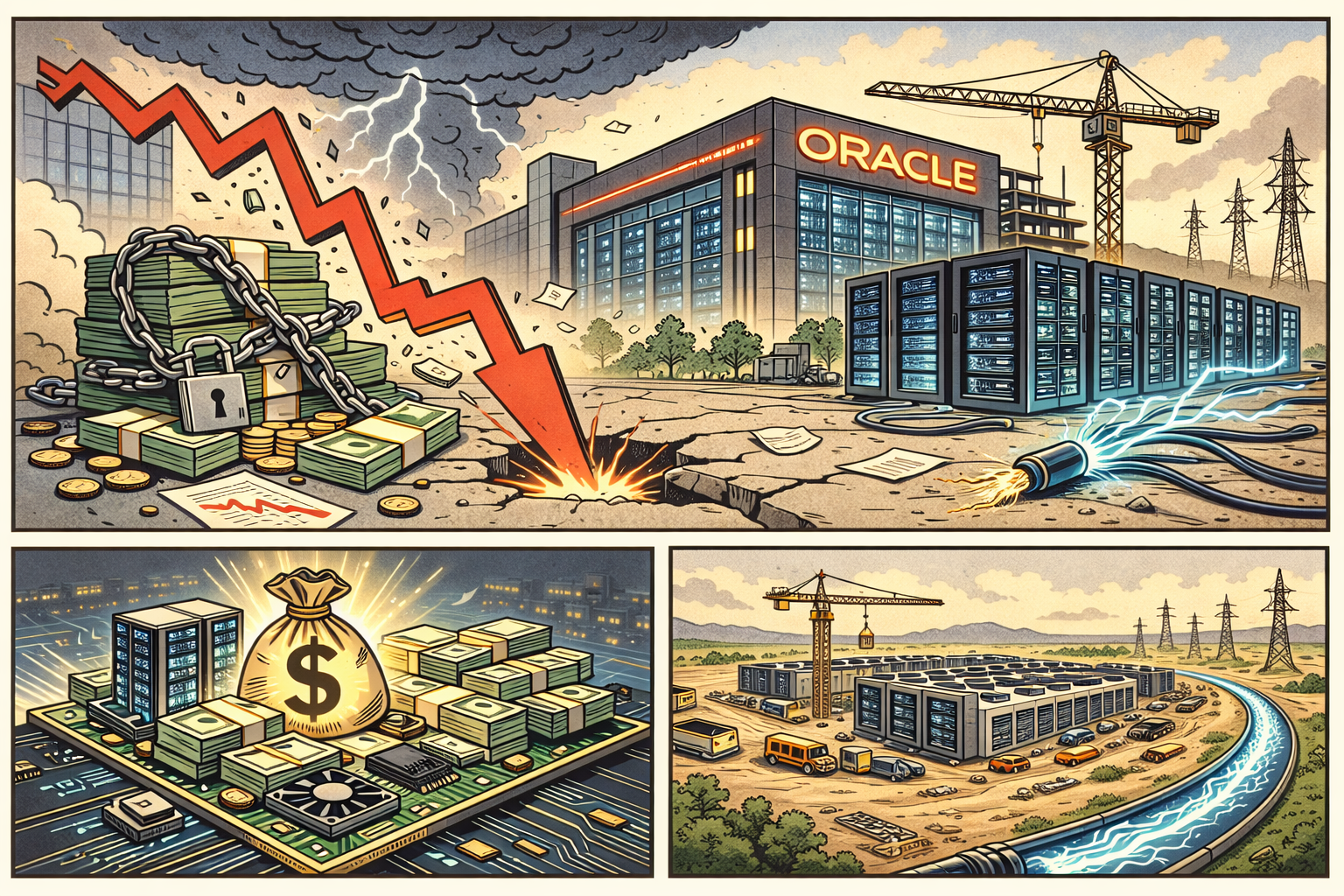
Op vrijdag sloot het aandeel Oracle fors lager op 148,08 dollar, een daling van 5,40 procent of 8,46 dollar op de dag. De intraday low lag op 147,39 dollar en het volume bedroeg ruim 29,6 miljoen aandelen, duidelijk hoger dan gemiddeld. Ter vergelijking: op donderdag 19 februari sloot het aandeel nog rond 156,54 dollar.
Sinds de piek van circa 327 dollar in september 2025 is de koers ongeveer 55 procent gedaald. De markt behandelt Oracle inmiddels als een directe proxy voor stress in de AI-financieringsketen. Het aandeel reageert niet alleen op eigen cijfers, maar vooral op zorgen rond hyperscale datacenters, private credit, leverage en de betalingscapaciteit van grote AI-klanten.
Tegelijkertijd rondt OpenAI een historische financieringsronde af van meer dan 100 miljard dollar. In theorie zou dit positief moeten zijn voor Oracle. In de praktijk weegt de markt zwaarder aan execution risk en balansdruk.
Extreem capex-plan als kern van de spanning
Oracle heeft een zeer agressief investeringsplan. Het bedrijf verwacht in kalenderjaar 2026 tussen 45 en 50 miljard dollar op te halen via een combinatie van schuld en aandelenuitgifte om extra capaciteit te bouwen voor Oracle Cloud Infrastructure.
Deze capaciteit is nodig om grote contracten te bedienen, met name OpenAI. De samenwerking heeft een omzetpotentieel van honderden miljarden over meerdere jaren, waarbij Oracle een belangrijke compute-provider is voor training en inference.
Daarnaast dragen ook partijen als Meta, Nvidia, AMD, xAI en TikTok bij aan de snel oplopende backlog. De remaining performance obligations liggen boven 500 miljard dollar, grotendeels AI-gerelateerd.
Het probleem is niet de vraagzijde. Het probleem is de financiering en de timing.
Waarom de markt het aandeel straft
De koersdruk komt voort uit een combinatie van factoren.
Ten eerste de hoge schuldpositie. Oracle heeft meer dan 100 miljard dollar aan totale schuld uitstaan, recent rond 108 miljard dollar exclusief leaseverplichtingen. In februari 2026 werd nog 25 miljard dollar aan obligaties uitgegeven. Daarnaast zijn er omvangrijke off-balance sheet verplichtingen voor datacenters, met leasecontracten van 15 tot 19 jaar die in totaal kunnen oplopen tot honderden miljarden.
De markt vreest een mismatch tussen lange leaseverplichtingen en kortere of voorwaardelijke klantcommitments. Als AI-omzet trager ramp-upt dan verwacht, ontstaat druk op vrije kasstromen, ratings en fundingkosten.
Ten tweede de directe exposure aan OpenAI. Oracle is sterk gekoppeld aan het succes van OpenAI. CDS-spreads op Oracle zijn opgelopen, wat wijst op stijgende gepercipieerde kredietrisico’s. Ondanks het nieuws over de mega-financiering prijst de markt nog steeds onzekerheid in rond burn rate, winstgevendheid en structurele cashgeneratie bij OpenAI en andere AI-spelers.
Ten derde het bredere sentiment rond private credit en AI-infrastructuur. Liquiditeitsproblemen bij Blue Owl en eerder vastgelopen datacenterdeals, zoals het project van 10 miljard dollar in Michigan met OpenAI, hebben het vertrouwen in de financieringsketen onder druk gezet. Hoewel Oracle veel via publieke obligatiemarkten en projectfinanciering werkt, raakt sentiment de hele sector.
Ten vierde de recente negatieve vrije kasstroom. Door circa 12 miljard dollar aan capex in recente kwartalen lag de vrije kasstroom ongeveer 10 miljard dollar negatief. Daarnaast lopen er class-action rechtszaken rond vermeende misleidende disclosures over AI-capex en verwachte opbrengsten.
De markt ziet leverage, execution risk en timing-onzekerheid tegelijk samenkomen.
OpenAI rondt historische financieringsronde af
OpenAI bevindt zich in de afrondende fase van een recordbrekende fundingronde die meer dan 100 miljard dollar kan ophalen, mogelijk oplopend tot 126 miljard dollar inclusief latere tranches. Dit zou de grootste private kapitaalronde ooit zijn.
De waardering ligt rond 730 miljard dollar pre-money en kan boven 850 miljard dollar uitkomen post-money.
Belangrijke investeerders en indicatieve bedragen:
- Amazon: tot ongeveer 50 miljard dollar in tranches
- SoftBank: tot ongeveer 30 miljard dollar
- Nvidia: circa 30 miljard dollar
- Microsoft: aanvullende lage miljarden
- Daarnaast diverse venture capital partijen en sovereign wealth funds
De eerste fase wordt verwacht eind februari 2026 te sluiten, met uitbetaling in tranches over 2026.
OpenAI heeft de compute-uitgaven naar beneden bijgesteld naar circa 600 miljard dollar tot 2030, van eerder 1,4 biljoen dollar. De omzetverwachting ligt boven 280 miljard dollar in 2030, tegenover circa 20 miljard dollar op jaarbasis nu. Tegelijk worden verliezen van circa 14 miljard dollar in 2026 verwacht en cumulatief 44 miljard dollar tot 2029.
De financiering verlengt de runway aanzienlijk en ondersteunt verplichtingen aan partners zoals Oracle. Maar de burn rate blijft hoog, wat de kritische blik van investeerders versterkt.
Waarom positief nieuws niet direct positief uitwerkt
In theorie versterkt de OpenAI-financiering het betalingsvermogen richting Oracle. In de praktijk prijst de markt drie risico’s in:
- De payoff van AI-investeringen kan vertraagd zijn
- Execution risk bij zowel Oracle als OpenAI blijft aanwezig
- Hoge leverage vergroot de gevoeligheid voor tegenvallers
Zolang er geen tastbaar bewijs is dat capex daadwerkelijk versneld in omzet en kasstromen wordt omgezet, blijft het aandeel kwetsbaar.
Onze positie
Wij hebben momenteel geen positie in Oracle. Wij observeren scherp, maar zien op dit moment te veel onzekerheid. De combinatie van sentiment-gedreven proxy-stress, hoge schuld, afhankelijkheid van AI-monetisatie en timing-risico maakt het risico-rendementsprofiel op korte termijn onvoldoende aantrekkelijk.
De kernactiviteiten van Oracle blijven sterk, met groeiende cloudactiviteiten en een forse backlog. Maar in de huidige fase wegen de balans- en financieringsrisico’s zwaarder.
Wanneer kan de neerwaartse druk stoppen
Het is op dit moment niet duidelijk wanneer de neerwaartse druk definitief afneemt. Mogelijke hersteltriggers zijn:
- Definitieve closing van de OpenAI-ronde met bevestigde commitments
- Meer transparantie over OpenAI’s pad naar winstgevendheid
- Sterke kwartaalresultaten bij Oracle met versnelling in OCI-omzet
- Bewijs dat capex daadwerkelijk omzet genereert
- Stabilisatie in private credit en tech-schuldmarkten
- Een bredere marktrotatie terug naar AI-aandelen
Zonder concrete katalysatoren kan de druk aanhouden. Volatiliteit blijft waarschijnlijk zolang AI-spending en financieringsstructuren onder het vergrootglas liggen.
Slotconclusie
Oracle bevindt zich op een cruciaal kruispunt. Operationeel is het bedrijf diep verankerd in de AI-infrastructuurcyclus, met een uitzonderlijk grote backlog en strategische relaties met de belangrijkste spelers in het ecosysteem. De vraag naar compute lijkt structureel aanwezig en de commerciële positie is sterk.
Tegelijkertijd heeft Oracle zichzelf in een fase van maximale financiële expansie geplaatst. Het agressieve capex-programma, de oplopende schuld en de lange leaseverplichtingen zorgen ervoor dat de markt het aandeel momenteel primair beoordeelt op balansrisico en niet op groeipotentieel. De OpenAI-megaronde biedt fundamentele steun, maar verandert op korte termijn weinig aan het feit dat de kasstroomtransitie nog moet worden bewezen.
De huidige koers reflecteert geen gebrek aan strategische relevantie, maar twijfel over timing, leverage en de duurzaamheid van AI-monetisatie. Zolang dat spanningsveld niet wordt opgelost via harde cijfers en zichtbare kasstroomverbetering, blijft het aandeel gevoelig voor volatiliteit.
Wij blijven daarom aan de zijlijn. Pas wanneer duidelijk wordt dat capex overtuigend wordt omgezet in structurele omzet en vrije kasstroom, kan het risicoprofiel fundamenteel verbeteren. Tot die tijd overheerst voorzichtigheid boven opportunisme.
🔵 English version
Oracle (ORCL): sharp decline as AI proxy under pressure, despite mega OpenAI financing
On Friday, February 20, 2026, Oracle (ORCL) closed sharply lower at 148.08 dollars, a decline of 5.40 percent or 8.46 dollars on the day. The intraday low was 147.39 dollars and volume reached more than 29.6 million shares, clearly above average. For comparison, on Thursday, February 19, the stock closed around 156.54 dollars.
Since the peak of approximately 327 dollars in September 2025, the share price has fallen about 55 percent. The market now treats Oracle as a direct proxy for stress in the AI financing chain. The stock reacts not only to its own figures, but mainly to concerns around hyperscale data centers, private credit, leverage and the payment capacity of major AI customers.
At the same time, OpenAI is finalizing a historic financing round of more than 100 billion dollars. In theory, this should be positive for Oracle. In practice, the market weighs execution risk and balance sheet pressure more heavily.
Extreme capex plan at the core of the tension
Oracle has a highly aggressive investment plan. The company expects to raise between 45 and 50 billion dollars in calendar year 2026 through a combination of debt and equity issuance to build additional capacity for Oracle Cloud Infrastructure.
This capacity is required to serve large contracts, particularly OpenAI. The partnership carries revenue potential of hundreds of billions over multiple years, with Oracle acting as a key compute provider for training and inference.
In addition, parties such as Meta, Nvidia, AMD, xAI and TikTok contribute to the rapidly increasing backlog. Remaining performance obligations exceed 500 billion dollars, largely AI-related.
The issue is not demand. The issue is financing and timing.
Why the market is punishing the stock
The price pressure stems from a combination of factors.
First, the high debt position. Oracle has more than 100 billion dollars in total debt outstanding, recently around 108 billion dollars excluding lease obligations. In February 2026, another 25 billion dollars in bonds were issued. In addition, there are substantial off-balance sheet commitments for data centers, with lease contracts of 15 to 19 years that can total hundreds of billions.
The market fears a mismatch between long lease commitments and shorter or conditional customer commitments. If AI revenue ramps up more slowly than expected, pressure on free cash flow, ratings and funding costs may arise.
Second, the direct exposure to OpenAI. Oracle is closely linked to OpenAI’s success. CDS spreads on Oracle have widened, indicating rising perceived credit risk. Despite news of the mega financing, the market still prices in uncertainty around burn rate, profitability and structural cash generation at OpenAI and other AI players.
Third, broader sentiment around private credit and AI infrastructure. Liquidity problems at Blue Owl and previously stalled data center deals, such as the 10 billion dollar Michigan project with OpenAI, have undermined confidence in the financing chain. Although Oracle relies heavily on public bond markets and project finance, sentiment affects the entire sector.
Fourth, recent negative free cash flow. Due to approximately 12 billion dollars in capex in recent quarters, free cash flow was roughly 10 billion dollars negative. In addition, class action lawsuits are ongoing regarding alleged misleading disclosures about AI capex and expected revenues.
The market sees leverage, execution risk and timing uncertainty converging simultaneously.
OpenAI finalizing historic financing round
OpenAI is in the final phase of a record-breaking funding round that could raise more than 100 billion dollars, potentially increasing to 126 billion dollars including later tranches. This would be the largest private capital raise ever.
The valuation stands at around 730 billion dollars pre-money and could exceed 850 billion dollars post-money.
Key investors and indicative amounts:
- Amazon: up to approximately 50 billion dollars in tranches
- SoftBank: up to approximately 30 billion dollars
- Nvidia: approximately 30 billion dollars
- Microsoft: additional low billions
- In addition, various venture capital firms and sovereign wealth funds
The first phase is expected to close at the end of February 2026, with funds disbursed in tranches throughout 2026.
OpenAI has revised its compute spending downward to approximately 600 billion dollars through 2030, from a previous 1.4 trillion dollars. Revenue expectations exceed 280 billion dollars in 2030, compared to roughly 20 billion dollars annualized today. At the same time, losses of approximately 14 billion dollars are expected in 2026 and cumulatively 44 billion dollars through 2029.
The financing significantly extends the runway and supports commitments to partners such as Oracle. However, the burn rate remains high, reinforcing investor scrutiny.
Why positive news does not immediately translate into upside
In theory, OpenAI’s financing strengthens its payment capacity toward Oracle. In practice, the market prices in three risks:
- The payoff of AI investments may be delayed
- Execution risk at both Oracle and OpenAI remains present
- High leverage increases sensitivity to setbacks
As long as there is no tangible evidence that capex is being converted into revenue and cash flow at an accelerated pace, the stock remains vulnerable.
Our position
We currently have no position in Oracle, neither long nor short.
We are observing closely, but at this stage we see too much uncertainty. The combination of sentiment-driven proxy stress, high debt, dependence on AI monetization timing and balance sheet risk makes the short-term risk-reward profile unattractive.
Oracle’s core business remains solid, with growing cloud operations and a substantial backlog. However, in the current phase, balance sheet and financing risks outweigh the growth narrative.
When could the downward pressure ease
At present, it is unclear when downward pressure will definitively subside. Potential recovery triggers include:
- Full closing of the OpenAI round with confirmed commitments
- Greater clarity on OpenAI’s path to profitability
- Strong quarterly results at Oracle with accelerated OCI revenue growth
- Evidence that capex is generating revenue
- Stabilization in private credit and tech debt markets
- A broader market rotation back into AI equities
Without concrete catalysts, pressure may persist. Volatility is likely to remain elevated as long as AI spending and financing structures remain under scrutiny.
Conclusion
Oracle finds itself at a critical crossroads. Operationally, the company is deeply embedded in the AI infrastructure cycle, with an exceptional backlog and strategic relationships with the leading players in the ecosystem. Demand for compute appears structurally present and the commercial positioning is strong.
At the same time, Oracle has entered a phase of maximum financial expansion. The aggressive capex program, rising debt and long-term lease commitments mean the market currently evaluates the stock primarily on balance sheet risk rather than growth potential. The OpenAI mega round provides fundamental support, but in the short term it does little to change the fact that the cash flow transition still needs to be proven.
The current valuation does not reflect a lack of strategic relevance, but rather doubts about timing, leverage and the sustainability of AI monetization. Until this tension is resolved through hard numbers and visible cash flow improvement, the stock remains vulnerable to volatility.
We therefore remain on the sidelines. Only when it becomes clear that capex is convincingly converted into structural revenue and free cash flow can the risk profile fundamentally improve. Until then, caution prevails over opportunism.
Disclaimer Aan de door ons opgestelde informatie kan op geen enkele wijze rechten worden ontleend. Alle door ons verstrekte informatie en analyses zijn geheel vrijblijvend. Alle consequenties van het op welke wijze dan ook toepassen van de informatie blijven volledig voor uw eigen rekening.
Wij aanvaarden geen aansprakelijkheid voor de mogelijke gevolgen of schade die zouden kunnen voortvloeien uit het gebruik van de door ons gepubliceerde informatie. U bent zelf eindverantwoordelijk voor de beslissingen die u neemt met betrekking tot uw beleggingen.


