💫 NVIDIA met de resulaten: Analyse en visie op het aandel
◼ NVIDIA rapporteerde Q1 FY2027 over het kwartaal dat eindigde op 26 april 2026 en bevestigde opnieuw zijn centrale rol binnen de wereldwijde AI-infrastructuur.
◼ De omzet kwam uit op een recordniveau van $81,6 miljard, gedragen door Data Center, Blackwell, networking en de snelle bouw van AI-fabrieken.
◼ De non-GAAP winst per aandeel steeg naar $1,87, waarmee de operationele hefboom opnieuw duidelijk zichtbaar werd.
◼ De Q2-outlook van $91,0 miljard omzet, plus of min 2%, is extra sterk omdat NVIDIA daarin geen Data Center compute revenue uit China meeneemt.
◼ NVIDIA verhoogt het kwartaaldividend van $0,01 naar $0,25 per aandeel en keurt daarnaast een extra aandeleninkoopmachtiging van $80 miljard goed.
◼ De case blijft positief, omdat NVIDIA steeds meer lagen van de AI-stack naar zich toetrekt: compute, networking, software, systemen, Edge Computing en platformarchitectuur.
NVIDIA heeft opnieuw cijfers gepubliceerd die duidelijk maken waarom dit op dit moment waarschijnlijk het belangrijkste bedrijf ter wereld is. De onderneming is niet langer alleen een chipbedrijf, maar de centrale infrastructuurlaag achter AI-fabrieken, hyperscale datacenters, AI Clouds, enterprise AI, sovereign AI, networking, Edge Computing, agentic AI en uiteindelijk fysieke AI via robotics, automotive en AI-RAN.
Wil je alle artikelen kunnen lezen en elke podcast beluisteren? Neem dan een abonnement en krijg toegang tot alle artikelen en de database met duizenden berichten.
Het belangrijkste punt zit niet alleen in het afgelopen kwartaal, maar vooral in de vooruitblik. NVIDIA verwacht voor Q2 FY2027 een omzet van $91,0 miljard, plus of min 2%, met een non-GAAP gross margin van ongeveer 75,0%. Opvallend is dat het bedrijf in deze outlook geen Data Center compute revenue uit China meeneemt. Daarmee geeft NVIDIA aan dat de vraag buiten China al sterk genoeg is om de omzet richting meer dan $90 miljard per kwartaal te brengen.
Investment view
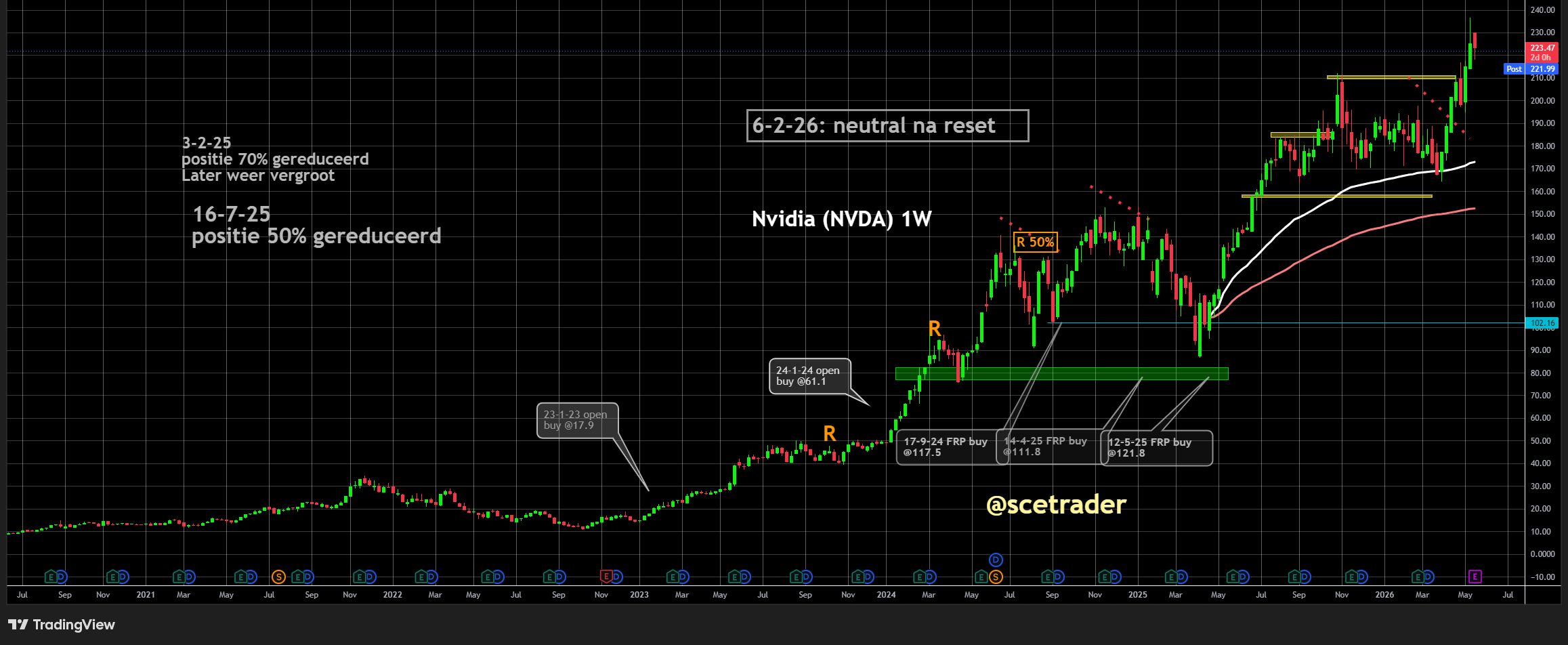
De investment case bij NVIDIA is sterker geworden, omdat de onderneming niet alleen harder groeit dan verwacht, maar ook laat zien dat de AI-vraag breder wordt. Hyperscale blijft enorm, maar ACIE is bijna even groot geworden. Daarmee verschuift NVIDIA van een leverancier voor vooral de grootste cloudspelers naar een bredere infrastructuurspeler voor AI Clouds, enterprise, industrial, sovereign AI en AI-fabrieken. Dat maakt de groeibasis robuuster en onderbouwt waarom wij verdere koersstijging mogelijk achten.
🟪 De groeibasis wordt breder, omdat ACIE bijna even groot is geworden als Hyperscale.
🟪 De Q2-outlook zonder China Data Center compute revenue laat zien dat de onderliggende vraag uitzonderlijk krachtig blijft.
🟪 Networking, software en platformarchitectuur maken NVIDIA strategisch sterker dan een gewone chipproducent.
De strategische kracht van NVIDIA zit in de controle over meerdere lagen van de AI-stack. In eerdere halfgeleidercycli draaide het vaak om één chipgeneratie, één eindmarkt of één tijdelijke upgradecyclus. Bij NVIDIA is dat anders. Wie grote AI-modellen wil trainen, inference op schaal wil draaien, agentic AI wil uitrollen of AI-fabrieken wil bouwen, heeft geïntegreerde infrastructuur nodig. NVIDIA levert die infrastructuur bijna van onder tot boven.
Dat maakt het aandeel structureel interessanter dan een klassieke chipnaam. De omzet komt niet alleen uit GPU’s, maar uit een platform waarin compute, networking, software, interconnects en systemen elkaar versterken. Dit creëert schaalvoordelen, hoge switching costs en een sterk ecosysteem. Klanten die voor NVIDIA kiezen, bouwen vaak verder binnen dezelfde architectuur omdat prestaties, softwarecompatibiliteit, ontwikkelaarskennis en infrastructuurplanning met elkaar verweven raken.
De nieuwe rapportagestructuur is daarom belangrijk. NVIDIA splitst de markt voortaan in Data Center en Edge Computing. Binnen Data Center komen Hyperscale en ACIE, waarbij ACIE staat voor AI Clouds, Industrial en Enterprise. Daarmee wordt zichtbaar dat de AI-vraag niet meer alleen uit de grootste cloudbedrijven komt. De groei verspreidt zich naar gespecialiseerde AI Clouds, industriële toepassingen, enterprise-implementaties en nationale AI-infrastructuur.
Dat is een belangrijk waarderingsargument. Een bedrijf dat afhankelijk is van enkele hyperscalers krijgt snel vragen over concentratierisico. NVIDIA laat nu zien dat Hyperscale en ACIE bijna even groot zijn geworden. De vraagbasis wordt dus breder, waardoor de markt meer vertrouwen kan krijgen dat deze AI-cyclus langer duurt dan één klassieke capex-golf bij enkele grote cloudspelers.
Networking is een tweede reden waarom het aandeel verder kan worden ondersteund. AI-fabrieken bestaan niet uit losse chips, maar uit enorme systemen waarin duizenden accelerators moeten samenwerken. Zonder snelle verbindingen wordt AI duurder, trager en minder schaalbaar. NVIDIA verdient daardoor niet alleen aan rekenkracht, maar ook aan de verbindingen die die rekenkracht bruikbaar maken. InfiniBand, Spectrum-X Ethernet en NVLink zijn daarmee geen bijproducten, maar strategische winsthefboom.
De financiële slagkracht is uitzonderlijk. NVIDIA genereerde $48,6 miljard vrije kasstroom, gaf ongeveer $20 miljard terug aan aandeelhouders en keurde nog eens $80 miljard extra aandeleninkoop goed. Het dividend werd verhoogd van $0,01 naar $0,25 per aandeel. Dat maakt NVIDIA geen traditioneel dividendaandeel, maar het laat wel zien dat de cashmachine inmiddels zo krachtig is dat groei-investeringen, capaciteitsopbouw en kapitaaluitkeringen naast elkaar kunnen bestaan.
De dividendverhoging is bovendien concreet. Het nieuwe kwartaaldividend van $0,25 per aandeel is betaalbaar op 26 juni 2026 aan aandeelhouders die op 4 juni 2026 geregistreerd staan, met een ex-dividenddatum van 3 juni 2026. Dat verandert NVIDIA niet in een income-stock, maar het markeert wel een nieuwe fase waarin de onderneming naast groei ook structureler kapitaal kan teruggeven.
Er zijn ook duidelijke risico’s. China blijft onzeker, de waardering is hoog, de verwachtingen zijn extreem en de voorraad plus supply commitments zijn groot. Ook stijgen de kosten hard, omdat NVIDIA blijft investeren in mensen, infrastructuur, compute en nieuwe productontwikkelingen. Toch wegen die risico’s op dit moment niet zwaarder dan de strategische positie. NVIDIA blijft de dominante onderneming in een AI-infrastructuurcyclus die nog steeds versnelt.
Daarom blijft de visie positief. De markt kan op korte termijn scherp reageren op waardering, geopolitiek of details in compute revenue, maar de grote lijn blijft dat NVIDIA de rails levert waarop de AI-economie wordt gebouwd. Zolang AI-fabrieken, inference, agentic AI, sovereign AI, enterprise AI en networking blijven opschalen, blijft verdere koersstijging verdedigbaar.
De nieuwe structuur: Data Center en Edge Computing
NVIDIA past zijn rapportagestructuur aan omdat het bedrijf zelf ook verandert. De onderneming rapporteert voortaan via twee grote market platforms: Data Center en Edge Computing. Dat is geen administratieve wijziging, maar een manier om beter te laten zien waar de toekomstige groei vandaan komt.
Data Center wordt verdeeld in twee submarkten. Hyperscale omvat de public clouds en de grootste internetbedrijven ter wereld. ACIE omvat AI Clouds, Industrial en Enterprise. Daarmee laat NVIDIA zien dat de datacentervraag niet alleen uit cloudgiganten komt, maar ook uit gespecialiseerde AI Clouds, industriële AI-fabrieken, bedrijven en nationale AI-projecten.
Edge Computing omvat apparaten en systemen voor agentic en fysieke AI, waaronder pc’s, gameconsoles, workstations, AI-RAN base stations, robotics en automotive. Dit segment is vandaag kleiner dan Data Center, maar strategisch relevant omdat AI uiteindelijk niet alleen in datacenters blijft draaien. Robots, voertuigen, telecomnetwerken, industriële machines en lokale apparaten zullen steeds meer AI-rekenkracht nodig hebben.
Deze nieuwe indeling maakt de case duidelijker. NVIDIA groeit niet alleen binnen één markt, maar breidt zijn rol uit over meerdere lagen van de toekomstige AI-economie. Dat maakt het bedrijf minder afhankelijk van één klantengroep of één productcategorie.
ACIE: waarom dit de belangrijkste nieuwe laag is
ACIE is misschien wel de belangrijkste strategische toevoeging in de nieuwe rapportage. Deze categorie omvat AI Clouds, Industrial en Enterprise en kwam in Q1 FY2027 uit op $37,4 miljard omzet. Daarmee is ACIE bijna even groot als Hyperscale, dat $37,9 miljard omzet realiseerde.
Dat is cruciaal. Veel beleggers kijken naar NVIDIA alsof het vooral afhankelijk is van Microsoft, Amazon, Google, Meta en enkele andere hyperscalers. Die klanten blijven extreem belangrijk, maar de nieuwe cijfers laten zien dat de vraag zich veel breder ontwikkelt. AI Clouds bouwen gespecialiseerde capaciteit voor modelbouwers en bedrijven. Industriële klanten gebruiken AI voor simulatie, digital twins, productieoptimalisatie, robotica en automatisering. Enterprises willen AI inzetten voor data, softwareontwikkeling, klantenservice, cybersecurity en workflow-automatisering.
Sovereign AI past ook in dit bredere verhaal. Landen willen eigen AI-infrastructuur ontwikkelen om minder afhankelijk te worden van buitenlandse cloudcapaciteit, modellen en datastromen. Dat creëert een nieuwe vraaglaag die niet alleen commercieel, maar ook geopolitiek wordt gedreven.
Voor de waardering van NVIDIA is dit belangrijk. Een groeicyclus die alleen afhankelijk is van hyperscaler-capex kan sneller pieken. Een infrastructuurcyclus waarin clouds, bedrijven, industrieën en landen tegelijk investeren, kan langer doorlopen. ACIE maakt de NVIDIA-case dus minder smal en strategisch sterker.
Networking: de onderschatte winsthefboom
Networking verdient veel meer aandacht dan het vaak krijgt. Data Center networking revenue kwam uit op $14,8 miljard en groeide 199% op jaarbasis. Dat is op zichzelf al indrukwekkend, maar vooral de strategische betekenis is groot.
AI-fabrieken vragen om systeemniveau. Duizenden accelerators moeten met elkaar communiceren alsof zij één grote machine vormen. De snelheid, latency en efficiëntie van die verbindingen bepalen mede hoeveel waarde klanten uit hun AI-investeringen halen. Daarom wordt networking een kernonderdeel van de AI-economie.
NVIDIA heeft hier een sterke positie met InfiniBand, Spectrum-X Ethernet en NVLink. InfiniBand blijft belangrijk voor zeer krachtige AI-clusters. Spectrum-X Ethernet geeft NVIDIA een sterkere positie in Ethernet-gebaseerde datacenterarchitecturen. NVLink zorgt voor snelle verbindingen tussen GPU’s en systemen. Samen maken deze technologieën het mogelijk om complete AI-infrastructuur te leveren in plaats van alleen losse accelerators.
Dit versterkt de lock-in. Wanneer klanten hun AI-infrastructuur rond NVIDIA bouwen, raken hardware, software, networking en workloads met elkaar verweven. Overstappen wordt dan moeilijker, omdat het niet meer gaat om het vervangen van één chip, maar om het wijzigen van een volledige infrastructuurarchitectuur.
Dat verklaart ook waarom NVIDIA zulke hoge marges kan vasthouden. Het bedrijf verkoopt niet alleen componenten, maar een geïntegreerd platform. Die platformkracht is een van de belangrijkste redenen waarom NVIDIA strategisch sterker staat dan veel andere halfgeleiderbedrijven.
Blackwell, Vera Rubin en de productcyclus
Blackwell is de huidige motor van de groei. NVIDIA geeft aan dat Data Center werd gedragen door de ramp van Blackwell 300 en sterke vraag naar InfiniBand, Spectrum-X Ethernet en NVLink. In de presentatie staat bovendien dat Blackwell wordt geadopteerd en uitgerold door grote hyperscalers, cloudproviders en modelbouwers.
Dat is belangrijk omdat Blackwell niet alleen een nieuwe chipgeneratie is. Het is een platform voor de volgende fase van AI-compute, waarbij training, inference, networking en datacenterarchitectuur samenkomen. Inference wordt steeds belangrijker, omdat AI niet alleen modellen traint, maar ook dagelijks op grote schaal antwoorden, acties, agents en workflows moet produceren.
Vera Rubin wordt de volgende productcyclus waar beleggers naar gaan kijken. Volgens de presentatie ligt Vera Rubin op schema voor de tweede helft van dit jaar, beginnend in Q3. Dat is belangrijk, omdat de markt bij NVIDIA niet alleen naar de huidige vraag kijkt, maar ook naar de continuïteit van technologische vernieuwing. Blackwell draagt nu de groei, maar Vera Rubin kan de volgende prestatiestap worden waarmee NVIDIA zijn voorsprong in AI-compute en systeemarchitectuur verder verdedigt.
Voor NVIDIA is deze productcadans belangrijk. Het bedrijf blijft de markt niet alleen bedienen met bestaande vraag, maar duwt de sector telkens naar een nieuwe prestatielaag. Dat houdt klanten in het ecosysteem en maakt het moeilijker voor concurrenten om de volledige stack in te halen.
Edge Computing en fysieke AI
Edge Computing kwam uit op $6,4 miljard omzet en groeide 29% op jaarbasis. Dat is kleiner dan Data Center, maar de strategische waarde ligt in de toekomstige marktverbreding. AI zal niet alleen in datacenters draaien. Steeds meer AI-verwerking zal plaatsvinden dichter bij apparaten, machines, voertuigen en netwerken.
Dit segment omvat pc’s, gameconsoles, workstations, AI-RAN base stations, robotics en automotive. De groei werd ondersteund door sterke Blackwell-workstationvraag, al werd de consumer pc-vraag afgeremd door hogere memory- en systeemprijzen. Dat is een aandachtspunt, maar het verandert de strategische richting niet.
De langere termijn draait om agentic en fysieke AI. Robots, autonome voertuigen, industriële machines, telecomnetwerken en AI-pc’s hebben lokale of semi-lokale rekenkracht nodig. NVIDIA heeft daar al een positie. Edge Computing is vandaag nog niet de grootste winsthefboom, maar het kan de volgende uitbreiding van de markt worden.
Daarom hoort Edge Computing wel degelijk in de investment case thuis. Het biedt optionaliteit buiten het datacenter en kan later een grotere rol krijgen als AI meer wordt geïntegreerd in de fysieke wereld.
Kapitaalallocatie en financiële slagkracht
NVIDIA gaf in Q1 ongeveer $20 miljard terug aan aandeelhouders via aandeleninkoop en dividend. Daarnaast werd een extra aandeleninkoopmachtiging van $80 miljard goedgekeurd, zonder einddatum. Het kwartaaldividend werd verhoogd van $0,01 naar $0,25 per aandeel.
Deze dividendverhoging maakt NVIDIA geen klassiek dividendaandeel. De yield blijft waarschijnlijk beperkt. Maar het signaal is belangrijk. De onderneming genereert zoveel cash dat zij tegelijk kan investeren in groei, nieuwe producten, supply, cloud service commitments en aandeelhoudersrendement.
De vrije kasstroom bedroeg $48,6 miljard. Dat geeft NVIDIA uitzonderlijke flexibiliteit. Het bedrijf kan capaciteit veiligstellen, R&D verhogen, strategische investeringen doen, cloudcapaciteit inkopen, voorraad opbouwen en alsnog grote aandeleninkopen doen.
Voor beleggers is dat belangrijk. De waardering van NVIDIA wordt niet alleen gedragen door omzetgroei, maar ook door de kwaliteit van de kasstroom. Een bedrijf dat met deze snelheid groeit en tegelijk zulke hoeveelheden cash genereert, krijgt vanzelf een premiumwaardering.
Voorraad, commitments en cloudcapaciteit
De balans laat zien dat NVIDIA vooruit investeert in vraag die verder reikt dan alleen het volgende kwartaal. Inventory steeg naar $25,8 miljard en supply-related commitments bedroegen $119,0 miljard. NVIDIA geeft aan dat het bewust voorraad en capaciteit veiligstelt om de vraag voorbij de komende kwartalen te kunnen bedienen.
Dit is strategisch logisch. AI-infrastructuur vraagt om enorme productieplanning, toeleveringszekerheid, geavanceerde packaging, networkingcomponenten en datacenterintegratie. Wie te weinig capaciteit heeft, mist omzet. Wie te veel capaciteit vastlegt, loopt later risico als de vraag vertraagt. NVIDIA kiest duidelijk voor het eerste risico: liever capaciteit veiligstellen dan de AI-cyclus missen.
Ook de multi-year cloud service commitments van $30,0 miljard verdienen aandacht. NVIDIA koopt zelf veel cloudcapaciteit in om de groeiende behoefte aan onderzoek en ontwikkeling te ondersteunen. Dat onderstreept hoe zwaar de AI-race inmiddels is geworden. NVIDIA bouwt niet alleen infrastructuur voor klanten, maar heeft zelf ook enorme compute nodig om producten, software, modellen en platformen verder te ontwikkelen.
Deze posten zijn dus geen puur negatief signaal. Ze laten zien hoe groot de schaal van de markt is. Maar ze verhogen wel de druk op uitvoering. De vraag moet sterk genoeg blijven om de vastgelegde capaciteit en voorraad later in omzet, marge en kasstroom om te zetten.
Zwakke punten en risico’s
China blijft het grootste geopolitieke risico. NVIDIA verscheepte in Q1 FY2027 geen Data Center Hopper-producten naar China, terwijl dat in Q1 FY2026 nog $4,6 miljard was. De Q2-outlook rekent ook niet op Data Center compute revenue uit China. Dat maakt de outlook sterker, maar het bevestigt ook dat een grote markt structureel beperkt is.
Compute was niet perfect. Data Center compute revenue bedroeg $60,4 miljard, iets onder de aangeleverde verwachting van ongeveer $61,0 miljard. Dat verschil is beperkt en wordt gecompenseerd door networking, totale Data Center-omzet en de sterke outlook. Toch laat het zien dat de markt kritisch blijft op elk detail.
De kostenbasis stijgt hard. Non-GAAP operating expenses kwamen uit op $7,4 miljard, een stijging van 49% op jaarbasis. Dat komt door hogere personeelskosten, compensatie, compute- en infrastructuurkosten en ontwikkelingsmateriaal voor nieuwe producten. Dit past bij de groeifase, maar vraagt blijvende omzetgroei om de operationele hefboom sterk te houden.
Voorraad en supply commitments zijn groot. Inventory steeg naar $25,8 miljard, tegenover $21,4 miljard een kwartaal eerder. Supply-related commitments bedroegen $119,0 miljard. NVIDIA zegt dat dit bewust is gedaan om vraag voorbij de komende kwartalen te bedienen. Strategisch is dat logisch, maar het verhoogt de druk op toekomstige vraag.
De GAAP-nettowinst is niet volledig operationeel schoon. NVIDIA boekte $15,9 miljard aan netto winsten op equity securities. Daardoor ligt de GAAP-winst per aandeel van $2,39 hoger dan wat de operationele ontwikkeling alleen zou suggereren. Voor de beoordeling van de onderliggende business is de non-GAAP winst per aandeel van $1,87 daarom belangrijker.
De margeverbetering moet ook eerlijk worden gelezen. De jaar-op-jaarverbetering in gross margin werd mede geholpen doordat vorig jaar een H20-gerelateerde charge van $4,5 miljard op excess inventory en purchase obligations drukte op de marge. De huidige marge is nog steeds uitzonderlijk sterk, maar de vergelijkingsbasis was door die last vertekend.
Accounts receivable bedroeg $40,7 miljard en DSO daalde naar 45 dagen, mede door timing van cash collections en klantbetalingen vóór de factuurvervaldata van het volgende kwartaal. NVIDIA verwacht dat DSO in het volgende kwartaal weer naar meer normale niveaus terugkeert. Dat is geen groot probleem, maar wel een detail om te volgen bij een bedrijf dat op deze schaal groeit.
Ook cash taxes worden een aandachtspunt in Q2. NVIDIA verwacht een forse stijging van cash taxes door federale en staatsbelastingbetalingen. Dat is geen fundamenteel probleem, maar het kan de kasstroomontwikkeling in het volgende kwartaal beïnvloeden.
De waardering blijft gevoelig. NVIDIA is waarschijnlijk het sterkste AI-infrastructuurbedrijf ter wereld, maar het aandeel wordt ook zo behandeld. Zelfs kleine signalen van vertraging kunnen voor forse volatiliteit zorgen.
Opmerkelijke zaken
De Q2-outlook is het sterkste signaal in de update. Een omzetverwachting van $91,0 miljard zonder Data Center compute revenue uit China laat zien dat de wereldwijde AI-vraag uitzonderlijk robuust blijft.
ACIE is bijna even groot als Hyperscale. Dat maakt duidelijk dat NVIDIA niet alleen meer afhankelijk is van de grootste cloudbedrijven, maar ook profiteert van AI Clouds, industrial, enterprise en sovereign AI.
Networking is uitgegroeid tot een kernactiviteit. De omzet van $14,8 miljard en de groei van 199% op jaarbasis laten zien dat NVIDIA steeds meer verdient aan de volledige AI-fabriek.
Blackwell is inmiddels de dominante architectuur in de omzetmix. Dat ondersteunt de overgang naar een nieuwe generatie AI-infrastructuur.
Vera Rubin ligt op schema voor de tweede helft van dit jaar, beginnend in Q3. Daarmee krijgt de markt alweer een volgende productcyclus om naar vooruit te kijken.
De dividendverhoging is opvallend groot. De stap van $0,01 naar $0,25 per aandeel is vooral symbolisch belangrijk, omdat het laat zien dat NVIDIA naast groei ook structureler kapitaal kan teruggeven.
De H20-margevergelijking vraagt nuance. De marge is sterk, maar de jaar-op-jaarverbetering werd geholpen door het wegvallen van een grote H20-gerelateerde last uit het vorige jaar.
Catalysts
🟩 De Q2 FY2027-outlook van $91,0 miljard omzet kan het aandeel verder ondersteunen.
🟩 Blackwell-adoptie bij hyperscalers, cloudproviders en modelbouwers blijft een grote groeimotor.
🟩 ACIE-groei toont dat AI-vraag breder wordt dan alleen hyperscale cloud.
🟩 Networking via InfiniBand, Spectrum-X Ethernet en NVLink versterkt NVIDIA’s systeempositie.
🟩 Vera Rubin kan de volgende productcyclus richting de tweede helft van het jaar openen.
🟩 De extra aandeleninkoopmachtiging van $80 miljard geeft extra steun aan kapitaalallocatie.
🟩 Agentic AI, sovereign AI, enterprise AI, robotics en AI-RAN kunnen nieuwe vraaglagen creëren.
🟥 China blijft een structureel geopolitiek risico.
🟥 Hoge verwachtingen maken het aandeel gevoelig voor elke vertraging.
🟥 Oplopende inventory en supply commitments vergroten de druk op toekomstige vraag.
🟥 Operating expenses stijgen hard door investeringen in groei.
🟥 De waardering blijft kwetsbaar als beleggers gaan twijfelen aan de duurzaamheid van de AI-cyclus.
Cijfers en outlook
De omzet bedroeg $81,615 miljard.
De omzet steeg met 85% op jaarbasis.
De omzet steeg met 20% ten opzichte van Q4 FY2026.
De GAAP gross margin bedroeg 74,9%.
De non-GAAP gross margin bedroeg 75,0%.
De GAAP operating income bedroeg $53,536 miljard.
De non-GAAP operating income bedroeg $53,783 miljard.
De GAAP nettowinst bedroeg $58,321 miljard.
De non-GAAP nettowinst bedroeg $45,548 miljard.
De GAAP winst per aandeel bedroeg $2,39.
De non-GAAP winst per aandeel bedroeg $1,87.
Compute & Networking omzet bedroeg $74,550 miljard.
Graphics omzet bedroeg $7,065 miljard.
Data Center omzet bedroeg $75,246 miljard.
Hyperscale omzet bedroeg $37,869 miljard.
AI Clouds, Industrial en Enterprise omzet bedroeg $37,377 miljard.
Edge Computing omzet bedroeg $6,369 miljard.
Data Center compute revenue bedroeg $60,4 miljard.
Data Center networking revenue bedroeg $14,8 miljard.
Cash flow from operating activities bedroeg $50,3 miljard.
Free cash flow bedroeg $48,6 miljard.
Cash, cash equivalents en marketable debt securities bedroegen $50,3 miljard.
Accounts receivable bedroeg $40,7 miljard.
DSO bedroeg 45 dagen.
Inventory bedroeg $25,8 miljard.
Supply-related commitments bedroegen $119,0 miljard.
Multi-year cloud service commitments bedroegen $30,0 miljard.
NVIDIA gaf ongeveer $20,0 miljard terug aan aandeelhouders in Q1.
De resterende aandeleninkoopmachtiging bedroeg aan het einde van het kwartaal ongeveer $38,5 miljard.
NVIDIA keurde een extra aandeleninkoopmachtiging van $80,0 miljard goed.
Het kwartaaldividend werd verhoogd van $0,01 naar $0,25 per aandeel.
Het nieuwe kwartaaldividend is betaalbaar op 26 juni 2026.
De record date voor het dividend is 4 juni 2026.
De ex-dividenddatum is 3 juni 2026.
Voor Q2 FY2027 verwacht NVIDIA $91,0 miljard omzet, plus of min 2%.
NVIDIA verwacht voor Q2 FY2027 een non-GAAP gross margin van 75,0%, plus of min 50 basispunten.
NVIDIA verwacht voor Q2 FY2027 non-GAAP operating expenses van ongeveer $8,3 miljard.
NVIDIA neemt in de Q2-outlook geen Data Center compute revenue uit China mee.
Voor FY2027 verwacht NVIDIA een GAAP en non-GAAP tax rate van 16,0% tot 18,0%, exclusief discrete items en materiële veranderingen in de fiscale omgeving.
Slotvisie
NVIDIA heeft opnieuw laten zien waarom het bedrijf centraal staat in de wereldwijde AI-economie. De Q1-cijfers waren sterk, maar de Q2-outlook is nog belangrijker. Een omzetverwachting van $91,0 miljard zonder Data Center compute revenue uit China geeft aan dat de vraag naar AI-infrastructuur buiten China uitzonderlijk robuust blijft.
De investment case draait om de volledige AI-stack. NVIDIA bouwt een platform rond compute, networking, software, interconnects, systemen en Edge Computing. Daardoor wordt de onderneming steeds meer de infrastructuurlaag waarop AI-fabrieken, agentic AI, enterprise AI en sovereign AI draaien.
De risico’s zijn duidelijk. China blijft onzeker, de waardering is hoog, de voorraad neemt toe en de supply commitments zijn groot. Ook de margevergelijking bevat nuance door het H20-effect van vorig jaar, terwijl GAAP-nettowinst werd geholpen door equity gains. Toch wegen die punten op dit moment niet zwaarder dan de strategische kracht, de kasstroom en de breedte van de vraag.
Wij blijven positief over NVIDIA. Het aandeel kan volgens ons verder stijgen, omdat het bedrijf de infrastructuur levert waarop de AI-economie wordt gebouwd.
🔵 English version
NVIDIA $NVDA: AI infrastructure keeps accelerating and the outlook sets the tone
◼ NVIDIA reported Q1 FY2027 for the quarter ended 26 April 2026 and again confirmed its central role in global AI infrastructure.
◼ Revenue reached a record $81.6 billion, driven by Data Center, Blackwell, networking and the rapid buildout of AI factories.
◼ Non-GAAP EPS rose to $1.87, showing strong operating leverage once again.
◼ Q2 revenue guidance of $91.0 billion, plus or minus 2%, is particularly strong because NVIDIA includes no Data Center compute revenue from China.
◼ NVIDIA raised its quarterly dividend from $0.01 to $0.25 per share and approved an additional $80 billion share repurchase authorization.
◼ The case remains positive because NVIDIA is pulling more layers of the AI stack into its platform: compute, networking, software, systems, Edge Computing and platform architecture.
NVIDIA again reported numbers that show why it is probably the most important company in the world today. The company is no longer just a chip company. It is the central infrastructure layer behind AI factories, hyperscale data centers, AI Clouds, enterprise AI, sovereign AI, networking, Edge Computing, agentic AI and ultimately physical AI through robotics, automotive and AI-RAN.
The key point is not only the reported quarter, but especially the outlook. NVIDIA expects Q2 FY2027 revenue of $91.0 billion, plus or minus 2%, with non-GAAP gross margin around 75.0%. Notably, this outlook includes no Data Center compute revenue from China. In effect, NVIDIA is saying that global AI demand outside China is already strong enough to move quarterly revenue toward more than $90 billion.
Investment view
The NVIDIA investment case has become stronger because the company is not only growing faster than expected, but also showing that AI demand is broadening. Hyperscale remains enormous, but ACIE is now almost the same size. NVIDIA is therefore moving from being mainly a supplier to the largest cloud players toward becoming a broader infrastructure provider for AI Clouds, enterprise, industrial, sovereign AI and AI factories. That makes the growth base more resilient and supports our view that further upside remains possible.
🟪 The growth base is broadening because ACIE is now almost as large as Hyperscale.
🟪 The Q2 outlook without China Data Center compute revenue shows that underlying demand remains exceptionally strong.
🟪 Networking, software and platform architecture make NVIDIA strategically stronger than a traditional chip producer.
NVIDIA’s strategic strength lies in its control over multiple layers of the AI stack. In previous semiconductor cycles, the story often depended on one chip generation, one end market or one temporary upgrade cycle. NVIDIA is different. Training large AI models, running inference at scale, deploying agentic AI or building AI factories all require integrated infrastructure. NVIDIA provides that infrastructure across almost the entire stack.
This makes the stock structurally more interesting than a classic semiconductor name. Revenue is not only coming from GPUs, but from a platform where compute, networking, software, interconnects and systems reinforce one another. That creates scale advantages, high switching costs and a powerful ecosystem. Customers choosing NVIDIA often continue building inside the same architecture because performance, software compatibility, developer knowledge and infrastructure planning become deeply connected.
The new reporting structure is therefore important. NVIDIA now splits the market into Data Center and Edge Computing. Within Data Center, the company separates Hyperscale and ACIE, which stands for AI Clouds, Industrial and Enterprise. This shows that AI demand is no longer coming only from the largest cloud companies. Growth is spreading into specialized AI Clouds, industrial applications, enterprise deployments and national AI infrastructure.
This matters for valuation. A company dependent on only a few hyperscalers would quickly face concentration concerns. NVIDIA is now showing that Hyperscale and ACIE have become almost equal in size. The demand base is therefore broader, giving the market more confidence that this AI cycle can last longer than a traditional capex wave from a few large cloud players.
Networking is a second reason why the stock can remain supported. AI factories are not loose collections of chips, but enormous systems where thousands of accelerators must work together. Without fast connections, AI becomes more expensive, slower and less scalable. NVIDIA therefore earns not only from compute, but also from the connections that make compute useful. InfiniBand, Spectrum-X Ethernet and NVLink are not side products. They are strategic profit drivers.
The financial position is exceptional. NVIDIA generated $48.6 billion in free cash flow, returned around $20 billion to shareholders and approved another $80 billion in additional share repurchases. The dividend was raised from $0.01 to $0.25 per share. This does not make NVIDIA a traditional dividend stock, but it shows that the cash engine is now powerful enough to support growth investments, capacity buildout and capital returns at the same time.
The dividend increase is also concrete. The new quarterly dividend of $0.25 per share is payable on 26 June 2026 to shareholders of record on 4 June 2026, with an ex-dividend date of 3 June 2026. This does not change NVIDIA into an income stock, but it does mark a new phase in which the company can return capital more structurally alongside growth.
There are clear risks. China remains uncertain, valuation is high, expectations are extreme and inventory plus supply commitments are large. Costs are also rising quickly as NVIDIA continues investing in people, infrastructure, compute and new product development. Still, these risks do not currently outweigh the strategic position. NVIDIA remains the dominant company in an AI infrastructure cycle that is still accelerating.
The conclusion remains positive. The market can react sharply to valuation, geopolitics or details in compute revenue, but the broader picture is that NVIDIA supplies the rails on which the AI economy is being built. As long as AI factories, inference, agentic AI, sovereign AI, enterprise AI and networking continue to scale, further upside remains defensible.
The new structure: Data Center and Edge Computing
NVIDIA is changing its reporting structure because the company itself is changing. It will now report through two major market platforms: Data Center and Edge Computing. This is not an administrative change, but a clearer way to show where future growth is coming from.
Data Center is split into two submarkets. Hyperscale includes public clouds and the world’s largest internet companies. ACIE includes AI Clouds, Industrial and Enterprise. This shows that data center demand is not only coming from cloud giants, but also from specialized AI Clouds, industrial AI factories, enterprises and national AI projects.
Edge Computing includes devices and systems for agentic and physical AI, including PCs, game consoles, workstations, AI-RAN base stations, robotics and automotive. This segment is currently smaller than Data Center, but strategically relevant because AI will not remain confined to data centers. Robots, vehicles, telecom networks, industrial machines and local devices will increasingly require AI compute.
This new structure makes the case clearer. NVIDIA is not only growing inside one market. It is expanding its role across multiple layers of the future AI economy. That reduces dependence on one customer group or one product category.
ACIE: why this is the most important new layer
ACIE may be the most important strategic addition in the new reporting framework. This category includes AI Clouds, Industrial and Enterprise and generated $37.4 billion in Q1 FY2027 revenue. That makes ACIE almost as large as Hyperscale, which generated $37.9 billion.
That is crucial. Many investors view NVIDIA as heavily dependent on Microsoft, Amazon, Google, Meta and a few other hyperscalers. Those customers remain extremely important, but the new numbers show demand developing much more broadly. AI Clouds are building specialized capacity for model builders and companies. Industrial customers use AI for simulation, digital twins, production optimization, robotics and automation. Enterprises want AI for data, software development, customer service, cybersecurity and workflow automation.
Sovereign AI also fits into this broader story. Countries want to develop their own AI infrastructure to reduce dependence on foreign cloud capacity, models and data flows. That creates a new layer of demand driven not only by commercial needs, but also by geopolitics.
For NVIDIA’s valuation, this matters. A growth cycle that depends only on hyperscaler capex can peak faster. An infrastructure cycle where clouds, companies, industries and countries invest at the same time can last longer. ACIE therefore makes the NVIDIA case less narrow and strategically stronger.
Networking: the underappreciated profit lever
Networking deserves far more attention than it usually receives. Data Center networking revenue reached $14.8 billion and grew 199% year over year. That is impressive by itself, but the strategic meaning is even larger.
AI factories require system-level performance. Thousands of accelerators must communicate as if they are one large machine. Speed, latency and efficiency determine how much value customers get from their AI investments. That makes networking a core part of the AI economy.
NVIDIA has a strong position with InfiniBand, Spectrum-X Ethernet and NVLink. InfiniBand remains important for the most powerful AI clusters. Spectrum-X Ethernet strengthens NVIDIA’s position in Ethernet-based data center architectures. NVLink provides high-bandwidth connections between GPUs and systems. Together, these technologies allow NVIDIA to deliver full AI infrastructure rather than standalone accelerators.
This strengthens lock-in. When customers build AI infrastructure around NVIDIA, hardware, software, networking and workloads become intertwined. Switching becomes harder because the issue is no longer replacing one chip. It is changing an entire infrastructure architecture.
This also explains why NVIDIA can sustain such high margins. The company is not selling only components. It is selling an integrated platform. That platform strength is one of the key reasons why NVIDIA is strategically stronger than many other semiconductor companies.
Blackwell, Vera Rubin and the product cycle
Blackwell is the current growth engine. NVIDIA says Data Center was driven by the ramp of Blackwell 300 and demand for InfiniBand, Spectrum-X Ethernet and NVLink. The presentation also indicates that Blackwell is being adopted and deployed by major hyperscalers, cloud providers and model builders.
This matters because Blackwell is not just another chip generation. It is a platform for the next phase of AI compute, where training, inference, networking and data center architecture come together. Inference is becoming increasingly important because AI is not only training models, but producing answers, actions, agents and workflows at massive daily scale.
Vera Rubin is the next product cycle investors will watch. According to the presentation, Vera Rubin is on track for the second half of this year, starting in Q3. This matters because the market is not only looking at current demand, but also at the continuity of technological renewal. Blackwell is carrying the growth today, while Vera Rubin can become the next performance step with which NVIDIA defends its lead in AI compute and system architecture.
For NVIDIA, this product cadence is important. The company is not only serving existing demand, but repeatedly pushing the industry into a new performance layer. That keeps customers inside the ecosystem and makes it harder for competitors to catch up across the full stack.
Edge Computing and physical AI
Edge Computing revenue was $6.4 billion and grew 29% year over year. This is smaller than Data Center, but its strategic value lies in future market expansion. AI will not only run in data centers. More AI processing will move closer to devices, machines, vehicles and networks.
This segment includes PCs, game consoles, workstations, AI-RAN base stations, robotics and automotive. Growth was supported by strong Blackwell workstation demand, although consumer PC demand was held back by elevated memory and system prices. That is a watchpoint, but it does not change the strategic direction.
The longer-term story is agentic and physical AI. Robots, autonomous vehicles, industrial machines, telecom networks and AI PCs all need local or semi-local compute. NVIDIA already has a position there. Edge Computing is not yet the largest profit lever, but it can become the next expansion area for the company.
This is why Edge Computing belongs in the investment case. It adds optionality beyond the data center and can become more important as AI becomes embedded in the physical world.
Capital allocation and financial power
NVIDIA returned around $20 billion to shareholders in Q1 through repurchases and dividends. It also approved an additional $80 billion share repurchase authorization without expiration. The quarterly dividend was raised from $0.01 to $0.25 per share.
This dividend increase does not turn NVIDIA into a classic dividend stock. The yield will likely remain limited. But the signal is important. The company generates enough cash to invest in growth, new products, supply, cloud service commitments and shareholder returns at the same time.
Free cash flow was $48.6 billion. This gives NVIDIA exceptional flexibility. The company can secure capacity, increase R&D, make strategic investments, buy cloud capacity, build inventory and still repurchase large amounts of stock.
For investors, this matters. NVIDIA’s valuation is supported not only by revenue growth, but also by the quality of cash generation. A company growing at this pace while producing this much cash naturally earns a premium valuation.
Inventory, commitments and cloud capacity
The balance sheet shows that NVIDIA is investing ahead of demand beyond just the next quarter. Inventory rose to $25.8 billion and supply-related commitments reached $119.0 billion. NVIDIA says it is deliberately securing inventory and capacity to serve demand beyond the next several quarters.
This is strategically logical. AI infrastructure requires massive production planning, supply assurance, advanced packaging, networking components and data center integration. Too little capacity means missed revenue. Too much committed capacity becomes a risk if demand slows. NVIDIA is clearly choosing to avoid the first risk: securing capacity rather than missing the AI cycle.
The multi-year cloud service commitments of $30.0 billion also deserve attention. NVIDIA itself is buying substantial cloud capacity to support the growing needs of research and development. This underlines how intense the AI race has become. NVIDIA is not only building infrastructure for customers, but also needs enormous compute capacity itself to develop products, software, models and platforms.
These items are therefore not purely negative. They show the scale of the market. But they do raise execution pressure. Demand must remain strong enough to convert committed capacity and inventory into revenue, margins and cash flow.
Weak points and risks
China remains the largest geopolitical risk. NVIDIA shipped no Data Center Hopper products to China in Q1 FY2027, compared with $4.6 billion in Q1 FY2026. The Q2 outlook also assumes no Data Center compute revenue from China. That makes the outlook stronger, but it also confirms that a large market remains structurally constrained.
Compute was not perfect. Data Center compute revenue was $60.4 billion, slightly below the provided expectation of around $61.0 billion. The difference is limited and offset by networking, total Data Center revenue and strong guidance. Still, it shows that the market remains highly sensitive to details.
The cost base is rising sharply. Non-GAAP operating expenses were $7.4 billion, up 49% year over year. This reflects higher headcount, compensation, compute and infrastructure costs and development materials for new products. This fits the growth phase, but continued revenue growth is needed to preserve operating leverage.
Inventory and supply commitments are large. Inventory rose to $25.8 billion, compared with $21.4 billion in the previous quarter. Supply-related commitments reached $119.0 billion. NVIDIA says this is intentional to support demand beyond the next several quarters. Strategically, this makes sense, but it increases pressure on future demand.
GAAP net income is not fully clean operationally. NVIDIA recorded $15.9 billion in net gains from equity securities. As a result, GAAP EPS of $2.39 looks stronger than the underlying operating development alone would suggest. Non-GAAP EPS of $1.87 is therefore more important for assessing the core business.
The margin improvement also needs to be read fairly. The year-over-year improvement in gross margin was helped by the fact that the prior year included a $4.5 billion H20-related charge for excess inventory and purchase obligations. The current margin is still exceptionally strong, but the comparison base was distorted by that prior charge.
Accounts receivable was $40.7 billion and DSO declined to 45 days, helped by timing of cash collections and customer payments before next quarter’s invoice due dates. NVIDIA expects DSO to return to more normal levels next quarter. This is not a major issue, but it is worth watching in a company growing at this scale.
Cash taxes will also matter in Q2. NVIDIA expects a substantial increase in cash taxes due to federal and state tax payments. This is not a fundamental problem, but it can affect cash flow development next quarter.
Valuation remains sensitive. NVIDIA is probably the strongest AI infrastructure company in the world, but the stock is also valued that way. Even small signs of slower growth can create significant volatility.
Notable items
The Q2 outlook is the strongest signal in the update. Revenue guidance of $91.0 billion without Data Center compute revenue from China shows that global AI demand remains exceptionally robust.
ACIE is almost as large as Hyperscale. This makes clear that NVIDIA is no longer only dependent on the largest cloud companies, but also benefits from AI Clouds, industrial, enterprise and sovereign AI.
Networking has become a core business. Revenue of $14.8 billion and 199% year-over-year growth show that NVIDIA is increasingly monetizing the full AI factory.
Blackwell is now the dominant architecture in the revenue mix. This supports the transition to a new generation of AI infrastructure.
Vera Rubin is on track for the second half of this year, starting in Q3. That gives the market another product cycle to anticipate.
The dividend increase is unusually large. The move from $0.01 to $0.25 per share is mainly symbolically important because it shows that NVIDIA can now return capital more structurally alongside growth.
The H20 margin comparison needs nuance. Margins are strong, but the year-over-year improvement was helped by the absence of a large H20-related charge from the prior year.
Catalysts
🟩 Q2 FY2027 revenue guidance of $91.0 billion can further support the stock.
🟩 Blackwell adoption by hyperscalers, cloud providers and model builders remains a major growth driver.
🟩 ACIE growth shows AI demand is broadening beyond hyperscale cloud.
🟩 Networking through InfiniBand, Spectrum-X Ethernet and NVLink strengthens NVIDIA’s system position.
🟩 Vera Rubin can open the next product cycle in the second half of the year.
🟩 The additional $80 billion share repurchase authorization adds support to capital allocation.
🟩 Agentic AI, sovereign AI, enterprise AI, robotics and AI-RAN can create new demand layers.
🟥 China remains a structural geopolitical risk.
🟥 High expectations make the stock sensitive to any slowdown.
🟥 Rising inventory and supply commitments increase pressure on future demand.
🟥 Operating expenses are rising sharply because of growth investments.
🟥 Valuation remains vulnerable if investors question the durability of the AI cycle.
Numbers and outlook
Revenue was $81.615 billion.
Revenue increased 85% year over year.
Revenue increased 20% versus Q4 FY2026.
GAAP gross margin was 74.9%.
Non-GAAP gross margin was 75.0%.
GAAP operating income was $53.536 billion.
Non-GAAP operating income was $53.783 billion.
GAAP net income was $58.321 billion.
Non-GAAP net income was $45.548 billion.
GAAP EPS was $2.39.
Non-GAAP EPS was $1.87.
Compute & Networking revenue was $74.550 billion.
Graphics revenue was $7.065 billion.
Data Center revenue was $75.246 billion.
Hyperscale revenue was $37.869 billion.
AI Clouds, Industrial and Enterprise revenue was $37.377 billion.
Edge Computing revenue was $6.369 billion.
Data Center compute revenue was $60.4 billion.
Data Center networking revenue was $14.8 billion.
Cash flow from operating activities was $50.3 billion.
Free cash flow was $48.6 billion.
Cash, cash equivalents and marketable debt securities were $50.3 billion.
Accounts receivable was $40.7 billion.
DSO was 45 days.
Inventory was $25.8 billion.
Supply-related commitments were $119.0 billion.
Multi-year cloud service commitments were $30.0 billion.
NVIDIA returned around $20.0 billion to shareholders in Q1.
Remaining share repurchase authorization was around $38.5 billion at quarter-end.
NVIDIA approved an additional $80.0 billion share repurchase authorization.
The quarterly dividend was increased from $0.01 to $0.25 per share.
The new quarterly dividend is payable on 26 June 2026.
The dividend record date is 4 June 2026.
The ex-dividend date is 3 June 2026.
For Q2 FY2027, NVIDIA expects revenue of $91.0 billion, plus or minus 2%.
For Q2 FY2027, NVIDIA expects non-GAAP gross margin of 75.0%, plus or minus 50 basis points.
For Q2 FY2027, NVIDIA expects non-GAAP operating expenses of approximately $8.3 billion.
NVIDIA is not assuming any Data Center compute revenue from China in the Q2 outlook.
For FY2027, NVIDIA expects a GAAP and non-GAAP tax rate of 16.0% to 18.0%, excluding discrete items and material changes to the tax environment.
Final view
NVIDIA again showed why it stands at the center of the global AI economy. The Q1 numbers were strong, but the Q2 outlook matters even more. Revenue guidance of $91.0 billion without Data Center compute revenue from China shows that AI infrastructure demand outside China remains exceptionally robust.
The investment case is built around the full AI stack. NVIDIA is creating a platform around compute, networking, software, interconnects, systems and Edge Computing. This increasingly makes the company the infrastructure layer on which AI factories, agentic AI, enterprise AI and sovereign AI run.
The risks are clear. China remains uncertain, valuation is high, inventory is rising and supply commitments are large. The margin comparison also requires nuance because of the prior-year H20 effect, while GAAP net income was helped by equity gains. Still, these points do not currently outweigh the strategic strength, cash flow and breadth of demand.
We remain positive on NVIDIA. In our view, the stock can continue to move higher because the company supplies the infrastructure on which the AI economy is being built.
Disclaimer Aan de door ons opgestelde informatie kan op geen enkele wijze rechten worden ontleend. Alle door ons verstrekte informatie en analyses zijn geheel vrijblijvend. Alle consequenties van het op welke wijze dan ook toepassen van de informatie blijven volledig voor uw eigen rekening.
Wij aanvaarden geen aansprakelijkheid voor de mogelijke gevolgen of schade die zouden kunnen voortvloeien uit het gebruik van de door ons gepubliceerde informatie. U bent zelf eindverantwoordelijk voor de beslissingen die u neemt met betrekking tot uw beleggingen.


