NVIDIA: Reconstructie van val Huang, Trump's ingreep en de crisis die niet verdween
Geen tijd om het hele artikel te lezen? Dit zijn de punten die het verschil maken.
■ NVIDIA: Huangs terugkeer heeft één probleem opgelost, namelijk wie de CEO is. De China-kwestie, accounting, exportcontrole, de financiële constructies, de governanceproblemen en de onderzoeken zijn niet verdwenen, terwijl de markt bijna $1 biljoen aan beurswaarde terugzette alsof het dossier gesloten was.
■ Investment View: Bearish op NVIDIA na de enorme relief-rally. Het aandeel kan nog weken of maanden stijgen, maar iedere nieuwe rally zonder echte schoonmaak vergroot volgens ons de afstand tussen koers en fundamentele zekerheid en daarmee het risico op een veel hardere correctie later.
■ Board: Op 8 november startte NVIDIA een onafhankelijk onderzoek, op 12 november vertrok Huang en op 17 en 18 november sloot de board zijn terugkeer nog publiek uit. Enkele dagen later draaide exact dezelfde board unaniem nadat Trump, Vance, investeerders en andere bondgenoten druk hadden gezet.
■ Kress: Colette Kress bewees dat NVIDIA operationeel zonder Huang kon draaien en begon tegelijk de financiële discipline rond neoclouds, garanties en andere commitments aan te scherpen. Reuters beschreef haar op basis van mensen rond NVIDIA als de bestuurder die Huangs grootste financiële weddenschappen regelmatig afremde.
■ Trump: De inmenging van het Witte Huis staat vast. NVIDIA bevestigt input van hoge regeringsniveaus, Trump zegt dat zijn interventie belangrijk was en Reuters berekende bovendien dat zijn portefeuille tussen $11 miljard en $55 miljard aan NVIDIA-aandelen bevatte, terwijl het Witte Huis zegt dat externe beheerders de portefeuille onafhankelijk besturen.
■ Too Big To Fail: NVIDIA is geen bank en heeft geen formele staatsgarantie, maar Washington behandelde een ongecontroleerde leiderschapscrisis wel alsof die systeemschade kon veroorzaken. De markt deed hetzelfde toen Huangs comeback NVIDIA 31,5% hoger zette en ook de Nasdaq en S&P 500 uitzonderlijk hard omhoog trok.
■ China: Megaspeed stond al sinds 2024 onder Amerikaans onderzoek en werd op de dag van Huangs comeback op de Entity List gezet. Tegelijk rekent NVIDIA in zijn huidige outlook helemaal niet meer op Data Center compute-omzet uit China en blijven Singapore en Amerikaanse autoriteiten het dossier onderzoeken.
■ Onderzoeken: De SEC onderzoekt accounting, Californië onderzoekt China en disclosure, het Congres wil Huang en general counsel Tim Teter horen en NVIDIA's eigen onafhankelijke enquête loopt door. De board heeft Huang dus teruggehaald vóórdat de belangrijkste onderzoeken zijn afgerond.
■ Financiering: NVIDIA is niet alleen leverancier, maar ook investeerder, capacity buyer, huurder en garant geworden in een ecosysteem dat vervolgens enorme hoeveelheden NVIDIA-hardware afneemt. De officiële cijfers tonen $518 miljard aan verschillende toekomstige commitments, $32 miljard aanvullende neocloud-commitments en maximaal $118 miljard aan garanties.
■ Optiehandel: Rond de laatste handelsdag vóór de comeback circuleerde een explosieve claim over een mysterieuze callpositie van $3,4 miljoen die op maandag theoretisch ruim $300 miljoen waard zou zijn geweest. Die specifieke positie is niet onafhankelijk hard bevestigd, maar grote calltransacties, een beperkte informatiekring en een formele oproep van senator Ruben Gallego tot onderzoek maken de pre-announcement handel wel degelijk onderdeel van het dossier.
■ Rally: Dit was geen klassieke short squeeze. Slechts iets meer dan 1% van de free float stond short, al leden short sellers volgens ORTEX circa $12,2 miljard papieren verlies en konden negatieve gamma, dealerhedging en momentum de eerste fundamentele koerssprong verder uitvergroten.
■ Desk-view: Wij denken dat de markt te snel van crisis naar vrijspraak is gegaan. Hoe hoger NVIDIA stijgt zonder dat governance, China, accounting en financiering werkelijk worden opgeschoond, hoe kwetsbaarder iedere volgende rally wordt.
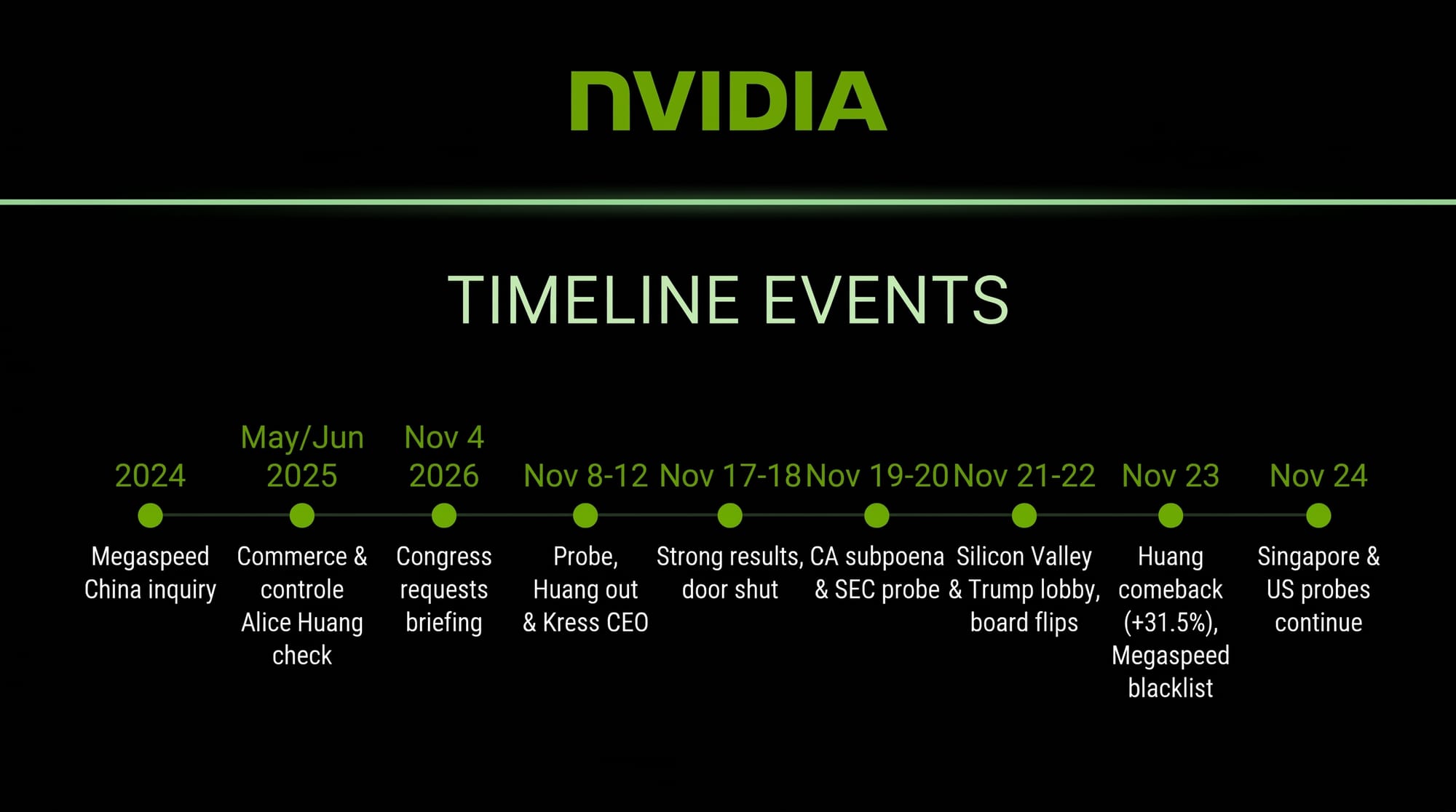
Tijdlijn: hoe de crisis zich werkelijk opbouwde
■ 2024: Amerikaanse autoriteiten beginnen Megaspeed te onderzoeken vanwege mogelijke omleiding van geavanceerde NVIDIA-chips richting China. Het China- en exportcontroledossier bestaat daarmee ruim vóór Huangs publieke bestuurscrisis.
■ Mei 2025: Commerce vraagt NVIDIA om verkoopgegevens rond Megaspeed. Daarmee komt NVIDIA zelf rechtstreeks in beeld bij het handhavingstraject.
■ Juni 2025: Amerikaanse en Singaporese autoriteiten voeren een controle uit bij Megaspeed en interviewen Alice Huang. Het onderzoek richt zich op mogelijke chipomleiding en compliance.
■ 4 november 2026: Republikeinse commissievoorzitters vragen Huang om een gesloten briefing over Alice Huang, Megaspeed en mogelijke veiligheidsrisico's. Het dossier is dan al politiek geëscaleerd.
■ 8 november: De NVIDIA-board kondigt een onafhankelijk onderzoek aan naar mogelijke buitenlandse beïnvloeding rond Huang. Tegelijk zegt de board al dat zij op dat moment geen reden ziet te denken dat nationale veiligheid of NVIDIA-geheimen zijn gecompromitteerd.
■ 10 november: De onafhankelijke bestuurders huren voormalig federaal aanklager Joon Kim en Wachtell Lipton in. Pas vanaf dat moment staat het externe onderzoeksteam formeel klaar.
■ 11 november: De board accepteert Huangs ontslag, benoemt Kress tot interim-CEO en maakt Harvey Jones voorzitter. De officiële overgang naar een nieuw leiderschapsmodel begint.
■ 12 november: NVIDIA publiceert de CEO-transitie en zegt dat operations, klantenverplichtingen en productroadmap zonder onderbreking doorgaan. De board start een echte zoektocht naar een permanente opvolger.
■ 15 november: Treasury Secretary Scott Bessent zegt dat NVIDIA een externe CEO nodig heeft en een harde leiderschapsschoonmaak moet uitvoeren. Washington wil tegelijk antwoorden over China, verkoopcultuur en compliance.
■ 17 november: NVIDIA rapporteert $115,8 miljard omzet, $107,6 miljard Data Center-omzet en een outlook van ongeveer $130 miljard. Operationeel blijkt de onderneming zonder Huang niet in te storten.
■ 17 november: De board richt een permanent National Security and Export Control Oversight Committee op. NVIDIA bouwt dus juist extra controlemechanismen in op het moment dat de onderneming zonder Huang opereert.
■ 17 en 18 november: Harvey Jones zegt dat de board Huangs ontslag unaniem heeft geaccepteerd en hem niet opnieuw als CEO zal installeren. Kress herhaalt dezelfde lijn en de externe CEO-search loopt door.
■ 18 november: Kress legt meer nadruk op financiële discipline en NVIDIA brengt de neocloud-commitments terug van $36 miljard naar $32 miljard. De markt begint rekening te houden met een minder agressieve balans onder een nieuwe CEO.
■ 19 november: Californië dagvaardt NVIDIA. De staat wil weten of geavanceerde chips of vertrouwelijke informatie richting China konden gaan en of beleggers daarover mogelijk verkeerd of onvolledig zijn geïnformeerd.
■ 19 november: Amerikaanse disclosures laten opnieuw NVIDIA-transacties in Trumps portefeuille zien. Het Witte Huis zegt dat externe partijen die portefeuille onafhankelijk beheren.
■ 20 november: Reuters meldt dat de SEC mogelijke accountingkwesties onderzoekt. NVIDIA daalt die dag hard en de bredere AI-verkoop versnelt.
■ Vrijdag 20 november: Grote optieposities trekken achteraf aandacht en online circuleert een claim dat iemand $3,4 miljoen in maandag-expirerende $160-calls heeft gestoken. Die specifieke claim is niet onafhankelijk bevestigd, maar de handel vlak vóór een besloten boardbesluit leidt later wel tot een formele oproep voor onderzoek.
■ Weekend 21 en 22 november: Een groep Silicon Valley-bondgenoten lobbyt richting Trump en Vance voor Huangs terugkeer. FT noemt onder anderen Travis Kalanick, Gavin Baker, Brad Gerstner en Marc Andreessen.
■ 22 november: Bessent zegt nog steeds dat Washington antwoorden nodig heeft over NVIDIA's China-verkopen en compliance. Op dezelfde dag draait de board uiteindelijk volledig.
■ 22 november: De board stemt unaniem voor Huangs onmiddellijke terugkeer als CEO, president en bestuurder. Kress keert terug naar haar CFO-rol.
■ 23 november: NVIDIA maakt de comeback bekend en zegt dat regeringsinput voldoende comfort gaf dat Huangs terugkeer geen nationaal veiligheidsrisico vormt. De board zegt bovendien tevreden te zijn over zijn openheid.
■ 23 november: Trump zegt dat zijn interventie belangrijk was. Daarmee is politieke invloed geen interpretatie meer maar een vaststaand onderdeel van de reconstructie.
■ 23 november: NVIDIA stijgt 31,5% en krijgt bijna $1 biljoen beurswaarde terug. De Nasdaq en S&P 500 springen eveneens uitzonderlijk hard omhoog.
■ 23 november: Megaspeed wordt op dezelfde dag op de Amerikaanse zwarte handelslijst gezet. Het bedrijf dat midden in het China-dossier staat wordt dus zwaarder aangepakt terwijl Huang terugkeert.
■ 24 november: Singapore zegt het eigen Megaspeed-onderzoek voort te zetten. Californië zegt dat Huangs comeback niets aan zijn onderzoek verandert en Reuters zet een lange lijst van nog lopende federale en staatsdossiers op een rij.
De eerste fout zit al in het begin van de boardreactie
De board opende op 8 november een onafhankelijk onderzoek naar mogelijke buitenlandse beïnvloeding rond Huang. In dezelfde verklaring zei NVIDIA echter al dat de bestuurders op dat moment geen reden hadden om te denken dat nationale veiligheid of NVIDIA-geheimen waren gecompromitteerd, terwijl het externe onderzoeksteam pas twee dagen later formeel werd aangesteld.
Dat is een opvallende volgorde. Een board kan uiteraard een voorlopig oordeel hebben, maar hier werd de markt eerst gerustgesteld en werd daarna pas het externe onderzoek volledig ingericht.
Juist die volgorde is belangrijk omdat de crisis later steeds verder verbreedde. Wat begon als een onderzoek naar mogelijke buitenlandse beïnvloeding groeide uit tot een dossier waarin exportcontrole, accounting, China, boardtoezicht en persoonlijke disclosure allemaal door elkaar liepen.
De board had dus vanaf het begin een probleem dat groter was dan alleen de vraag of Huang persoonlijk staatsgeheimen had gedeeld. Zij moest aantonen dat de onderneming zelf voldoende controle had op een CEO die jarenlang vrijwel gelijk stond aan het bedrijf.
Huang had geen superstemrecht, maar NVIDIA draaide wel om Huang
Huang bezat geen meerderheid en beschikte niet over een Zuckerberg-achtige supervotingstructuur. Zijn macht kwam uit iets anders: meer dan drie decennia aan operationele controle, technologische reputatie, directe klantrelaties en een organisatie die sterk rond hem was gebouwd.
Dat werd zichtbaar toen de board na zijn vertrek voor het eerst een formele voorzitter benoemde. Harvey Jones werd pas in november 2026 NVIDIA's eerste echte chair, terwijl Kress tegelijk interim-CEO werd en een structurele opvolgingsprocedure begon.
De governancevraag is daardoor veel groter dan één mislukte persoonlijke beslissing. Een onderneming met biljoenen dollars beurswaarde bleek een enorme key-man-risk te hebben opgebouwd zonder dat de markt daar tijdens de bullfase veel premie voor vroeg.
De comeback versterkt die conclusie. Wanneer één man zó belangrijk is dat zijn afwezigheid binnen enkele dagen politieke interventie, een marktcrisis en een bijna ongekende beursreactie veroorzaakt, heeft NVIDIA zelf een concentratierisico gecreëerd dat niet met een nieuwe compliancefunctie wordt opgelost.
De officiële lijn was eerst: NVIDIA kan zonder Huang
NVIDIA's eerste officiële boodschap na het vertrek was opvallend zelfverzekerd. De board sprak volledig vertrouwen uit in Kress en het leiderschapsteam en zei dat operations, klantenverplichtingen en de productroadmap zonder onderbreking zouden doorgaan.
De cijfers bevestigden die boodschap. Onder Kress kwam de kwartaalomzet uit op $115,8 miljard, Data Center op $107,6 miljard en de vooruitblik op ongeveer $130 miljard, terwijl Vera Rubin volgens NVIDIA volgens plan werd uitgerold.
Dat bewijs is essentieel omdat het een groot deel van de latere uitleg onderuit haalt. NVIDIA hoefde Huang niet terug te halen omdat de operationele machine zonder hem instortte.
De onderneming leverde juist het tegenovergestelde bewijs. Klanten bleven bestellen, de omzet bleef groeien, de productroadmap liep door en de nieuwe CEO kon geloofwaardig zeggen dat de business gewoon functioneerde.
Kress was tegelijk de financiële rem
Hier wordt het verhaal veel interessanter. Reuters reconstrueerde op basis van mensen rond NVIDIA dat Kress jarenlang een van de weinige senior executives was die Huangs financiële risicobereidheid werkelijk afremde.
Haar team botste met Huang en sales over omvangrijke financieringsconstructies rond onder meer OpenAI, Lambda en andere delen van de AI-infrastructuurketen. Een voorgesteld steunpakket rond een groot Ohio-project werd volgens die bronnen teruggebracht van ongeveer $250 miljard naar circa $120 miljard.
Dat verschil is geen boekhoudkundige voetnoot. Het gaat om tientallen miljarden dollars aan balansrisico en om de fundamentele vraag hoeveel van de AI-bouwgolf NVIDIA zelf moet helpen financieren.
Tijdens haar korte interimperiode werd de toon direct strakker. NVIDIA bracht de neocloud-commitments terug en benadrukte dat dergelijke verplichtingen afhankelijk zijn van externe financiering en daadwerkelijke ingebruikname van capaciteit.
Voor kredietbeleggers was dat een belangrijke verandering. Reuters citeerde fixed-incomebeleggers die verwachtten dat vrijwel iedere opvolger van Huang een lagere risicodrempel zou hanteren voor het gebruik van NVIDIA's balans.
De financiële machine achter NVIDIA was al vóór de crisis onderwerp van discussie
NVIDIA had ondertussen een constructie opgebouwd die veel verder ging dan chips verkopen. Het bedrijf werd investeerder, afnemer van capaciteit, huurder, garant en soms financiële steunpilaar binnen hetzelfde ecosysteem dat vervolgens enorme hoeveelheden NVIDIA-systemen koopt.
De officiële Q3-documentatie laat $518 miljard aan toekomstige commitments zien. Daarvan is $390 miljard gewone supply- en capacity-inkoop, voornamelijk meerjarige procurement van geheugen en andere onderdelen, waardoor het onjuist zou zijn dat hele bedrag als klantfinanciering neer te zetten.
Dezelfde tabel bevat echter ook $28 miljard aan cloudservicecontracten, $74 miljard aan nog niet begonnen datacenterleases, $20 miljard aan toekomstige equity-investeringen en $6 miljard aan capex. Buiten die tabel staan nog $32 miljard aan aanvullende neocloud-commitments.
Daarnaast rapporteert NVIDIA maximaal $118 miljard bruto garantie-exposure. Daarvan hangt $105 miljard samen met SB Energy en PORTS-Pike, waar circa 4,25 GW aan infrastructuur wordt gebouwd voor OpenAI onder langlopende leases en vrijwel uitsluitend NVIDIA-systemen.
Dit betekent niet dat NVIDIA morgen honderden miljarden moet betalen. Het betekent wel dat de grootste chipverkoper ter wereld steeds dieper financieel verweven raakt met de infrastructuur die zijn eigen toekomstige omzet moet dragen.
Credit had daar al vóór Huangs vertrek moeite mee
De financiële markt was daar al langer niet volledig comfortabel mee. Reuters beschreef hoe banken en kredietbeleggers veel conservatiever rekenden aan GPU-restwaarde, projectfinanciering en de kwaliteit van neocloudbalansen dan de meest agressieve AI-bulls.
De spanning werd zichtbaar bij CoreWeave en Nebius. CoreWeave-obligaties die rond 9,625% waren uitgegeven gingen richting bijna 15% yield, terwijl Nebius-convertibles naar ongeveer 70 cent op de dollar zakten en boven 12% rendement noteerden.
NVIDIA stond midden in beide ecosystemen. Het had een $6,3 miljard capacity commitment richting CoreWeave en had miljarden in Nebius geïnvesteerd, waardoor kredietstress bij deze partijen direct relevant werd voor de vraag hoe ver NVIDIA zijn eigen klantenkring financieel zou blijven ondersteunen.
Daarom was Huangs vertrek voor credit niet alleen een governancecrisis. Het bood ook het vooruitzicht dat NVIDIA minder avontuurlijk met zijn eigen balans zou omgaan.
Kress vertegenwoordigde precies dat alternatief. Haar buitenspel zetten bij de comeback, zoals FT en andere bronnen op basis van ingewijden meldden, krijgt daardoor een veel zwaardere betekenis dan alleen een intern managementconflict.
Op 18 november was de deur nog dicht
Na de sterke cijfers bleef de officiële lijn duidelijk. Harvey Jones zei dat de board Huangs ontslag unaniem had geaccepteerd en niet van plan was hem opnieuw als CEO te installeren.
Huang had toen al laten weten dat hij bereid was terug te keren. De board kon hem dus meteen terughalen en koos daar op dat moment bewust niet voor.
Een echte opvolgingsprocedure liep bovendien door. Externe kandidaten werden benaderd en Arm-CEO René Haas werd in verband gebracht met de functie, waarna Haas later zijn contract bij Arm tot 2033 verlengde.
De board was dus niet bezig met een symbolische tussenfase. Op 18 november was NVIDIA daadwerkelijk onderweg naar een post-Huangstructuur.
Dat maakt wat daarna gebeurde veel explosiever. De persoon die niet terug mocht komen, zat vier dagen later opnieuw in de CEO-stoel.
De omslag kwam vanuit Silicon Valley en Washington
FT reconstrueerde een weekendcampagne waarin een kleine groep bondgenoten van Huang de comeback actief organiseerde. Travis Kalanick, Gavin Baker, Brad Gerstner, Marc Andreessen en anderen benaderden het Witte Huis en JD Vance en voerden zowel publiek als achter de schermen campagne.
Volgens FT werd Kress zelfs buiten de beslissende gesprekken gehouden. Trump sprak persoonlijk met de board en Vance had een lang gesprek met Huang waarin exportcontrole, remote access en Megaspeed werden besproken.
Dat is geen theorie over politieke druk. NVIDIA zegt zelf dat de board input van hoge regeringsniveaus kreeg voordat hij concludeerde dat Huangs terugkeer geen nationaal veiligheidsrisico vormde.
Trump bevestigde daarna zelf dat zijn interventie belangrijk was. Reuters beschreef de comeback dan ook expliciet als een terugkeer onder druk van de president.
Hiermee wordt een centrale vraag onvermijdelijk. Hoe onafhankelijk is een board die binnen enkele dagen een categorisch besluit volledig omdraait nadat de president, de vicepresident, grote investeerders en technologiefiguren zich met de uitkomst bemoeien?
De regering was zelf enkele dagen eerder nog verdeeld
De ommezwaai binnen Washington is minstens zo opvallend als die binnen NVIDIA. Bessent zei op 15 november nog dat NVIDIA juist een externe CEO nodig had en een harde leiderschapsverandering moest doorvoeren.
Op 22 november, een dag vóór de comeback, zei hij bovendien dat Washington nog steeds antwoorden wilde over de verkoop van NVIDIA-chips aan China en over de verantwoordelijkheid voor compliance binnen het bedrijf.
Daarna geeft dezelfde regering de board voldoende comfort om te zeggen dat Huangs terugkeer geen nationaal veiligheidsrisico vormt. Die sprong verdient veel meer uitleg dan de markt tot nu toe heeft geëist.
Het verschil is niet alleen politiek interessant. Het laat zien hoe snel de balans tussen nationale veiligheid en economische systeemrisico verschoof zodra de beurscrisis rond NVIDIA groter werd.
Trump speelde meerdere rollen tegelijk
Trump was in dit dossier tegelijk president, beleidsmaker rond chiprestricties, persoonlijke bondgenoot van Huang en de man die rechtstreeks druk op de board uitoefende. Daarbovenop had zijn financiële portefeuille volgens Reuters tussen $11 miljoen en $55 miljoen blootstelling aan NVIDIA.
Reuters berekende dat de koerssprong van maandag zijn vermogen op papier met maximaal ongeveer $17 miljoen kon verhogen. Het Witte Huis zegt dat onafhankelijke financiële instellingen de portefeuille beheren en dat Trump en zijn familie geen individuele transacties kunnen sturen.
Dat maakt persoonlijk financieel motief niet bewezen. De overlap tussen beleidsmacht, directe bedrijfsinterventie en financiële blootstelling staat wel vast.
De transactiedisclosures maken die overlap concreet. In augustus werd tot $1,6 miljoen NVIDIA gekocht en tot $1 miljoen verkocht, terwijl in september nog eens tot $265.000 werd gekocht en tot $15.000 verkocht.
Tegelijk bepaalde dezelfde regering hoeveel chips NVIDIA richting China kon verkopen. Een House-commissie maakte bekend dat tussen december 2025 en mei 2026 vergunningen waren goedgekeurd voor bijna 880.000 geavanceerde NVIDIA- en AMD-chips richting Chinese ondernemingen.
Wij hoeven daar geen onbewezen corruptieclaim bovenop te zetten. De gedocumenteerde combinatie is op zichzelf al uitzonderlijk genoeg.
Er was ook een echte strategische reden om Huang terug te halen
Een serieuze reconstructie moet ook laten zien waarom Washington hem inhoudelijk terug wilde. Reuters meldde op basis van mensen rond het dossier dat Trump en Vance Huang zagen als een cruciale verdediger van de Amerikaanse positie in open-weight AI-modellen.
FT beschreef dezelfde redenering vanuit de Silicon Valley-groep. Hun boodschap was dat Huang niet alleen belangrijk was voor NVIDIA, maar voor de Amerikaanse AI-industrie, de beurs en uiteindelijk de economie.
AP meldde bovendien dat Trump bang was dat China Huang zou kunnen aantrekken en dat de president de daling van AI-aandelen en de economische betekenis van NVIDIA expliciet mee liet wegen.
Dat maakt de comeback niet minder politiek. Het laat juist zien waarom de regering bereid was zo ver te gaan.
Washington keek niet meer alleen naar NVIDIA als beursbedrijf. Het keek naar Huang als strategische Amerikaanse asset.
Daarmee wordt Too Big To Fail zichtbaar
NVIDIA is juridisch geen systeembank en de Amerikaanse overheid heeft geen formele garantie afgegeven dat aandeelhouders of schuldeisers worden gered. De term Too Big To Fail gaat hier dus niet over een klassieke bailout.
Het gaat over gedrag. Een interne leiderschapscrisis werd groot genoeg dat het Witte Huis niet meer afwachtte wat bestuurders, aandeelhouders en de markt zelf zouden beslissen.
De beursreactie bevestigde hoe breed het systeemrisico inmiddels loopt. NVIDIA steeg 31,5%, de S&P 500 ongeveer 4,7% en de Nasdaq circa 6,5%, terwijl bijna $1 biljoen aan NVIDIA-beurswaarde in één dag terugkwam.
Dat is geen normale reactie op de benoeming van één CEO. De markt behandelde Huangs comeback als een herstel van een cruciale pijler onder de hele AI-investeringsthesis.
De onderliggende logica is duidelijk. NVIDIA zit midden in hyperscaler-capex, datacenterfinanciering, HBM, networking, energie, neoclouds, frontier labs en de Amerikaanse indexmarkt.
Een langdurige crisis bij NVIDIA kan daardoor doorwerken naar kapitaaluitgaven, aandelenvermogen, kredietmarkten en economisch vertrouwen. De politieke interventie laat zien dat Washington dat risico inmiddels serieus genoeg vindt om direct in corporate governance in te grijpen.
Maar de board draaide vóórdat zijn eigen onderzoek klaar was
Dat is misschien wel het meest vernietigende governancepunt in de hele tijdlijn. NVIDIA zegt op 23 november dat de board tevreden is met Huangs openheid en leiderschap, terwijl de eigen onafhankelijke enquête nog doorloopt.
Dezelfde verklaring bevestigt bovendien dat het National Security and Export Control Committee blijft bestaan en dat NVIDIA nog steeds een Chief Compliance Officer zoekt. Het bedrijf blijft ook meewerken aan lopende overheidsvragen.
De board zegt dus tegelijkertijd twee dingen. Huang is veilig genoeg om onmiddellijk terug te keren, maar de onderzoeken en extra controles zijn nog steeds nodig.
Dat hoeft juridisch niet onmogelijk te zijn. Voor beleggers betekent het wel dat de board het eindpunt heeft gekozen voordat alle bewijsstukken publiek op tafel liggen.
Het woord candor botst met Reuters' interne reconstructie
De comebackverklaring gebruikt bewust het woord candor, oftewel Huangs openheid tegenover de board. Dat woord is extra gevoelig omdat Reuters eerder op basis van interne correspondentie en twee mensen rond NVIDIA meldde dat Huang topjurist Tim Teter en marketingchef Alison Wagonfeld een onvolledig beeld gaf van zijn relatie met Alice Huang.
Volgens Reuters omschreef Huang de contacten in oktober nog als normale zakelijke interacties. Later erkende hij de affaire en bood hij excuses aan voor zijn ontrouw.
Reuters kon niet vaststellen wanneer de relatie precies intiem werd en Amerikaanse autoriteiten hebben Alice Huang niet als bewezen Chinese spion bestempeld. Dat verandert niets aan de corporate governance-vraag: de board beroept zich bij de comeback precies op een kwaliteit die eerder onderwerp was van serieuze interne twijfel.
De board kan tijdens latere gesprekken nieuwe informatie hebben gekregen. Zolang het onafhankelijke onderzoek niet is afgerond, weet de markt alleen nog niet welke informatie die spectaculaire ommezwaai rechtvaardigde.
De onderzoeken verdwenen niet, ze stapelden zich op
Reuters zette op 24 november het onderzoeksspectrum op een rij. FBI en Amerikaanse inlichtingendiensten kijken naar de mogelijke buitenlandse inlichtingencomponent, DOJ onderzoekt onder meer acquisities, verkooppraktijken en mogelijke tying van AI-chips en networkingproducten, de SEC kijkt naar accounting en Californië onderzoekt China en mogelijke misleiding van beleggers.
Daarbovenop komen de congressional investigations. Huang moet op 3 december publiek getuigen bij de Senate Banking Committee en bevestigde interviews met House-commissies staan eveneens gepland.
Aandeelhouders hebben daarnaast rechtszaken aangespannen tegen NVIDIA, Huang en delen van de board. Reuters meldde dat zowel een securities class action als een derivative suit loopt, waardoor ook de vraag naar boardtoezicht juridisch onderdeel van het dossier is geworden.
De comeback sluit dus geen enkel groot juridisch dossier. Het verandert alleen wie namens NVIDIA tegenover al deze onderzoekers komt te zitten.
China werd op de dag van de comeback juist harder
De timing rond Megaspeed is bijna symbolisch. Op dezelfde dag waarop NVIDIA Huang opnieuw installeerde, plaatste Commerce Megaspeed en gelieerde ondernemingen op de Entity List.
Megaspeed stond volgens Reuters al sinds 2024 onder onderzoek naar mogelijke chipomleiding. Amerikaanse en Singaporese handhavers deden in 2025 een locatiecontrole en interviewden Alice Huang.
Singapore zei op 24 november dat het onderzoek gewoon doorgaat. Premier Lawrence Wong benadrukte dat wordt bekeken of lokaal recht is overtreden en dat Singapore met de Verenigde Staten blijft samenwerken.
Dat maakt de officiële timing ongemakkelijk. De board concludeert dat Huangs terugkeer geen nationaal veiligheidsrisico vormt terwijl het bedrijf dat midden in de oorspronkelijke affaire staat op exact hetzelfde moment zwaarder door Washington wordt aangepakt.
NVIDIA zelf haalt China inmiddels uit de outlook
De commerciële impact is ondertussen niet hypothetisch. NVIDIA verkocht in het afgelopen kwartaal nog $2,4 miljard aan Amerikaanse goedgekeurde Hopper-datacenterproducten richting China en stopte daarna met het verschepen ervan.
In de huidige kwartaaloutlook rekent het bedrijf vervolgens helemaal niet meer op Data Center compute-omzet uit China. Dat is een veel harder signaal dan welke politieke geruststelling ook.
Reuters meldde daarnaast dat de omzet uit klanten met hoofdkantoor in China en Hongkong in een jaar was opgelopen van $2,97 miljard naar $11,05 miljard. De economische inzet is dus groot genoeg om iedere nieuwe exportregel onmiddellijk relevant te maken voor omzetgroei en waardering.
Huang kan beter onderhandelen dan vrijwel iedere andere technologie-CEO. Hij kan alleen niet tegelijkertijd onbeperkte China-toegang en steeds strengere Amerikaanse veiligheidsdoelen garanderen.
De optiehandel: het virale verhaal is explosief, maar het harde dossier is interessanter
Na de comeback ging een verhaal viraal dat een onbekende handelaar op vrijdag ongeveer $3,4 miljoen in $160-calls met expiratie op maandag had gestoken. Omdat NVIDIA maandag boven $160 opende, zou die positie theoretisch ongeveer $312 miljoen waard zijn geweest, een papieren rendement van bijna 9000%.
Die specifieke trade is niet onafhankelijk bevestigd. Het is onbekend of de positie werkelijk nieuw werd geopend, of de genoemde hoeveelheid klopt en of iemand de positie überhaupt tegen de theoretische maandagwaarde kon sluiten.
Dat betekent niet dat de pre-announcement handel oninteressant is. Integendeel, de informatie over de comeback zat in een bijzonder kleine kring terwijl er vrijdag grote optieposities werden verhandeld en de board enkele dagen eerder nog publiek het tegenovergestelde had gezegd.
Senator Ruben Gallego heeft daarom formeel om onderzoek gevraagd naar posities die vóór de aankondiging werden ingenomen. Dat is de harde kern van het verhaal, niet een onbewezen screenshot op sociale media.
De vergelijking met Martha Stewart die vervolgens rondging is begrijpelijk vanwege de bedragen, maar moet feitelijk kloppen. De SEC stelde destijds dat Stewart $45.673 aan verlies had vermeden, terwijl haar gevangenisstraf voortkwam uit conspiracy, obstruction en valse verklaringen aan onderzoekers.
Het verschil in schaal maakt de NVIDIA-claim sensationeel, maar schaal is geen bewijs van voorkennis. De juiste vraag is wie vrijdag de posities innam, wat die partij wist en wanneer die informatie beschikbaar kwam.
De rally was geen klassieke squeeze
De explosieve beweging van maandag werd vervolgens te makkelijk als short squeeze beschreven. ORTEX berekende weliswaar ongeveer $12,2 miljard aan papieren shortverliezen, maar iets meer dan 1% van de vrije float stond daadwerkelijk short.
Dat is te weinig voor een klassieke squeeze die volledig door gedwongen short covering wordt gedragen. ORTEX zelf beschreef de beweging daarom vooral als een reactie op het nieuws.
De technische marktstructuur kon de beweging wel versnellen. Negatieve gamma rond belangrijke strikes betekent dat dealers bij stijgende koersen extra aandelen kunnen moeten kopen om hun hedges aan te passen.
De fundamentele trigger was dus Huangs terugkeer. Opties, dealerhedging, momentum en de plotselinge heropening van de AI-trade konden daarna van een grote rally een extreem grote rally maken.
De markt vierde een oplossing die nog niet bestaat
Dit is uiteindelijk de centrale fout die wij in de koersreactie zien. De markt behandelde de terugkeer van Huang alsof daarmee een groot deel van de onderliggende crisis was verdwenen.
In werkelijkheid is alleen de onzekerheid over de CEO opgelost. Het China-dossier, Megaspeed, de SEC, California, DOJ, congressional scrutiny, de financieringsmachine en de governancevragen bestaan nog steeds.
De board heeft Huang teruggehaald voordat zijn eigen onderzoek klaar is. Kress werd volgens FT buiten de beslissende gesprekken gehouden en de financiële tegenmacht die zij vertegenwoordigde moet nog bewijzen dat zij onder Huang werkelijk overeind blijft.
Washington heeft bovendien een precedent geschapen. De markt weet nu dat een NVIDIA-crisis groot genoeg kan worden om directe presidentiële inmenging uit te lokken.
Dat is op korte termijn bullish voor sentiment. Op langere termijn kan het juist gevaarlijk zijn omdat bestuurders en financiers minder hard risico hoeven te begrenzen wanneer zij denken dat systeemschade uiteindelijk politieke interventie oproept.
Een hogere koers maakt het probleem niet kleiner
Onze bearish visie vereist niet dat NVIDIA morgen instort. Het aandeel kan na deze comeback nog weken of maanden stijgen en zelfs nieuwe toppen bereiken.
De operationele onderneming blijft extreem sterk. Rubin groeit hard, de omzet explodeert en NVIDIA blijft de dominante leverancier van accelerated computing.
Maar koers is geen schoonmaak. Een nieuwe all-time high sluit geen SEC-onderzoek, verwijdert geen $105 miljard garantie en maakt China niet opnieuw volledig toegankelijk.
Iedere rally zonder zichtbare verbetering in governance, accounting, China en financiële discipline vergroot daarom de afstand tussen wat de beurs veronderstelt en wat werkelijk is opgelost.
Die afstand kan lang blijven bestaan. Dat maakt haar niet ongevaarlijk.
Wanneer één van de open dossiers later opnieuw hard negatief terugkomt, begint de correctie vanaf een hogere waardering en met meer optimisme in de prijs. Dat kan de uiteindelijke beweging juist groter maken.
Wat zou echte schoonmaak zijn?
De eerste test ligt bij de board. NVIDIA moet uitleggen welke nieuwe feiten tussen de categorische afwijzing van Huang en zijn terugkeer lagen en waarom die feiten zwaar genoeg waren om een volledige 180-graden draai te rechtvaardigen.
De tweede test is Kress. Haar functietitel is minder belangrijk dan de vraag of zij grote garanties, investeringen en customer-financingconstructies daadwerkelijk kan blijven terugdringen wanneer zij de rekensom te agressief vindt.
De derde test is compliance. De nieuwe National Security and Export Control Committee en de toekomstige Chief Compliance Officer moeten zichtbare macht krijgen over exportcontrole en nationale veiligheidsrisico's.
De vierde test ligt bij de financiële machine. NVIDIA moet aantonen dat neoclouds en andere AI-infrastructuurpartners zelfstandig financierbaar blijven zonder dat NVIDIA steeds verder als investeerder, huurder, capacity buyer en garant moet optreden.
De vijfde test is China. De onderneming moet laten zien dat de omzetkwaliteit en eindbestemming van hardware controleerbaar blijven in een markt waarin Washington de regels telkens verder aanscherpt en Beijing steeds meer lokale alternatieven stimuleert.
Zolang deze vijf punten niet aantoonbaar verbeteren, is de comeback voor ons geen structurele oplossing. Het is vooral een krachtige politieke en psychologische reset van de markt.
Desk-view: dit dossier gaat fout aflopen als NVIDIA alleen de koers repareert
De afgelopen weken laten zien hoe groot NVIDIA inmiddels is geworden. Een bestuurscrisis bij één onderneming trok de volledige AI-handel omlaag en de terugkeer van één man bracht binnen uren bijna $1 biljoen beurswaarde terug.
Dat is indrukwekkend en tegelijk gevaarlijk. Een bedrijf kan technologisch uitzonderlijk zijn en toch een governance- en financieringsstructuur ontwikkelen die steeds kwetsbaarder wordt naarmate de marktwaarde stijgt.
Washington heeft de leiderschapscrisis helpen beëindigen. Het heeft de SEC-probe, China, Megaspeed, de boardvragen en de financiële verwevenheid van NVIDIA met zijn eigen ecosysteem niet beëindigd.
Wij denken daarom dat de markt de comeback te snel als vrijspraak behandelt. Dat kan nog lang goed gaan zolang winstgroei, momentum en politieke steun de aandacht van de open dossiers afleiden.
Maar hoe hoger het aandeel stijgt zonder dat NVIDIA echt schoon schip maakt, hoe groter de kwetsbaarheid wordt wanneer één van die dossiers opnieuw breekt.
Voor nu blijven wij bearish op NVIDIA.
Niet omdat Huang geen uitzonderlijke CEO is.
Maar omdat Too Big To Fail de problemen tijdelijk kan bedekken en ze daarmee juist groter kan maken.
🔵 English version
NVIDIA is becoming Too Big To Fail: reconstructing Huang’s fall, Trump’s intervention and the crisis that never disappeared
No time to read the full article? These are the points that matter.
■ NVIDIA: Huang's return solved one problem, who is CEO. China, accounting, export controls, financing structures, governance and multiple investigations remain, while markets restored almost $1 trillion of value as though the file had been closed.
■ Investment View: Bearish on NVIDIA after the enormous relief rally. The shares can continue rising for weeks or months, but every additional rally without a genuine cleanup increases the gap between valuation and certainty in our view and therefore raises the risk of a much harder correction later.
■ Board: NVIDIA opened an independent investigation on November 8, Huang left on November 12 and the board was still publicly ruling out his return on November 17 and 18. Days later the same board unanimously reversed after pressure from Trump, Vance, investors and other influential allies.
■ Kress: Colette Kress demonstrated that NVIDIA could operate without Huang and simultaneously began imposing greater discipline around neoclouds, guarantees and other commitments. Reuters described her, based on people around NVIDIA, as the executive who repeatedly pushed back against Huang's largest financial bets.
■ Trump: White House involvement is established fact. NVIDIA confirms input from senior government levels, Trump says his intervention mattered and Reuters estimated his portfolio held between $11 million and $55 million of NVIDIA shares, while the White House says outside institutions manage those assets independently.
■ Too Big To Fail: NVIDIA is not a bank and has no formal government guarantee, but Washington treated an uncontrolled leadership crisis as though it could create systemic damage. Markets did the same when Huang's return pushed NVIDIA 31.5% higher and lifted the Nasdaq and S&P 500 by extraordinary amounts.
■ China: Megaspeed had been under U.S. investigation since 2024 and was placed on the Entity List on the day Huang returned. NVIDIA now assumes no Data Center compute revenue from China in its current outlook while Singapore and U.S. authorities continue investigating the broader file.
■ Investigations: The SEC is examining accounting, California is examining China and disclosure, Congress wants testimony from Huang and general counsel Tim Teter and NVIDIA's own independent inquiry continues. The board therefore reinstated Huang before the major investigations were complete.
■ Financing: NVIDIA is no longer simply a supplier but also an investor, capacity buyer, tenant and guarantor inside an ecosystem that subsequently buys enormous quantities of NVIDIA hardware. Official disclosures show $518 billion of different future commitments, $32 billion of additional neocloud commitments and maximum gross guarantee exposure of $118 billion.
■ Options trading: An explosive claim circulated around the final trading session before the comeback that a mysterious $3.4 million call bet could theoretically have been worth more than $300 million on Monday. That specific position has not been independently verified, but large call activity, a narrow information circle and Senator Ruben Gallego's formal request for investigation make pre-announcement trading part of the file.
■ Rally: This was not a classic short squeeze. Just over 1% of free float was short, although ORTEX estimated roughly $12.2 billion of paper losses for short sellers and negative gamma, dealer hedging and momentum could amplify the initial fundamental move.
■ Desk view: We believe markets moved too quickly from crisis to exoneration. The higher NVIDIA rises without genuine cleanup in governance, China, accounting and financing, the more vulnerable each subsequent rally becomes.
Timeline: how the crisis actually developed
■ 2024: U.S. authorities begin investigating Megaspeed over possible diversion of advanced NVIDIA chips into China. The China and export-control file therefore predates Huang's public governance crisis by years.
■ May 2025: Commerce requests NVIDIA sales records related to Megaspeed. NVIDIA itself becomes directly involved in the enforcement process.
■ June 2025: U.S. and Singaporean authorities conduct an on-site check at Megaspeed and interview Alice Huang. The inquiry focuses on potential chip diversion and compliance.
■ November 4, 2026: Republican committee chairs request a closed briefing from Huang regarding Alice Huang, Megaspeed and potential security risks. The issue has already escalated politically.
■ November 8: NVIDIA's board launches an independent investigation into possible foreign intelligence targeting of Huang. At the same time, the board says it then has no reason to believe U.S. national security or NVIDIA secrets were compromised.
■ November 10: Independent directors retain former federal prosecutor Joon Kim and Wachtell Lipton. Only then is the outside investigation team formally in place.
■ November 11: The board accepts Huang's resignation, appoints Kress interim CEO and makes Harvey Jones chair. The formal transition to a different leadership model begins.
■ November 12: NVIDIA announces the transition and says operations, customer commitments and the product roadmap will continue without interruption. The board launches a genuine search for a permanent successor.
■ November 15: Treasury Secretary Scott Bessent says NVIDIA needs an external CEO and a major leadership cleanup. Washington simultaneously demands answers about China, sales culture and compliance.
■ November 17: NVIDIA reports $115.8 billion of revenue, $107.6 billion of Data Center revenue and guides toward roughly $130 billion. Operationally, the company proves it is not collapsing without Huang.
■ November 17: The board creates a permanent National Security and Export Control Oversight Committee. NVIDIA is therefore adding controls while operating without Huang.
■ November 17 and 18: Harvey Jones says the board unanimously accepted Huang's resignation and does not intend to reinstall him as CEO. Kress repeats the same message and the external CEO search continues.
■ November 18: Kress emphasizes greater financial discipline and NVIDIA reduces neocloud commitments from $36 billion to $32 billion. Markets begin pricing the possibility of a less aggressive balance sheet under a new CEO.
■ November 19: California subpoenas NVIDIA. The state wants to know whether advanced chips or confidential information could have reached China and whether investors were misled or incompletely informed.
■ November 19: U.S. disclosures again show NVIDIA transactions inside Trump's portfolio. The White House says outside institutions manage the portfolio independently.
■ November 20: Reuters reports that the SEC is investigating possible accounting issues. NVIDIA falls sharply and the broader AI selloff accelerates.
■ Friday, November 20: Large options positions attract attention after the fact and a claim circulates that someone placed $3.4 million into Monday-expiring $160 calls. The specific claim is not independently confirmed, but trading immediately before a closed board decision later triggers a formal call for investigation.
■ Weekend of November 21-22: A group of Silicon Valley allies lobbies Trump and Vance for Huang's return. FT names Travis Kalanick, Gavin Baker, Brad Gerstner and Marc Andreessen among those involved.
■ November 22: Bessent still says Washington needs answers regarding NVIDIA's China sales and compliance. The board reverses the same day.
■ November 22: Directors vote unanimously to restore Huang immediately as CEO, president and director. Kress returns to her CFO role.
■ November 23: NVIDIA announces the comeback and says government input gave the board sufficient comfort that Huang's reinstatement poses no national-security risk. Directors also say they are satisfied with his candor.
■ November 23: Trump says his intervention mattered. Political influence is therefore no longer an interpretation but an established part of the reconstruction.
■ November 23: NVIDIA rises 31.5% and recovers almost $1 trillion of market value. The Nasdaq and S&P 500 also jump by extraordinary amounts.
■ November 23: Megaspeed is placed on the U.S. trade blacklist the same day. The company at the center of the China file is therefore receiving tougher treatment even as Huang returns.
■ November 24: Singapore says its Megaspeed inquiry continues. California says Huang's comeback changes nothing about its investigation and Reuters lists multiple federal and state probes that remain open.
The first problem appears in the board's opening response
On November 8, the board opened an independent investigation into possible foreign intelligence targeting of Huang. In the same statement, NVIDIA said directors had no reason at that point to believe U.S. national security or NVIDIA secrets had been compromised, even though the outside investigation team was only formally appointed two days later.
That sequence is notable. A board can obviously hold a preliminary view, but markets were reassured before the external investigative machinery had been fully installed.
The crisis then broadened well beyond the original question. What began as a foreign-intelligence review expanded into export control, accounting, China, board oversight and personal disclosure.
NVIDIA's directors therefore faced something larger than the question of whether Huang personally transmitted state secrets. They had to demonstrate that a company built closely around one founder still possessed credible controls over that founder.
Huang had no supervoting control, but NVIDIA still revolved around Huang
Huang did not control a majority of votes and had no Zuckerberg-style supervoting structure. His power came from more than three decades of operating control, technological reputation, direct customer relationships and an organization shaped closely around him.
That became visible after he left, when NVIDIA appointed a formal board chair for the first time. Harvey Jones became chair as Kress became interim CEO and a structural succession process began.
The governance question is therefore much larger than one bad personal decision. A company worth trillions had accumulated enormous key-man risk without markets charging much for it during the bull phase.
The comeback strengthens that conclusion. When one individual is important enough that his absence creates political intervention, market stress and a near-unprecedented equity reaction within days, NVIDIA itself has built a concentration risk that cannot be repaired by creating one new compliance position.
The original corporate message was that NVIDIA could operate without Huang
NVIDIA's first message after the departure was remarkably confident. The board expressed full confidence in Kress and the leadership team and said operations, customer commitments and the product roadmap would continue without interruption.
The numbers backed that up. Under Kress, quarterly revenue reached $115.8 billion, Data Center revenue $107.6 billion and guidance approximately $130 billion, while Vera Rubin remained on track.
That evidence is crucial because it undermines much of the later implied justification. NVIDIA did not need Huang back because the operating machine was collapsing.
The company demonstrated the opposite. Customers continued ordering, revenue kept growing, the roadmap continued and a new CEO could credibly tell markets that the business was functioning.
Kress was also the financial brake
This is where the story becomes much more interesting. Reuters reconstructed, based on people around NVIDIA, that Kress had long been one of the few senior executives willing to restrain Huang's financial risk appetite.
Her team clashed with Huang and sales over enormous financing structures involving OpenAI, Lambda and other parts of the AI infrastructure chain. A proposed support package around a large Ohio development was reduced from roughly $250 billion to around $120 billion, according to those sources.
That difference is not an accounting footnote. It represents tens of billions of dollars of balance-sheet risk and the fundamental question of how much of the AI buildout NVIDIA itself should finance.
During her brief interim period, the language immediately tightened. NVIDIA reduced neocloud commitments and emphasized that such arrangements depended on outside financing and actual deployment of capacity.
For credit investors that mattered. Reuters quoted fixed-income investors expecting almost any successor to Huang to use NVIDIA's balance sheet with a lower risk tolerance.
NVIDIA's financial machine was controversial before the crisis
NVIDIA had already built a structure extending far beyond chip sales. It became an investor, capacity buyer, tenant, guarantor and sometimes financial supporter inside the same ecosystem that subsequently purchases enormous quantities of NVIDIA systems.
Official Q3 documents show $518 billion of future commitments. Of this amount, $390 billion is ordinary supply and capacity procurement, largely multiyear purchases of memory and other components, so describing the entire amount as customer financing would be wrong.
The same table nevertheless includes $28 billion of cloud-service agreements, $74 billion of future data-center leases not yet commenced, $20 billion of future equity investments and $6 billion of capex. Another $32 billion of neocloud commitments sits outside that table.
NVIDIA also reports up to $118 billion of maximum gross guarantee exposure. $105 billion of that relates to SB Energy and PORTS-Pike, where roughly 4.25 GW of infrastructure is being developed for OpenAI under long leases and expected to host almost exclusively NVIDIA systems.
None of this means NVIDIA owes hundreds of billions tomorrow. It does mean the world's dominant AI hardware supplier is becoming deeply financially intertwined with the infrastructure that is supposed to create its future revenue.
Credit had already become uncomfortable
Financial markets were already less comfortable with this structure. Reuters described banks and credit investors using much more conservative assumptions around GPU residual values, project financing and neocloud balance sheets than the most aggressive AI bulls.
The tension became visible in CoreWeave and Nebius. CoreWeave bonds originally issued around a 9.625% yield moved toward nearly 15%, while Nebius convertibles fell to roughly 70 cents on the dollar and yields above 12%.
NVIDIA sat at the center of both ecosystems. It had a $6.3 billion capacity commitment with CoreWeave and billions invested in Nebius, making credit stress at those companies directly relevant to how far NVIDIA might continue supporting its customer network.
Huang's departure was therefore not only a governance event for credit investors. It also raised the prospect that NVIDIA would become less adventurous with its own balance sheet.
Kress represented that alternative. Her reported exclusion from the decisive comeback discussions therefore carries far more weight than a simple internal management dispute.
On November 18, the door was still shut
After the strong earnings report, the official position remained clear. Harvey Jones said the board had unanimously accepted Huang's resignation and did not intend to reinstall him as CEO.
Huang had already indicated that he was willing to return. The board therefore had the opportunity to bring him back and consciously chose not to do so.
A genuine succession process was also moving forward. External candidates were contacted and Arm CEO Rene Haas was linked to the position before later extending his Arm contract through 2033.
NVIDIA was not operating a symbolic transition. On November 18 the company was genuinely moving toward a post-Huang structure.
That makes what happened next far more dramatic. The person who was not supposed to return was back in the CEO chair four days later.
The reversal came from Silicon Valley and Washington
The FT reconstructed a weekend campaign in which a small group of Huang allies actively organized his comeback. Travis Kalanick, Gavin Baker, Brad Gerstner, Marc Andreessen and others lobbied the White House and JD Vance both publicly and privately.
According to the FT, Kress herself was excluded from the decisive discussions. Trump spoke directly to the board and Vance held a lengthy conversation with Huang covering export controls, remote access and Megaspeed.
This is not speculation about political pressure. NVIDIA itself says the board received input from senior levels of the U.S. government before concluding that Huang's return posed no national-security risk.
Trump then confirmed that his intervention mattered. Reuters explicitly described the comeback as occurring under pressure from the president.
The central governance question therefore becomes unavoidable. How independent is a board that completely reverses a categorical decision within days after the president, vice president, major investors and technology figures intervene?
The administration itself had held a different view days earlier
Washington's own reversal is almost as striking as NVIDIA's. On November 15, Bessent said the company needed an outside CEO and a major leadership shakeup.
On November 22, one day before the comeback, he still said Washington needed answers about NVIDIA's sales into China and responsibility for compliance inside the company.
The same government then provided the board with enough comfort to state that Huang's reinstatement created no national-security risk. That jump deserves far more explanation than markets have demanded.
The difference is not merely politically interesting. It shows how rapidly the balance between national-security concerns and systemic economic risk shifted as the NVIDIA crisis grew.
Trump occupied several roles at once
Trump was simultaneously president, the policymaker overseeing chip restrictions, a personal ally of Huang and the person pressuring the board to restore him. His financial portfolio also held between $11 million and $55 million of NVIDIA exposure, according to Reuters.
Reuters estimated that Monday's rally could have increased his paper wealth by as much as roughly $17 million. The White House says independent financial institutions manage the portfolio and neither Trump nor his family directs individual trades.
That does not establish a personal financial motive. The overlap between policy power, direct corporate intervention and financial exposure is nevertheless a documented fact.
Trading disclosures make that overlap concrete. Up to $1.6 million of NVIDIA shares were purchased in August and up to $1 million sold, while September brought another maximum $265,000 of purchases and up to $15,000 of sales.
The same administration simultaneously determined how much NVIDIA could sell into China. A House committee said nearly 880,000 advanced NVIDIA and AMD chips had received export approvals between December 2025 and May 2026.
There is no need to add an unproven corruption allegation. The documented combination is extraordinary on its own.
There was also a strategic argument for bringing Huang back
A serious reconstruction must explain why Washington wanted him back. Reuters reported, based on people familiar with the discussions, that Trump and Vance saw Huang as critical to the U.S. position in open-weight AI models.
The FT described the same case being made by the Silicon Valley group. Their argument was that Huang mattered not only to NVIDIA but to the wider U.S. AI industry, stock market and ultimately the economy.
AP further reported that Trump worried China could recruit Huang and that the president was paying attention to the damage in AI stocks and NVIDIA's importance to economic growth.
That does not make the comeback less political. It explains why the administration was willing to intervene so aggressively.
Washington had stopped viewing NVIDIA purely as a listed corporation. It was viewing Huang as a strategic American asset.
That is where Too Big To Fail becomes visible
NVIDIA is not legally a systemically important bank and the U.S. government has issued no formal guarantee to protect its shareholders or creditors. Too Big To Fail therefore does not mean a conventional bailout here.
It means behavior. An internal leadership crisis became serious enough that the White House no longer waited for directors, shareholders and markets to resolve it.
The market reaction showed the same systemic reach. NVIDIA gained 31.5%, the S&P 500 around 4.7% and the Nasdaq about 6.5%, while almost $1 trillion of NVIDIA market capitalization returned in one day.
That is not a normal response to the appointment of one CEO. Markets treated Huang's return as the restoration of a key pillar underneath the entire AI investment thesis.
The underlying logic is clear. NVIDIA sits at the center of hyperscaler capex, data-center financing, HBM, networking, energy, neoclouds, frontier labs and the U.S. index complex.
A prolonged NVIDIA crisis can therefore flow into capital spending, household wealth, credit markets and economic confidence. Political intervention shows Washington now considers that risk serious enough to interfere directly in corporate governance.
Yet the board reversed before its own investigation finished
This may be the most damaging governance point in the entire timeline. NVIDIA said on November 23 that the board was satisfied with Huang's candor and leadership while its own independent investigation remained open.
The same statement confirms that the National Security and Export Control Committee remains in place and that NVIDIA is still searching for a Chief Compliance Officer. The company also says it will continue cooperating with government inquiries.
The board is therefore saying two things simultaneously. Huang is safe enough to return immediately, but the investigations and additional controls are still necessary.
That may be legally possible. For investors it means the board selected the outcome before all of the supporting evidence had become public.
The word candor collides with Reuters' internal reconstruction
The comeback statement deliberately uses the word candor when describing the board's confidence in Huang. That becomes especially sensitive because Reuters previously reported, based on internal correspondence and two people familiar with the matter, that Huang gave general counsel Tim Teter and marketing chief Alison Wagonfeld an incomplete picture of his relationship with Alice Huang.
Reuters said Huang described the interactions in October as ordinary business dealings. He later acknowledged the affair and apologized for his infidelity.
Reuters could not determine exactly when the relationship became intimate and U.S. authorities have not established Alice Huang as a proven Chinese spy. That does not remove the corporate-governance issue: the board relies on precisely the quality that had already become a subject of serious internal doubt.
Directors may have received new information in later discussions. Until the independent investigation is finished, markets simply do not know what information justified the dramatic change in assessment.
The investigations did not disappear, they multiplied
Reuters listed the remaining investigations on November 24. The FBI and intelligence agencies are examining the potential foreign-intelligence dimension, the Justice Department is reviewing acquisitions, sales practices and potential tying, the SEC is examining accounting and California is examining China and investor disclosure.
Congressional investigations sit on top of that. Huang is scheduled to testify publicly before the Senate Banking Committee on December 3 and House interviews are also planned.
Shareholders have separately filed litigation against NVIDIA, Huang and members of the board. Reuters reported both a proposed securities class action and a derivative suit, bringing board oversight itself into the legal file.
The comeback therefore closes none of the major legal matters. It only changes who will represent NVIDIA while they continue.
China became harder on the day of the comeback
The timing around Megaspeed is almost symbolic. On the same day NVIDIA restored Huang, Commerce placed Megaspeed and related entities on the Entity List.
Megaspeed had already been under investigation since 2024 over suspected chip diversion. U.S. and Singaporean authorities conducted an on-site check in 2025 and interviewed Alice Huang.
Singapore said on November 24 that its own investigation would continue. Prime Minister Lawrence Wong said authorities were examining whether local law had been breached and remained in contact with the United States.
The official timing is therefore uncomfortable. The board says Huang's return creates no national-security risk while the company at the center of the original China file is receiving tougher U.S. treatment at exactly the same moment.
NVIDIA itself has removed China from its outlook
The commercial impact is no longer theoretical. NVIDIA sold another $2.4 billion of U.S.-approved Hopper data-center products into China during the latest quarter and then stopped shipping them.
The company's current-quarter outlook subsequently assumes no Data Center compute revenue from China. That is a much harder signal than any political reassurance.
Reuters also reported that revenue from customers headquartered in China and Hong Kong had risen from $2.97 billion to $11.05 billion in a year. The economic stakes are therefore large enough for every export-control change to matter immediately for growth and valuation.
Huang may negotiate better than almost any other technology CEO. He cannot simultaneously guarantee unrestricted China access and increasingly strict U.S. security objectives.
Options trading: the viral story is explosive, but the hard file is more interesting
After the comeback, a claim went viral that an unidentified trader had spent roughly $3.4 million on $160 calls expiring Monday. Because NVIDIA opened Monday above $160, the position was theoretically said to have been worth roughly $312 million, a paper gain approaching 9000%.
That specific trade has not been independently verified. It remains unclear whether the reported position was genuinely opened from scratch, whether the size is correct or whether anyone could actually exit at the theoretical Monday value.
That does not make pre-announcement trading uninteresting. Information about the comeback sat within an unusually small circle while major options positions were being traded on Friday and the board had publicly said only days earlier that Huang would not return.
Senator Ruben Gallego has therefore formally called for an investigation into positions established before the announcement. That is the hard core of the issue, not an unverified social-media screenshot.
The Martha Stewart comparison that followed online is understandable because of the amounts involved, but history needs to be stated correctly. The SEC said Stewart avoided $45,673 in losses, while her prison sentence resulted from conspiracy, obstruction and false statements to investigators.
The difference in scale makes the NVIDIA claim sensational. Scale does not prove advance knowledge.
The rally was not a classic squeeze
Monday's explosive move was also too quickly described as a short squeeze. ORTEX estimated roughly $12.2 billion of paper short losses, but only slightly more than 1% of free float was actually sold short.
That is not enough for a classic squeeze driven primarily by forced covering. ORTEX itself characterized the move mainly as a reaction to the news.
Market structure could still accelerate the move. Negative gamma around important strikes means dealers may need to buy additional shares as prices rise in order to adjust hedges.
The fundamental trigger was Huang's return. Options, dealer hedging, momentum and the reopening of the broader AI trade could then turn a large rally into an extreme one.
Markets celebrated a solution that does not yet exist
This is ultimately the central mistake we see in the share-price reaction. Markets treated Huang's return as though a large part of the underlying crisis had disappeared.
In reality, only CEO uncertainty was removed. China, Megaspeed, the SEC, California, DOJ, congressional scrutiny, financing structures and governance questions remain.
The board restored Huang before its own investigation was finished. Kress was reportedly excluded from the decisive discussions and the financial counterweight she represented still needs to prove it survives under Huang.
Washington has also created a precedent. Markets now know that an NVIDIA crisis can become important enough to trigger direct presidential involvement.
That is bullish for sentiment in the short term. Over time it can be dangerous because directors and financiers may become less disciplined if they believe sufficiently large systemic damage will eventually trigger political support.
A higher share price does not make the problem smaller
Our bearish view does not require NVIDIA to collapse tomorrow. The stock can rise for weeks or months after this comeback and may even set new records.
The operating company remains extremely powerful. Rubin is ramping, revenue is exploding and NVIDIA remains the dominant supplier of accelerated computing.
But price is not cleanup. A new all-time high does not close an SEC investigation, remove a $105 billion guarantee or reopen the Chinese market.
Every additional rally without visible progress in governance, accounting, China and financial discipline therefore widens the gap between what markets assume and what has actually been solved.
That gap can remain open for a long time. It does not make it safe.
When one of the unresolved files eventually turns sharply negative again, the correction begins from a higher valuation with more optimism embedded in the price. That can make the final move larger rather than smaller.
What would genuine cleanup look like?
The first test is the board. NVIDIA needs to explain what new facts emerged between its categorical rejection of Huang and his return, and why those facts justified a complete 180-degree reversal.
The second test is Kress. Her title matters less than whether she can still reject major guarantees, investments and customer-financing arrangements when she believes the economics are too aggressive.
The third test is compliance. The new National Security and Export Control Committee and future Chief Compliance Officer need visible authority over export controls and national-security risk.
The fourth test is the financing machine. NVIDIA must demonstrate that neoclouds and other AI infrastructure partners can remain financeable without NVIDIA continually becoming a larger investor, tenant, capacity buyer and guarantor.
The fifth test is China. The company needs to show that revenue quality and hardware end-use remain controllable in a market where Washington is repeatedly tightening rules and Beijing is pushing domestic alternatives.
Until those five points show material improvement, we do not view the comeback as a structural solution. We view it primarily as a powerful political and psychological market reset.
Desk-view: this ends badly if NVIDIA repairs only the stock price
The past several weeks show how large NVIDIA has become. A governance crisis at one company pulled the entire AI trade lower and the return of one man restored almost $1 trillion of market value within hours.
That is impressive and dangerous at the same time. A company can be technologically exceptional while developing a governance and financing structure that becomes more fragile as its market value rises.
Washington helped end the leadership crisis. It did not end the SEC probe, China, Megaspeed, board questions or NVIDIA's financial entanglement with its own ecosystem.
We therefore believe markets moved too quickly from crisis to exoneration. Huang's comeback removed immediate pain from the stock without removing the causes of that pain.
This can continue to work for a long time while earnings growth, momentum and political support keep unresolved issues in the background. That does not mean the issues have disappeared.
The higher NVIDIA rises without genuine cleanup, the greater the vulnerability when one of those files breaks open again.
For now, we remain bearish on NVIDIA.
Not because Huang is not an exceptional CEO.
But because Too Big To Fail can hide problems temporarily and make them larger in the process.
Disclaimer Aan de door ons opgestelde informatie kan op geen enkele wijze rechten worden ontleend. Alle door ons verstrekte informatie en analyses zijn geheel vrijblijvend. Alle consequenties van het op welke wijze dan ook toepassen van de informatie blijven volledig voor uw eigen rekening.
Wij aanvaarden geen aansprakelijkheid voor de mogelijke gevolgen of schade die zouden kunnen voortvloeien uit het gebruik van de door ons gepubliceerde informatie. U bent zelf eindverantwoordelijk voor de beslissingen die u neemt met betrekking tot uw beleggingen.


