Melexis directe leverancier BYD: kans rally, maar nog geen structurele uitbraak
Geen tijd om het hele artikel te lezen? Dit zijn de vijf belangrijkste punten.
■ Melexis heeft een Master Purchase Agreement met BYD gesloten en wordt daarmee directe leverancier binnen het wereldwijde inkoopnetwerk van een van de grootste producenten van elektrische voertuigen ter wereld.
■ De overeenkomst staat niet op zichzelf. Melexis heeft zijn positie in China de afgelopen jaren sterk uitgebreid en levert onder meer al strategische current-sensorchips aan NIO.
■ De timing is gunstig: Q2 2026 liet herstel zien met €217,1 miljoen omzet, een stijging van 7% op kwartaalbasis, en een operationele marge van 17,8%.
■ Onze Investment view voor de korte termijn is positief. Na het slot van €64,50 maandag kan het BYD-nieuws dinsdag een rally uitlokken en bij gunstig marktsentiment kan in de daaropvolgende dagen ongeveer €70 weer in beeld komen.
■ Dat zou nog geen structurele uitbraak betekenen. De actuele brede 52-weeksbandbreedte ligt grofweg tussen €49 en €87. Pas een overtuigende doorbraak aan de bovenkant zou het veel grotere technische beeld werkelijk veranderen.
Inleiding
Wil je alle artikelen kunnen lezen en elke podcast beluisteren? Neem dan een abonnement en krijg toegang tot alle artikelen en de database met duizenden berichten.
Melexis begint dinsdag met nieuws dat voor beleggers direct relevant is. Het Belgische semiconductorbedrijf heeft een Master Purchase Agreement met BYD gesloten en wordt daarmee rechtstreeks onderdeel van het wereldwijde procurement-ecosysteem van de Chinese fabrikant. De overeenkomst formaliseert en verdiept een relatie die al langer bestond en kan de toegang van Melexis tot toekomstige BYD-platforms en toepassingen aanzienlijk vereenvoudigen.
Dat maakt dit strategisch belangrijker dan een gewone losse design win. BYD produceert op enorme schaal elektrische en geëlektrificeerde voertuigen en gebruikt steeds meer halfgeleiders voor onder meer powertrain, current sensing, steering, braking, thermal management en andere elektronisch aangestuurde functies. Juist in dergelijke sensoren en drivers heeft Melexis een sterke positie.
Het nieuws komt bovendien op een moment waarop het onderliggende bedrijf weer beter begint te presteren. Na de forse automotive inventory correction van de afgelopen periode trekt de vraag geleidelijk aan, terwijl Melexis tegelijkertijd zijn positie in China en nieuwe groeimarkten zoals robotics verder uitbreidt. Daarmee krijgt de BYD-overeenkomst meer betekenis dan wanneer zij midden in een verder verslechterende cyclus zou zijn aangekondigd.
Investment view
Onze Investment view is voor de korte termijn duidelijk positief. Melexis sloot maandag op €64,50 en de directe supplierstatus bij BYD is naar onze mening sterk genoeg om dinsdag voor een positieve eerste koersreactie te zorgen. Het belangrijkste punt is niet alleen de eventuele omzet uit één bestaand programma, maar vooral dat Melexis rechtstreeks wordt opgenomen in het inkoopnetwerk van BYD. Dat kan de drempel verlagen voor aanvullende design wins binnen toekomstige modellen en platformen.
Bij een gunstige algemene beursstemming zien wij daarom ruimte voor een verdere beweging in de dagen na de eerste reactie. Rond €70 ligt een logisch eerste gebied dat opnieuw getest kan worden. Het aandeel handelde daar eerder deze maand nog boven en vanaf het slot van €64,50 zou een beweging richting €70 een stijging van ongeveer 8,5% betekenen. Dat is stevig, maar zeker niet uitzonderlijk voor een aandeel dat de afgelopen maanden opnieuw grote bewegingen binnen zijn handelszone heeft laten zien.
Dit blijft nadrukkelijk een trading-scenario en geen nieuw langetermijnkoersdoel. Melexis beweegt op jaarbasis nog altijd binnen een uitzonderlijk brede zone van ongeveer €49 tot €87. Daarmee bevindt het aandeel zich na het slot van maandag nog altijd ongeveer in het midden van die bandbreedte. Zelfs een rally naar €70 zou het grote technische beeld dus niet veranderen.
Daar ligt voor ons het belangrijkste onderscheid. Voor dinsdag en mogelijk de eerstvolgende handelsdagen zijn wij positief door de combinatie van BYD, verbeterende fundamentals en de mogelijkheid dat momentumbeleggers opnieuw instappen. Voor een structureel nieuwe bullfase is veel meer nodig. Pas wanneer Melexis uiteindelijk overtuigend door de bovenkant van de brede zone rond €87 breekt en daar ook boven weet te blijven, kunnen we spreken van een echte verandering van het langetermijnbeeld.
De richting is daarmee helder: korte termijn positief, circa €70 kan bij gunstig sentiment opnieuw in beeld komen, maar binnen de brede €49–€87-bandbreedte blijft dit voorlopig een rally en nog geen structurele uitbraak.
BYD is meer dan één losse klant
De betekenis van de overeenkomst zit vooral in de schaal en structuur van BYD. Een Master Purchase Agreement creëert een raamwerk waarbinnen toekomstige business gemakkelijker kan worden afgesloten en geeft Melexis directe toegang tot de procurementorganisatie van BYD.
Voor semiconductorleveranciers is dat belangrijk. Automotive design wins hebben vaak een lange levensduur en wanneer een chip eenmaal in een voertuigplatform is gekwalificeerd, kan de leverancier jarenlang meeprofiteren van productievolumes. Bovendien kan een succesvolle samenwerking binnen één toepassing de deur openen naar andere functies in dezelfde voertuigarchitectuur.
Melexis heeft een breed portfolio aan sensoren en drivers dat aansluit bij de verdere elektrificatie van voertuigen. Daardoor hoeft de relatie met BYD niet beperkt te blijven tot één specifiek component of één generatie auto's. Juist die potentiële verbreding maakt de directe supplierstatus interessanter dan de omzetwaarde van één afzonderlijk project.
China is al veel belangrijker voor Melexis dan veel beleggers denken
De BYD-overeenkomst is geen plotselinge Chinese strategie. Melexis bouwt al meer dan twintig jaar aan zijn aanwezigheid in China en heeft die strategie de afgelopen jaren versneld.
In 2024 kwam 60% van de totale omzet uit Azië-Pacific en Greater China vertegenwoordigde bijna de helft daarvan. Melexis realiseerde daar design wins in onder meer automotive powertrain, interior lighting, steering en braking. Sindsdien is niet alleen de commerciële aanwezigheid maar ook de supply chain verder gelokaliseerd.
Vanaf 2024 werd lokale semiconductor assembly en test in China opgezet. Later kwam daar een Chinese wafer manufacturing partner bij voor producten die specifiek voor de lokale markt worden ontwikkeld. In 2026 zette Melexis een volgende stap met een volledig eigen Chinese entiteit en een end-to-end lokale supply chain.
Daarmee probeert het bedrijf sneller te opereren in een markt waar Chinese autofabrikanten veel kortere ontwikkelingscycli hanteren dan traditionele Europese OEM's.
NIO bewees al eerder dat Melexis bij Chinese EV-platforms binnenkomt
BYD is ook niet de eerste grote Chinese autofabrikant waarmee Melexis een strategische relatie heeft.
NIO selecteerde Melexis in 2024 als strategische leverancier van current-sensorchips voor de traction inverter systems van zijn batterij-elektrische modellen. Die sensoren meten nauwkeurig de elektrische stroom in het aandrijfsysteem en zijn daarmee belangrijk voor zowel prestaties als veiligheid.
Die relatie is relevant omdat zij laat zien dat de Chinese automotivepositie van Melexis niet afhankelijk is van één nieuwe aankondiging. De onderneming heeft al bewezen dat haar technologie kan worden gekwalificeerd binnen geavanceerde Chinese EV-platforms.
BYD voegt daar nu een veel grotere potentiële schaal aan toe.
De cijfers bewegen eindelijk weer de goede kant op
De timing van de deal is belangrijk omdat de resultaten van Melexis eveneens beginnen te herstellen.
In Q2 2026 bedroeg de omzet €217,1 miljoen. Dat was 3% hoger dan een jaar eerder en 7% meer dan in Q1. De brutowinst kwam uit op €87,9 miljoen, goed voor een brutomarge van 40,5%, terwijl het operationele resultaat met 16% op kwartaalbasis steeg naar €38,6 miljoen. De operationele marge bedroeg 17,8%.
Over de eerste zes maanden kwam de omzet uit op €419,2 miljoen. Melexis gaf daarbij aan dat de vraag van klanten verder herstelde en wees vooral op goede prestaties bij position sensors, current sensors en motor drivers. Steering & braking en thermal management behoorden eveneens tot de beter presterende toepassingen.
Voor Q3 mikt het management op €220–225 miljoen omzet. Voor de volledige tweede jaarhelft wordt €445–455 miljoen voorzien, met een brutomarge rond 41% en een operationele marge rond 18%.
Dat is nog geen terugkeer naar de piekgroei van eerdere jaren, maar de richting is duidelijk verbeterd.
Automotive blijft veruit de belangrijkste motor
Ondanks alle aandacht voor nieuwe markten blijft Melexis in essentie een automotive semiconductorbedrijf. In Q2 2026 kwam 89% van de omzet uit automotive toepassingen.
Die blootstelling heeft twee kanten. Elektrificatie, ADAS, thermal management, steering en braking zorgen structureel voor meer semiconductorcontent per voertuig. Een moderne elektrische auto bevat veel meer sensing en control dan traditionele voertuigen, waardoor Melexis zelfs zonder sterke volumegroei van de totale automarkt kan groeien door meer content per auto te leveren.
Tegelijkertijd blijft de onderneming daardoor gevoelig voor automotive productiecycli en voorraden bij klanten. Juist dat veroorzaakte de afgelopen periode forse druk toen autofabrikanten en Tier-1 leveranciers te grote chipvoorraden begonnen af te bouwen.
De recente verbetering is daarom belangrijk, maar een paar betere kwartalen zijn nog onvoldoende om te zeggen dat alle cycliciteit verdwenen is.
Robotics kan de afhankelijkheid van automotive langzaam verminderen
Naast automotive ontstaat een tweede interessante groeimarkt. Melexis heeft in China een specifiek roboticsteam opgezet en richt zich nadrukkelijker op sensing- en driveoplossingen voor robots.
Dat is technologisch logisch. Robots hebben veel van dezelfde kerntechnologie nodig als elektrische voertuigen: position sensing, current sensing, motor control, temperature management en nauwkeurige motion control. Hoe autonomer machines worden, hoe belangrijker het wordt dat zij hun omgeving en eigen beweging exact kunnen meten.
Melexis meldde bij de Q2-update bovendien nieuwe design wins en een snelgroeiende pipeline rond robotics en Physical AI. Dat is nog te klein om automotive op korte termijn naar de achtergrond te drukken, maar het kan wel een nieuwe structurele markt worden waarin bestaande technologie opnieuw kan worden verkocht.
Voor beleggers is dat interessanter dan wanneer Melexis volledig afhankelijk zou blijven van de mondiale autoproductie.
Lokale productie in China kan strategisch belangrijk worden
De verdere lokalisatie van de Chinese supply chain is eveneens belangrijk voor de concurrentiepositie.
Chinese OEM's ontwikkelen voertuigen in hoog tempo en verwachten hetzelfde van leveranciers. Kortere lead times, lokale engineering en lokale semiconductorproductie kunnen daarom een commerciële voorwaarde worden in plaats van alleen een kostenvoordeel.
Melexis heeft sinds 2024 lokale OSAT-capaciteit opgebouwd en een Chinese waferpartner toegevoegd. Met de eigen Chinese entiteit kan het bedrijf inmiddels veel dichter bij klanten opereren en een groter deel van het traject lokaal organiseren.
Dat kan zowel de ontwikkelingssnelheid als kostenpositie verbeteren en maakt het bedrijf een aantrekkelijkere leverancier voor ondernemingen als BYD.
Tegelijkertijd brengt verdere lokalisatie ook risico's mee. De Chinese automotiveketen kent zware prijsconcurrentie en lokale semiconductorbedrijven ontwikkelen zich snel. Melexis moet dus niet alleen volumes winnen, maar zijn technologische differentiatie en marges beschermen.
De deal is strategisch belangrijker dan de directe omzet
Melexis heeft geen concrete omzetwaarde voor de BYD-overeenkomst bekendgemaakt. Dat hoeft de betekenis ervan niet klein te maken.
Een automotive semiconductorrelatie ontwikkelt zich doorgaans via platformen en design wins. De relevante vraag is daarom niet hoeveel omzet dinsdag ineens wordt toegevoegd, maar hoeveel deuren het nieuwe raamwerk in de komende jaren kan openen.
Wanneer Melexis binnen BYD voor meerdere functies wordt gekwalificeerd en die technologie vervolgens in verschillende modellen wordt gebruikt, kan de economische waarde uiteindelijk veel groter zijn dan één initiële order doet vermoeden.
Maar daar moet wel eerst bewijs voor komen. Direct supplier zijn is een belangrijke strategische stap; het is nog geen garantie op enorme nieuwe omzet.
De grootste risico's blijven cyclisch en competitief
De automotive semiconductorcyclus blijft het voornaamste kortetermijnrisico. Hoewel de vraag herstelt, blijft Melexis sterk afhankelijk van voertuigproductie en inventory management bij klanten.
Daarnaast is Chinese prijsconcurrentie een belangrijk punt. BYD staat bekend om zijn sterke verticale integratie en kostenfocus. Een grote klant kan veel volume opleveren, maar grotere volumes zijn alleen aantrekkelijk wanneer Melexis zijn marges voldoende kan beschermen.
Ook valuta blijft relevant. De ontwikkeling van de euro tegenover de dollar kan de gerapporteerde omzet en winstgevendheid zowel positief als negatief beïnvloeden.
Ten slotte moet het bedrijf aantonen dat de nieuwe roboticskansen werkelijk converteren naar materiële omzet. Een snelgroeiende opportunity pipeline is interessant, maar design wins en uiteindelijke serieproductie bepalen de werkelijke economische waarde.
Wat moet fundamenteel worden bewezen?
De belangrijkste fundamentele meetlat ligt nu in H2. Melexis verwacht €445–455 miljoen omzet en ongeveer 18% operationele marge. Wanneer die doelstellingen worden gehaald of overtroffen, bevestigt dat dat de automotive inventory correction daadwerkelijk achter het bedrijf begint te liggen.
Daarnaast willen we zien dat de Chinese strategie meer concrete design wins oplevert. BYD is een belangrijke stap en NIO biedt al bewijs van bestaande penetratie, maar meerdere grote Chinese OEM-platforms zouden het verhaal overtuigender maken.
Robotics vormt de derde test. De kansen groeien snel, maar uiteindelijk moeten deze activiteiten zichtbaar worden in omzet. Juist wanneer Melexis automotiveherstel kan combineren met een tweede structurele groeipoot, wordt de fundamentele case veel sterker.
Conclusie
De directe supplierstatus bij BYD is belangrijk nieuws voor Melexis. Het formaliseert een relatie met een van de grootste EV-producenten ter wereld en past in een Chinese strategie die al veel langer wordt opgebouwd. Tegelijkertijd verbeteren de resultaten weer, heeft Melexis met NIO al bewezen toegang tot Chinese EV-platforms te hebben en ontstaat met robotics een interessante nieuwe groeimarkt.
Voor beleggers is vooral belangrijk dat dit nieuws niet geïsoleerd komt. De onderneming staat er operationeel beter voor dan tijdens het dieptepunt van de automotive inventory correction en krijgt nu een nieuwe commerciële katalysator op een moment dat omzet en marges alweer herstellen.
De volgende fase moet echter door de cijfers worden bevestigd. BYD moet uiteindelijk meer design wins en omzet opleveren, het H2-herstel moet doorzetten en robotics moet van interessante pipeline naar echte business evolueren. Als die drie elementen samenkomen, krijgt Melexis eindelijk een fundament dat sterker is dan alleen de gebruikelijke cyclische opleving.
English version
Melexis becomes a direct supplier to BYD: potential for a strong rally, but no structural breakout yet
No time to read the full article? These are the five key points:
■ Melexis has signed a Master Purchase Agreement with BYD and will become a direct supplier within the global procurement network of one of the world's largest electric-vehicle manufacturers.
■ The agreement does not stand alone. Melexis has significantly expanded its position in China in recent years and already supplies strategic current-sensor chips to NIO.
■ The timing is favourable: Q2 2026 showed recovery, with revenue of €217.1 million, up 7% sequentially, and an operating margin of 17.8%.
■ Our short-term Investment view is positive. Following Monday's €64.50 close, the BYD announcement could trigger a rally on Tuesday and, with supportive market sentiment, approximately €70 could come back into view in the following days.
■ That would still not represent a structural breakout. The current broad 52-week range is roughly €49 to €87. Only a convincing break through the upper end would materially change the much larger technical picture.
Introduction
Melexis enters Tuesday with news that is directly relevant to investors. The Belgian semiconductor company has signed a Master Purchase Agreement with BYD and will therefore become a direct participant in the Chinese manufacturer's global procurement ecosystem. The agreement formalises and deepens an existing relationship and could significantly simplify Melexis' access to future BYD platforms and applications.
Strategically, this is more important than an ordinary standalone design win. BYD produces electric and electrified vehicles on an enormous scale and uses increasingly large semiconductor content across powertrain, current sensing, steering, braking, thermal management and other electronically controlled functions. Those are precisely the areas where Melexis has strong sensor and driver capabilities.
The news also arrives at a time when the underlying business is beginning to improve again. Following the substantial automotive inventory correction, demand is gradually recovering while Melexis is simultaneously expanding its position in China and new growth markets such as robotics. The BYD agreement therefore carries more weight than it would have if announced in the middle of a deteriorating operating cycle.
Investment view
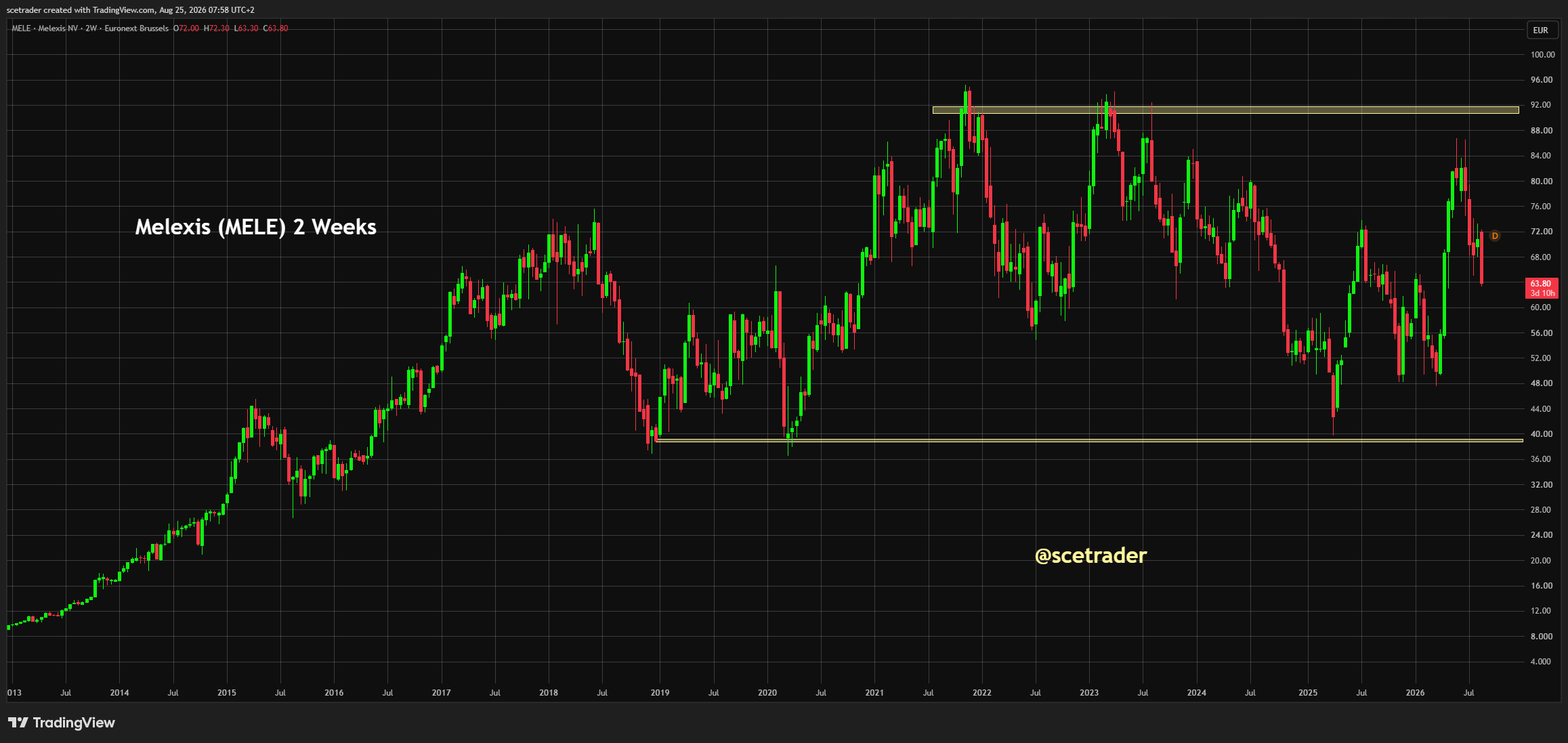
Our short-term Investment view is clearly positive. Melexis closed Monday at €64.50 and we believe direct supplier status with BYD is significant enough to trigger a positive initial reaction on Tuesday. The key point is not merely potential revenue from one existing programme, but the fact that Melexis is now directly embedded in BYD's procurement network. That could lower the threshold for additional design wins across future models and platforms.
With supportive overall market sentiment, we therefore see scope for further upside in the days following the initial reaction. Around €70 represents a logical first area that could be tested again. From Monday's €64.50 close, a move towards €70 would represent an increase of roughly 8.5%. That is substantial, but certainly not exceptional for a share that has continued to make large moves within its trading range.
This explicitly remains a trading scenario rather than a new long-term price target. Melexis still trades within an exceptionally broad annual range of approximately €49 to €87. Following Monday's close, the shares therefore remain around the middle of that range. Even a rally towards €70 would not materially change the larger technical picture.
That is the key distinction for us. We are positive for Tuesday and potentially the following trading days because of the combination of BYD, improving fundamentals and the possibility of renewed momentum buying. A genuinely new structural bull phase requires much more. Only if Melexis ultimately breaks convincingly above the top of the broad range around €87 and manages to remain above it would we regard the long-term picture as materially changed.
The direction is therefore clear: short-term positive, approximately €70 can return to view if sentiment remains supportive, but within the broad €49–€87 range this would still represent a rally rather than a structural breakout.
BYD is more than a single customer
The significance of the agreement mainly lies in BYD's scale and structure. A Master Purchase Agreement creates a framework under which future business can be conducted more efficiently and gives Melexis direct access to BYD's procurement organisation.
That matters for semiconductor suppliers. Automotive design wins often have long lifetimes and once a chip has been qualified in a vehicle platform, the supplier can benefit from production volumes for years. Successful cooperation in one application can also open the door to additional functions within the same vehicle architecture.
Melexis has a broad portfolio of sensors and drivers aligned with further vehicle electrification. The relationship with BYD therefore does not need to remain limited to one specific component or one generation of vehicles. That potential expansion makes direct supplier status more interesting than the revenue value of one individual programme.
China already matters far more to Melexis than many investors realise
The BYD agreement is not the beginning of a sudden China strategy. Melexis has been building its presence in China for more than two decades and has accelerated that strategy in recent years.
In 2024, 60% of total revenue came from Asia-Pacific and Greater China represented almost half of that. Melexis achieved design wins there across automotive powertrain, interior lighting, steering and braking. Since then, not only the commercial presence but also the supply chain has become increasingly localised.
From 2024 onwards, local semiconductor assembly and test capacity was established in China. A Chinese wafer manufacturing partner was subsequently added for products developed specifically for the local market. In 2026, Melexis took another step with a wholly owned Chinese entity and an end-to-end local supply chain.
This allows the company to operate more rapidly in a market where Chinese automakers tend to have much shorter development cycles than traditional European OEMs.
NIO had already demonstrated Melexis' access to Chinese EV platforms
BYD is also not the first major Chinese automaker with which Melexis has established a strategic relationship.
NIO selected Melexis in 2024 as a strategic supplier of current-sensor chips for the traction inverter systems of its battery-electric vehicles. These sensors precisely measure current flows within the drivetrain and are therefore important for both performance and safety.
That relationship matters because it demonstrates that Melexis' Chinese automotive position is not dependent on one new announcement. The company has already shown that its technology can qualify for advanced Chinese EV platforms.
BYD now adds substantially greater potential scale.
The numbers are finally moving in the right direction again
The timing of the agreement matters because Melexis' results are also beginning to recover.
Revenue in Q2 2026 was €217.1 million, 3% above the prior-year period and 7% higher than in Q1. Gross profit reached €87.9 million, corresponding to a 40.5% gross margin, while operating profit increased 16% sequentially to €38.6 million. The operating margin was 17.8%.
Revenue for the first six months reached €419.2 million. Melexis indicated that customer demand continued to recover and highlighted strong performance in position sensors, current sensors and motor drivers. Steering & braking and thermal management were also among the stronger applications.
Management is targeting €220–225 million of revenue for Q3. For the full second half, it expects €445–455 million of revenue, a gross margin of around 41% and an operating margin of approximately 18%.
This is not yet a return to peak growth rates, but the direction has clearly improved.
Automotive remains by far the main engine
Despite all the attention around new markets, Melexis remains fundamentally an automotive semiconductor company. Automotive applications represented 89% of revenue in Q2 2026.
That exposure has two sides. Electrification, ADAS, thermal management, steering and braking structurally increase semiconductor content per vehicle. A modern electric vehicle requires significantly more sensing and control than a traditional car, meaning Melexis can grow through higher content per vehicle even without strong overall automotive production growth.
At the same time, the company remains sensitive to automotive production cycles and customer inventories. That was precisely what created substantial pressure during the recent period as carmakers and Tier-1 suppliers reduced excessive semiconductor inventories.
The recent improvement is therefore important, but several stronger quarters are still needed before cyclicality can be dismissed.
Robotics could gradually reduce dependence on automotive
Alongside automotive, a second interesting growth market is emerging. Melexis has created a dedicated robotics team in China and is focusing more explicitly on sensing and drive solutions for robots.
Technologically, that makes sense. Robots need many of the same core technologies as electric vehicles: position sensing, current sensing, motor control, temperature management and accurate motion control. The more autonomous machines become, the more important it is that they can precisely measure both their environment and their own movement.
Melexis also reported new design wins and a rapidly growing pipeline around robotics and Physical AI in its Q2 update. These activities remain too small to displace automotive in the near term, but they could become a new structural market in which existing Melexis technology can be reused.
For investors, that is more attractive than a business completely dependent on global automotive production.
Local production in China could become strategically important
Further localisation of the Chinese supply chain is also important for competitiveness.
Chinese OEMs develop vehicles at high speed and expect suppliers to operate at similar pace. Shorter lead times, local engineering and local semiconductor production can therefore become commercial requirements rather than merely cost advantages.
Since 2024, Melexis has built local OSAT capacity and added a Chinese wafer partner. With its own Chinese entity, the company can now operate much closer to customers and organise a larger part of the development and supply process locally.
That can improve both development speed and the cost position and make the company a more attractive supplier to businesses such as BYD.
Further localisation also creates risks. China's automotive supply chain is intensely price competitive and local semiconductor companies are developing rapidly. Melexis therefore needs not only to win volume, but also to protect its technological differentiation and margins.
The agreement is strategically more important than immediate revenue
Melexis has not disclosed a specific revenue value for the BYD agreement. That does not necessarily reduce its significance.
An automotive semiconductor relationship usually develops through platforms and design wins. The relevant question is therefore not how much revenue is added immediately, but how many additional opportunities the new framework can open over the coming years.
If Melexis qualifies for multiple functions within BYD and that technology is subsequently used across multiple models, the economic value could eventually be far greater than that of one initial order.
Evidence is still required. Direct supplier status is an important strategic step, but it is not a guarantee of enormous new revenue.
The main risks remain cyclical and competitive
The automotive semiconductor cycle remains the principal near-term risk. Although demand is recovering, Melexis remains highly dependent on vehicle production and inventory management at customers.
Chinese pricing pressure is another important factor. BYD is known for strong vertical integration and intense cost discipline. A major customer can deliver high volumes, but additional volume is only attractive if Melexis can preserve adequate margins.
Currency also remains relevant. Movements in the euro against the dollar can affect reported revenue and profitability in either direction.
Finally, the company still needs to demonstrate that its new robotics opportunities genuinely convert into material revenue. A rapidly expanding opportunity pipeline is interesting, but design wins and eventual serial production determine the real economic value.
What needs to be proven fundamentally?
The main fundamental benchmark now lies in H2. Melexis expects €445–455 million of revenue and an operating margin of around 18%. Meeting or exceeding these targets would confirm that the automotive inventory correction is increasingly behind the company.
We also want to see the China strategy deliver more concrete design wins. BYD is an important step and NIO already provides evidence of existing penetration, but several large Chinese OEM platforms would make the story much more convincing.
Robotics is the third test. Opportunities are growing quickly, but ultimately these activities need to become visible in revenue. If Melexis can combine automotive recovery with a second structural growth engine, the fundamental case becomes substantially stronger.
Conclusion
Direct supplier status with BYD is important news for Melexis. It formalises a relationship with one of the world's largest EV manufacturers and fits within a China strategy that has been built over many years. At the same time, results are improving again, Melexis has already demonstrated access to Chinese EV platforms through NIO and robotics is emerging as an interesting new growth market.
For investors, the key point is that this news does not arrive in isolation. The company is operationally in better shape than at the low point of the automotive inventory correction and now receives a new commercial catalyst at a time when revenue and margins are already recovering.
The next phase still needs to be confirmed through the numbers. BYD ultimately needs to produce more design wins and revenue, the H2 recovery needs to continue and robotics must evolve from an attractive pipeline into real business. If those three elements come together, Melexis could finally build a foundation that is stronger than the usual cyclical rebound.
Disclaimer Aan de door ons opgestelde informatie kan op geen enkele wijze rechten worden ontleend. Alle door ons verstrekte informatie en analyses zijn geheel vrijblijvend. Alle consequenties van het op welke wijze dan ook toepassen van de informatie blijven volledig voor uw eigen rekening.
Wij aanvaarden geen aansprakelijkheid voor de mogelijke gevolgen of schade die zouden kunnen voortvloeien uit het gebruik van de door ons gepubliceerde informatie. U bent zelf eindverantwoordelijk voor de beslissingen die u neemt met betrekking tot uw beleggingen.

