Circle cijfers: USDC bereikt institutioneel kantelpunt - ARC maakt kwaliteit lastiger te lezen

■ De headlinecijfers zijn uitzonderlijk sterk, maar moeten worden genormaliseerd: Total revenue and reserve income steeg 17% naar $865 miljoen en diluted EPS kwam uit op $0,84. Adjusted EBITDA steeg 85% naar $317 miljoen, maar de $182 miljoen ARC-tokenpresale heeft een uitzonderlijk grote invloed op zowel omzet als winst.
■ Zonder ARC ziet het kwartaal er duidelijk minder spectaculair uit: Revenue and reserve income exclusief ARC bedraagt ongeveer $683 miljoen en adjusted EBITDA ongeveer $135 miljoen. Daarmee ligt de recurrentere winstcapaciteit onder het niveau van een jaar geleden, ondanks de zeer sterke headlinebeat.
■ Reserve income staat onder druk van lagere rente: Reserve income daalde 8% naar $658 miljoen, terwijl gemiddelde USDC-circulatie met 8% steeg naar $73,3 miljard. De reserve return rate daalde met 61 basispunten naar 3,54%, waardoor volumegroei de rentedaling nog niet kon compenseren.
■ USDC-supply groeit momenteel veel langzamer dan de langetermijndoelstelling: End-of-period circulation bedroeg $73,9 miljard en was vrijwel vlak op jaarbasis. Circle blijft echter mikken op ongeveer 40% CAGR door de cyclus heen, waardoor een duidelijke versnelling vanaf 2027 nodig is om de volledige bull case te bevestigen.
■ Het gebruik van USDC groeit veel sneller dan de supply: Onchain transaction volume steeg 49% naar $13,9 biljoen en Circle schat dat USDC ongeveer 79% van stablecoin transaction volume vertegenwoordigt bij slechts circa 27% van de relevante supply. Dat wijst op zeer diepe liquiditeit en hoge netwerkutility, maar niet iedere dollar onchainvolume wordt rechtstreeks gemonetiseerd.
■ CPN begint een serieuze tweede groeipijler te worden: Circle Payments Network bereikte $41,3 miljard annualized TPV, 15,2 keer zoveel als een jaar geleden en 2,8 keer zoveel als in Q2. Inmiddels zijn 205 financiële instellingen enrolled, waardoor de institutionele payment use case steeds geloofwaardiger wordt.
■ Tazapay kan de internationale paymentrails fors uitbreiden: De voorgenomen overname brengt meer dan $25 miljard annualized payment volume, meer dan 60 banking- en fintechpartners en payoutmogelijkheden in ruim 100 markten. Circa 60% van het bestaande volume gebruikt al stablecoins, waardoor de strategische aansluiting op CPN sterk is.
■ Arc is operationeel veel verder dan alleen de tokenpresale: Kort na mainnet stond ongeveer $1,5 miljard aan assets op Arc, was meer dan $30 miljard USDC-volume verwerkt en draaide het netwerk rond 500.000 transacties per dag. Meer dan 100 instellingen en apps zijn betrokken, waardoor Arc al vroege institutionele tractie laat zien.
■ ARC geeft Circle enorme optionaliteit maar maakt de resultaten grilliger: De initiële supply bedraagt 10 miljard tokens en Circle houdt zelf 25% daarvan. Token sales kunnen incidenteel veel omzet en EBITDA creëren, maar horen niet dezelfde waarderingsmultiple te krijgen als recurring reserve income, payments of software.
■ De GENIUS Act kan vanaf januari 2027 een structurele katalysator worden: Circle heeft zijn regulatory infrastructuur jaren vooruit opgebouwd en beschikt inmiddels over een federale trustbank onder OCC-toezicht. Een duidelijk federaal stablecoinkader kan de drempel voor banken en grote ondernemingen om USDC te gebruiken fors verlagen.
■ De Democratische overwinning bij de midterms is vooral een kortetermijnrisico voor sentiment: De Democraten controleren straks zowel Huis als Senaat, waardoor bredere crypto-deregulering en nieuwe marktstructuurwetgeving moeilijker kunnen worden. De stablecoinwetgeving waarop de Circle-case rust is echter al aangenomen en strengere regelgeving kan Circle relatief zelfs bevoordelen tegenover minder gereguleerde concurrenten.
■ De institutionele distributie wordt breder: Binance investeert $100 miljoen en verlengt de USDC-samenwerking, Samsung Wallet maakt internationale USDC-transfers mogelijk en Visa Direct gebruikt stablecoin-prefunding commercieel. Ook SAP-gerelateerde enterprise workflows, bankinfrastructuur en institutionele liquiditeitsrelaties vergroten de praktische utility van USDC.
■ Circle is breder dan alleen USDC: EURC-circulatie groeit sterk en USYC-assets zijn eveneens fors gestegen, terwijl het aantal meaningful USDC-wallets verder toeneemt. Daarmee ontstaat geleidelijk een bredere suite van gereguleerde digitale assets en treasuryproducten.
■ De balans is sterk, maar reserveassets mogen niet met corporate cash worden verward: Het grootste gedeelte van de circa $77,7 miljard activa is afgescheiden voor stablecoinhouders en staat tegenover vergelijkbare verplichtingen. De gewone corporate cash bedraagt ongeveer $1,7 miljard en de onderneming heeft nauwelijks traditionele financiële schuld.
■ Stock-based compensation en toekomstige dilution verdienen aandacht: Q3 SBC bedroeg ongeveer $43 miljoen, het aantal uitgegeven aandelen is gestegen en Tazapay wordt grotendeels met nieuwe aandelen betaald. Voor aandeelhouders moet de economische waarde daarom altijd per aandeel worden beoordeeld.
■ Investment View: Wij zien Circle over de komende jaren op een veel hogere koers wanneer USDC, CPN en Arc samen uitgroeien tot een wereldwijde financiële infrastructuurlaag. Op korte termijn wachten wij echter af omdat ARC de kwartaalwinst sterk vertekent, USDC-supply opnieuw moet versnellen en de Democratische midtermsoverwinning extra politieke volatiliteit kan veroorzaken. Wanneer de recurrente platformgroei sterker wordt en eventuele correcties de waardering aantrekkelijker maken, zien wij juist nieuwe kansen.
Investment View
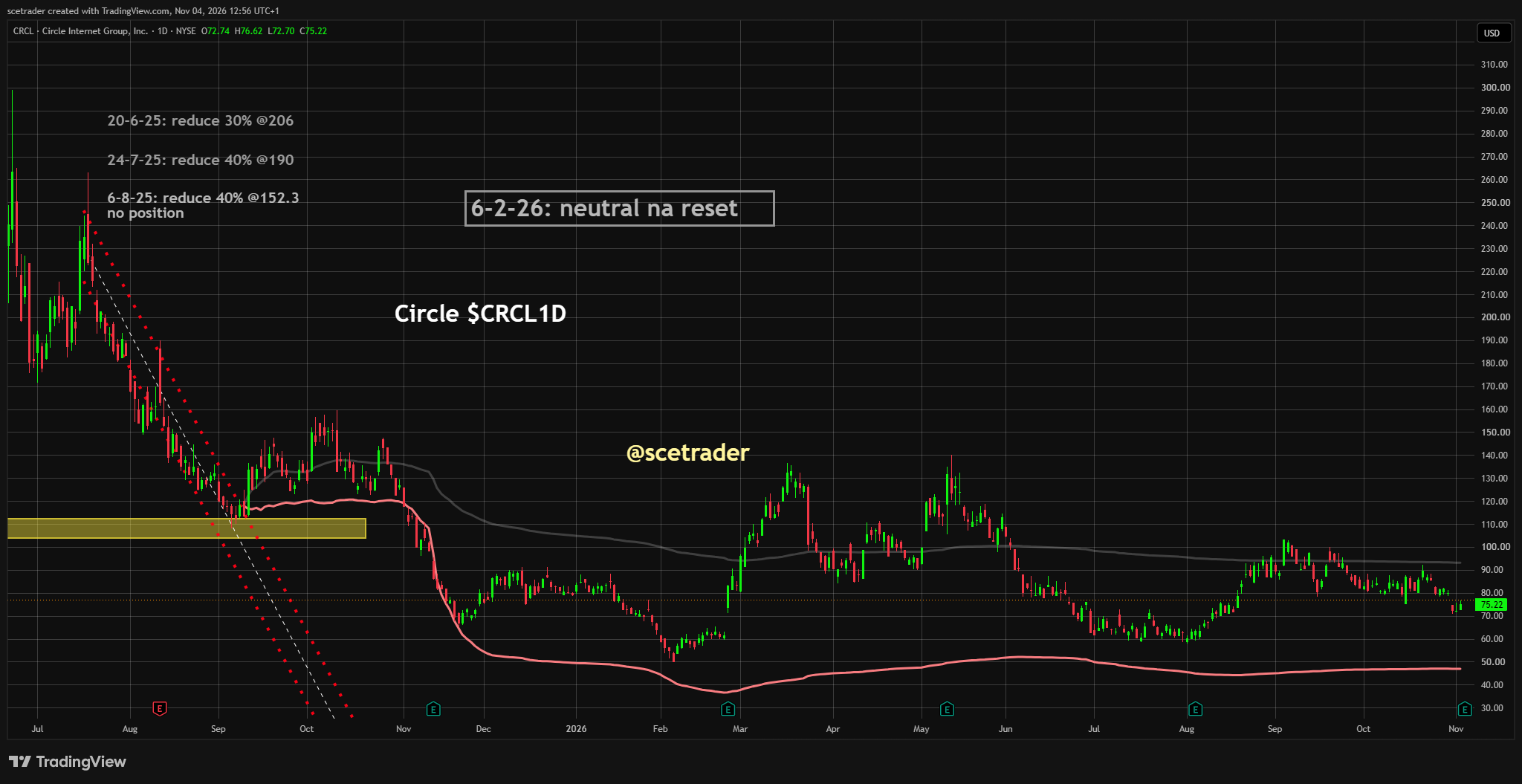
Circle bevindt zich naar onze mening op een strategisch kantelpunt. De onderneming begint zich te ontwikkelen van een stablecoin issuer waarvan de winst hoofdzakelijk wordt bepaald door rente op reserves naar een veel bredere financiële infrastructuurspeler rond digitale dollars, internationale betalingen, institutionele settlement, blockchaininfrastructuur, tokenized assets en uiteindelijk mogelijk zelfs machine-to-machine commerce. Wanneer Circle deze verschillende lagen daadwerkelijk weet te verbinden, zien wij over de komende jaren ruimte voor een veel hogere koers dan vandaag.
■ Onze lange termijn bull case draait vooral om het mogelijke vliegwiel tussen USDC, Circle Payments Network en Arc. Meer USDC creëert liquiditeit, meer CPN-gebruik brengt instellingen en betalingen naar het ecosysteem en meer activiteit op Arc kan vervolgens opnieuw vraag naar USDC en Circle-diensten creëren.
■ Voor de korte termijn zijn we duidelijk terughoudender. De ARC-tokenpresale maakt Q3 optisch veel sterker dan de recurrente kernactiviteiten werkelijk waren, terwijl lagere rente nog steeds druk zet op reserve income en de Democratische overwinning bij de midterms extra onzekerheid creëert rond de bredere Amerikaanse cryptoregelgeving.
■ We willen vooral zien dat USDC-circulatie opnieuw versnelt, CPN-volume uiteindelijk ook substantiële transaction revenue oplevert en Arc organisch blijft groeien zonder afhankelijk te worden van grote tokenverkopen. Wanneer die bevestiging komt, kunnen correcties juist aantrekkelijke momenten worden om de meerjarige bull case te spelen.
Het belangrijkste verschil met Circle van een jaar geleden is dat de onderneming steeds meer echte infrastructuur rondom USDC bouwt. USDC zelf heeft al diepe liquiditeit, maar CPN, Arc, Circle National Trust en Tazapay geven het bedrijf steeds meer controle over de betaal-, settlement- en custodylaag die rondom die digitale dollar ligt. Daardoor ontstaat een route naar inkomsten die minder rechtstreeks afhangen van de hoogte van de Amerikaanse beleidsrente.
Dat is voor ons essentieel, omdat de huidige reservebusiness zeer rentegevoelig blijft. Q3 laat precies zien hoe kwetsbaar het bestaande model daarvoor is. Gemiddelde USDC-circulatie groeide, maar de lagere reserve yield was voldoende om de reserve income alsnog te laten dalen.
De beste versie van de Circle-case is daarom niet simpelweg dat USDC veel groter wordt. De echte upside ontstaat wanneer meer USDC tegelijkertijd veel meer activiteiten binnen Circle-eigen netwerken creëert, waardoor het bedrijf payments fees, software-inkomsten, network economics en mogelijk staking revenue kan verdienen. Op dat moment kan de waardering verschuiven van een rentegevoelige financial naar een financieel infrastructuurplatform.
De midterms veranderen deze lange termijn visie niet fundamenteel. Democratische controle van beide kamers betekent waarschijnlijk meer toezicht, meer politieke gridlock en minder ruimte voor aanvullende crypto-deregulering. De cruciale stablecoinwetgeving is echter al aangenomen en de definitieve regels liggen vast, waardoor de belangrijkste regulatorische katalysator voor USDC niet opnieuw door het Congres hoeft.
Dat kan zelfs een relatief voordeel voor Circle opleveren. Banken en grote ondernemingen zullen naarmate de regels strenger worden waarschijnlijk meer waarde hechten aan federale supervisie, betrouwbare reserve-infrastructuur, auditability, compliance en bewezen redemptionmechanismen. Circle heeft hier jarenlang in geïnvesteerd en kan daardoor beter gepositioneerd zijn dan veel offshore of minder gereguleerde concurrenten.
Wij zouden op korte termijn desondanks niet automatisch achter een sterke earningsreactie aanlopen. De markt moet eerst normaliseren hoeveel van Q3 werkelijk recurring is en hoeveel uit ARC komt. Daarnaast willen we zien hoe crypto-gerelateerde aandelen de nieuwe politieke machtsverhoudingen verwerken voordat we veel gewicht geven aan de eerste koersreactie.
Cijfers en outlook
Circle rapporteerde Q3 total revenue and reserve income van $864,9 miljoen, tegenover $739,8 miljoen een jaar eerder. Dat is ongeveer 17% groei en ligt duidelijk boven de consensus die vooraf in de markt lag.
Reserve income bedroeg $657,6 miljoen en Other Revenue kwam uit op $207,3 miljoen. Het enorme verschil met eerdere kwartalen wordt vooral veroorzaakt door $182 miljoen ARC-token revenue, waardoor Other Revenue meer dan zeven keer zo hoog ligt als een jaar geleden.
Net income from continuing operations bedroeg $226,0 miljoen, ongeveer 5% meer dan vorig jaar. Diluted EPS steeg van $0,64 naar $0,84, waardoor de onderneming ook op GAAP-basis hogere winst rapporteert.
Adjusted EBITDA kwam uit op $316,7 miljoen, tegenover $171,5 miljoen in Q3 2025. Op headlinebasis is dat een stijging van ongeveer 85%, maar deze vergelijking is zonder correctie voor de ARC-tokenpresale niet representatief voor de recurrente winstontwikkeling.
Adjusted operating expenses bedroegen $138,8 miljoen, ongeveer 13% hoger dan vorig jaar. Circle blijft dus fors investeren, zelfs terwijl het een personeelsreductie doorvoert en bepaalde activiteiten herstructureert.
ARC vertekent de winstkwaliteit
De eigen presentatie van Circle laat precies zien hoeveel effect de tokenpresale heeft. Exclusief ARC-token sales bedraagt total revenue and reserve income ongeveer $683 miljoen in plaats van $865 miljoen.
Ook RLDC verandert volledig. Reported RLDC bedraagt $453 miljoen en de margin 52,4%, maar zonder ARC resteert ongeveer $271 miljoen en een margin van circa 39,7%.
Dat is vrijwel gelijk aan de 39,5% van vorig jaar. De spectaculaire reported marge-expansie is dus grotendeels een boekhoudkundig gevolg van een tokenverkoop met zeer andere economics dan de normale reservebusiness.
Adjusted EBITDA laat hetzelfde patroon zien. Reported komt het cijfer uit op $317 miljoen, maar exclusief ARC blijft ongeveer $135 miljoen over.
Een jaar eerder bedroeg adjusted EBITDA ongeveer $171 miljoen. Op een recurrentere basis is de winst dus duidelijk lager, ook al zijn de headlinecijfers uitzonderlijk sterk.
Dat maakt Q3 geen slecht kwartaal. Circle heeft echte economische waarde uit Arc gerealiseerd, maar een institutionele waardering moet event-driven token revenue afzonderlijk behandelen van inkomsten die ieder kwartaal opnieuw kunnen worden verdiend.
Core Other Revenue moet nog veel groter worden
Zonder ARC bedraagt Other Revenue slechts ongeveer $25 miljoen. Daarvan komt circa $20 miljoen uit subscriptions and services en ongeveer $5 miljoen uit transaction revenue.
Een jaar eerder bedroeg core Other Revenue ongeveer $29 miljoen. Dat betekent dat de enorme groei van CPN, Arc en andere nieuwe producten nog nauwelijks zichtbaar is in recurrente fee-based revenue.
Dit is één van de belangrijkste punten in de hele Circle-case. Strategisch is de onderneming veel breder geworden, maar financieel blijft de reservebusiness nog altijd verreweg dominant.
Dat creëert tegelijkertijd upside. Wanneer CPN, Arc, custody en andere diensten in 2027 en 2028 daadwerkelijk beginnen te monetiseren, kan Other Revenue vanuit een relatief lage basis veel sneller groeien dan de totale onderneming.
De guidance moet eveneens worden genormaliseerd
Circle handhaaft voor FY2026 Other Revenue van $310 miljoen tot $330 miljoen. Na negen maanden bedraagt Other Revenue al ongeveer $282 miljoen en daarvan bestaat $182 miljoen uit ARC.
Dat impliceert voor Q4 nog maar ongeveer $28 miljoen tot $48 miljoen Other Revenue. Management modelleert dus duidelijk geen tweede tokenverkoop van vergelijkbare omvang in het laatste kwartaal.
De FY2026 RLDC-margin guidance blijft 41,7% tot 43,7%. Ook die range bevat het positieve effect van de reeds gerealiseerde ARC-token revenue.
Adjusted operating expenses worden nog altijd geraamd op $570 miljoen tot $585 miljoen. Circle blijft daarmee zwaar investeren in payments, Arc, infrastructuur, compliance en internationale expansie.
Reserve income blijft het economische hart
Reserve income bedroeg $658 miljoen en daalde 8% op jaarbasis. De gemiddelde USDC-circulatie steeg juist 8% naar $73,3 miljard.
De verklaring zit volledig in de rente. De gemiddelde reserve return rate bedroeg 3,54%, tegenover ongeveer 4,15% een jaar geleden.
Een daling van 61 basispunten was daardoor voldoende om de groei van het gemiddelde USDC-volume volledig te neutraliseren. Dit is het duidelijkste bewijs dat Circle voorlopig nog sterk afhankelijk is van de renteomgeving.
End-of-period USDC circulation bedroeg $73,9 miljard. Dat was vrijwel gelijk aan een jaar geleden en slechts beperkt boven het niveau aan het einde van Q2.
De 40%-CAGR-doelstelling legt de lat hoog
Circle blijft mikken op ongeveer 40% CAGR in USDC circulation door de cyclus heen. De ontwikkeling in 2026 ligt daar momenteel ver onder.
USDC eindigde 2025 rond $75,3 miljard, liep in Q1 2026 op naar ongeveer $77 miljard en zakte daarna terug richting $73 miljard tot $74 miljard. Er is dus nog geen duidelijke nieuwe versnelling zichtbaar.
Dat hoeft de meerjarige doelstelling niet onmogelijk te maken. Regulatorische duidelijkheid, payment adoption en nieuwe institutionele integraties kunnen later een veel steilere groeifase veroorzaken.
De markt zal die versnelling echter willen zien. Een waardering die een 40%-CAGR-verhaal weerspiegelt kan niet jarenlang worden gedragen door een circulating supply die vrijwel vlak blijft.
Lagere rente blijft een directe tegenwind
Circle verdient rente op de reserves die USDC ondersteunen. Lagere korte rentes vertalen zich daarom vrijwel rechtstreeks naar een lagere reserve yield.
De onderneming heeft twee manieren om dat op te vangen. USDC-supply kan veel sneller groeien of Circle kan steeds meer omzet genereren uit activiteiten die niet rechtstreeks van rente afhangen.
Op korte termijn blijft de Federal Reserve daardoor relevant voor de winst. Een snellere rentedaling zonder voldoende USDC-groei kan reserve income nog verder onder druk zetten.
Op langere termijn moet het platformmodel dit risico verkleinen. Wanneer payments, Arc, custody en andere diensten een groter aandeel van de winst leveren, wordt Circle veel minder afhankelijk van één macrovariabele.
Net reserve margin laat wel verbetering zien
De net reserve margin bedroeg ongeveer 37,8%, tegenover circa 37,1% vorig jaar. Dat betekent dat Circle ondanks de lagere rente een iets groter gedeelte van de bruto reserve economics zelf wist te behouden.
Distribution and transaction costs daalden naar ongeveer $409 miljoen, tegenover $447 miljoen vorig jaar. Daardoor compenseerde de kostenzijde een gedeelte van de lagere reserve income.
Dit is belangrijk omdat niet alleen de omvang van USDC telt. De verdeling van de reserve economics tussen Circle en zijn distributiepartners bepaalt uiteindelijk hoeveel waarde voor aandeelhouders overblijft.
Wanneer USDC straks opnieuw hard groeit en de net reserve margin stabiel blijft of verder stijgt, kan de winst veel sneller toenemen. Wanneer partners een steeds groter gedeelte opeisen, wordt de economische waarde van extra supply aanzienlijk kleiner.
Coinbase blijft een cruciale economische partner
Ongeveer 31% van de USDC-supply stond aan het einde van Q3 op Coinbase. Een jaar eerder was dat ongeveer 24%, waardoor de relatieve afhankelijkheid van Coinbase als distributiekanaal juist is toegenomen.
Circle zelf hield ongeveer 19% op platform, tegenover 14% vorig jaar. Het off-platform gedeelte daalde van ongeveer 62% naar 50%.
De Coinbase-overeenkomst is economisch zeer belangrijk. Coinbase ontvangt een vergoeding op basis van USDC dat op zijn platform staat en ontvangt daarnaast een deel van de economics uit de bredere groei van het ecosysteem.
Dat heeft USDC geholpen om enorme liquiditeit en distributie op te bouwen, maar betekent ook dat Circle niet de volledige reserve economics zelf houdt. De relatie is daardoor tegelijkertijd een moat en een structurele margedeling.
Meer distributie kan winst én kosten verhogen
Circle wil naast Coinbase juist meer distributiepartners toevoegen. Binance is daar het duidelijkste nieuwe voorbeeld van.
Meer distributie is strategisch positief omdat USDC daardoor op meer exchanges, wallets, paymentrails en markten beschikbaar komt. Dat kan circulation en utility versnellen.
Nieuwe partners hebben echter onderhandelingsmacht en distribution expense kan daardoor eveneens stijgen. Circle waarschuwt zelf dat nieuwe distributieovereenkomsten andere economische voorwaarden kunnen hebben.
De juiste KPI is daarom niet alleen hoeveel USDC wordt uitgegeven. Het gaat om hoeveel netto economics Circle per dollar circulating supply weet te behouden.
De liquiditeitsmoat wordt steeds sterker
In Q3 werd ongeveer $104 miljard USDC gemint en ongeveer hetzelfde bedrag redeemed. Het totale primaire mint-and-redeem volume bedroeg daarmee circa $208 miljard.
Dat was 42% hoger dan een jaar geleden en ongeveer $2,3 miljard per dag. Over de eerste negen maanden van 2026 liep het volume al op naar ongeveer $523 miljard.
Deze liquiditeit is institutioneel zeer belangrijk. Grote banken, asset managers en payment companies willen digitale dollars op grote schaal kunnen creëren en terugwisselen zonder enorme spreads of settlementrisico.
Hoe dieper de primary liquidity, hoe aantrekkelijker USDC wordt voor nieuwe deelnemers. Dat creëert een netwerkvoordeel dat moeilijker te repliceren wordt naarmate het ecosysteem groeit.
Gebruik groeit veel harder dan supply
USDC onchain transaction volume kwam uit op $13,9 biljoen, 49% meer dan vorig jaar. De totale circulating supply groeide daarentegen nauwelijks.
Circle berekent dat iedere USDC in Q3 ongeveer 190 keer is verplaatst. Volgens de onderneming ligt dat ongeveer tien keer hoger dan bij USDT.
USDC vertegenwoordigde naar schatting ongeveer 79% van het stablecoin transaction volume, terwijl het slechts circa 27% van de relevante stablecoin supply vertegenwoordigde.
Dat is een sterke aanwijzing dat USDC zeer liquide en veel gebruikt is als settlementasset. Het is echter geen bewijs dat Circle iedere transactie monetiseert.
Onchain volume is geen merchant payment volume
De $13,9 biljoen komt uit unadjusted onchain data. Daar zitten exchange flows, DeFi, treasury transfers, arbitrage en andere financiële transacties in.
We moeten dit daarom niet presenteren alsof consumenten en bedrijven voor $13,9 biljoen aan goederen en diensten hebben gekocht. Het cijfer meet vooral de hoeveelheid activiteit die door USDC beweegt.
Voor echte payment adoption vinden wij CPN daarom veel belangrijker. Dat netwerk is specifiek gebouwd rond institutionele pay-ins, payouts, treasury management en andere betaalstromen.
De combinatie van diepe onchain liquiditeit en groeiende echte betalingsinfrastructuur is echter krachtig. USDC heeft hierdoor zowel een crypto-native als een traditionele financiële use case.
USDC verliest nog steeds supply market share
Circle rapporteert een stablecoin supply market share van ongeveer 27%. Dat is 183 basispunten lager dan een jaar geleden.
De totale relevante stablecoinmarkt bedraagt ongeveer $274 miljard. Daarmee groeit USDC momenteel niet sneller dan de markt wanneer alleen circulating supply wordt bekeken.
Dit vormt een belangrijke tegenhanger van de sterke usage-statistieken. Het netwerk is zeer actief, maar die activiteit heeft nog niet geleid tot stijgend supply market share.
De GENIUS Act kan hier vanaf 2027 verandering in brengen. Institutionele klanten kunnen gereguleerde stablecoins veel makkelijker gaan gebruiken wanneer het juridische kader volledig operationeel wordt.
Meaningful wallets blijven groeien
Het aantal meaningful USDC-wallets kwam uit op ongeveer 7,3 miljoen, 16% meer dan een jaar geleden. Circle definieert deze wallets als onchain wallets met meer dan $10 USDC.
Dit is geen perfect gebruikerscijfer omdat één persoon of onderneming meerdere wallets kan beheren. Toch geeft het een nuttige indicatie dat de basis van echte USDC-houders verder groeit.
Naast circulating supply willen wij daarom ook wallets, mint-and-redeem activity en payment volume blijven volgen. Geen enkele KPI geeft op zichzelf een volledig beeld van adoption.
Wanneer alle indicatoren tegelijk versnellen, wordt de bull case veel overtuigender. Op dit moment is vooral usage sterk en supply nog te vlak.
EURC begint relevanter te worden
EURC-circulatie bedroeg ongeveer €413 miljoen en groeide 92% op jaarbasis. Circle noemt EURC inmiddels de grootste euro-stablecoin.
De absolute omvang blijft klein tegenover USDC. Toch laat de sterke groei zien dat Circle zijn infrastructuur ook naar andere gereguleerde valuta kan uitbreiden.
Dat kan vooral belangrijk worden voor Europese payments en treasury management. Een internationaal betalingsnetwerk heeft uiteindelijk meer nodig dan alleen digitale dollars wanneer klanten valutarisico willen beperken.
EURC is daarom nog geen materiële winstbron, maar wel relevante strategische optionaliteit. Het versterkt de positionering van Circle als issuer van gereguleerde digitale geldinstrumenten in plaats van alleen USDC.
USYC verbreedt de assetlaag
USYC assets bedroegen ongeveer $2,4 miljard en lagen circa 230% hoger dan een jaar eerder. Het product geeft bepaalde niet-Amerikaanse institutionele gebruikers toegang tot een tokenized money-market instrument.
Dat brengt Circle dichter naar tokenized capital markets. De onderneming kan hierdoor naast stablecoins ook andere gereguleerde financiële assets binnen hetzelfde ecosysteem aanbieden.
USYC kan bovendien extra activiteit richting Arc en institutional custody brengen. De waarde zit daarmee niet alleen in directe productomzet, maar ook in de bredere netwerkutility.
Samen met USDC en EURC ontstaat langzaam een echte digital-assets suite. Dat helpt de Circle-platformstrategie veel breder te maken dan één stablecoin.
CPN is één van de belangrijkste bull-case signalen
Circle Payments Network bereikte $41,3 miljard annualized TPV. Dat is 15,2 keer zoveel als een jaar geleden en 2,8 keer het niveau van Q2.
Het aantal enrolled financiële instellingen steeg naar 205. Dat is ruim vier keer zoveel als een jaar eerder.
CPN verbindt stablecoin pay-ins, payouts, managed payments en treasury management met banken en payment providers. Daarmee probeert Circle een directe concurrent of complement te worden voor bestaande internationale money-movement rails.
Voor de waardering is dat belangrijk. Een succesvol betalingsnetwerk verdient structureel een heel andere multiple dan een onderneming die alleen rente op reserves verdient.
CPN heeft nog nauwelijks monetisatie
Ondanks de spectaculaire TPV-groei bedroeg transaction revenue in Q3 slechts ongeveer $5 miljoen. Dat is een belangrijke realiteitscheck.
Circle kiest waarschijnlijk bewust voor snelle netwerkadoptie voordat het de volledige economics probeert te maximaliseren. Dat kan strategisch verstandig zijn omdat paymentsnetwerken sterker worden naarmate meer partijen meedoen.
Voor aandeelhouders moet de monetisatie uiteindelijk wel volgen. Een netwerk met enorme volumes maar zeer weinig revenue kan niet onbeperkt dezelfde platformmultiple rechtvaardigen.
2027 wordt daarom een belangrijk jaar. We willen zien dat CPN niet alleen meer dollars verwerkt, maar ook steeds meer recurrente Other Revenue genereert.
Treasury management kan CPN verdiepen
Circle heeft CPN uitgebreid met treasury management voor ondernemingen. Bedrijven kunnen daarmee USDC en EURC tussen dochterondernemingen en counterparties bewegen via bekende enterpriseplatforms.
Dat maakt stablecoins veel relevanter voor CFO's en treasuryteams dan alleen voor crypto trading. Cash kan sneller tussen landen en entiteiten worden verplaatst en settlement kan buiten traditionele bankuren plaatsvinden.
De integratie met enterpriseplatforms vergroot de kans dat stablecoins in normale bedrijfsprocessen worden ingebouwd. Dat is precies het soort usage dat minder afhankelijk is van cryptomarktsentiment.
Wanneer deze use cases opschalen, kan CPN veel stabielere volumes genereren dan exchange-gerelateerde flows. Voor de kwaliteit van de earnings zou dat zeer positief zijn.
Tazapay vult de internationale last mile in
Tazapay verwerkt meer dan $25 miljard annualized payment volume. De onderneming beschikt over meer dan 60 banking- en fintechpartners en lokale payoutmogelijkheden in meer dan 100 markten.
Ongeveer 60% van het huidige volume bevat al stablecoins. Circle hoeft de klanten daardoor niet eerst volledig te overtuigen van digitale settlement voordat de acquisitie strategische waarde krijgt.
De belangrijkste toevoeging is lokale fiatconnectiviteit. Een internationale USDC-payment is pas compleet wanneer de ontvanger eenvoudig lokale valuta kan ontvangen.
Tazapay geeft Circle daarom veel meer controle over het volledige traject van oorsprong tot payout. Dat kan CPN aantrekkelijker maken voor payment service providers, banken en grote ondernemingen.
De Tazapay-prijs veroorzaakt dilution
Circle betaalt ongeveer $400 miljoen in Class A-aandelen voor Tazapay. De deal verbruikt daardoor weinig corporate cash, maar verhoogt wel het aantal aandelen.
Dat kan economisch verstandig zijn wanneer de gekochte infrastructuur veel sneller groeit dan Circle hem zelfstandig zou kunnen bouwen. Lokale licenses, bankrelaties en payout rails zijn moeilijk en tijdrovend om per land op te zetten.
De return moet uiteindelijk per aandeel worden gemeten. Meer omzet is niet genoeg wanneer de share count bijna even snel groeit.
Wij vinden de strategische fit sterk. De financiële accretie moet de komende jaren nog worden bewezen.
Visa brengt stablecoinpayments naar commerciële productie
Visa heeft stablecoin-prefunding voor Visa Direct van pilots naar commerciële deployment gebracht. Inyo Global maakt het daarbij mogelijk om bepaalde cross-border payouts met USDC voor te financieren.
Visa Direct bereikt meer dan 180 landen. Daarmee krijgt USDC toegang tot een bestaand wereldwijd betalingsnetwerk in plaats van dat Circle iedere corridor zelfstandig moet opbouwen.
Dit soort samenwerkingen is strategisch belangrijk omdat het stablecoins onzichtbaar in bestaande financiële workflows kan integreren. De eindgebruiker hoeft niet eens noodzakelijk te weten dat een gedeelte van settlement via USDC loopt.
Voor Circle kan dit veel belangrijker zijn dan consumenten die expliciet met crypto willen betalen. Embedded stablecoin settlement kan veel grotere volumes bereiken wanneer het economisch goedkoper en sneller blijkt.
Samsung Wallet vergroot consumentendistributie
Samsung Wallet maakt het voor bepaalde Amerikaanse Galaxy-gebruikers mogelijk om geld via USDC naar bankrekeningen in meer dan 60 landen te versturen. De ontvanger krijgt de betaling vervolgens in lokale valuta.
Dit is een concreet voorbeeld van hoe stablecoins kunnen functioneren als onderliggende rail zonder dat de ontvanger zelf USDC hoeft te houden. Daarmee wordt het product veel toegankelijker voor normale consumenten.
De schaal van Samsung geeft Circle een enorm potentieel distributiekanaal. Niet iedere gebruiker zal de functie gebruiken, maar de technische integratie verlaagt de drempel aanzienlijk.
Het is bovendien aanvullend op CPN. Circle kan zowel institutionele backendpayments als consumentenproducten bedienen zonder voor iedere use case een volledig nieuw netwerk te bouwen.
Enterprise-integraties worden steeds relevanter
Tereina, een door SAP ondersteunde onderneming, integreert USDC en EURC in enterprise paymentinfrastructuur en workflows. Dit brengt digitale valuta dichter bij systemen die ondernemingen dagelijks gebruiken voor finance en treasury.
Volante Technologies werkt eveneens met Circle om financiële instellingen stablecoinpayment- en settlementmogelijkheden te laten integreren in bestaande betaalactiviteiten.
Allaria vergroot ondertussen institutionele USDC-liquiditeit en toegang in Argentinië. Voor emerging markets kan dollarliquiditeit een bijzonder sterke use case zijn wanneer lokale valuta instabieler zijn.
Individueel zijn dit geen activiteiten die vandaag honderden miljoenen omzet toevoegen. Gezamenlijk laten ze wel zien dat USDC steeds vaker in bestaande financiële infrastructuur wordt ingebouwd.
Binance wordt een tweede grote distributiehefboom
Binance investeert $100 miljoen rechtstreeks in Circle en heeft de strategische USDC-overeenkomst voor vijf jaar verlengd. Dat is een duidelijke commerciële endorsement van het product.
Binance heeft meer dan 300 miljoen geregistreerde gebruikers en volgens de onderneming bevindt ongeveer 77% daarvan zich in emerging markets. Juist daar kan de vraag naar dollars en cross-border settlement zeer groot zijn.
Dit kan USDC-distributie buiten de Verenigde Staten versnellen. In combinatie met Tazapay ontstaat een duidelijke emerging-marketsstrategie waarin Binance gebruikers en liquiditeit brengt terwijl Tazapay lokale payoutmogelijkheden toevoegt.
De economics moeten wel worden gevolgd. Net als Coinbase zal een grote distributeur waarde voor zichzelf willen behouden, waardoor snelle adoption niet automatisch tot even snelle margegroei leidt.
Chelsea vergroot vooral merkbekendheid
Circle is principal partner van Chelsea en USDC verschijnt op shirts van de mannen-, vrouwen- en academyteams. Het partnerschap geeft Circle blootstelling aan een wereldwijd sportpubliek.
Dit is vooral een brand- en awareness-investering en geen directe fundamentele earnings driver. Toch is consumentenvertrouwen belangrijk voor een digitaal geldproduct en kan wereldwijde zichtbaarheid de merkpositie ondersteunen.
Voor ons krijgt deze samenwerking veel minder gewicht dan CPN, Tazapay of Visa. De marketingcase is ondersteunend, maar niet bepalend voor de waardering.
Het is wel illustratief voor de ambitie om USDC buiten de cryptosector als wereldwijd digitaal dollarmerk neer te zetten. Circle wil niet alleen infrastructuur zijn, maar ook een herkenbaar financieel merk.
Arc is daadwerkelijk live en groeit snel
Arc public mainnet ging op 16 september live. Eind oktober stond ongeveer $1,5 miljard aan assets op het netwerk.
Daarvan bestond ongeveer $1,1 miljard uit USDC, circa $410 miljoen uit cirBTC en ongeveer $10 miljoen uit EURC. Sinds launch was meer dan $30 miljard USDC-volume verwerkt.
Het netwerk draaide rond 500.000 transacties per dag en had al meer dan 50 miljoen transacties verwerkt. Over de meest recente week liep het volume volgens Circle rond $1 miljard per dag.
Dat is een sterke start voor een nieuw Layer-1 netwerk. De uitdaging is nu om te bewijzen dat de activiteit blijft groeien nadat de initiële launchfase en tokenincentives normaliseren.
Arc heeft meteen institutionele integraties
Onder de betrokken banken bevinden zich BNY, HSBC, Société Générale en State Street. Bij payments zijn onder meer Mastercard, Visa, JCB en MoneyGram betrokken.
Exchanges zoals Binance, Bybit, Coinbase, Kraken en OKX zijn eveneens aangesloten. Aan de assetkant noemt Circle onder andere BUIDL, USYC, Bitwise en Janus Henderson.
DeFi-platforms zoals Aave, Morpho en Uniswap vormen een andere laag. Daardoor ontstaat direct een combinatie van traditionele financiële instellingen en crypto-native infrastructuur.
Dat is precies de positionering die Circle met Arc zoekt. Het netwerk moet geen puur speculatieve blockchain worden, maar een settlementlaag waarop institutionele finance en onchain applications elkaar ontmoeten.
De recente Arc-use cases zijn relevant
Coinbase is live met Arc op exchange- en walletniveau. Extended heeft perpetual settlement naar Arc verplaatst en Aster biedt USDC-quoted perpetuals.
xStocks brengt tokenized aandelen en ETF's naar het netwerk. Dat is interessant omdat tokenized securities één van de grootste toekomstige onchainmarkten kunnen worden.
Circle werkt daarnaast aan aparte sectors voor privacy, high-volume payments en AI agents. De payment sector heeft als doel meer dan 100.000 transacties per seconde te kunnen verwerken.
Deze roadmap is ambitieus en nog niet volledig operationeel. Ze laat wel zien dat Arc gericht is op specifieke financiële workloads en niet alleen als algemene smart-contractchain wordt gepositioneerd.
De Arc-flywheel is de kern van de platformcase
Circle wil drie netwerken elkaar laten versterken. Digital Assets levert gereguleerd digitaal geld en assets, Circle Apps brengt instellingen en betalingen samen en Arc zorgt voor programmeerbare settlement.
Meer USDC-adoptie vergroot de liquiditeit die beschikbaar is voor CPN en Arc. Meer CPN-members brengen vervolgens extra payments en transacties richting Arc.
Meer Arc-apps en assets creëren opnieuw vraag naar USDC als settlementasset. Zo kan een zichzelf versterkend netwerk ontstaan waarin iedere nieuwe gebruiker, builder en asset de andere onderdelen waardevoller maakt.
Wanneer dit werkelijk werkt, verandert Circle fundamenteel. Dan verdient de onderneming niet alleen rente op stablecoinreserves, maar bezit het een steeds groter gedeelte van de infrastructuur waarlangs digitaal geld beweegt.
De ARC-tokenpresale moet afzonderlijk worden gewaardeerd
Circle heeft in totaal 807,5 miljoen ARC-tokens aan institutionele investeerders verkocht tegen $0,30 per token. Dat impliceerde een volledig verwaterde netwerkwaardering van ongeveer $3 miljard en bruto proceeds van circa $242 miljoen.
In Q3 werd $182 miljoen daarvan als omzet herkend. Deze boekhoudkundige verwerking verklaart het grootste gedeelte van de enorme stijging van Other Revenue.
Token sales zijn volgens Circle event-based. Ze kunnen dus later opnieuw opbrengsten creëren, maar zijn niet vergelijkbaar met een jaarlijks terugkerende abonnements- of paymentfee.
Voor onze waardering zouden we reported EBITDA en EBITDA exclusief token sales daarom altijd naast elkaar blijven zetten. Alleen zo blijft zichtbaar hoe de recurrente kernactiviteiten zich werkelijk ontwikkelen.
Circle bezit nog 25% van ARC
De initiële ARC-supply bedraagt 10 miljard tokens. Circle houdt 2,5 miljard tokens en bezit daarmee 25% van de initiële supply.
Deze positie kan zeer waardevol worden wanneer Arc op grote schaal wordt gebruikt. Tegelijk mag de theoretische tokenwaarde niet simpelweg als harde corporate asset worden gezien.
Tokenprijs, liquiditeit, lockups, governance en regelgeving kunnen de economische waarde sterk beïnvloeden. Bovendien worden Circle's eigen holdings pas financieel herkend wanneer ze worden verkocht of gedistribueerd.
Wij behandelen deze positie daarom als grote optionaliteit. De kernwaardering moet vooral worden gedragen door de infrastructuur en recurrente cashflows die Arc uiteindelijk kan creëren.
De ARC-contracten bevatten echte uitvoeringsrisico's
De presalecontracten bevatten repayment rights wanneer bepaalde voorwaarden niet worden gehaald. Een belangrijk voorbeeld is dat Arc uiterlijk op 8 mei 2028 moet zijn overgestapt op Proof of Stake of delegated Proof of Stake.
Ook problemen rond levering, juridische voorwaarden of compliance kunnen contractuele terugbetalingsrechten activeren. Dat betekent dat de economische risico's niet verdwenen zijn alleen omdat een deel van de omzet al is geboekt.
De verkochte tokens hebben bovendien lockupvoorwaarden. Dat helpt voorkomen dat alle presaletokens direct op de markt komen, maar maakt de structuur complexer.
Deze contractdetails zijn belangrijk omdat ze laten zien dat ARC geen volledig risicoloze boekhoudkundige winst is. De onderneming moet de technische en regulatorische roadmap daadwerkelijk uitvoeren.
Arc kan later recurring economics opleveren
Na de overgang naar Proof of Stake kan Circle ARC verdienen door staking en validatoractiviteiten. Volgens de eigen accountingopzet worden dergelijke rewards Other Revenue wanneer ze worden ontvangen.
Dat is veel interessanter dan een eenmalige tokenverkoop. Staking kan terugkerende economics creëren zolang Circle actief blijft binnen het netwerk en Arc voldoende waarde heeft.
Daarnaast kan Circle ecosystem incentives uitdelen aan developers en partners. Deze kunnen omzet creëren, maar worden economisch gecompenseerd via andere distribution costs en zijn daardoor niet automatisch extra winst.
De belangrijkste waarde van Arc blijft indirect. Wanneer het netwerk USDC-demand, CPN-volume en institutionele activiteit vergroot, kan de totale platformwaarde veel groter worden dan de directe tokeninkomsten.
Agentic payments openen een nieuwe optionaliteit
Circle bouwt expliciet voor een wereld waarin AI-agents zelfstandig transacties uitvoeren. Volgens de presentatie settlede ongeveer 99,6% van x402 agent-payment volume in USDC.
Circle noemt daarnaast ongeveer 2.800 endpoints die inmiddels voor agents beschikbaar zijn. In Q1 2027 wil de onderneming de Agent Stack verder openen voor commerciële activiteiten.
Agents moeten diensten kunnen publiceren, door andere agents worden gevonden, per call of per seconde kunnen worden betaald en automatisch settlement uitvoeren. Dat sluit natuurlijk aan bij programmeerbare digitale dollars.
Wij zetten hier vandaag nog geen grote omzetwaarde op. De markt is extreem vroeg, maar Circle heeft wel een logische positie wanneer machine-to-machine commerce daadwerkelijk op grote schaal ontstaat.
De GENIUS Act kan 2027 fundamenteel veranderen
De definitieve regels worden op 18 januari 2027 effectief. Vanaf dat moment krijgt de Amerikaanse stablecoinmarkt een duidelijk federaal kader voor toegestane issuers, reserves, custody, reporting en toezicht.
Dat verlaagt één van de grootste institutionele barrières. Banken en ondernemingen hoeven niet langer volledig zelf te bepalen hoe toezichthouders stablecoins mogelijk later zullen behandelen.
Circle heeft hier jarenlang op voorbereid. Compliance, licensing en reserve-infrastructuur die vroeger vooral hoge kosten veroorzaakten kunnen daardoor veranderen in een competitieve moat.
Dit betekent niet dat de regelgeving alleen maar positief is. Nieuwe gereguleerde concurrenten kunnen gemakkelijker ontstaan en grote banken kunnen zelf tokenized deposits of stablecoins ontwikkelen.
Circle National Trust versterkt het institutionele verhaal
Circle heeft definitieve OCC-goedkeuring gekregen voor Circle National Trust. De trustbank staat rechtstreeks onder federaal toezicht en richt zich op fiduciary custody van digitale assets.
Op termijn kan de instelling ook een rol spelen bij het beheer van USDC-reserves. Daarmee kan een groter gedeelte van de operationele infrastructuur onder één federale toezichtstructuur vallen.
Voor grote financiële instellingen is dit belangrijk. Banken kijken niet alleen naar technologie, maar ook naar wie assets bewaart, onder welk juridisch regime dat gebeurt en welke bescherming bestaat bij insolventie.
Circle kan hierdoor een trust- en custodylaag toevoegen aan zijn stablecoin- en paymentinfrastructuur. Dat maakt de institutionele propositie duidelijk sterker.
De midterms zorgen voor divided government
De Democraten hebben zowel het Huis als de Senaat gewonnen, terwijl Donald Trump president blijft. Vanaf januari ontstaat daardoor divided government.
Dat maakt nieuwe wetgeving politiek moeilijker. Voor de brede cryptosector kan dat betekenen dat marktstructuurwetgeving, deregulering en andere pro-crypto initiatieven minder snel worden aangenomen.
Democratische commissies kunnen daarnaast meer nadruk leggen op consumentenbescherming, AML, conflicts of interest en toezicht op digitale assetbedrijven. Dat kan op korte termijn een hogere risicopremie voor cryptoaandelen opleveren.
Voor Circle is het effect echter minder negatief dan voor veel andere crypto-exposure. De cruciale stablecoinregels liggen al vast voordat het nieuwe Congres aantreedt.
Strengere oversight kan Circle relatief sterker maken
Een strengere regulatory omgeving kan zwakkere spelers uit de markt drukken of hun kosten sterk verhogen. Circle heeft die compliance-infrastructuur grotendeels al gebouwd.
Dat geeft geen garantie op marktaandeelwinst. Grote banken, payment companies en bestaande crypto-instellingen beschikken eveneens over voldoende middelen om aan de nieuwe regels te voldoen.
Circle begint echter met een zeer liquide stablecoin, diepe institutionele relaties en een gevestigde redemption-infrastructuur. Die combinatie is moeilijker na te bouwen dan alleen een nieuwe token uitgeven.
Wij zien de politieke verschuiving daarom vooral als een korte termijn onzekerheid voor sentiment en toekomstige wetgeving. De reeds opgebouwde stablecoinpositie blijft structureel aantrekkelijk.
De concurrentie zal juist toenemen
Regulering maakt USDC institutioneel geloofwaardiger, maar verlaagt tegelijkertijd de juridische onzekerheid voor potentiële concurrenten. Banken kunnen eigen stablecoins of tokenized deposits bouwen en paymentbedrijven kunnen nieuwe digitale settlementproducten lanceren.
Daarnaast bestaan yield-bearing alternatieven. Een belegger die rente kan ontvangen op een tokenized money-market fund kan minder reden hebben om lang USDC zonder yield aan te houden.
Circle moet daarom meer bieden dan alleen een gereguleerde dollar. Liquiditeit, payments, custody, software, interoperability en settlement moeten samen een netwerkmoat vormen.
Dat is precies waarom CPN en Arc zo belangrijk zijn. Zonder die extra lagen blijft USDC gemakkelijker vervangbaar door een andere gereguleerde digitale dollar.
Stablecoin run risk blijft bestaan
USDC is ontworpen om één op één redeemable te zijn, maar iedere stablecoin blijft gevoelig voor vertrouwen. Een plotselinge golf aan redemptions kan operationele en liquiditeitsdruk veroorzaken.
Circle houdt een groot gedeelte van de reserves in zeer liquide instrumenten en heeft een uitgebreide mint-and-redeem infrastructuur. Dat vermindert het risico aanzienlijk.
Toch kan een systeemshock, probleem bij een custodian of negatieve publiciteit zeer snel grote flows veroorzaken. Stablecoins hebben bovendien geen lange geschiedenis door meerdere financiële crises heen.
Dit is geen reden om de case af te wijzen, maar het hoort wel bij een institutionele risk assessment. Een groot netwerk voor digitaal geld moet vooral betrouwbaar blijven op het moment dat iedereen tegelijk liquiditeit wil.
Counterparty- en custodyrisico blijven relevant
Circle is afhankelijk van banken, custodians, asset managers en andere financiële partijen voor een deel van zijn infrastructuur. Problemen bij één van deze partijen kunnen operationele gevolgen hebben.
Circle National Trust vermindert op termijn mogelijk een gedeelte van die externe afhankelijkheid. Het brengt custody en mogelijk later reserve management dichter bij een Circle-controlled institutionele structuur.
Tegelijk blijft het netwerk internationaal afhankelijk van een groot aantal banken en paymentpartners. Die relaties zijn juist essentieel voor de globale utility van USDC.
De kracht van het model zit daarom in diversificatie. Hoe meer betrouwbare counterparties, rails en landen beschikbaar zijn, hoe minder één individuele storing het totale netwerk kan raken.
Cybersecurity en operationele betrouwbaarheid zijn cruciaal
Circle beheert financiële infrastructuur waarop tientallen miljarden dollars aan stablecoinverplichtingen rusten. Technologische verstoring, hacks of fouten kunnen daardoor zeer grote reputatie- en financiële gevolgen hebben.
Arc voegt hier een nieuwe laag complexiteit aan toe. Circle moet niet alleen USDC veilig uitgeven en redeemen, maar nu ook blockchaininfrastructuur, validators, governance en tokenmechanismen beheren.
De onderneming investeert fors in IT-infrastructuur en compliance. Dat is noodzakelijk en verklaart een gedeelte van de stijgende operationele kosten.
Een infrastructuurplatform krijgt alleen een premium waardering wanneer de betrouwbaarheid extreem hoog blijft. Voor financiële instellingen is veiligheid uiteindelijk belangrijker dan snelle productlanceringen.
De corporate balans is sterk
De totale balans bedraagt ongeveer $77,7 miljard, maar dit cijfer moet zorgvuldig worden geïnterpreteerd. Ongeveer $73,6 miljard cash en cash equivalents is afgescheiden voor stablecoinhouders.
Daartegenover staat ongeveer $73,45 miljard aan deposits from stablecoin holders. Deze activa zijn dus geen vrij beschikbare corporate middelen.
De gewone cash and cash equivalents bedragen ongeveer $1,7 miljard. Daarnaast bezit Circle ongeveer $124 miljoen investments en circa $130 miljoen digitale assets.
Stockholders' equity bedraagt ongeveer $3,86 miljard. De oude convertible debt is vrijwel volledig verdwenen, waardoor de corporate leverage zeer laag is.
Circle heeft voldoende financiële ruimte om te investeren
De lage financiële leverage geeft Circle ruimte om Arc, CPN, regulatory infrastructure en internationale expansie te financieren. Het bedrijf hoeft hiervoor niet zwaar op vreemd vermogen te leunen.
Dat is relevant omdat de strategie momenteel zeer kapitaal- en talentintensief is. Circle bouwt tegelijkertijd een paymentnetwork, een blockchain, custodyinfrastructuur en internationale rails.
De uitdaging ligt daarom niet bij solvabiliteit. De echte vraag is of deze investeringen voldoende rendement creëren om de hoge platformwaardering te rechtvaardigen.
De komende jaren moeten steeds meer van die investeringen zichtbaar worden in recurring Other Revenue. Wanneer dat gebeurt, kan de balans een belangrijke accelerator van groei zijn.
Stock-based compensation is nog steeds materieel
Q3 stock-based compensation bedroeg ongeveer $43 miljoen en daar kwam ongeveer $2,7 miljoen aan gerelateerde payroll taxes bovenop. Tegenover $135 miljoen adjusted EBITDA exclusief ARC is dat geen klein bedrag.
De non-GAAP winst moet daarom met enige voorzichtigheid worden geïnterpreteerd. SBC veroorzaakt geen directe cashoutflow, maar bestaande aandeelhouders worden wel verwaterd.
Het aantal uitgegeven Class A-aandelen steeg gedurende 2026 verder. Ook de geplande betaling van Tazapay in aandelen voegt toekomstige dilution toe.
Voor ons telt uiteindelijk economische winst per aandeel. Een snelgroeiende onderneming kan aandeelhouderswaarde vernietigen wanneer te veel van die groei via steeds meer aandelen wordt gefinancierd.
Circle verlaagt tegelijkertijd het personeelsbestand
Circle heeft ongeveer 5% van de workforce gereduceerd en daarvoor ongeveer $9 miljoen restructuring expense genomen. Management zegt hiermee de organisatie beter op zijn nieuwe prioriteiten af te stemmen.
Tegelijk lagen adjusted operating expenses 13% hoger dan een jaar geleden. Dit is dus duidelijk geen klassieke brede kostenbesparing.
De onderneming lijkt vooral middelen te verschuiven richting activiteiten waar zij de grootste lange termijn kansen ziet. Arc, CPN, infrastructuur, marketing en regelgeving blijven veel investeringen vragen.
Dit kan verstandig zijn zolang die nieuwe activiteiten voldoende snel monetiseren. Wanneer core Other Revenue te lang klein blijft, komt de efficiency van de investeringsagenda steeds meer ter discussie te staan.
De CFO-transitie voegt een executionpunt toe
Jeremy Fox-Geen vertrekt uiterlijk eind december na meer dan vijf jaar als CFO. Circle is inmiddels gestart met het zoeken naar een opvolger.
Het bedrijf presenteert dit als een geplande persoonlijke overgang en Fox-Geen blijft beschikbaar om de transitie soepel te laten verlopen. Er is geen aanwijzing dat het vertrek direct samenhangt met problemen binnen de onderneming.
De timing is desondanks relevant. Circle staat midden in de Tazapay-acquisitie, de GENIUS Act-implementatie, Arc-scaling en internationale expansie.
Voor ons is dit geen rode vlag, maar wel een governance- en executionpunt dat gevolgd moet worden. Een sterke opvolger is belangrijk in een fase waarin de financiële structuur snel complexer wordt.
Waardering blijft veeleisend
Circle wordt al gewaardeerd als een toekomstig financieel infrastructuurplatform en niet simpelweg als een stablecoin issuer. Dat is logisch gezien de potentiële omvang van de opportunity, maar laat weinig ruimte voor teleurstelling.
Reported Q3 adjusted EBITDA geeft daarbij een te gunstig beeld. De $317 miljoen annualiseren zou de recurrente earnings power zwaar overschatten.
Wanneer we in plaats daarvan kijken naar ongeveer $135 miljoen adjusted EBITDA exclusief ARC, wordt duidelijk dat de markt al veel toekomstige groei inprijst. De waardering vereist dus substantiële versnelling in USDC, CPN en Arc.
Daarom zijn wij kortetermijn terughoudend. Een goede onderneming kan nog steeds een slechte aankoop zijn wanneer de markt te veel toekomstige perfectie vooruitbetaalt.
De waardering kan wel snel normaliseren bij sterke groei
De andere kant is dat Circle over zeer hoge operationele leverage beschikt wanneer circulating supply versnelt. Veel compliance-, engineering- en infrastructuurkosten zijn al opgebouwd.
Een veel groter USDC-volume kan daardoor substantiële extra reserve income opleveren zonder dat alle operationele kosten even snel hoeven mee te groeien. CPN en Arc kunnen daar additionele fee-based economics bovenop leggen.
Wanneer het platform werkt zoals management verwacht, kan de huidige winstbasis binnen enkele jaren veel groter worden. Een vandaag hoge multiple kan daardoor snel dalen zonder dat de aandelenkoers hoeft te dalen.
Dat is precies waarom we de lange termijn case veel positiever beoordelen dan de korte termijn timing. Circle heeft een credible route naar een veel grotere earnings base, maar de uitvoering moet eerst zichtbaar worden.
Upside scenario
In het positieve scenario versnelt USDC-circulatie vanaf 2027 opnieuw sterk. Banken, payment companies en grote ondernemingen beginnen na de invoering van de GENIUS Act op grotere schaal met regulated stablecoin settlement.
Circle beweegt dan daadwerkelijk richting de 40%-CAGR-doelstelling. De lagere rente wordt meer dan gecompenseerd door veel grotere reservebalances en een stabiele of stijgende net reserve margin.
CPN groeit ondertussen van tientallen miljarden annualized TPV naar honderden miljarden. Tazapay maakt internationale payouts veel eenvoudiger en Circle begint een groter gedeelte van iedere cross-border transactie economisch te monetiseren.
Arc ontwikkelt zich tot een serieuze settlementlaag voor tokenized assets, payments, DeFi en agentic commerce. Meer assets en apps creëren extra USDC-demand en de network flywheel begint daadwerkelijk te werken.
Recurring Other Revenue groeit daardoor veel sneller. Reserve income blijft belangrijk, maar wordt niet langer de enige dominante winstbron.
In dat scenario kan Circle steeds meer worden gewaardeerd als een wereldwijd payment- en settlementnetwork. Dan zien wij over meerdere jaren zeer duidelijke ruimte voor een hogere koers.
Downside scenario
In het negatieve scenario blijft USDC-circulatie rond het huidige niveau hangen terwijl de Federal Reserve de rente verder verlaagt. Reserve income daalt dan sneller dan Circle fee-based inkomsten kan opbouwen.
CPN blijft enorme volumes rapporteren, maar pricing blijft zo laag dat transaction revenue nauwelijks groeit. De netwerkactiviteit ziet er indrukwekkend uit terwijl de economische monetisatie achterblijft.
Arc kan eveneens teleurstellen wanneer activiteit na de eerste launchfase vertraagt. Wanneer token sales de belangrijkste winstbijdrage blijven in plaats van recurring network economics, kan de markt de platformmultiple fors verlagen.
Nieuwe gereguleerde stablecoins, tokenized deposits en yield-bearing digitale assets vergroten tegelijkertijd de concurrentie. Circle kan daardoor marktaandeel blijven verliezen ondanks sterke absolute usage.
Hoge distribution costs vormen een aanvullende rem. Wanneer Circle meer economics moet delen om USDC-distributie te behouden, kan volume hard groeien zonder even sterke winstgroei.
In dat scenario zou de huidige waardering moeilijk te verdedigen zijn. De sterke balans beschermt de onderneming tegen financiële stress, maar niet tegen multiplecompressie.
Conclusie
Circle heeft een kwartaal gepubliceerd dat op headlinebasis uitzonderlijk sterk oogt. Total revenue and reserve income steeg naar $865 miljoen, diluted EPS kwam uit op $0,84 en adjusted EBITDA bereikte $317 miljoen.
De eerste analyse moet echter direct verder kijken dan deze cijfers. De $182 miljoen ARC-tokenpresale heeft een buitengewoon groot effect op zowel omzet als winst en maakt Q3 veel sterker dan de recurrente activiteiten op zichzelf.
Exclusief ARC komt revenue and reserve income uit rond $683 miljoen. Adjusted EBITDA bedraagt ongeveer $135 miljoen en ligt daarmee duidelijk lager dan een jaar eerder.
De reservebusiness laat tegelijkertijd zien waarom Circle zijn inkomstenmodel moet verbreden. Gemiddelde USDC-circulatie groeide 8%, maar de reserve return rate daalde voldoende om reserve income met 8% te laten afnemen.
Dat is vandaag nog de fundamentele spanning binnen Circle. Adoption kan groeien terwijl earnings dalen wanneer rente sneller afneemt dan circulating supply stijgt.
De net reserve margin geeft enige compensatie. Circle houdt iets meer van de reserve economics zelf, maar distribution costs blijven groot en Coinbase blijft een zeer belangrijke economische partner.
De supplyontwikkeling is eveneens nog onvoldoende voor de volledige bull case. End-of-period USDC is vrijwel vlak op jaarbasis terwijl management op langere termijn een CAGR van ongeveer 40% nastreeft.
Tegelijk is de daadwerkelijke netwerkutility bijzonder sterk. USDC verwerkt enorme onchainvolumes, mint-and-redeem activity staat op recordniveau en het aantal meaningful wallets groeit.
Daar bovenop zien we een veel bredere institutionele adoptie ontstaan. Binance vergroot de internationale distributie, Visa gebruikt stablecoin-prefunding commercieel, Samsung brengt cross-border USDC-transfers naar consumenten en enterpriseintegraties trekken digitale dollars steeds verder normale financiële workflows in.
EURC en USYC bewijzen bovendien dat Circle niet volledig afhankelijk hoeft te blijven van één dollarstablecoin. De absolute bedragen zijn nog kleiner, maar de bredere assetlaag vergroot de strategische waarde van het ecosysteem.
CPN is misschien wel de belangrijkste operationele ontwikkeling. Een jaarlijkse run-rate van meer dan $41 miljard en 205 aangesloten financiële instellingen laat zien dat institutionele stablecoinpayments snel van experiment naar infrastructuur verschuiven.
De monetisatie daarvan staat echter nog aan het begin. Transaction revenue is nog klein en de komende kwartalen moeten bewijzen dat enorme paymentvolumes daadwerkelijk economische waarde voor Circle-aandeelhouders opleveren.
Tazapay kan dat proces versnellen. Lokale payout rails in meer dan 100 markten vullen precies het ontbrekende stuk in tussen wereldwijde USDC-settlement en lokale bankrekeningen.
Arc brengt vervolgens een derde belangrijke laag. Het netwerk heeft binnen enkele weken miljarden aan assets, tientallen miljarden aan volume en meer dan honderd institutionele en ecosystemintegraties opgebouwd.
De brede lijst van banken, payment networks, exchanges, asset managers en DeFi-protocollen geeft Arc vanaf de start veel meer institutionele geloofwaardigheid dan een gemiddeld nieuw blockchainnetwerk. Het echte bewijs moet nu komen uit duurzame activiteit en monetisatie.
De ARC-tokenpresale toont tegelijk zowel de opportunity als het risico. Circle kan enorme economische waarde uit het netwerk halen, maar tokeninkomsten zijn event-driven en kunnen niet zonder meer worden gebruikt als basis voor een recurring earningsmultiple.
Daarnaast bestaan echte contractuele en regulatorische risico's. Circle moet de geplande transitie naar Proof of Stake uitvoeren en bepaalde voorwaarden halen om mogelijke repaymentverplichtingen te vermijden.
De 25% ARC-holding van Circle kan op langere termijn zeer waardevol worden. Voorlopig zien wij die positie echter als optionaliteit en niet als harde kernwaarde.
De GENIUS Act kan vanaf januari 2027 een veel belangrijker katalysator worden dan één kwartaal tokenomzet. Grote Amerikaanse financiële instellingen krijgen eindelijk een duidelijk federaal kader voor payment stablecoins.
Circle National Trust versterkt die positionering verder. Federale supervisie, custodyinfrastructuur en de mogelijkheid om later meer reserveactiviteiten binnen hetzelfde kader te brengen maken de institutionele moat sterker.
De Democratische overwinning bij de midterms verandert wel het kortetermijnsentiment. Verdere crypto-deregulering kan moeilijker worden en oversight zal waarschijnlijk toenemen.
Voor Circle is dat echter niet automatisch negatief. De belangrijkste stablecoinregels zijn al aangenomen en strengere naleving kan juist ondernemingen bevoordelen die al diep in compliance en institutionele infrastructuur hebben geïnvesteerd.
De concurrentie wordt daardoor wel scherper. Banken en grote paymentbedrijven krijgen eveneens meer zekerheid om eigen digitale dollars, tokenized deposits en settlementproducten te bouwen.
Daarom moet Circle sneller blijven bewegen dan alleen de regelgeving. USDC-liquiditeit, CPN, Arc, custody en internationale payoutrails moeten samen een netwerk creëren dat veel moeilijker te repliceren is dan één stablecoincontract.
De balans geeft Circle voldoende tijd om dat te proberen. De onderneming heeft weinig traditionele schuld en voldoende corporate liquidity, al moeten de enorme stablecoinreserveassets nadrukkelijk buiten de analyse van vrije corporate cash worden gehouden.
SBC en dilution blijven aandachtspunten. Tazapay wordt met aandelen betaald en de bestaande share count is al gestegen, waardoor de uiteindelijke waardecreatie per aandeel belangrijker is dan totale platformgroei.
Ook de CFO-transitie verdient monitoring. Het vertrek hoeft inhoudelijk niets negatiefs te betekenen, maar de onderneming bevindt zich in een uitzonderlijk belangrijke uitvoeringsfase en financiële continuïteit blijft daarom relevant.
Op korte termijn wachten wij af. Wij willen zien hoe de markt de ARC-bijdrage uit de headlinecijfers filtert, hoe de nieuwe politieke situatie wordt ingeprijsd en of USDC-supply opnieuw begint te versnellen.
Wij zouden daardoor niet blind achter een sterke koersreactie aanlopen. De huidige waardering vraagt nog steeds veel toekomstige uitvoering en de recurrente winstbasis is minder indrukwekkend dan de headline doet vermoeden.
Voor de komende jaren blijven wij echter duidelijk positief. Circle zit op een unieke positie tussen gereguleerde digitale dollars, payments, institutional settlement, tokenized assets en programmeerbare blockchaininfrastructuur.
Wanneer CPN en Arc daadwerkelijk op USDC gaan stapelen in plaats van alleen naast USDC te bestaan, kan de onderneming een fundamenteel ander winstprofiel krijgen. De rente op reserves wordt dan één inkomstenbron binnen een veel groter financieel netwerk.
Dat is de reden waarom wij in de komende jaren een veel hogere koers mogelijk achten. Circle heeft de kans om van stablecoin issuer door te groeien naar een kernlaag van de mondiale digitale financiële infrastructuur.
De weg daarheen zal vol volatiliteit blijven. Rente, regelgeving, concurrentie, token economics, distribution costs en dilution kunnen regelmatig tot scherpe correcties leiden.
Zolang USDC adoption, CPN, Arc en institutionele integraties fundamenteel vooruit blijven gaan, zien wij zulke correcties echter eerder als potentiële kansen dan als bewijs dat de lange termijn case is gebroken. Onze korte termijn houding blijft afwachtend, maar de meerjarige investment view blijft duidelijk positief.
🔵 English version
Circle $CRCL: USDC is approaching an institutional inflection point, but ARC makes earnings quality harder to read
■ Headline results are exceptionally strong but need to be normalised: Total revenue and reserve income increased 17% to $865 million and diluted EPS reached $0.84. Adjusted EBITDA increased 85% to $317 million, but the $182 million ARC token presale has an unusually large impact on both revenue and earnings.
■ Excluding ARC, the quarter looks materially less spectacular: Revenue and reserve income excluding ARC is approximately $683 million and adjusted EBITDA approximately $135 million. Recurring earnings power is therefore below the prior-year level despite the very strong headline beat.
■ Reserve income is under pressure from lower rates: Reserve income declined 8% to $658 million while average USDC circulation increased 8% to $73.3 billion. The reserve return rate fell 61 basis points to 3.54%, meaning volume growth was not yet sufficient to offset lower yields.
■ USDC supply is currently growing far more slowly than the long-term target: End-of-period circulation was $73.9 billion and was essentially flat year over year. Circle continues targeting approximately 40% CAGR through the cycle, making a clear acceleration from 2027 important to fully validate the bull case.
■ USDC usage is growing far faster than supply: Onchain transaction volume increased 49% to $13.9 trillion and Circle estimates USDC represents roughly 79% of stablecoin transaction volume despite only around 27% of relevant supply. This indicates deep liquidity and high network utility, although Circle does not directly monetise every dollar of onchain activity.
■ CPN is becoming a serious second growth pillar: Circle Payments Network reached $41.3 billion of annualized TPV, 15.2 times the prior-year level and 2.8 times Q2. The network now has 205 enrolled financial institutions, making the institutional payments use case increasingly credible.
■ Tazapay can significantly expand international payment rails: The proposed acquisition brings more than $25 billion of annualized payment volume, over 60 banking and fintech partners and payout capabilities across more than 100 markets. Approximately 60% of current volume already involves stablecoins, creating strong strategic alignment with CPN.
■ Arc is operationally much further advanced than the token presale alone suggests: Shortly after mainnet launch approximately $1.5 billion of assets were already on Arc, more than $30 billion of USDC volume had been processed and the network was handling around 500,000 transactions per day. More than 100 institutions and applications are already involved.
■ ARC provides enormous optionality but makes results more volatile: Initial supply is 10 billion tokens and Circle retains 25%. Token sales can create substantial episodic revenue and EBITDA, but should not receive the same valuation multiple as recurring reserve income, payments or software economics.
■ The GENIUS Act can become a structural catalyst from January 2027: Circle has built regulatory infrastructure years ahead of the market and now operates a federally supervised trust bank. A clear federal stablecoin framework can materially lower the barrier for banks and large enterprises to use USDC.
■ The Democratic midterm victory is primarily a near-term sentiment risk: Democrats will control both the House and Senate, potentially making broader crypto deregulation and new market-structure legislation more difficult. The stablecoin legislation underlying the Circle thesis has already been enacted, however, and stricter enforcement can relatively favour Circle over less regulated competitors.
■ Institutional distribution continues to broaden: Binance is investing $100 million and renewing its USDC partnership, Samsung Wallet enables international USDC transfers and Visa Direct is commercially using stablecoin prefunding. SAP-related enterprise workflows, banking infrastructure and institutional liquidity partnerships are also increasing the practical utility of USDC.
■ Circle is becoming broader than USDC alone: EURC circulation is growing rapidly and USYC assets have also increased substantially, while meaningful USDC wallets continue to expand. Circle is gradually building a wider suite of regulated digital assets and treasury products.
■ The balance sheet is strong, but reserve assets must not be confused with corporate cash: Most of the approximately $77.7 billion of assets are segregated for stablecoin holders and offset by corresponding liabilities. Ordinary corporate cash is approximately $1.7 billion and traditional financial debt is minimal.
■ Stock-based compensation and future dilution deserve attention: Q3 SBC was approximately $43 million, issued share count has increased and Tazapay will largely be paid for with new shares. Economic value therefore needs to be analysed on a per-share basis.
■ Investment View: We see Circle trading materially higher over the coming years if USDC, CPN and Arc evolve together into a global financial infrastructure layer. In the near term we remain patient because ARC materially distorts quarterly earnings, USDC supply needs to reaccelerate and the Democratic midterm victory can create additional political volatility. If recurring platform growth strengthens and corrections improve valuation, we would view that weakness as an opportunity.
Investment View
Circle is approaching a strategic inflection point in our view. The company is evolving from a stablecoin issuer whose earnings are primarily driven by interest earned on reserves into a much broader financial infrastructure business spanning digital dollars, international payments, institutional settlement, blockchain infrastructure, tokenized assets and potentially machine-to-machine commerce. If Circle succeeds in connecting these layers, we see substantial room for a materially higher share price over the coming years.
■ Our long-term bull case is built primarily around the potential flywheel between USDC, Circle Payments Network and Arc. More USDC creates liquidity, greater CPN usage brings institutions and payments into the ecosystem and more Arc activity can then create additional demand for USDC and Circle services.
■ Near term, we are clearly more cautious. The ARC token presale makes Q3 appear substantially stronger than the recurring core business, lower rates continue to pressure reserve income and the Democratic midterm victory adds uncertainty around the broader U.S. crypto regulatory agenda.
■ We primarily want to see USDC circulation reaccelerate, CPN volume begin generating materially more transaction revenue and Arc continue growing organically without depending on large token sales. If those confirmations emerge, corrections can become attractive opportunities to participate in the multi-year bull case.
The most important difference compared with Circle a year ago is that the company is building significantly more real infrastructure around USDC. USDC already has deep liquidity, but CPN, Arc, Circle National Trust and Tazapay increasingly give Circle control over the payment, settlement and custody layers surrounding the digital dollar. This creates a route toward revenue streams that are less directly dependent on U.S. policy rates.
That transition is essential because the current reserve business remains highly rate sensitive. Q3 demonstrates exactly how vulnerable the existing model is to lower yields. Average USDC circulation increased, but the decline in reserve return was sufficient to reduce reserve income anyway.
The best version of the Circle thesis therefore goes well beyond USDC simply becoming larger. The real upside emerges when more USDC also generates substantially more activity inside Circle-controlled networks, allowing the company to earn payment fees, software revenue, network economics and potentially recurring staking income. At that point the valuation framework can shift from an interest-sensitive financial company toward a genuine financial infrastructure platform.
The midterms do not fundamentally change this long-term thesis. Democratic control of both chambers is likely to produce greater oversight, more political gridlock and less room for additional crypto deregulation. The critical stablecoin legislation has already been enacted and final implementation rules have been established, meaning the main regulatory catalyst for USDC does not need to pass Congress again.
This can even create a relative advantage for Circle. As rules become more demanding, banks and large enterprises are likely to place greater value on federal supervision, reliable reserve infrastructure, auditability, compliance and proven redemption mechanisms. Circle has spent years building precisely those capabilities and can therefore be better positioned than many offshore or less regulated competitors.
We would nevertheless not automatically chase a strong earnings reaction in the near term. The market first needs to normalise how much of Q3 is genuinely recurring and how much came from ARC. We also want to see how crypto-related equities absorb the new political balance before placing too much weight on the first share-price response.
Results and outlook
Circle reported Q3 total revenue and reserve income of $864.9 million compared with $739.8 million a year earlier. This represents approximately 17% growth and was materially ahead of market expectations.
Reserve income was $657.6 million while Other Revenue reached $207.3 million. The enormous difference versus previous quarters is primarily driven by $182 million of ARC token revenue, pushing Other Revenue to more than seven times its prior-year level.
Net income from continuing operations was $226.0 million, approximately 5% above last year. Diluted EPS increased from $0.64 to $0.84, meaning Circle also generated positive GAAP earnings growth.
Adjusted EBITDA reached $316.7 million compared with $171.5 million in Q3 2025. On the surface this represents approximately 85% growth, although the comparison is not representative of recurring earnings without adjusting for the ARC token presale.
Adjusted operating expenses were $138.8 million, approximately 13% above the prior-year level. Circle therefore continues investing heavily even as it reduces headcount and restructures selected activities.
ARC materially distorts earnings quality
Circle's own presentation shows exactly how large the effect of the token presale is. Excluding ARC token sales, total revenue and reserve income is approximately $683 million rather than $865 million.
RLDC changes completely as well. Reported RLDC is $453 million and margin is 52.4%, while excluding ARC leaves approximately $271 million and a margin of roughly 39.7%.
That is almost identical to 39.5% one year ago. The spectacular reported margin expansion is therefore primarily an accounting consequence of token revenue with very different economics from the normal reserve business.
Adjusted EBITDA shows the same pattern. Reported adjusted EBITDA is $317 million, but excluding ARC leaves approximately $135 million.
Adjusted EBITDA was approximately $171 million one year ago. On a more recurring basis, earnings are therefore materially lower even though the headline results are exceptional.
This does not make Q3 a poor quarter. Circle generated genuine economic value from Arc, but an institutional valuation needs to treat event-driven token revenue separately from income that can be earned repeatedly every quarter.
Core Other Revenue still needs to become much larger
Excluding ARC, Other Revenue is only approximately $25 million. Roughly $20 million came from subscriptions and services while around $5 million came from transaction revenue.
Core Other Revenue was approximately $29 million a year earlier. This means the enormous growth of CPN, Arc and other new products remains barely visible in recurring non-reserve revenue.
This is one of the central issues in the entire Circle thesis. Strategically the company has become much broader, but financially the reserve business still overwhelmingly dominates.
This simultaneously creates upside. If CPN, Arc, custody and other services begin monetising meaningfully in 2027 and 2028, Other Revenue can grow rapidly from a relatively small base.
Guidance also requires normalisation
Circle maintained FY2026 Other Revenue guidance of $310 million to $330 million. After nine months, Other Revenue is already approximately $282 million, including $182 million from ARC.
This implies only around $28 million to $48 million of Other Revenue in Q4. Management is therefore clearly not modelling a second token sale of comparable size during the final quarter.
FY2026 RLDC margin guidance remains 41.7% to 43.7%. That range also includes the positive impact of already recognised ARC token revenue.
Adjusted operating expenses remain projected at $570 million to $585 million. Circle therefore continues investing heavily across payments, Arc, infrastructure, compliance and international expansion.
Reserve income remains the economic core
Reserve income was $658 million and declined 8% year over year. Average USDC circulation increased 8% to $73.3 billion.
The explanation lies entirely in interest rates. The average reserve return rate was 3.54% compared with approximately 4.15% one year ago.
A decline of 61 basis points was enough to fully offset growth in average USDC balances. This is the clearest evidence that Circle remains highly dependent on the interest-rate environment today.
End-of-period USDC circulation was $73.9 billion. This was essentially flat year over year and only modestly above the end-Q2 level.
The 40% CAGR target sets a demanding bar
Circle continues targeting approximately 40% CAGR in USDC circulation through the cycle. Current 2026 performance is far below that target.
USDC ended 2025 around $75.3 billion, increased to approximately $77 billion in Q1 2026 and subsequently declined back toward the $73 billion to $74 billion range. There is therefore no clear new acceleration yet.
This does not make the multi-year target impossible. Regulatory clarity, payments adoption and new institutional integrations can create a much steeper growth phase later.
The market will nevertheless want to see that acceleration. A valuation reflecting a 40% CAGR narrative cannot indefinitely be supported by essentially flat circulating supply.
Lower rates remain a direct headwind
Circle earns interest on the assets supporting USDC. Lower short-term rates therefore translate almost directly into a lower reserve yield.
The company has two ways to offset that pressure. USDC supply can grow much faster or Circle can generate increasing revenue from activities that are not directly linked to interest rates.
Federal Reserve policy therefore remains important for near-term earnings. Faster rate cuts without sufficient USDC growth can continue pressuring reserve income.
Over time the platform model needs to reduce this sensitivity. If payments, Arc, custody and other services become a larger share of earnings, Circle becomes materially less dependent on one macro variable.
Net reserve margin shows some improvement
Net reserve margin reached approximately 37.8% compared with around 37.1% a year ago. Circle therefore retained a slightly larger portion of gross reserve economics despite lower rates.
Distribution and transaction costs declined to approximately $409 million from $447 million a year earlier. Lower costs therefore partially offset the decline in reserve income.
This matters because the size of USDC is not the only important variable. How reserve economics are divided between Circle and distribution partners ultimately determines how much value remains for shareholders.
If USDC reaccelerates while net reserve margin remains stable or improves, earnings can grow much faster. If partners capture an increasing portion of economics, the value of additional supply becomes materially lower.
Coinbase remains a critical economic partner
Approximately 31% of USDC supply was held on Coinbase at the end of Q3. This compares with roughly 24% one year ago, meaning relative dependence on Coinbase as a distribution channel has increased.
Circle itself held approximately 19% on platform compared with 14% last year, while off-platform supply declined from roughly 62% to 50%.
The Coinbase agreement is economically important. Coinbase receives compensation based on USDC held on its platform and also receives a share of economics generated by broader ecosystem growth.
This arrangement has helped USDC build enormous liquidity and distribution, but means Circle does not retain all reserve economics itself. The Coinbase relationship is therefore both a moat and a structural margin-sharing arrangement.
More distribution can increase both growth and costs
Circle wants to add distribution beyond Coinbase and Binance is the clearest new example.
More distribution is strategically positive because it makes USDC available across more exchanges, wallets, payment rails and markets, potentially accelerating circulation and utility.
Large partners also possess bargaining power and distribution expenses can rise. Circle itself warns that new distribution agreements can carry different economic terms.
The correct KPI is therefore not simply how much USDC is issued. The key is how much net economics Circle retains per dollar of circulating supply.
The liquidity moat continues to strengthen
Approximately $104 billion of USDC was minted in Q3 and roughly the same amount was redeemed, producing around $208 billion of primary mint-and-redeem activity.
This was 42% above the prior-year period and equivalent to approximately $2.3 billion per day. Year-to-date activity reached about $523 billion.
This liquidity is highly valuable for institutions. Banks, asset managers and payment companies need to be able to create and redeem digital dollars at scale without large spreads or settlement uncertainty.
As primary liquidity deepens, USDC becomes more attractive to additional institutions, potentially reinforcing the network advantage further.
Usage is expanding much faster than supply
USDC onchain transaction volume reached $13.9 trillion, up 49% year over year, while circulating supply barely increased.
Circle calculates that each USDC moved roughly 190 times during Q3. The company says this is approximately ten times the turnover of USDT.
USDC represented an estimated 79% of stablecoin transaction volume while accounting for only around 27% of relevant stablecoin supply.
This is strong evidence that USDC is highly liquid and actively used as a settlement asset, although it does not mean Circle monetises every transaction directly.
Onchain volume is not merchant payment volume
The $13.9 trillion figure comes from unadjusted onchain data and includes exchange flows, DeFi, treasury transfers, arbitrage and other financial transactions.
It would therefore be incorrect to present the figure as $13.9 trillion of goods and services purchased by consumers and businesses.
For actual payments adoption we consider CPN far more important. The network is specifically designed around institutional pay-ins, payouts, treasury management and other money-movement flows.
The combination of deep onchain liquidity and expanding real-world payment infrastructure is still powerful. USDC increasingly has both crypto-native and traditional financial use cases.
USDC continues losing supply market share
Circle reports stablecoin supply market share of approximately 27%, around 183 basis points below the prior-year level.
The relevant stablecoin market is approximately $274 billion, meaning USDC is currently not outgrowing the market when measured solely by circulating supply.
This is an important counterpoint to the strong usage statistics. The network is highly active, but that activity has not yet translated into rising supply market share.
The GENIUS Act may change this from 2027 onward by making regulated stablecoins easier for institutional customers to adopt.
Meaningful wallets continue growing
Meaningful USDC wallets reached approximately 7.3 million, up 16% year over year. Circle defines these as onchain wallets holding more than $10 of USDC.
This is not a perfect user metric because one person or institution can control multiple wallets. It nevertheless provides a useful indication that the base of meaningful USDC holders is expanding.
We therefore want to monitor wallets, mint-and-redeem activity and payment volume alongside circulating supply. No single KPI provides a complete picture of adoption.
The bull case becomes much stronger when all of these indicators accelerate simultaneously. Today, usage is particularly strong while supply growth remains too weak.
EURC is becoming more relevant
EURC circulation reached approximately €413 million and increased 92% year over year. Circle now describes EURC as the largest euro stablecoin.
The absolute amount remains small relative to USDC, but rapid growth shows Circle can extend its infrastructure to additional regulated currencies.
This can become particularly relevant for European payments and treasury management. A truly global payments network ultimately benefits from multiple digital currencies when customers need to manage FX exposure.
EURC is not yet a material earnings source, but it provides meaningful strategic optionality and reinforces Circle's position as a broader issuer of regulated digital money.
USYC broadens the asset layer
USYC assets reached approximately $2.4 billion, roughly 230% above the prior-year level. The product gives qualifying non-U.S. institutional investors access to a tokenized money-market instrument.
This moves Circle closer to tokenized capital markets and allows the ecosystem to contain more than stablecoins alone.
USYC can also create additional activity for Arc and institutional custody. Its value therefore extends beyond direct product revenue.
Together with USDC and EURC, Circle is gradually creating a genuine digital-assets suite. This makes the overall platform strategy much broader than one stablecoin.
CPN is one of the strongest bull-case signals
Circle Payments Network reached $41.3 billion of annualized TPV, 15.2 times the prior-year level and 2.8 times Q2.
The number of enrolled financial institutions increased to 205, more than four times the level of one year ago.
CPN connects stablecoin pay-ins, payouts, managed payments and treasury management with banks and payment providers. Circle is effectively trying to become a new layer for international money movement.
This matters enormously for valuation. A successful payments network deserves a structurally different multiple from a company that only earns interest on reserves.
CPN monetisation remains barely visible
Despite extraordinary TPV growth, transaction revenue in Q3 was only approximately $5 million, providing an important reality check.
Circle is likely prioritising network adoption over near-term monetisation. This can be strategically rational because payment networks become stronger as more institutions join.
For shareholders, however, monetisation ultimately needs to follow. A network processing enormous volume but producing very little revenue cannot indefinitely justify the same platform valuation.
2027 will therefore be important. We want to see CPN translate not only into more dollars moved but also into meaningfully higher recurring Other Revenue.
Treasury management can deepen CPN
Circle has expanded CPN with treasury-management capabilities for enterprises, allowing businesses to move USDC and EURC between subsidiaries and counterparties through familiar enterprise systems.
This makes stablecoins much more relevant to corporate finance teams than crypto trading alone. Cash can move across borders and entities more rapidly and outside traditional banking hours.
Integration with existing enterprise software increases the probability that stablecoins become embedded inside normal business processes rather than remaining a standalone crypto product.
If these use cases scale, CPN can generate far more stable volumes than exchange-related activity. That would be very positive for earnings quality.
Tazapay fills the international last mile
Tazapay processes more than $25 billion of annualized payment volume and provides local payout capabilities across more than 100 markets.
The company works with more than 60 banking and fintech partners, while approximately 60% of current volume already involves stablecoins.
The most valuable addition for Circle is local fiat connectivity. An international USDC transaction only becomes fully useful when the recipient can efficiently receive local currency into a bank account.
Tazapay therefore gives Circle significantly greater control over the entire payment path from origination to payout, making CPN more useful to PSPs, banks and large enterprises.
Tazapay creates dilution
Circle is paying approximately $400 million in Class A shares for Tazapay, which preserves cash but increases the share count.
This can still be economically attractive if the acquired infrastructure accelerates CPN materially faster than Circle could build the same rails internally.
Local licences, banking relationships and payout connections take significant time and capital to establish across multiple countries.
Returns therefore need to be judged on a per-share basis. More company-level revenue is not sufficient if share count rises almost as quickly.
Visa brings stablecoin payments into commercial production
Visa has moved stablecoin prefunding for Visa Direct from pilots into commercial deployment, with Inyo Global allowing selected cross-border payouts to be prefunded using USDC.
Visa Direct reaches more than 180 countries, giving USDC access to an existing global payment network rather than requiring Circle to build every corridor independently.
This type of partnership is strategically important because stablecoins can become invisible infrastructure inside existing financial products. The end user does not necessarily need to know that part of the settlement process uses USDC.
Embedded settlement can ultimately become more important than consumers explicitly choosing to pay with crypto. If stablecoins are simply faster or cheaper rails, they can reach far larger volumes.
Samsung Wallet expands consumer distribution
Samsung Wallet allows eligible U.S. Galaxy users to send money using USDC to bank accounts across more than 60 countries, with recipients receiving local currency.
This is a concrete example of a stablecoin functioning as an underlying rail without requiring the recipient to hold USDC directly.
Samsung's scale gives Circle a potentially significant consumer distribution channel, even if only a minority of users ultimately use the functionality.
It is also complementary to CPN. Circle can support both institutional backend payments and consumer-facing products using the same core digital-dollar infrastructure.
Enterprise integrations are becoming more relevant
Tereina, a SAP-backed company, is integrating USDC and EURC into enterprise payments infrastructure and workflows, moving digital currencies closer to systems used by companies in daily treasury operations.
Volante Technologies is working with Circle to help financial institutions integrate stablecoin payment and settlement capabilities into existing payment operations.
Allaria is expanding institutional USDC liquidity and access in Argentina, where digital dollars can have especially strong utility when local currency stability is lower.
Individually these relationships are not yet major earnings contributors. Collectively they demonstrate that USDC is increasingly being embedded in existing financial infrastructure rather than remaining isolated inside crypto markets.
Binance becomes a second major distribution lever
Binance is investing $100 million directly in Circle and has renewed its strategic USDC relationship for five years, providing both financial validation and a major distribution channel.
Binance has more than 300 million registered users and says approximately 77% are located in emerging markets, where access to dollars and cross-border settlement can be especially valuable.
This can accelerate USDC distribution outside the United States. Combined with Tazapay, Circle gains a clear emerging-markets strategy where Binance contributes users and liquidity while Tazapay contributes local payout rails.
Economics still need to be monitored because large distributors naturally seek to retain part of the value they help create.
Chelsea primarily expands brand awareness
Circle has become a Principal Partner of Chelsea, with Circle and USDC branding appearing across the club's shirts during the 2026/27 season.
This is primarily a marketing and awareness investment rather than a direct earnings driver, but consumer trust matters for a digital-money product.
We give this partnership significantly less weight than CPN, Tazapay or Visa in the fundamental thesis.
It nevertheless illustrates Circle's ambition to position USDC as a globally recognised digital-dollar brand rather than purely financial backend infrastructure.
Arc is already live and scaling quickly
Arc public mainnet launched on September 16 and had approximately $1.5 billion of assets on the network by the end of October.
The asset mix included around $1.1 billion of USDC, approximately $410 million of cirBTC and around $10 million of EURC, while more than $30 billion of USDC volume had been processed since launch.
The network was handling approximately 500,000 transactions per day and had already processed more than 50 million cumulative transactions.
This is a strong start for a new Layer-1 network. The next challenge is proving that activity continues growing after launch incentives and initial excitement normalise.
Arc launched with meaningful institutional integrations
Participating banks include BNY, HSBC, Société Générale and State Street, while payment companies include Mastercard, Visa, JCB and MoneyGram.
Exchanges such as Binance, Bybit, Coinbase, Kraken and OKX are also involved, with asset providers including BUIDL, USYC, Bitwise and Janus Henderson.
DeFi platforms such as Aave, Morpho and Uniswap provide another layer, giving Arc a combination of traditional institutions and crypto-native infrastructure from the beginning.
This is precisely the positioning Circle is seeking. Arc is intended to become a settlement layer where institutional finance and onchain applications converge rather than simply another speculative blockchain.
Recent Arc use cases are relevant
Coinbase is live with Arc across its exchange and wallet infrastructure, while Extended moved perpetual settlement onto Arc and Aster launched USDC-quoted perpetuals.
xStocks is bringing tokenized equities and ETFs onto the network, an important opportunity if tokenized securities develop into a major onchain asset class.
Circle is also developing dedicated sectors for privacy, high-volume payments and AI agents, with the payment sector targeting more than 100,000 transactions per second.
The roadmap remains ambitious and not all of these capabilities are operational today. It does show that Arc is designed around specific financial workloads rather than as a generic smart-contract platform.
The Arc flywheel is central to the platform thesis
Circle wants three networks to reinforce one another. Digital Assets provides regulated digital money and tokenized assets, Circle Apps brings institutions and payment flows together and Arc provides programmable settlement.
Greater USDC adoption creates more liquidity for CPN and Arc, while additional CPN members can bring more transactions onto Arc.
More Arc applications and assets can then generate additional demand for USDC as the native settlement asset, creating a potentially self-reinforcing network.
If this works, Circle changes fundamentally. The company no longer earns primarily from interest on stablecoin reserves but owns an increasing portion of the infrastructure through which digital money moves.
ARC token sales should be valued separately
Circle sold a total of 807.5 million ARC tokens to institutional investors at $0.30 per token, implying a fully diluted network valuation of approximately $3 billion and gross proceeds around $242 million.
Circle recognised $182 million of this as revenue in Q3, explaining most of the extraordinary increase in Other Revenue.
Token sales are event-driven and can potentially recur, but they are not equivalent to a recurring subscription or payment fee.
We would therefore always analyse reported EBITDA and EBITDA excluding token sales side by side, preserving visibility into the performance of the recurring core business.
Circle still owns 25% of ARC
Initial ARC supply is 10 billion tokens and Circle retains 2.5 billion, representing 25% of initial supply.
This position can become extremely valuable if Arc scales successfully, but theoretical token values should not simply be treated as hard corporate assets.
Token prices, liquidity, lockups, governance and regulation can all materially affect economic value, while Circle's own holdings are recognised financially only when sold or distributed.
We therefore treat the ARC stake as substantial optionality rather than a core valuation anchor.
ARC contracts contain real execution risk
The presale agreements contain repayment rights if specific conditions are not met, including a requirement for Arc to transition to Proof of Stake or delegated Proof of Stake by May 8, 2028.
Delivery issues and certain legal, regulatory or compliance conditions can also trigger contractual rights.
This means economic risk has not disappeared simply because part of the token revenue has already been recognised.
These contract terms are important because they demonstrate that ARC is not entirely risk-free accounting profit. Circle still needs to execute the technical and regulatory roadmap.
Arc can eventually generate recurring economics
After the planned Proof-of-Stake transition, Circle can earn ARC through staking and validator activity, with rewards expected to be recognised as Other Revenue when received.
This is more attractive than a one-time token sale because it can become recurring as long as Circle remains active in the network.
Circle can also distribute ecosystem incentives to developers and partners, although these economics are offset through related distribution costs and should not be treated as pure incremental profit.
The most important value of Arc remains indirect. If it drives additional USDC demand, CPN volume and institutional activity, the overall platform economics can become far larger than direct token revenue.
Agentic payments create another layer of optionality
Circle is explicitly building infrastructure for AI agents and says approximately 99.6% of x402 agent-payment volume currently settles in USDC.
The company also cites around 2,800 endpoints available to agents and intends to expand the Agent Stack commercially in Q1 2027.
Agents are expected to publish services, discover one another, receive payment per call or per second and settle automatically.
We do not assign substantial current revenue to this opportunity, but Circle has a logical strategic position if machine-to-machine commerce becomes meaningful at scale.
The GENIUS Act can fundamentally change 2027
The final rules become effective on January 18, 2027, establishing a clear federal framework for stablecoin issuers, reserve requirements, custody, reporting and supervision.
This removes one of the largest barriers to institutional adoption. Banks and enterprises no longer need to independently guess how regulators may eventually treat payment stablecoins.
Circle has spent years preparing for this moment. Compliance, licensing and reserve infrastructure that once primarily increased costs can now become a significant barrier to entry.
The framework is not purely positive, because it also makes it easier for new regulated competitors to enter. Large banks can build stablecoins or tokenized deposits under a clearer legal regime.
Circle National Trust strengthens institutional positioning
Circle has received final OCC approval for Circle National Trust, a federally supervised trust bank focused on fiduciary digital-asset custody.
Over time, the trust can potentially play a role in managing USDC reserves as well, bringing more of Circle's infrastructure inside a federally supervised structure.
This matters for large financial institutions that care not only about technology but about custody, legal protections and the regulatory framework surrounding their assets.
Circle can therefore add a trusted custody layer to its stablecoin and payment infrastructure, materially strengthening the institutional proposition.
The midterms create divided government
Democrats won both the House and Senate while Donald Trump remains president, creating divided government beginning in January.
New legislation will consequently become more politically difficult. For the broader crypto industry, additional market-structure reform and deregulation may proceed more slowly.
Democratic committees are also likely to emphasise consumer protection, AML, conflicts of interest and oversight of digital-asset companies, potentially increasing the near-term risk premium on crypto equities.
Circle is somewhat insulated because the critical stablecoin framework was enacted before the new Congress takes office.
Stricter oversight can strengthen Circle relatively
A more demanding regulatory environment can force weaker competitors to increase spending or leave certain markets.
Circle has already built substantial compliance, reserve-management, attestation and institutional infrastructure.
This does not guarantee market-share gains because major banks and payment companies also have sufficient resources to comply with stricter regulation.
Circle nevertheless begins with deep USDC liquidity, strong institutional relationships and a proven redemption network, a combination that is more difficult to replicate than simply issuing a new token.
Competition is likely to increase
Clear rules make USDC more credible for institutions but also reduce legal uncertainty for potential competitors.
Banks can build proprietary stablecoins or tokenized deposits while payment companies may launch alternative digital-settlement products.
Yield-bearing alternatives represent another competitive threat because users may prefer tokenized money-market instruments when they can earn a return rather than hold non-yielding USDC.
Circle therefore needs more than a regulated digital dollar. Liquidity, payments, custody, interoperability and settlement together need to form a network moat.
Stablecoin run risk remains
USDC is designed to be redeemable one-for-one, but every stablecoin remains dependent on confidence.
A sudden wave of redemptions can create operational and liquidity pressure even when reserves are high quality.
Circle holds the majority of reserves in highly liquid instruments and has extensive mint-and-redeem infrastructure, materially reducing the risk.
A system shock, custodian problem or reputational event can nevertheless generate very rapid flows, making resilience during stressed markets a critical part of the investment thesis.
Counterparty and custody risk remain relevant
Circle depends on banks, custodians, asset managers and payment partners for portions of its infrastructure.
Problems at one counterparty can therefore create operational consequences even if Circle itself remains financially sound.
Circle National Trust can gradually reduce some external dependence by bringing custody and potentially reserve management closer to a Circle-controlled federally supervised structure.
The international network will still depend on numerous outside banks and payment rails, making diversification of partners an important source of resilience.
Cybersecurity and operating reliability are critical
Circle supports financial infrastructure with tens of billions of dollars of stablecoin liabilities, meaning outages, security incidents or technology failures can have material consequences.
Arc adds further complexity because Circle now also needs to manage blockchain infrastructure, validators, governance and token mechanics.
The company is investing heavily in IT infrastructure and compliance, which partly explains rising operating expenses.
A premium financial-infrastructure valuation requires extremely high reliability. Institutions will value security and operational resilience more than the speed of product launches.
The corporate balance sheet remains strong
Circle reports approximately $77.7 billion of total assets, but roughly $73.6 billion is cash segregated for stablecoin holders.
Approximately $73.45 billion of deposits from stablecoin holders sits on the liability side, meaning these reserve assets are not freely deployable corporate capital.
Ordinary cash and cash equivalents are approximately $1.7 billion, while Circle also holds investments and digital assets at the corporate level.
Stockholders' equity is approximately $3.86 billion and traditional financial leverage is minimal, leaving the corporate balance sheet in a strong position.
Circle has ample capacity to invest
Low leverage gives Circle substantial flexibility to fund Arc, CPN, regulatory infrastructure and international expansion.
This matters because the current strategy is both talent intensive and operationally complex, with the company simultaneously building a payment network, blockchain, custody infrastructure and global rails.
The challenge is therefore not solvency. The question is whether these investments ultimately generate sufficient returns to justify a premium platform valuation.
Recurring Other Revenue needs to become increasingly visible over the coming years. If this occurs, the balance sheet can become an important accelerator of growth.
Stock-based compensation remains material
Q3 stock-based compensation was approximately $43 million, with another roughly $2.7 million of related payroll taxes.
Relative to approximately $135 million of adjusted EBITDA excluding ARC, this is not a trivial amount.
Non-GAAP earnings therefore need to be interpreted carefully. SBC does not create an immediate cash outflow but does dilute existing shareholders.
Issued Class A shares have increased during 2026 and the proposed Tazapay acquisition adds further future dilution.
Circle is reducing headcount at the same time
Circle reduced its workforce by approximately 5% and recorded around $9 million of restructuring expense.
Adjusted operating expenses were nevertheless 13% above the prior-year level, making this clearly more than a broad cost-cutting programme.
The company appears to be reallocating resources toward activities with the highest strategic priority, including Arc, CPN, infrastructure, marketing and regulatory capabilities.
This can be sensible as long as new investments monetise rapidly enough. If core Other Revenue remains small for too long, investment efficiency will increasingly be questioned.
The CFO transition adds an execution consideration
Jeremy Fox-Geen is stepping down as CFO by the end of December after more than five years in the role, while Circle has begun searching for a successor.
The company presents this as a planned personal transition and Fox-Geen will remain available to support a smooth handover, with no indication that the departure reflects a financial problem.
Timing is nevertheless relevant because Circle is simultaneously integrating Tazapay, implementing the GENIUS Act framework, scaling Arc and expanding internationally.
We do not consider this a red flag, but it remains a governance and execution point worth monitoring during a particularly important phase.
Valuation remains demanding
Circle is already valued as a future financial-infrastructure platform rather than simply a stablecoin issuer, which is understandable given the potential size of the opportunity but leaves little room for disappointment.
Reported Q3 adjusted EBITDA provides an overly favourable anchor because annualising $317 million would materially overstate recurring earnings power.
Using approximately $135 million of adjusted EBITDA excluding ARC makes it clear that investors are already pricing substantial future growth in USDC, CPN and Arc.
We therefore remain cautious on near-term timing. Even an excellent business can be a poor entry when too much future perfection is already embedded in valuation.
Valuation can normalise quickly if growth accelerates
The other side of the argument is that Circle can generate significant operating leverage when circulating supply reaccelerates.
Much of the compliance, engineering and infrastructure cost base is already in place, meaning significantly larger USDC balances do not necessarily require equivalent growth in operating expenses.
CPN and Arc can add additional fee-based economics on top of the reserve engine.
If the platform develops as management expects, the current earnings base can become substantially larger within several years, allowing a high multiple to compress without requiring the share price to decline.
Upside scenario
In the positive scenario, USDC circulation reaccelerates sharply from 2027 as the GENIUS Act becomes fully effective and banks, payment companies and enterprises adopt regulated stablecoin settlement at much greater scale.
Circle then moves much closer toward its 40% CAGR objective, allowing significantly larger reserve balances to more than offset lower interest rates while net reserve margin remains stable or improves.
CPN expands from tens of billions of annualised TPV into hundreds of billions, while Tazapay makes international payouts much easier and allows Circle to capture more economics from each cross-border transaction.
Arc develops into a serious settlement layer for tokenized assets, payments, DeFi and agentic commerce, generating incremental USDC demand as the network flywheel begins to work in practice.
Recurring Other Revenue accelerates and reserve income becomes only one component of a much broader earnings mix.
Under this scenario Circle can increasingly be valued as a global payments and settlement network, supporting substantial multi-year upside in the share price.
Downside scenario
In the negative scenario, USDC circulation remains near current levels while the Federal Reserve continues reducing rates, placing sustained pressure on reserve income.
CPN continues reporting impressive volumes but monetisation remains weak, leaving Circle with an attractive network narrative but insufficient recurring Other Revenue to diversify the reserve business.
Arc could disappoint if organic activity fades after launch and token sales remain the largest source of incremental economics.
New regulated stablecoins, tokenized deposits and yield-bearing digital assets increase competitive pressure, potentially causing USDC to continue losing supply market share despite strong absolute usage.
High distribution costs create another constraint if Circle needs to share more economics in order to maintain distribution.
Under this scenario the current valuation becomes difficult to defend. The strong balance sheet protects the company from financial distress but cannot protect shareholders from multiple compression.
Conclusion
Circle delivered a quarter that looks exceptional at first glance. Total revenue and reserve income reached $865 million, diluted EPS was $0.84 and adjusted EBITDA climbed to $317 million.
A proper analysis needs to move beyond those numbers immediately. The $182 million ARC token presale has an unusually large influence on both revenue and profitability and makes Q3 materially stronger than the recurring activities alone.
Excluding ARC, revenue and reserve income is approximately $683 million. Adjusted EBITDA is around $135 million and therefore clearly below the prior-year level.
The reserve business simultaneously demonstrates why Circle needs to broaden its revenue model. Average USDC circulation increased 8%, but the reserve return rate fell enough to reduce reserve income by 8%.
This is the fundamental tension inside Circle today. Adoption can rise while earnings decline if interest rates fall more quickly than circulating supply increases.
Net reserve margin provides some offset because Circle is retaining slightly more of the reserve economics, but distribution costs remain substantial and Coinbase continues to be a critical economic partner.
Supply growth also remains insufficient for the full bull case. End-of-period USDC is essentially flat year over year while management targets approximately 40% CAGR over the longer term.
Actual network utility is far stronger. USDC processes enormous onchain volumes, mint-and-redeem activity is at record levels and meaningful wallets continue expanding.
Institutional adoption is also broadening rapidly. Binance increases international distribution, Visa is commercially using stablecoin prefunding, Samsung is bringing USDC-powered cross-border transfers to consumers and enterprise integrations are embedding digital dollars deeper inside normal financial workflows.
EURC and USYC demonstrate that Circle does not need to remain entirely dependent on one dollar stablecoin. Absolute scale is smaller, but a broader asset layer increases the strategic value of the platform.
CPN may be the most important operating development. An annualised run rate above $41 billion and 205 enrolled financial institutions demonstrate that institutional stablecoin payments are moving rapidly from experimentation toward infrastructure.
Monetisation remains early, however. Transaction revenue is still small and the coming quarters need to show that large payment volumes ultimately translate into meaningful shareholder economics.
Tazapay can accelerate that process by providing local payout rails across more than 100 markets, filling a critical gap between global USDC settlement and local bank accounts.
Arc provides a third major layer. Within weeks of mainnet launch the network had accumulated billions of dollars of assets, tens of billions of transaction volume and more than one hundred institutional and ecosystem integrations.
The broad mix of banks, payment networks, exchanges, asset managers and DeFi protocols gives Arc far more institutional credibility at launch than the average new blockchain. The next test is sustainable activity and monetisation.
The ARC token presale simultaneously illustrates both the opportunity and the risk. Circle can realise significant economic value from the network, but token revenue is event-driven and should not be used as the foundation for a recurring earnings multiple.
There are also real contractual and regulatory risks. Circle needs to execute the planned Proof-of-Stake transition and satisfy specified conditions to avoid potential repayment obligations.
Circle's 25% ARC holding can become highly valuable over time, but we currently treat the stake as optionality rather than hard core value.
The GENIUS Act can become a much larger catalyst from January 2027 than one quarter of token revenue. U.S. financial institutions will finally operate under a clear federal framework for payment stablecoins.
Circle has spent years preparing for this moment, allowing regulatory infrastructure that historically represented a cost to become a potential competitive moat.
Circle National Trust strengthens this position further by adding federally supervised custody infrastructure and the potential to bring more reserve-related operations under the same framework.
The Democratic midterm victory changes near-term political sentiment because additional crypto deregulation may become more difficult and congressional oversight is likely to increase.
For Circle, however, the effect is less negative than for many crypto companies because the core stablecoin legislation has already been enacted and the implementation framework is established.
Stricter enforcement can even relatively favour companies that have already invested heavily in compliance and institutional infrastructure.
Competition will nevertheless become more intense. Banks and major payment companies now have greater regulatory clarity to build their own digital dollars, tokenized deposits and settlement products.
Circle therefore needs to move faster than regulation alone. USDC liquidity, CPN, Arc, custody and international payment rails must collectively create a network that is much more difficult to replicate than a single stablecoin contract.
The balance sheet gives Circle sufficient time to pursue this strategy. Financial leverage is minimal and corporate liquidity is strong, although stablecoin reserve assets must be excluded when assessing freely available cash.
SBC and dilution remain important considerations. Tazapay is being funded with shares and the existing share count has already increased, making per-share economics more important than aggregate platform growth.
The CFO transition also merits monitoring. The departure does not appear to signal a financial problem, but Circle is entering an unusually important execution phase and leadership continuity remains relevant.
In the near term we remain patient. We want to see how the market separates the ARC contribution from core earnings, how the new political landscape is priced and whether USDC supply begins accelerating again.
We would therefore not blindly chase a strong earnings reaction. Current valuation still requires substantial future execution and recurring earnings power is less impressive than the headline results suggest.
Our multi-year view remains clearly positive. Circle occupies a unique position across regulated digital dollars, payments, institutional settlement, tokenized assets and programmable blockchain infrastructure.
If CPN and Arc begin compounding on top of USDC rather than simply existing alongside it, Circle can develop a fundamentally different earnings profile. Reserve interest would then become one revenue source inside a much larger financial network.
This is why we believe a materially higher share price is possible over the coming years. Circle has a credible opportunity to evolve from stablecoin issuer into a core layer of global digital financial infrastructure.
The path will remain volatile. Interest rates, regulation, competition, token economics, distribution costs and dilution can all create sharp corrections along the way.
As long as USDC adoption, CPN, Arc and institutional integrations continue progressing fundamentally, we would view those corrections as potential opportunities rather than evidence that the long-term thesis is broken. Our near-term stance remains patient, while our multi-year Investment View remains clearly positive.
Disclaimer Aan de door ons opgestelde informatie kan op geen enkele wijze rechten worden ontleend. Alle door ons verstrekte informatie en analyses zijn geheel vrijblijvend. Alle consequenties van het op welke wijze dan ook toepassen van de informatie blijven volledig voor uw eigen rekening.
Wij aanvaarden geen aansprakelijkheid voor de mogelijke gevolgen of schade die zouden kunnen voortvloeien uit het gebruik van de door ons gepubliceerde informatie. U bent zelf eindverantwoordelijk voor de beslissingen die u neemt met betrekking tot uw beleggingen.


