🛣️ Besi: Besluit Samsung over hybrid bonding kan rally veroorzaken - HERHALING
Dit artikel is op dinsdag reeds geplaatst en wordt nu herhaald.
🟧 Samsung Electronics wordt rond het midden van dit jaar verwacht meer duidelijkheid te geven over de invoering van hybrid bonding.
🟧 Als Samsung vol inzet op deze technologie, kan dat voor een forse rally in Besi zorgen.
🟧 Besi blijft strategisch sterk gepositioneerd in advanced packaging, HBM en de bredere AI-halfgeleiderketen.
🟧 Hybrid bonding kan belangrijk worden voor hogere snelheid, lager energieverbruik, betere warmteafvoer en hogere interconnect density.
🟧 De JEDEC-discussie verandert volgens Besi het structurele hybrid bonding-verhaal niet.
🟧 De vermoedelijke druk vanuit NVIDIA maakt hybrid bonding steeds minder vrijblijvend.
Besi staat opnieuw centraal in één van de belangrijkste technologische verschuivingen binnen advanced packaging. Samsung Electronics wordt rond het midden van dit jaar verwacht meer duidelijkheid te geven over de invoering van hybrid bonding. Deze technologie wordt steeds nadrukkelijker gezien als een noodzakelijke stap voor de volgende generatie HBM, high-layer NAND en complexere chiparchitecturen.
Wil je alle artikelen kunnen lezen en elke podcast beluisteren? Neem dan een abonnement en krijg toegang tot alle artikelen en de database met duizenden berichten.
Tijdens de conference call over het eerste kwartaal van 2026 gaf Besi aan dat er rond het midden van dit jaar meer definitief nieuws kan komen over de adoptie van hybrid bonding door Samsung. Dat ligt in lijn met de eerdere boodschap bij de jaarcijfers over 2025, toen al werd aangegeven dat Samsung in het tweede kwartaal richting adoptie van hybrid bonding zou kunnen bewegen.
Voor Besi is dit een belangrijk moment. Het bedrijf wordt gezien als een wereldwijde leider in hybrid bonding equipment. Vooral in die bonding heeft Besi een sterke technologische positie opgebouwd, met een combinatie van precisie, snelheid en schaalbaarheid. Als Samsung daadwerkelijk vol inzet op hybrid bonding, kan dat een krachtige bevestiging zijn van de strategische positie van Besi.
De kern van het verhaal is dat hybrid bonding niet alleen een nieuwe productietechniek is. Het kan een standaard worden voor de volgende fase van AI-hardware. HBM wordt steeds belangrijker voor AI-accelerators. De eisen aan snelheid, energieverbruik, warmteafvoer en pakketdikte nemen toe. Daardoor verschuift de aandacht steeds meer naar bedrijven die deze nieuwe packaging-technologie mogelijk maken.
Investment view
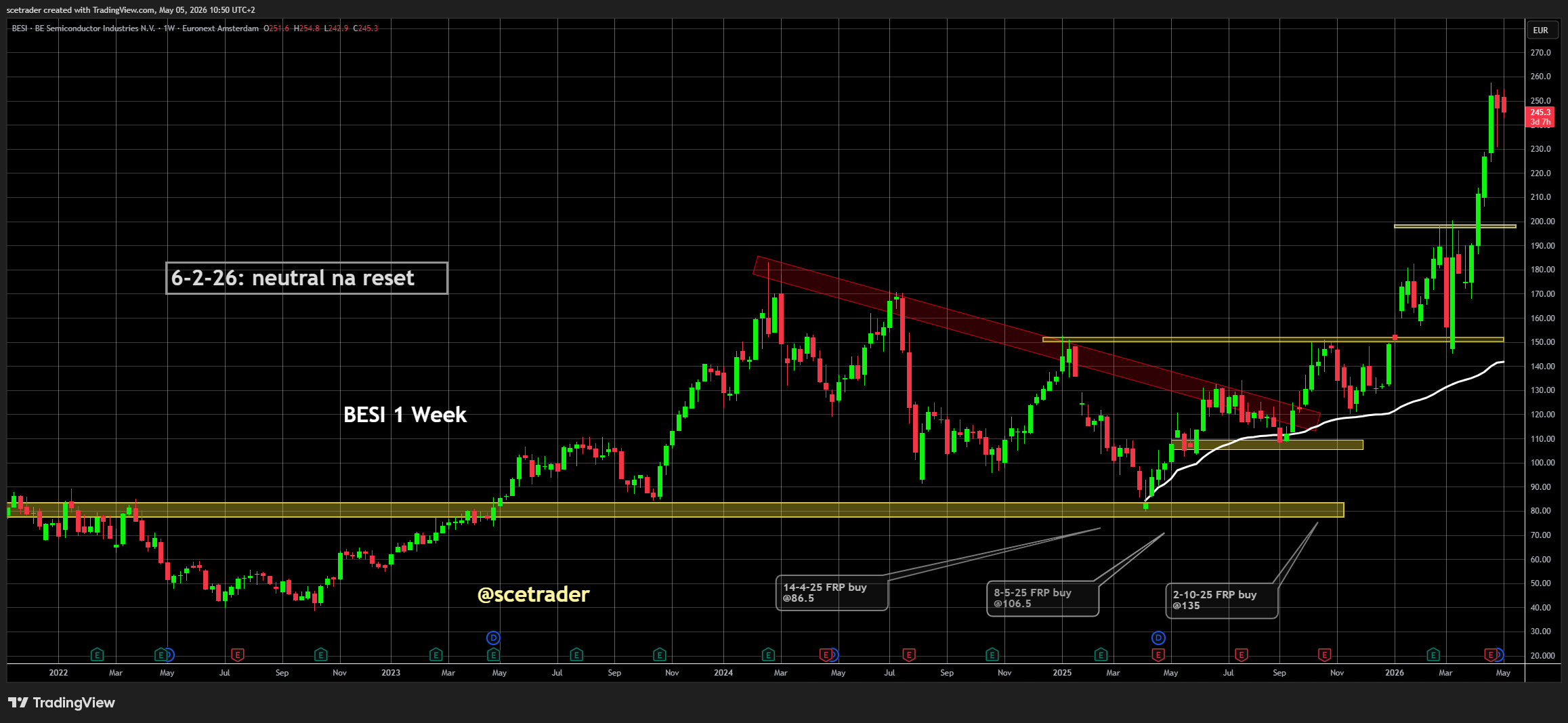
Wij hebben eerder winst genomen op Besi en staan daardoor niet onder druk om het aandeel op elk niveau opnieuw te kopen. Fundamenteel zijn wij bullish voor de lange termijn, omdat Besi een sterke positie heeft in hybrid bonding en daarmee direct raakt aan advanced packaging, HBM en de bredere AI-halfgeleiderketen. Toch willen wij pas opnieuw kopen bij een duidelijke correctie of bij een echte technische uitbraak. Ook als dat betekent dat wij een deel van de beweging missen, vinden wij dat op dit moment verstandiger dan achter de koers aanlopen.
Als wij de aandelen nog zouden hebben, zouden wij met een stop in de winst blijven zitten en de trend verder laten werken. Dat geeft precies aan hoe wij naar het aandeel kijken. De lange termijn case blijft sterk, maar na eerdere winstneming hoeven wij niet geforceerd opnieuw in te stappen. Voor een nieuwe positie willen wij eerst een beter risk/reward-moment zien.
◼ Wij blijven lange termijn positief over Besi, omdat hybrid bonding een structurele rol kan krijgen binnen HBM, high-layer NAND en toekomstige chiparchitecturen.
◼ Wij kopen het aandeel op dit moment niet blind bij, omdat timing, waardering en technische instap belangrijk blijven bij een premium halfgeleidernaam.
◼ Een duidelijke correctie kan opnieuw een interessant instapmoment bieden, zeker als de fundamentele case rond Samsung, NVIDIA en HBM intact blijft.
◼ Een echte uitbraak kan eveneens een nieuw koopsignaal geven, omdat de markt dan bevestigt dat orderverwachtingen en technologisch momentum opnieuw in de koers worden verwerkt.
◼ Wij accepteren dat wij mogelijk een deel van de move missen, omdat discipline bij Besi belangrijker is dan emotioneel achter een sterk verhaal aanlopen.
De investment case blijft sterk, maar dat betekent niet dat elk koersniveau automatisch aantrekkelijk is. Besi is geen achtergebleven cyclische naam waar de markt nog niets in ziet. Het aandeel wordt al langer gewaardeerd als een kwalitatieve speler binnen de halfgeleiderketen. Daardoor ligt de lat hoog. De markt wil bewijs zien in klantadoptie, orderinstroom en uiteindelijk omzetbijdrage uit hybrid bonding.
De reden dat wij lange termijn bullish blijven, is dat Besi op een cruciaal punt in de waardeketen zit. Hybrid bonding raakt direct aan de volgende fase van AI-hardware. De groei van AI-datacenters vraagt om snellere geheugenoplossingen, hogere bandbreedte, lager energieverbruik en betere thermische prestaties. HBM is daarin een onmisbare bouwsteen. Als de technische complexiteit verder toeneemt, stijgt ook de strategische waarde van bedrijven die de juiste machines leveren voor die packaging-stap.
Wil je alle artikelen kunnen lezen en elke podcast beluisteren? Neem dan een abonnement en krijg toegang tot alle artikelen en de database met duizenden berichten.
Toch willen wij het aandeel niet kopen puur omdat het fundamentele verhaal aantrekkelijk is. Bij Besi is de timing van belang. Een correctie kan de risk/reward verbeteren. Een echte uitbraak kan laten zien dat de markt opnieuw bereid is om hogere multiples te betalen voor de hybrid bonding-case. Zonder één van die twee signalen blijven wij positief, maar gedisciplineerd.
Waarom hybrid bonding belangrijk is
Hybrid bonding verschilt fundamenteel van traditionele thermo-compression bonding, ook wel TC bonding genoemd. Bij TC bonding worden fijne metalen bumps gebruikt om gestapelde dies met elkaar te verbinden. Hybrid bonding doet dat anders. De technologie verbindt de koperen oppervlakken van twee chips direct met elkaar.
Dat heeft meerdere voordelen. De interconnects worden korter. De integratiedichtheid gaat omhoog. De snelheid kan verbeteren. Het energieverbruik kan dalen. Ook de warmteontwikkeling kan beter worden beheerst. Voor HBM en nieuwe generaties NAND flash is dat belangrijk, omdat elke extra laag en elke extra verbinding de technische druk verhoogt.
Volgens Besi biedt hybrid copper bonding 15 keer zoveel interconnect density als TC bonding. Ook zou de energy-efficiency performance meer dan 100 keer hoger liggen. Samsung stelde tijdens GTC 2026 dat hybrid bonding de thermische weerstand met meer dan 20% kan verbeteren ten opzichte van TC bonding en stacks van 16-high en hoger ondersteunt.
Dat is belangrijk, omdat de HBM-markt richting hogere stack-aantallen beweegt. Hoe hoger de stacks worden, hoe groter de uitdaging rond pakketdikte, warmteafvoer, signaalkwaliteit en energieverbruik. Hybrid bonding adresseert meerdere van die problemen tegelijk. Daardoor is de technologie aantrekkelijker dan een oplossing die alleen helpt om de hoogte van een pakket te verminderen.
De JEDEC-discussie verandert volgens Besi het verhaal niet
Een belangrijk discussiepunt in de markt is de mogelijke versoepeling van de hoogte-eisen voor next-generation HBM door JEDEC. De huidige limiet ligt naar verluidt op 775 micrometer. Er wordt gesproken over een verhoging naar 825 micrometer of zelfs 900 micrometer.
Sommige analisten stellen dat een hogere toegestane pakkethoogte de levensduur van bestaande TC bonding kan verlengen. Als HBM-pakketten hoger mogen worden, is hybrid bonding minder noodzakelijk om alleen de totale dikte te verlagen. Dat zou de adoptie kunnen vertragen.
Besi ziet dat anders. CEO Richard Blickman gaf aan dat de enige reden waarom JEDEC naar versoepeling kijkt, is dat één van de drie grote geheugenproducenten die extra hoogte nodig heeft voor zijn huidige proces. De andere twee zouden volgens hem niet door die wijziging worden geraakt. De drie grote HBM-spelers zijn Samsung Electronics, SK Hynix en Micron.
De implicatie is duidelijk. Als één partij meer hoogte nodig heeft om met bestaande of aangepaste TC-processen verder te kunnen, betekent dat niet dat de andere twee hun hybrid bonding-plannen vertragen. Volgens Besi wordt hybrid bonding namelijk niet alleen gekozen vanwege pakketdikte. De technologie wordt gekozen vanwege snelheid, energieverbruik, warmteafvoer en toekomstige schaalbaarheid.
Wil je alle artikelen kunnen lezen en elke podcast beluisteren? Neem dan een abonnement en krijg toegang tot alle artikelen en de database met duizenden berichten.
Dat maakt de uitleg van Besi belangrijk. De markt kijkt vaak te smal naar de dikte van HBM-pakketten. Besi benadrukt juist dat de structurele voordelen van hybrid bonding breder zijn. Als dat klopt, dan is een versoepeling van de JEDEC-hoogtelimiet geen echte bedreiging voor de adoptiecurve. Het kan hooguit de overgang voor bepaalde spelers iets minder urgent maken.
Samsung als mogelijke katalysator
Samsung is in dit verhaal de directe katalysator. Het bedrijf presenteerde tijdens NVIDIA GTC 2026 zijn hybrid bonding-technologie voor HBM. Daarbij wees Samsung op betere thermische prestaties, hogere interconnect density en ondersteuning voor 16-high en hogere stacks.
Dat is relevant, omdat Samsung in HBM terrein moet winnen ten opzichte van concurrenten. De markt voor AI-geheugen is sterk geconcentreerd en wordt gedreven door strenge eisen van grote klanten. Wanneer Samsung hybrid bonding versneld inzet, kan dat helpen om technologisch sterker te positioneren in de volgende generatie HBM.
Voor Besi zou een concrete adoptiebeslissing door Samsung een duidelijk signaal zijn richting de markt. Het zou bevestigen dat hybrid bonding niet alleen een technologie voor de lange termijn is, maar ook een concreet order- en omzetthema kan worden. Zeker als de invoering gekoppeld is aan HBM-producten die volgend jaar richting massaproductie gaan.
Als Samsung vol inzet op deze technologie, kan dat voor een forse rally in Besi zorgen. De markt zou dat kunnen lezen als bevestiging dat Besi aan de goede kant van de advanced packaging-transitie zit. Vooral omdat Samsung, SK Hynix en Micron allemaal onder druk staan om de volgende HBM-generaties technisch sterker te maken, kan een duidelijke keuze van Samsung het sentiment rond Besi snel verbeteren.
Besi verwacht dat massaproductie van HBM op basis van hybrid bonding volgend jaar kan beginnen. Dat betekent dat 2026 vooral een jaar is van kwalificatie, evaluatie, klantbeslissingen en voorbereiding. Voor beleggers is dat belangrijk. De echte omzetimpact hoeft niet volledig direct zichtbaar te zijn, maar de markt kan vooruitlopen op ordermomentum en strategische bevestiging.
Voor ons is Samsung daarom een duidelijke katalysator, maar geen reden om zonder discipline achter de koers aan te lopen. Het nieuws kan de lange termijn case versterken, maar de instap moet nog steeds kloppen. Wij willen daarom ofwel een correctie zien die de waardering aantrekkelijker maakt, ofwel een echte uitbraak die bevestigt dat de markt het momentum opnieuw breed oppakt.
Rol van NVIDIA en de eindklantdruk
Besi gaf aan dat alle drie de geheugenproducenten apparatuur evalueren op basis van dezelfde criteria die door een specifieke eindklant zijn opgesteld. Die eindklant heeft volgens Besi gevraagd om tegen het einde van dit jaar hybrid-bonded stacked products veilig te stellen, met als doel om volgend jaar afgewerkte producten naar de markt te brengen.
De eindklant wordt waarschijnlijk gezien als NVIDIA. Dat past logisch binnen het bredere HBM-verhaal. NVIDIA is een van de belangrijkste drijvende krachten achter de vraag naar high-performance memory voor AI-accelerators. Wanneer NVIDIA of een vergelijkbare grote eindklant technische eisen oplegt aan geheugenleveranciers, ontstaat een sterke druk om de juiste packaging-technologie tijdig klaar te hebben.
Voor Besi is dat een belangrijk signaal. Equipmentvraag ontstaat niet alleen omdat chipproducenten intern een nieuwe technologie willen testen. De vraag ontstaat ook omdat eindklanten hogere prestaties eisen. Dat vergroot de kans dat investeringen in hybrid bonding niet vrijblijvend blijven.
Dit is precies waar de economische waarde voor Besi zit. Het bedrijf verkoopt niet simpelweg machines in een cyclische equipmentmarkt. Het levert technologie die nodig kan zijn om de volgende generatie HBM op het gewenste prestatieniveau te produceren. Dat geeft Besi een andere kwaliteit binnen de halfgeleiderketen.
Sterke punten
Het eerste sterke punt is de technologische positie van Besi. Het bedrijf wordt gezien als een wereldwijde leider in hybrid bonding equipment. Vooral in die bonding zijn precisie en throughput cruciaal. Bij advanced packaging gaat het niet alleen om het kunnen verbinden van chips, maar om dat op schaal, met hoge nauwkeurigheid en voldoende productiesnelheid te doen. Besi lijkt op dat vlak een duidelijke voorsprong te hebben.
Het tweede sterke punt is de directe koppeling met AI-infrastructuur. HBM is een kerncomponent binnen AI-systemen. Naarmate AI-modellen groter worden en accelerators meer geheugenbandbreedte vereisen, stijgt de druk op de geheugenketen. Besi profiteert niet rechtstreeks van de verkoop van AI-chips, maar wel van de noodzakelijke productietechnologie achter die chips.
Het derde sterke punt is dat hybrid bonding meerdere technische problemen tegelijk oplost. Het gaat niet alleen om hoogte. Het gaat ook om snelheid, energieverbruik, warmte en interconnect density. Dat maakt de adoptiecase sterker. Technologieën die maar één probleem oplossen, zijn kwetsbaarder voor alternatieven. Hybrid bonding lijkt juist op meerdere punten waarde toe te voegen.
Het vierde sterke punt is de betrokkenheid van Applied Materials. Applied Materials heeft een belang van 9% in Besi en is daarmee de grootste aandeelhouder. Dat geeft strategische validatie. Applied Materials is de grootste halfgeleiderapparatuurproducent ter wereld. Een dergelijk belang onderstreept dat Besi een relevante positie heeft binnen de toekomstige packaging-roadmap.
Zwakke punten
Het eerste zwakke punt blijft timing. De markt kan enthousiast worden over hybrid bonding, maar de daadwerkelijke orderinstroom en massaproductie kunnen in fases verlopen. Als Samsung of andere geheugenproducenten later beslissen dan verwacht, kan dat op korte termijn druk geven op het aandeel.
Het tweede zwakke punt is dat de JEDEC-discussie verwarring kan veroorzaken. Ook al stelt Besi dat de versoepeling van hoogte-eisen de adoptie niet verandert, beleggers kunnen het nieuws anders interpreteren. Wanneer de markt denkt dat TC bonding langer relevant blijft, kan dat tijdelijk druk zetten op de waardering van Besi.
Het derde zwakke punt is de hoge verwachting rond Besi. Het aandeel wordt vaak gewaardeerd als een premium semi-equipmentnaam. Dat betekent dat positieve ontwikkelingen deels al in de koers kunnen zitten. Bij premium aandelen is de foutmarge kleiner. De markt wil bewijs zien in orders, omzetgroei en concrete klantadoptie.
Het vierde zwakke punt is dat een sterk fundamenteel verhaal niet automatisch een goed instapmoment betekent. Juist omdat Besi kwalitatief sterk is, kan de waardering snel vooruitlopen op de feiten. Dat is de reden waarom wij na eerdere winstneming niet zomaar opnieuw kopen, maar wachten op een correctie of een echte uitbraak.
Catalysts
🟩 Meer duidelijkheid rond Samsung kan een directe katalysator zijn. Als Samsung rond het midden van dit jaar inderdaad concreter wordt over hybrid bonding-adoptie, kan dat de markt overtuigen dat de technologie richting commerciële toepassing gaat.
🟩 Een volledige inzet van Samsung op hybrid bonding kan voor een forse rally in Besi zorgen. Dat zou de markt kunnen zien als bevestiging dat Besi een sleutelpositie heeft binnen de volgende fase van HBM-productie.
🟩 Evaluaties bij alle drie de grote HBM-producenten kunnen ordermomentum ondersteunen. Besi gaf aan dat Samsung, SK Hynix en Micron apparatuur evalueren op basis van criteria van dezelfde eindklant.
🟩 De overgang naar 16-high en hogere HBM-stacks kan de noodzaak van hybrid bonding vergroten. Hogere stacks maken warmteafvoer, interconnect density en energieverbruik belangrijker.
🟩 Een grote eindklant die hybrid-bonded stacked products tegen het einde van dit jaar wil veiligstellen, kan de adoptiesnelheid verhogen. Dat maakt het thema minder vrijblijvend voor geheugenproducenten.
🟩 Een duidelijke technische uitbraak kan voor ons een nieuw koopsignaal worden. In dat scenario bevestigt de markt dat de lange termijn case opnieuw wordt gedragen door momentum, verwachtingen en kapitaalinstroom.
🟥 Vertraging bij Samsung of een ruimere inzet van TC bonding kan het sentiment tijdelijk raken. Als de markt de JEDEC-versoepeling leest als uitstel van hybrid bonding, kan dat op korte termijn druk geven.
🟥 Een premium waardering maakt Besi gevoeliger voor tegenvallende timing. Het aandeel heeft bevestiging nodig via orders, klanten en zicht op massaproductie.
🟥 Als het aandeel hard oploopt zonder correctie of uitbraakbevestiging, blijven wij liever gedisciplineerd aan de zijlijn. Dat kan betekenen dat wij een deel van de beweging missen, maar voorkomt dat wij op een minder aantrekkelijk risk/reward-niveau kopen.
Cijfers en technische claims uit het nieuws
Besi gaf tijdens de conference call van 23 april aan dat rond het midden van dit jaar meer definitief nieuws wordt verwacht over de adoptie van hybrid bonding door Samsung.
Samsung liet tijdens GTC 2026 zien dat hybrid bonding voor HBM de thermische weerstand met meer dan 20% kan verbeteren ten opzichte van TC bonding.
Samsung gaf ook aan dat hybrid bonding ondersteuning biedt voor stacks van 16-high en hoger.
Volgens Besi biedt hybrid copper bonding 15 keer zoveel interconnect density als TC bonding.
Volgens Besi ligt de energy-efficiency performance van hybrid copper bonding meer dan 100 keer hoger dan bij TC bonding.
JEDEC zou overwegen om de HBM-hoogtelimiet te verhogen van 775 micrometer naar 825 micrometer of 900 micrometer.
Besi verwacht dat massaproductie van HBM op basis van hybrid bonding volgend jaar kan starten.
Applied Materials heeft een belang van 9% in Besi en is daarmee de grootste aandeelhouder.
Opvallende zaken
Het meest opvallende punt is dat Besi de discussie rond JEDEC duidelijk probeert te neutraliseren. De markt kan een hogere toegestane HBM-pakkethoogte zien als negatief voor hybrid bonding, maar Besi draait die redenering om. Volgens Richard Blickman is de versoepeling vooral relevant voor één van de drie geheugenproducenten. De andere twee zouden er niet door worden geraakt.
Dat betekent dat de markt volgens Besi niet moet kijken naar hybrid bonding als alleen een oplossing voor pakketdikte. De technologie moet worden gezien als een bredere performance-oplossing. De voordelen zitten in snelheid, energieverbruik, warmte, interconnect density en schaalbaarheid. Dat is een veel sterkere adoptiecase.
Een tweede opvallend punt is de rol van de eindklant. Besi spreekt over één specifieke eindklant die de geheugenproducenten vraagt om hybrid-bonded stacked products tegen het einde van dit jaar veilig te stellen. Dat maakt het verhaal concreter. Het gaat niet alleen om interne roadmap-discussies bij geheugenbedrijven, maar om klantgedreven druk vanuit de AI-keten.
Een derde opvallend punt is dat Samsung hybrid bonding publiekelijk heeft gepresenteerd tijdens GTC 2026. Dat is geen klein detail. GTC is de plek waar AI-hardware, datacenterarchitectuur en de roadmap van de industrie samenkomen. Als Samsung daar hybrid bonding voor HBM naar voren schuift, is dat een signaal dat de technologie strategisch belangrijk is.
Een vierde opvallend punt is dat de fundamentele case sterk blijft, maar dat dit niet automatisch betekent dat wij nu agressief kopen. Wij hebben eerder winst genomen en kijken daardoor rustiger naar het aandeel. De lange termijn visie blijft bullish, maar de handelsdiscipline blijft leidend.
Conclusie
Besi blijft strategisch sterk gepositioneerd, maar wij blijven gedisciplineerd. Als Samsung vol inzet op hybrid bonding, kan dat voor een forse rally in Besi zorgen. Toch kopen wij pas opnieuw bij een duidelijke correctie of bij een echte uitbraak.
Wil je alle artikelen kunnen lezen en elke podcast beluisteren? Neem dan een abonnement en krijg toegang tot alle artikelen en de database met duizenden berichten.
English version
Besi $BESI: Samsung hybrid bonding decision moves closer
🟧 Samsung Electronics is expected to provide more clarity around the middle of this year on the introduction of hybrid bonding.
🟧 If Samsung fully commits to this technology, it could trigger a sharp rally in Besi.
🟧 Besi remains strategically well positioned in advanced packaging, HBM and the broader AI semiconductor chain.
🟧 Hybrid bonding could become important for higher speed, lower power consumption, better thermal performance and higher interconnect density.
🟧 According to Besi, the JEDEC discussion does not change the structural hybrid bonding story.
🟧 The likely pressure from NVIDIA makes hybrid bonding increasingly less optional.
Besi is once again at the center of one of the most important technological shifts in advanced packaging. Samsung Electronics is expected to provide more clarity around the middle of this year on the introduction of hybrid bonding. This technology is increasingly being viewed as a necessary step for next-generation HBM, high-layer NAND and more complex chip architectures.
During its first-quarter 2026 earnings conference call, Besi said that more definitive news could arrive around the middle of this year regarding Samsung’s adoption of hybrid bonding. That is consistent with the earlier message given during the 2025 full-year results, when Besi already indicated that Samsung could move toward hybrid bonding adoption in the second quarter.
For Besi, this is an important moment. The company is seen as a global leader in hybrid bonding equipment. Especially in die bonding, Besi has built a strong technological position through a combination of precision, speed and scalability. If Samsung truly commits to hybrid bonding, that could be a powerful confirmation of Besi’s strategic position.
The core of the story is that hybrid bonding is not just a new production technique. It could become a standard for the next phase of AI hardware. HBM is becoming increasingly important for AI accelerators. Requirements for speed, power consumption, thermal performance and package thickness are rising. That is why investor attention is increasingly shifting toward companies that enable this new packaging technology.
Investment view
We previously took profit on Besi and are therefore not under pressure to buy the stock back at every level. Fundamentally, we are bullish for the long term because Besi has a strong position in hybrid bonding and is directly exposed to advanced packaging, HBM and the broader AI semiconductor chain. Still, we only want to buy again on a clear correction or a real technical breakout. Even if that means missing part of the move, we believe that is more sensible than chasing the stock.
If we still owned the shares, we would stay invested with a stop in profit and allow the trend to keep working. That shows exactly how we view the stock. The long-term case remains strong, but after taking profit earlier, we do not need to force a new entry. For a new position, we first want to see a better risk/reward moment.
◼ We remain positive on Besi for the long term because hybrid bonding could gain a structural role in HBM, high-layer NAND and future chip architectures.
◼ We are not blindly buying the stock at this level because timing, valuation and technical entry remain important for a premium semiconductor name.
◼ A clear correction could offer an attractive new entry point, especially if the fundamental case around Samsung, NVIDIA and HBM remains intact.
◼ A real breakout could also provide a new buy signal, because the market would then confirm that order expectations and technological momentum are being priced in again.
◼ We accept that we may miss part of the move, because discipline in Besi is more important than emotionally chasing a strong story.
The investment case remains strong, but that does not mean every price level is automatically attractive. Besi is not a forgotten cyclical name that the market has ignored. The stock has long been valued as a high-quality player in the semiconductor chain. That means the bar is high. The market wants evidence in customer adoption, order intake and ultimately revenue contribution from hybrid bonding.
The reason we remain bullish for the long term is that Besi sits at a critical point in the value chain. Hybrid bonding is directly linked to the next phase of AI hardware. The growth of AI data centers requires faster memory solutions, higher bandwidth, lower power consumption and better thermal performance. HBM is an essential building block in that chain. As technical complexity increases, the strategic value of the companies supplying the right machines for this packaging step also rises.
Still, we do not want to buy the stock purely because the fundamental story is attractive. In Besi, timing matters. A correction can improve the risk/reward profile. A real breakout can show that the market is once again willing to pay higher multiples for the hybrid bonding case. Without one of those two signals, we remain positive, but disciplined.
Why hybrid bonding matters
Hybrid bonding differs fundamentally from traditional thermo-compression bonding, also known as TC bonding. In TC bonding, fine metal bumps are used to connect stacked dies. Hybrid bonding works differently. The technology directly connects the copper surfaces of two chips.
That brings several advantages. Interconnects become shorter. Integration density increases. Speed can improve. Power consumption can fall. Thermal performance can also be better controlled. For HBM and new generations of NAND flash, that matters because every additional layer and every additional connection increases technical pressure.
According to Besi, hybrid copper bonding offers 15 times the interconnect density of TC bonding. Energy-efficiency performance is also said to be more than 100 times higher. Samsung stated during GTC 2026 that hybrid bonding can improve thermal resistance for HBM by more than 20% compared with TC bonding and can support 16-high and higher stacks.
That matters because the HBM market is moving toward higher stack counts. The higher the stacks become, the greater the challenge around package thickness, thermal performance, signal quality and power consumption. Hybrid bonding addresses several of these problems at once. That makes the technology more attractive than a solution that only helps reduce package height.
According to Besi, the JEDEC discussion does not change the story
An important debate in the market is the possible relaxation of height requirements for next-generation HBM by JEDEC. The current limit is reportedly 775 micrometers. The market is discussing a potential increase to 825 micrometers or even 900 micrometers.
Some analysts argue that a higher permitted package height could extend the life of existing TC bonding. If HBM packages are allowed to become taller, hybrid bonding becomes less necessary purely to reduce total thickness. That could delay adoption.
Besi sees this differently. CEO Richard Blickman said that the only reason JEDEC is looking at relaxing the height specification is that one of the three major memory makers needs the extra height for its current process. The other two would not be affected by that change. The three major HBM players are Samsung Electronics, SK Hynix and Micron.
The implication is clear. If one company needs more height to continue with existing or modified TC processes, that does not mean the other two are delaying their hybrid bonding plans. According to Besi, hybrid bonding is not being chosen only because of package thickness. The technology is being chosen for speed, power consumption, thermal performance and future scalability.
That makes Besi’s explanation important. The market often looks too narrowly at the thickness of HBM packages. Besi emphasizes that the structural advantages of hybrid bonding are broader. If that is correct, then a relaxation of JEDEC’s height limit is not a real threat to the adoption curve. It may only make the transition slightly less urgent for certain players.
Samsung as a potential catalyst
Samsung is the direct catalyst in this story. The company presented its hybrid bonding technology for HBM during NVIDIA GTC 2026. Samsung highlighted better thermal performance, higher interconnect density and support for 16-high and higher stacks.
That is relevant because Samsung needs to gain ground in HBM versus competitors. The AI memory market is highly concentrated and driven by strict requirements from major customers. If Samsung accelerates hybrid bonding deployment, it could help the company position itself more strongly in next-generation HBM.
For Besi, a concrete adoption decision by Samsung would be a clear signal to the market. It would confirm that hybrid bonding is not only a long-term technology, but also a real order and revenue theme. That is especially relevant if the adoption is linked to HBM products moving toward mass production next year.
If Samsung fully commits to this technology, it could trigger a sharp rally in Besi. The market could read that as confirmation that Besi is positioned on the right side of the advanced packaging transition. Since Samsung, SK Hynix and Micron are all under pressure to improve the next HBM generations technically, a clear decision from Samsung could quickly improve sentiment around Besi.
Besi expects mass production of hybrid-bonding-based HBM to begin next year. That means 2026 is mainly a year of qualification, evaluation, customer decisions and preparation. For investors, that matters. The real revenue impact does not need to be fully visible immediately, because the market can start discounting order momentum and strategic confirmation earlier.
For us, Samsung is therefore a clear catalyst, but not a reason to chase the stock without discipline. The news can strengthen the long-term case, but the entry still has to be right. We therefore want either a correction that makes the valuation more attractive, or a real breakout confirming that the market is again broadly picking up the momentum.
NVIDIA and end-customer pressure
Besi stated that all three memory manufacturers are evaluating equipment based on the same criteria set by a specific end customer. According to Besi, that end customer has asked the memory makers to secure hybrid-bonded stacked products by the end of this year, with the goal of bringing finished products to market next year.
The end customer is likely to be NVIDIA. That fits logically within the broader HBM story. NVIDIA is one of the most important drivers of demand for high-performance memory for AI accelerators. When NVIDIA or a comparable major end customer imposes technical requirements on memory suppliers, it creates strong pressure to have the right packaging technology ready on time.
For Besi, that is an important signal. Equipment demand does not arise only because chipmakers want to test a new technology internally. Demand also arises because end customers require higher performance. That increases the probability that investments in hybrid bonding will not remain optional.
This is exactly where Besi’s economic value sits. The company is not simply selling machines into a cyclical equipment market. It supplies technology that may be needed to produce next-generation HBM at the required performance level. That gives Besi a different quality within the semiconductor chain.
Strengths
The first strength is Besi’s technological position. The company is seen as a global leader in hybrid bonding equipment. Especially in die bonding, precision and throughput are crucial. In advanced packaging, the challenge is not only connecting chips, but doing so at scale, with high accuracy and sufficient production speed. Besi appears to have a clear advantage in that area.
The second strength is the direct link with AI infrastructure. HBM is a core component in AI systems. As AI models become larger and accelerators require more memory bandwidth, pressure on the memory chain increases. Besi does not benefit directly from the sale of AI chips, but it does benefit from the production technology needed behind those chips.
The third strength is that hybrid bonding solves several technical problems at once. It is not only about height. It is also about speed, power consumption, heat and interconnect density. That makes the adoption case stronger. Technologies that solve only one problem are more vulnerable to alternatives. Hybrid bonding appears to add value across several dimensions.
The fourth strength is the involvement of Applied Materials. Applied Materials owns a 9% stake in Besi and is therefore its largest shareholder. That provides strategic validation. Applied Materials is the world’s largest semiconductor equipment company. Such a stake underlines that Besi has a relevant position in the future packaging roadmap.
Weaknesses
The first weakness remains timing. The market may become enthusiastic about hybrid bonding, but actual order intake and mass production can develop in phases. If Samsung or other memory producers decide later than expected, the stock could come under short-term pressure.
The second weakness is that the JEDEC discussion can create confusion. Even though Besi says the relaxation of height requirements does not change adoption, investors may interpret the news differently. If the market believes TC bonding will remain relevant for longer, that can temporarily weigh on Besi’s valuation.
The third weakness is the high expectation level around Besi. The stock is often valued as a premium semiconductor equipment name. That means positive developments may already be partly reflected in the share price. With premium stocks, the margin for error is smaller. The market wants evidence in orders, customers and visibility on mass production.
The fourth weakness is that a strong fundamental story does not automatically mean a good entry point. Precisely because Besi is a high-quality name, the valuation can quickly move ahead of the facts. That is why, after taking profit earlier, we are not buying back indiscriminately, but waiting for a correction or a real breakout.
Catalysts
🟩 More clarity around Samsung could be a direct catalyst. If Samsung becomes more concrete around hybrid bonding adoption by the middle of this year, it could convince the market that the technology is moving toward commercial application.
🟩 A full Samsung commitment to hybrid bonding could trigger a sharp rally in Besi. The market could view that as confirmation that Besi holds a key position in the next phase of HBM production.
🟩 Evaluations at all three major HBM producers could support order momentum. Besi stated that Samsung, SK Hynix and Micron are evaluating equipment based on criteria from the same end customer.
🟩 The move toward 16-high and higher HBM stacks could increase the need for hybrid bonding. Higher stacks make thermal performance, interconnect density and power consumption more important.
🟩 A major end customer asking for hybrid-bonded stacked products by the end of this year could accelerate adoption. That makes the theme less optional for memory producers.
🟩 A clear technical breakout could become a new buy signal for us. In that scenario, the market confirms that the long-term case is again supported by momentum, expectations and capital inflows.
🟥 Delays at Samsung or broader use of TC bonding could temporarily hurt sentiment. If the market reads the JEDEC relaxation as a delay to hybrid bonding, that could pressure the stock in the short term.
🟥 A premium valuation makes Besi more sensitive to disappointing timing. The stock needs confirmation through orders, customers and visibility on mass production.
🟥 If the stock rallies hard without a correction or breakout confirmation, we prefer to remain disciplined on the sidelines. That may mean missing part of the move, but it prevents us from buying at a less attractive risk/reward level.
Figures and technical claims from the news
Besi stated during the April 23 conference call that more definitive news is expected around the middle of this year regarding Samsung’s adoption of hybrid bonding.
Samsung showed during GTC 2026 that hybrid bonding for HBM can improve thermal resistance by more than 20% compared with TC bonding.
Samsung also stated that hybrid bonding supports 16-high and higher stacks.
According to Besi, hybrid copper bonding offers 15 times the interconnect density of TC bonding.
According to Besi, the energy-efficiency performance of hybrid copper bonding is more than 100 times higher than TC bonding.
JEDEC is reportedly considering raising the HBM height limit from 775 micrometers to 825 micrometers or 900 micrometers.
Besi expects mass production of HBM based on hybrid bonding to start next year.
Applied Materials owns a 9% stake in Besi and is therefore the largest shareholder.
Notable points
The most notable point is that Besi is clearly trying to neutralize the JEDEC discussion. The market could view a higher permitted HBM package height as negative for hybrid bonding, but Besi turns that argument around. According to Richard Blickman, the relaxation is mainly relevant for one of the three memory producers. The other two would not be affected by it.
That means the market should not view hybrid bonding only as a solution for package thickness. According to Besi, the technology should be seen as a broader performance solution. The benefits are in speed, power consumption, thermal performance, interconnect density and scalability. That is a much stronger adoption case.
A second notable point is the role of the end customer. Besi refers to one specific end customer asking memory producers to secure hybrid-bonded stacked products by the end of this year. That makes the story more concrete. It is not only about internal roadmap discussions at memory companies, but about customer-driven pressure from the AI chain.
A third notable point is that Samsung publicly presented hybrid bonding during GTC 2026. That is not a small detail. GTC is where AI hardware, data center architecture and the industry roadmap come together. If Samsung highlights hybrid bonding for HBM there, it signals that the technology is strategically important.
A fourth notable point is that the fundamental case remains strong, but that does not automatically mean we are buying aggressively now. We previously took profit and are therefore looking at the stock more calmly. The long-term view remains bullish, but trading discipline remains leading.
Conclusion
Besi remains strategically well positioned, but we remain disciplined. If Samsung fully commits to hybrid bonding, it could trigger a sharp rally in Besi. Still, we only want to re-enter on a clear correction or a real breakout.
Disclaimer Aan de door ons opgestelde informatie kan op geen enkele wijze rechten worden ontleend. Alle door ons verstrekte informatie en analyses zijn geheel vrijblijvend. Alle consequenties van het op welke wijze dan ook toepassen van de informatie blijven volledig voor uw eigen rekening.
Wij aanvaarden geen aansprakelijkheid voor de mogelijke gevolgen of schade die zouden kunnen voortvloeien uit het gebruik van de door ons gepubliceerde informatie. U bent zelf eindverantwoordelijk voor de beslissingen die u neemt met betrekking tot uw beleggingen.


