Europa’s Chips Act 2.0: €120 miljard voor een sterkere chipketen
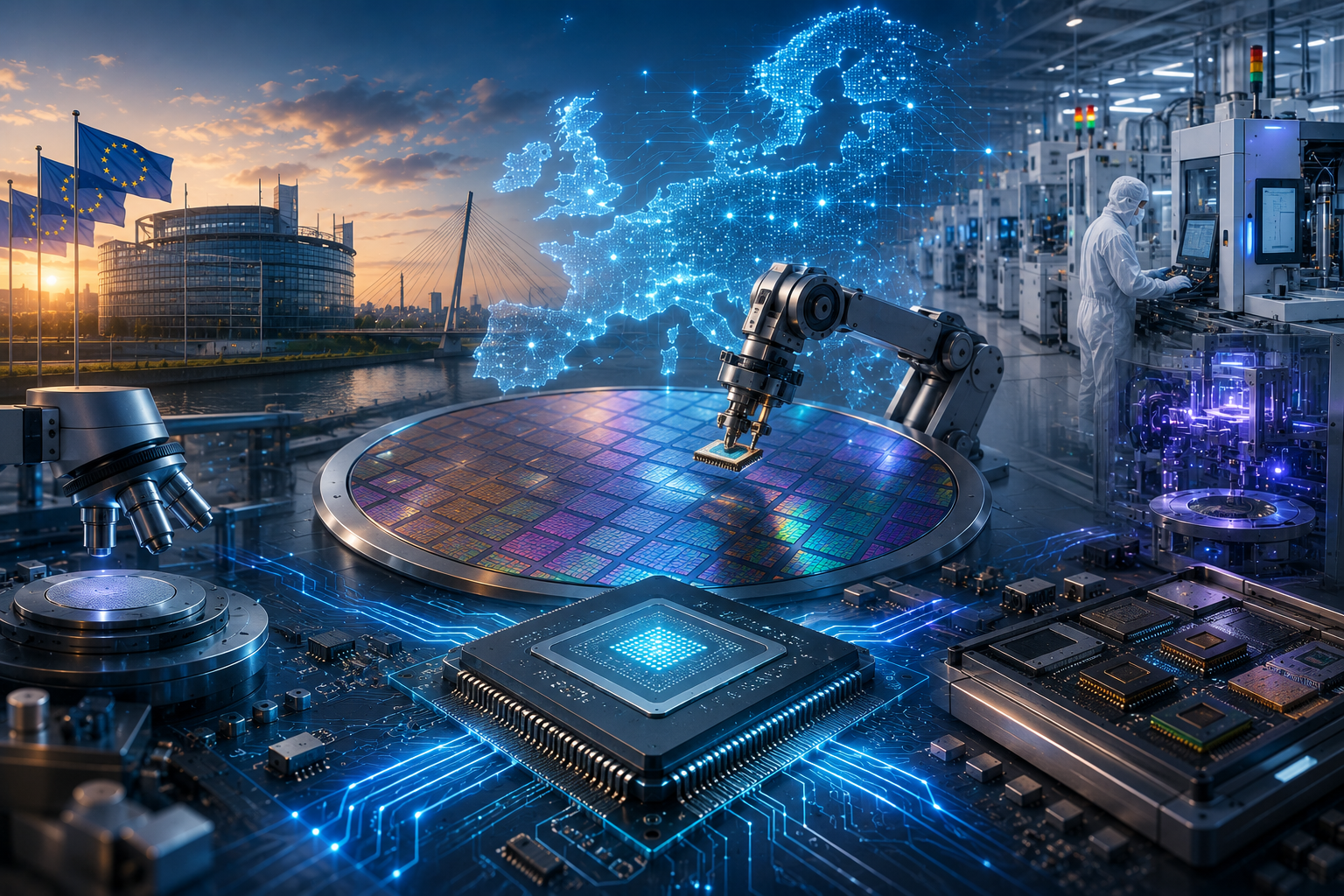
De Europese Unie werkt aan een nieuwe Chips Act 2.0 om de eigen halfgeleiderindustrie sterker en minder afhankelijk te maken. Volgens de aangeleverde informatie is tot 2035 ongeveer €120 miljard aan publieke en private investeringen nodig, waarvan circa €30 miljard voor geavanceerde semiconductor foundries.
■ De EU wil met Chips Act 2.0 de Europese chipindustrie opnieuw versterken.
■ Tot 2035 zou ongeveer €120 miljard aan publieke en private investeringen nodig zijn.
■ Circa €30 miljard zou gericht zijn op geavanceerde semiconductor foundries.
■ De nieuwe aanpak richt zich meer op vraagstimulering, offtake agreements en snellere coördinatie.
■ Voor Europese chipnamen is dit positief, maar uitvoering blijft de grote test.
Europa erkent daarmee opnieuw dat chips strategische infrastructuur zijn. Halfgeleiders zijn nodig voor AI, defensie, auto’s, cloud, energie-infrastructuur, medische apparatuur en industriële automatisering. De eerste Chips Act heeft investeringen losgemaakt, maar Europa heeft zijn doel om richting 20% wereldwijd marktaandeel te bewegen nog niet overtuigend waargemaakt.
Investment view
Wij zien dit als positief voor de Europese halfgeleiderketen, maar niet als directe gamechanger. De geplande €120 miljard tot 2035 laat zien dat Europa opnieuw kapitaal, industriebeleid en geopolitieke urgentie wil bundelen. Dat is vooral gunstig voor bedrijven waar Europa al sterk staat, zoals ASML, ASM International, BE Semiconductor Industries, Infineon, STMicroelectronics, NXP en Soitec.
🟪 Dit is lange termijn positief voor Europa’s chipketen, omdat beleid en kapitaal opnieuw richting halfgeleiders bewegen.
🟪 De grootste kansen liggen bij Europese sterktes zoals lithografie, deposition, packaging, power chips, automotive chips en substrates.
🟪 De nuance blijft dat Europa niet alleen plannen moet maken, maar projecten sneller moet goedkeuren, bouwen en vullen met echte klantvraag.
De juiste conclusie is dus niet dat Europa ineens TSMC of Samsung gaat inhalen. De betere conclusie is dat Europa zijn bestaande sterktes beter kan uitbouwen. Daar zit de realistische upside voor beleggers.
De eerste Chips Act liet zien dat grote bedragen alleen niet genoeg zijn. Projecten kunnen vertragen, bedrijven kunnen hun prioriteiten wijzigen en de concurrentie uit de Verenigde Staten, Taiwan, Zuid-Korea, Japan en China blijft groot. Chips Act 2.0 wordt pas echt relevant als Europa sneller en praktischer uitvoert dan bij de eerste ronde.
Wat er speelt
De EU werkt aan een nieuwe fase van het chipbeleid. De focus ligt niet alleen op productie, maar ook op het creëren van vraag naar Europese chips. Dat is belangrijk, omdat fabrieken alleen rendabel worden als klanten bereid zijn langjarig capaciteit af te nemen.
Daarom wordt gesproken over Demand Accelerators, offtake agreements en een demand forum. Daarmee wil Europa chipmakers, klanten, overheden en startups beter aan elkaar koppelen.
Ook snellere vergunningen horen bij het plan. Dat is belangrijk, omdat Europa vaak te langzaam is bij grote industriële projecten. Als procedures korter worden, kan de kans toenemen dat investeringen daadwerkelijk worden gebouwd.
Waarom dit positief is
Het positieve punt is dat Europa chips steeds meer behandelt als strategische infrastructuur. Dat past bij de wereld waarin AI, defensie, elektrificatie, auto’s, cloud en industriële automatisering allemaal afhankelijk zijn van halfgeleiders.
De nieuwe aanpak lijkt bovendien praktischer dan de eerste Chips Act. Niet alleen productiecapaciteit staat centraal, maar ook vraag, afnamezekerheid, coördinatie en vergunningen. Dat zijn precies de onderdelen die nodig zijn om een chipketen echt schaalbaar te maken.
Voor beleggers betekent dit dat Europese chipbedrijven meer beleidsmatige rugwind kunnen krijgen. Niet elk bedrijf profiteert evenveel, maar de sector als geheel wordt strategisch belangrijker.
Waarom de nuance belangrijk blijft
Europa heeft vaker grote ambities uitgesproken. De uitvoering blijft echter kwetsbaar. Grote projecten kunnen vastlopen op kosten, subsidies, vergunningen, marktomstandigheden of veranderende plannen bij bedrijven.
Daarom moet dit nieuws niet euforisch worden gelezen. Het is positief, maar de waarde zit vooral in de lange termijn richting. Eerst moet duidelijk worden hoeveel geld echt beschikbaar komt, welke projecten prioriteit krijgen en of er voldoende klanten zijn voor Europese chips.
De grootste fout zou zijn om dit als directe kooptrigger voor alle Europese chipaandelen te zien. De beste kansen liggen bij bedrijven die al een sterke positie hebben binnen de bestaande Europese chipketen.
ASML
ASML blijft de strategische kern van Europa’s chippositie. Zonder ASML is geavanceerde chipproductie wereldwijd veel moeilijker. EUV en High-NA EUV blijven cruciaal voor de meest complexe halfgeleiderproductie.
Voor ASML is Chips Act 2.0 vooral positief als bevestiging van strategische waarde. De directe orderimpact hoeft niet meteen zichtbaar te zijn, maar het belang van ASML als Europees technologisch kroonjuweel wordt opnieuw onderstreept.
ASM International
ASM International past goed in dit thema door zijn rol in deposition. Naarmate chips complexer worden, wordt de materiaalopbouw op waferniveau steeds belangrijker.
Meer Europese inzet op geavanceerde productie, R&D en toekomstige nodes kan thematisch gunstig zijn voor ASM International. Het bedrijf profiteert vooral als de chipketen verder complexer wordt en equipment voor geavanceerde processen belangrijker blijft.
BE Semiconductor Industries
BE Semiconductor Industries is relevant door advanced packaging. De chipindustrie draait steeds meer om het combineren van chips, chiplets, geheugen en andere componenten in geavanceerde pakketten.
Als Europa zijn chipketen wil versterken, kan packaging niet ontbreken. Voor AI, high-performance computing, automotive en industrial chips wordt dit steeds belangrijker. Dat maakt Besi een logische Europese naam binnen dit beleidsthema.
Infineon
Infineon past sterk bij de bestaande Europese chipsterktes. Het bedrijf is belangrijk in power semiconductors, automotive, industrie, energie-infrastructuur en elektrificatie.
Europa hoeft niet alleen te winnen in de meest geavanceerde AI-nodes. Het kan ook sterker worden in chips die essentieel zijn voor auto’s, energie, defensie en industriële automatisering. Daar zit Infineon middenin.
STMicroelectronics
STMicroelectronics is relevant door automotive, industrial, microcontrollers, sensors en power-gerelateerde toepassingen. Het bedrijf past goed bij een Europa dat meer lokale strategische chipcapaciteit wil.
De nuance is dat STMicroelectronics cyclisch gevoelig blijft. Europese steun verandert niet direct de vraag naar auto- en industrial chips. Toch kan meer lokale vraag op lange termijn positief zijn.
NXP
NXP hoort ook bij de logische Europese namen. Het bedrijf is sterk in automotive, secure connectivity, industrial en embedded chips.
Voor Europa zijn auto’s, slimme infrastructuur, cybersecurity en connected devices strategisch. NXP past goed bij een beleid dat niet alleen naar fabs kijkt, maar ook naar toepassingen en betrouwbare waardeketens.
Soitec
Soitec is interessant via engineered substrates. Die zijn minder zichtbaar dan lithografie of fabs, maar wel belangrijk binnen gespecialiseerde chipketens.
Als Europa het ecosysteem breder wil versterken, horen materialen, wafers, substrates en gespecialiseerde technologie daarbij. Soitec past daarom goed in de lange termijn gedachte achter Chips Act 2.0.
imec
imec is niet beursgenoteerd, maar wel cruciaal voor Europa. Het Belgische onderzoekscentrum speelt een belangrijke rol in R&D, prototyping en toekomstige chiptechnologie.
Europa hoeft niet overal de grootste commerciële fabcapaciteit te hebben om relevant te blijven. Via imec, pilot lines en samenwerking met bedrijven als ASML kan Europa een sterke positie houden in de ontwikkeling van toekomstige chiptechnologie.
Wat betekent dit voor beleggers?
Voor beleggers is Chips Act 2.0 vooral een lange termijn beleidskatalysator. Het verandert niet direct de winstverwachtingen van Europese chipaandelen, maar verhoogt wel hun strategische relevantie.
De meest interessante namen zijn bedrijven die al sterk staan in Europese kerngebieden. ASML in lithografie, ASM International in deposition, Besi in packaging, Infineon in power en automotive, STMicroelectronics in industrial en automotive, NXP in secure connectivity en Soitec in substrates.
Het thema is dus positief, maar selectief. Niet elk chipaandeel profiteert automatisch. De winnaars zijn waarschijnlijk bedrijven met technologie, schaal, klanten en een duidelijke rol binnen de Europese waardeketen.
Belangrijkste risico
Het grootste risico blijft uitvoering. Europa moet projecten niet alleen aankondigen, maar ook bouwen. Daarvoor zijn vergunningen, kapitaal, klanten, talent en politieke consistentie nodig.
Een tweede risico is versnippering. Als het geld te breed over landen en projecten wordt verdeeld, kan de impact verwateren. Chips Act 2.0 wordt pas krachtig als Europa duidelijke keuzes maakt.
De derde uitdaging is wereldwijde concurrentie. Andere regio’s investeren ook agressief. Europa moet dus niet alleen meer doen dan vroeger, maar ook sneller en gerichter.
Conclusie
Chips Act 2.0 is positief voor de Europese halfgeleiderketen. De verwachte investeringsbehoefte van €120 miljard tot 2035 laat zien dat Europa chips opnieuw als strategische infrastructuur behandelt.
Voor beleggers ligt de kans vooral bij Europese namen met bestaande kracht: ASML, ASM International, BE Semiconductor Industries, Infineon, STMicroelectronics, NXP en Soitec. imec blijft als onderzoekscentrum belangrijk voor het bredere ecosysteem.
Wij zien dit als positief, maar niet euforisch. Europa heeft de juiste urgentie, maar moet nu bewijzen dat het sneller, scherper en praktischer kan uitvoeren dan bij de eerste Chips Act.
🔵 English version
Europe’s Chips Act 2.0: €120 billion for a stronger chip chain
The European Union is working on a new Chips Act 2.0 to make its semiconductor industry stronger and less dependent. According to the supplied information, around €120 billion in public and private investment is needed through 2035, of which roughly €30 billion would be directed toward advanced semiconductor foundries.
■ The EU wants to strengthen Europe’s chip industry with Chips Act 2.0.
■ Around €120 billion in public and private investment may be needed through 2035.
■ Roughly €30 billion would be aimed at advanced semiconductor foundries.
■ The new approach focuses more on demand creation, offtake agreements and faster coordination.
■ For European chip names this is positive, but execution remains the major test.
Europe is again recognizing chips as strategic infrastructure. Semiconductors are needed for AI, defense, cars, cloud, energy infrastructure, medical equipment and industrial automation. The first Chips Act attracted investment, but Europe has not yet convincingly delivered on its ambition to move toward 20% of global chip production.
Investment view
We see this as positive for the European semiconductor chain, but not as an immediate gamechanger. The planned €120 billion through 2035 shows that Europe wants to bring capital, industrial policy and geopolitical urgency back together. This is especially favorable for companies where Europe already has strength, such as ASML, ASM International, BE Semiconductor Industries, Infineon, STMicroelectronics, NXP and Soitec.
🟪 This is long term positive for Europe’s chip chain because policy and capital are again moving toward semiconductors.
🟪 The biggest opportunities lie in European strengths such as lithography, deposition, packaging, power chips, automotive chips and substrates.
🟪 The nuance remains that Europe must not only make plans, but also approve, build and fill projects with real customer demand faster.
The right conclusion is therefore not that Europe will suddenly catch TSMC or Samsung. The better conclusion is that Europe can strengthen its existing areas of excellence. That is where the realistic upside for investors sits.
The first Chips Act showed that large amounts of money are not enough. Projects can be delayed, companies can change priorities and competition from the United States, Taiwan, South Korea, Japan and China remains intense. Chips Act 2.0 only becomes truly relevant if Europe executes faster and more practically than in the first round.
What is happening
The EU is working on a new phase of its chip policy. The focus is not only on production, but also on creating demand for European chips. That matters because fabs only become profitable when customers are willing to commit to long-term capacity.
That is why Demand Accelerators, offtake agreements and a demand forum are being discussed. Europe wants to connect chipmakers, customers, governments and startups more effectively.
Faster permitting is also part of the plan. This matters because Europe is often too slow with large industrial projects. If procedures become shorter, the chance increases that investments are actually built.
Why this is positive
The positive point is that Europe increasingly treats chips as strategic infrastructure. That fits a world in which AI, defense, electrification, cars, cloud and industrial automation all depend on semiconductors.
The new approach also appears more practical than the first Chips Act. The focus is not only on production capacity, but also on demand, offtake certainty, coordination and permits. Those are exactly the elements needed to make a chip chain scalable.
For investors, this means European chip companies can receive more policy support. Not every company benefits equally, but the sector as a whole becomes more strategically important.
Why the nuance still matters
Europe has announced big ambitions before. Execution remains vulnerable. Large projects can get stuck on costs, subsidies, permits, market conditions or changing corporate plans.
This news should therefore not be read euphorically. It is positive, but the value is mainly in the long term direction. First, it must become clear how much capital is truly available, which projects get priority and whether there is enough customer demand for European chips.
The biggest mistake would be to treat this as a direct buy trigger for all European chip stocks. The best opportunities sit with companies that already have a strong position inside the existing European chip chain.
ASML
ASML remains the strategic core of Europe’s chip position. Without ASML, advanced chip production worldwide becomes much harder. EUV and High-NA EUV remain crucial for the most complex semiconductor manufacturing.
For ASML, Chips Act 2.0 is mainly positive as confirmation of strategic value. The direct order impact does not have to be visible immediately, but ASML’s importance as a European technology crown jewel is again underlined.
ASM International
ASM International fits this theme well through its role in deposition. As chips become more complex, material build-up at wafer level becomes increasingly important.
More European focus on advanced production, R&D and future nodes can be thematically favorable for ASM International. The company benefits especially if the chip chain becomes more complex and equipment for advanced processes remains important.
BE Semiconductor Industries
BE Semiconductor Industries is relevant through advanced packaging. The chip industry increasingly revolves around combining chips, chiplets, memory and other components in advanced packages.
If Europe wants to strengthen its chip chain, packaging cannot be ignored. For AI, high-performance computing, automotive and industrial chips, this is becoming increasingly important. That makes Besi a logical European name within this policy theme.
Infineon
Infineon fits strongly with Europe’s existing chip strengths. The company is important in power semiconductors, automotive, industry, energy infrastructure and electrification.
Europe does not only need to win in the most advanced AI nodes. It can also become stronger in chips that are essential for cars, energy, defense and industrial automation. Infineon sits directly in that area.
STMicroelectronics
STMicroelectronics is relevant through automotive, industrial, microcontrollers, sensors and power-related applications. The company fits well with a Europe that wants more local strategic chip capacity.
The nuance is that STMicroelectronics remains cyclically sensitive. European support does not immediately change demand for automotive and industrial chips. Still, more local demand can be positive over the long term.
NXP
NXP also belongs among the logical European names. The company is strong in automotive, secure connectivity, industrial and embedded chips.
For Europe, cars, smart infrastructure, cybersecurity and connected devices are strategic. NXP fits well with a policy that does not only look at fabs, but also at applications and reliable value chains.
Soitec
Soitec is interesting through engineered substrates. These are less visible than lithography or fabs, but important within specialized chip chains.
If Europe wants to strengthen the broader ecosystem, materials, wafers, substrates and specialized technology belong in that plan. Soitec therefore fits well with the long term thinking behind Chips Act 2.0.
imec
imec is not listed, but it is crucial for Europe. The Belgian research center plays an important role in R&D, prototyping and future chip technology.
Europe does not need the largest commercial fab capacity everywhere to remain relevant. Through imec, pilot lines and cooperation with companies such as ASML, Europe can maintain a strong position in the development of future chip technology.
What this means for investors
For investors, Chips Act 2.0 is mainly a long term policy catalyst. It does not immediately change earnings expectations for European chip stocks, but it does increase their strategic relevance.
The most interesting names are companies that already have strength in Europe’s core areas. ASML in lithography, ASM International in deposition, Besi in packaging, Infineon in power and automotive, STMicroelectronics in industrial and automotive, NXP in secure connectivity and Soitec in substrates.
The theme is therefore positive, but selective. Not every chip stock benefits automatically. The likely winners are companies with technology, scale, customers and a clear role in the European value chain.
Main risk
The biggest risk remains execution. Europe must not only announce projects, but also build them. That requires permits, capital, customers, talent and political consistency.
A second risk is fragmentation. If money is spread too widely across countries and projects, the impact can weaken. Chips Act 2.0 only becomes powerful if Europe makes clear choices.
The third challenge is global competition. Other regions are also investing aggressively. Europe therefore has to do not only more than before, but also faster and more selectively.
Conclusion
Chips Act 2.0 is positive for the European semiconductor chain. The expected investment need of €120 billion through 2035 shows that Europe again treats chips as strategic infrastructure.
For investors, the opportunity mainly lies with European names that already have existing strength: ASML, ASM International, BE Semiconductor Industries, Infineon, STMicroelectronics, NXP and Soitec. imec remains important for the broader ecosystem as a research center.
We see this as positive, but not euphoric. Europe has the right urgency, but now needs to prove that it can execute faster, sharper and more practically than under the first Chips Act.
Disclaimer Aan de door ons opgestelde informatie kan op geen enkele wijze rechten worden ontleend. Alle door ons verstrekte informatie en analyses zijn geheel vrijblijvend. Alle consequenties van het op welke wijze dan ook toepassen van de informatie blijven volledig voor uw eigen rekening.
Wij aanvaarden geen aansprakelijkheid voor de mogelijke gevolgen of schade die zouden kunnen voortvloeien uit het gebruik van de door ons gepubliceerde informatie. U bent zelf eindverantwoordelijk voor de beslissingen die u neemt met betrekking tot uw beleggingen.


