Nederland wereldkampioen? Dit WK-model zet Oranje bovenaan
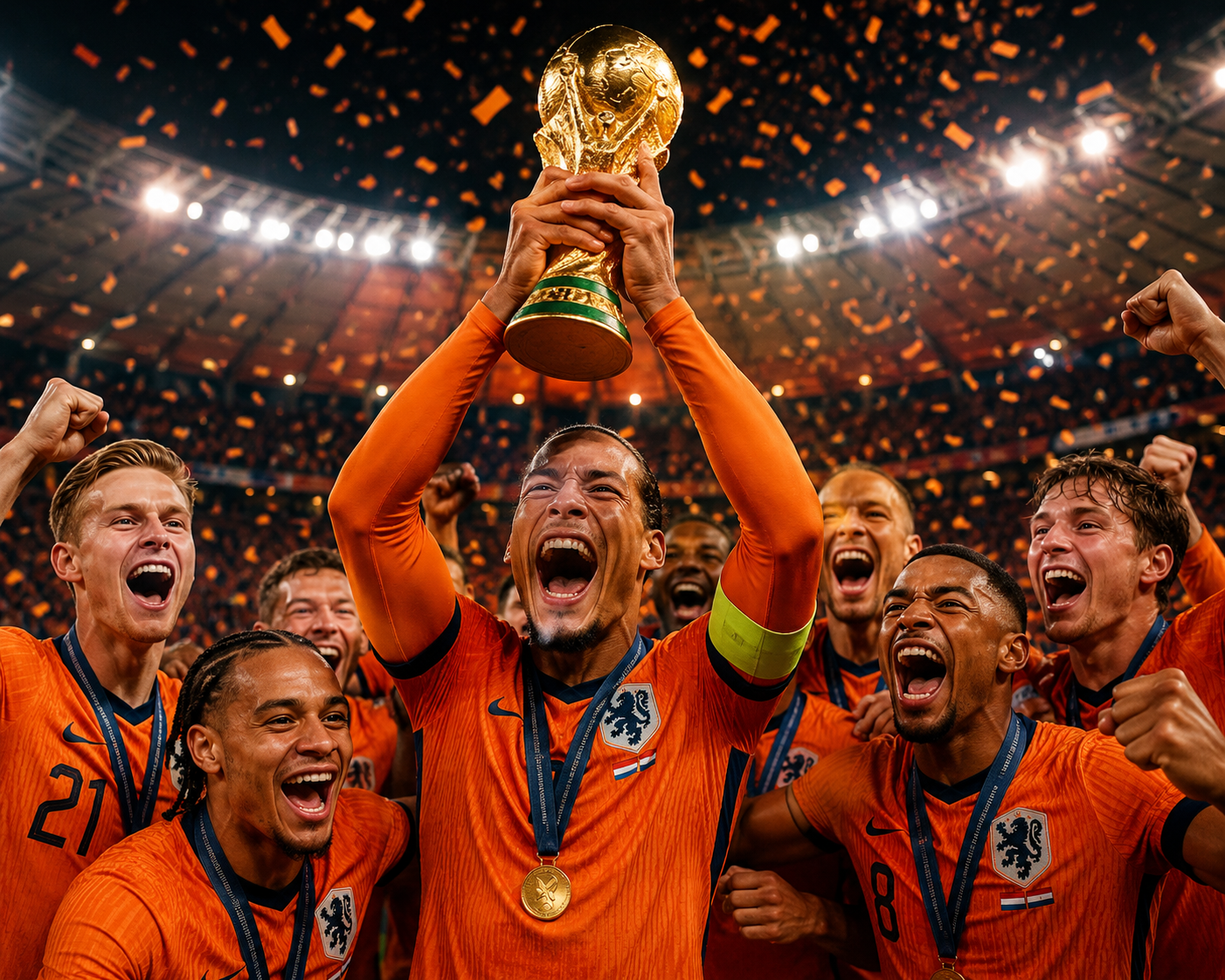
Panmure Liberum heeft zijn WK-model losgelaten op het wereldkampioenschap voetbal van 2026. Dat toernooi wordt gespeeld in Canada, de Verenigde Staten en Mexico, en de uitkomst is voor Nederlandse voetbalfans meer dan opvallend: het model voorspelt dat Oranje wereldkampioen wordt (zie bericht).
Ja, Nederland. Niet Spanje. Niet Frankrijk. Niet Engeland. Niet Argentinië. Niet Brazilië. Gewoon Nederland.
Dat is natuurlijk geen kleine voorspelling. Nederland verloor in het verleden drie WK-finales en geldt bijna altijd als een groot voetballand dat de hoofdprijs nog altijd mist. Volgens dit model komt daar in 2026 eindelijk verandering in.
Een model met een opvallend trackrecord
Het rapport is met humor geschreven, maar het model heeft wel een opvallend trackrecord. De auteur voorspelde eerder de winnaars van de laatste drie WK’s correct: Duitsland in 2014, Frankrijk in 2018 en Argentinië in 2022. Voor 2026 komt het model uit bij Nederland.
Dat maakt de voorspelling leuk om te volgen. Niet omdat voetbal volledig te vangen is in een model, maar omdat het rapport een aantal factoren gebruikt die wel degelijk invloed kunnen hebben op internationaal succes. Denk aan economische kracht, bevolkingsomvang, voetbalcultuur, temperatuur, thuisvoordeel en de actuele FIFA-ranking.
Volgens Panmure Liberum verklaart het model ongeveer 55% van de variatie in WK-succes. De rest blijft afhankelijk van toeval, vorm, blessures, strafschoppen en alles wat voetbal juist zo onvoorspelbaar maakt.
Nederland begint in een lastige groep
Nederland zit volgens het rapport in Groep F met Japan, Zweden en Tunesië. Oranje wordt gezien als favoriet om de groep te winnen, maar Japan wordt nadrukkelijk genoemd als gevaarlijke outsider. Het model geeft Nederland een kans van 73% om bij de eerste twee in de groep te eindigen, terwijl Japan op 58% staat.
Dat is geen makkelijke start. Zweden heeft met Viktor Gyökeres en Alexander Isak veel aanvallende kwaliteit, terwijl Japan volgens het rapport een ploeg is die later in het toernooi voor veel problemen kan zorgen. Juist daardoor kan de groepsfase voor Nederland waardevol zijn. Oranje wordt vroeg getest en moet direct scherp zijn.
Volgens het model komen Nederland en Japan allebei door de groep. Die zware start kan later in het toernooi een voordeel worden, omdat beide landen sneller gewend zijn aan de intensiteit van wedstrijden waarin weinig ruimte is voor fouten.
De route van Oranje wordt zwaar
Na de groepsfase wordt de route van Nederland serieus. In de laatste 32 schakelt Oranje Marokko uit. Dat wordt volgens het rapport geen eenvoudige wedstrijd, omdat Marokko sterk kan verdedigen. Nederland wint waarschijnlijk nipt, met een wedstrijdbeeld waarin één doelpunt genoeg kan zijn.
Daarna volgt Canada in de achtste finale. Canada profiteert als gastland mogelijk van extra steun, maar volgens het model is Nederland sterker en gaat Oranje door naar de kwartfinale. Daar wacht Frankrijk.
Dat is op papier de zwaarste horde. Frankrijk wordt in het rapport neergezet als één van de beste teams ter wereld, samen met Spanje. De selectie is enorm sterk, met Kylian Mbappé als grote naam, maar ook met spelers als Ousmane Dembélé, Michael Olise, Aurélien Tchouaméni, N’Golo Kanté, Dayot Upamecano, Ibrahima Konaté en de gebroeders Hernandez.
Toch voorspelt het model dat Nederland Frankrijk uitschakelt. Niet via een grote voetbalshow, maar via een 1-0 overwinning door een eigen goal van een Franse speler. Dat is precies het soort scenario dat een WK kan kantelen. Frankrijk heeft op papier misschien meer kwaliteit, maar Nederland overleeft en gaat door.
Japan zorgt voor de grote stunt tegen Brazilië
De grootste verrassing van het toernooi komt volgens het rapport van Japan. In de laatste 32 schakelt Japan Brazilië uit. Dat zou één van de grootste verrassingen in de WK-geschiedenis zijn.
Brazilië blijft bij elk WK een naam die direct serieus wordt genomen. Toch wijst het rapport erop dat Japan in sterke vorm is. Japan versloeg Duitsland op het WK van 2022, won in oktober 2025 met 3-2 van Brazilië in een oefenwedstrijd en klopte recent ook Schotland en Engeland met 1-0. Tegen Engeland gebeurde dat zelfs zonder enkele belangrijke spelers.
Daarmee wordt Japan neergezet als één van de gevaarlijkste outsiders van het toernooi. Geen ploeg met de meeste sterren, maar wel een team dat tactisch sterk is, volwassen speelt en niet bang lijkt te zijn voor grote voetballanden.
Japan haalt volgens het model zelfs de kwartfinale, maar wordt daar uitgeschakeld door Engeland.
Engeland komt ver, maar strandt opnieuw
Engeland wint volgens het rapport zijn groep en schakelt daarna Noorwegen, Zuid-Korea en Japan uit. Daarmee haalt Engeland de halve finale, waar Portugal wacht.
Dat past bij het beeld van Engeland als een ploeg met veel individuele kwaliteit, maar ook met blijvende vragen over de uitvoering op de beslissende momenten. Onder Thomas Tuchel heeft Engeland volgens het rapport nog niet overtuigend bewezen dat het topduels structureel kan winnen.
Portugal wordt in die halve finale de tegenstander. Ook daar ligt de spanning in de balans tussen individuele klasse en collectief functioneren. Het rapport ziet Portugal nipt winnen in een gesloten wedstrijd met weinig doelpunten.
Daarmee komt Engeland opnieuw dichtbij, maar blijft de finale buiten bereik. Voor Engelse fans klinkt dat waarschijnlijk pijnlijk bekend.
Spanje struikelt tegen Nederland
Aan de andere kant van het schema haalt Spanje de halve finale. Dat is geen verrassing. Spanje wordt in het rapport gezien als één van de beste ploegen ter wereld. De voorhoede met Lamine Yamal, Ferran Torres, Álvaro Morata en Nico Williams is sterk, terwijl het middenveld met Rodri, Pedri, Dani Olmo, Fabián Ruiz, Gavi en Martin Zubimendi enorm veel kwaliteit heeft.
Toch ziet het model een zwakke plek in de defensie. Dat wordt uiteindelijk beslissend. Spanje en Nederland komen na 120 minuten niet verder dan een gelijkspel, waarna Oranje de strafschoppenserie wint.
Dat is een klassiek WK-scenario. Spanje heeft misschien meer balbezit en meer technische controle, maar Nederland blijft overeind en trekt de wedstrijd naar het moment waarop druk, zenuwen en details alles bepalen.
Daarmee staat Nederland in de finale.
De finale wordt Nederland tegen Portugal
Volgens het model krijgen we een finale tussen Nederland en Portugal. Dat betekent dat het WK van 2026 hoe dan ook een nieuwe wereldkampioen krijgt. Beide landen hebben nog nooit de wereldtitel gewonnen.
Voor Nederland zou dat historisch zijn. Oranje verloor de WK-finales van 1974, 1978 en 2010 en draagt daardoor al decennialang het imago van het grote voetballand zonder wereldtitel. Portugal heeft met het EK van 2016 wel een grote prijs gewonnen, maar wacht nog altijd op de eerste wereldtitel.
Het rapport verwacht geen spectaculaire finale met veel doelpunten. Eerder een gesloten wedstrijd waarin beide ploegen weinig risico nemen. Dat past bij veel WK-finales. De druk is enorm, de ruimtes worden kleiner en geen enkele ploeg wil de fout maken die de wedstrijd beslist.
Volgens het model valt de finale uiteindelijk de kant van Nederland op. Oranje wordt wereldkampioen.
Waarom deze voorspelling zo leuk is
De voorspelling is vooral interessant omdat Nederland niet de logische topfavoriet is bij de bookmakers. Volgens het rapport stonden Spanje, Frankrijk, Engeland en Argentinië hoger aangeschreven. Ook op Polymarket lag Nederland duidelijk achter de grootste favorieten.
Juist daarom valt deze uitkomst op. Het model kiest niet voor de makkelijke naam, maar voor een route waarin Nederland moet overleven tegen Frankrijk en Spanje, terwijl Portugal Engeland uitschakelt aan de andere kant van het schema.
Voor Nederlandse voetbalfans is dat een heerlijk scenario. Een zware route, grote landen die sneuvelen, Japan als stuntploeg en uiteindelijk Oranje dat eindelijk de wereldtitel pakt. Dat is niet alleen een modeluitkomst, maar ook precies het soort verhaal waar een WK groot door wordt.
Nederland wereldkampioen in 2026. Het model zegt het. Nu Oranje nog.
🔵 English version
The Netherlands world champion? This World Cup model puts Oranje on top
Panmure Liberum has run its World Cup model for the 2026 FIFA World Cup. The tournament will be played in Canada, the United States and Mexico, and the outcome is more than striking for Dutch football fans: the model predicts that the Netherlands will become world champion.
Yes, the Netherlands. Not Spain. Not France. Not England. Not Argentina. Not Brazil. Just the Netherlands.
That is not a small call. The Netherlands has lost three World Cup finals in the past and is almost always seen as a major football nation still missing the ultimate prize. According to this model, that changes in 2026.
A model with a remarkable track record
The report is written with humour, but the model has a remarkable track record. The author correctly predicted the winners of the last three World Cups: Germany in 2014, France in 2018 and Argentina in 2022. For 2026, the model points to the Netherlands.
That makes the forecast fun to follow. Not because football can be fully captured in a model, but because the report uses several factors that can genuinely influence international football success. These include economic strength, population size, football culture, temperature, home advantage and the current FIFA ranking.
According to Panmure Liberum, the model explains roughly 55% of the variation in World Cup success. The rest still comes down to luck, form, injuries, penalties and everything that makes football so unpredictable.
The Netherlands starts in a difficult group
According to the report, the Netherlands is in Group F with Japan, Sweden and Tunisia. Oranje is seen as the favourite to win the group, but Japan is clearly highlighted as a dangerous outsider. The model gives the Netherlands a 73% chance of finishing in the top two, while Japan stands at 58%.
That is not an easy start. Sweden has serious attacking quality with Viktor Gyökeres and Alexander Isak, while Japan is described as a team that can cause problems later in the tournament. That makes the group stage valuable for the Netherlands. Oranje will be tested early and will need to be sharp from the start.
According to the model, both the Netherlands and Japan advance from the group. That tough start could become an advantage later, because both teams will already be used to the intensity of matches where there is very little room for error.
Oranje’s route is tough
After the group stage, the route becomes serious. In the round of 32, the Netherlands eliminates Morocco. The report does not expect that to be easy, because Morocco can defend very well. The Netherlands probably wins narrowly, in a match where one goal may be enough.
Canada follows in the round of 16. Canada may benefit from home support, but according to the model the Netherlands is stronger and advances to the quarter-final. There, France awaits.
On paper, that is the toughest obstacle. France is presented in the report as one of the best teams in the world, alongside Spain. The squad is extremely strong, with Kylian Mbappé as the headline name, but also with players such as Ousmane Dembélé, Michael Olise, Aurélien Tchouaméni, N’Golo Kanté, Dayot Upamecano, Ibrahima Konaté and the Hernandez brothers.
Still, the model predicts that the Netherlands eliminates France. Not through a dominant football display, but through a 1-0 win after an own goal by a French player. That is exactly the kind of scenario that can turn a World Cup. France may have more quality on paper, but the Netherlands survives and moves on.
Japan delivers the major shock against Brazil
The biggest surprise of the tournament, according to the report, comes from Japan. In the round of 32, Japan eliminates Brazil. That would be one of the biggest shocks in World Cup history.
Brazil is always taken seriously at every World Cup. Still, the report points out that Japan is in strong form. Japan beat Germany at the 2022 World Cup, defeated Brazil 3-2 in a friendly in October 2025 and recently beat both Scotland and England 1-0. The win over England even came without several important players.
That makes Japan one of the most dangerous outsiders in the tournament. It is not the team with the biggest stars, but it is tactically strong, mature and clearly not afraid of major football nations.
According to the model, Japan even reaches the quarter-final, where it is eliminated by England.
England goes far, but falls short again
According to the report, England wins its group and then eliminates Norway, South Korea and Japan. That takes England to the semi-final, where Portugal awaits.
That fits the picture of England as a team with plenty of individual quality, but also with persistent questions about execution in decisive matches. Under Thomas Tuchel, England has not yet fully proven that it can consistently win the biggest matches.
Portugal becomes the semi-final opponent. There too, the tension lies in the balance between individual quality and collective performance. The report sees Portugal winning narrowly in a tight match with few goals.
That means England gets close again, but not close enough. For English fans, that will sound painfully familiar.
Spain stumbles against the Netherlands
On the other side of the bracket, Spain reaches the semi-final. That is no surprise. The report sees Spain as one of the best teams in the world. Its front line with Lamine Yamal, Ferran Torres, Álvaro Morata and Nico Williams is strong, while the midfield with Rodri, Pedri, Dani Olmo, Fabián Ruiz, Gavi and Martin Zubimendi has enormous quality.
Still, the model sees a weakness in the defence. That ultimately becomes decisive. Spain and the Netherlands are level after 120 minutes, after which Oranje wins the penalty shootout.
That is a classic World Cup scenario. Spain may have more possession and more technical control, but the Netherlands stays alive and drags the match into the moment where pressure, nerves and details decide everything.
That sends the Netherlands into the final.
The final is the Netherlands against Portugal
According to the model, the final will be the Netherlands against Portugal. That means the 2026 World Cup will produce a new world champion either way. Neither country has ever won the World Cup.
For the Netherlands, that would be historic. Oranje lost the World Cup finals of 1974, 1978 and 2010 and has carried the image of the great football nation without a world title for decades. Portugal did win Euro 2016, but is still waiting for its first World Cup title.
The report does not expect a spectacular final full of goals. It expects a tight match in which both teams take few risks. That fits many World Cup finals. The pressure is enormous, the spaces become smaller and no team wants to make the mistake that decides the match.
According to the model, the final ultimately falls the way of the Netherlands. Oranje becomes world champion.
Why this forecast is so enjoyable
The forecast is especially interesting because the Netherlands is not the obvious top favourite with the bookmakers. According to the report, Spain, France, England and Argentina were rated higher. On Polymarket as well, the Netherlands was clearly behind the biggest favourites.
That is exactly why this outcome stands out. The model does not choose the easy name. It chooses a route in which the Netherlands has to survive France and Spain, while Portugal eliminates England on the other side of the bracket.
For Dutch football fans, that is a wonderful scenario. A tough route, major nations falling, Japan as the surprise team and finally Oranje lifting the trophy. That is not just a model output. It is exactly the kind of story that makes a World Cup great.
The Netherlands world champion in 2026. The model says it. Now Oranje just has to do it.
Disclaimer Aan de door ons opgestelde informatie kan op geen enkele wijze rechten worden ontleend. Alle door ons verstrekte informatie en analyses zijn geheel vrijblijvend. Alle consequenties van het op welke wijze dan ook toepassen van de informatie blijven volledig voor uw eigen rekening.
Wij aanvaarden geen aansprakelijkheid voor de mogelijke gevolgen of schade die zouden kunnen voortvloeien uit het gebruik van de door ons gepubliceerde informatie. U bent zelf eindverantwoordelijk voor de beslissingen die u neemt met betrekking tot uw beleggingen.
